
AT A GLANCE
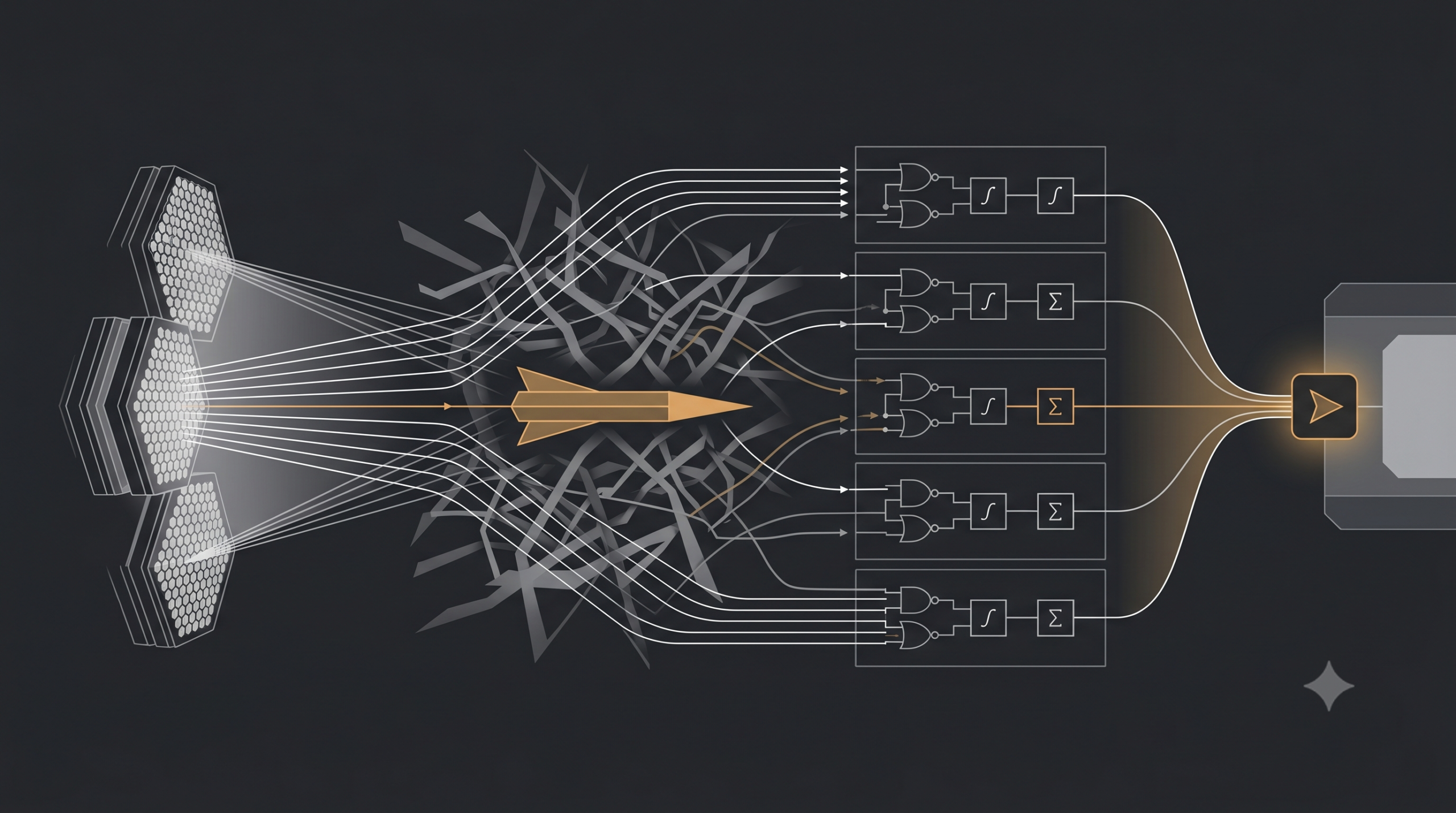
- Concept: Phased Arrays: Electronically steered antennas direct radio waves without any moving physical parts.
- Concept: Digital Beamforming: Independent receivers at each antenna element digitize signals to form multiple simultaneous beams.
- Concept: Subarray Partitioning: Large arrays divide into smaller modules to reduce processing costs and manage grating lobes.
- Concept: Doppler Filtering: Algorithms isolate the exact frequency shift of moving targets to eliminate static ground clutter.
HOW IT WORKS (THE MECHANISM)
Traditional radars spin massive mechanical dishes to sweep the sky. A phased array radar remains completely stationary. It utilizes thousands of individual microscopic antennas arranged in a flat panel grid.
The system controls the precise timing of the electromagnetic waves leaving each antenna. Engineers program phase shifters to artificially delay the signal at specific elements. These waves collide and combine constructively to create a focused beam of energy that steers electronically at the speed of light.
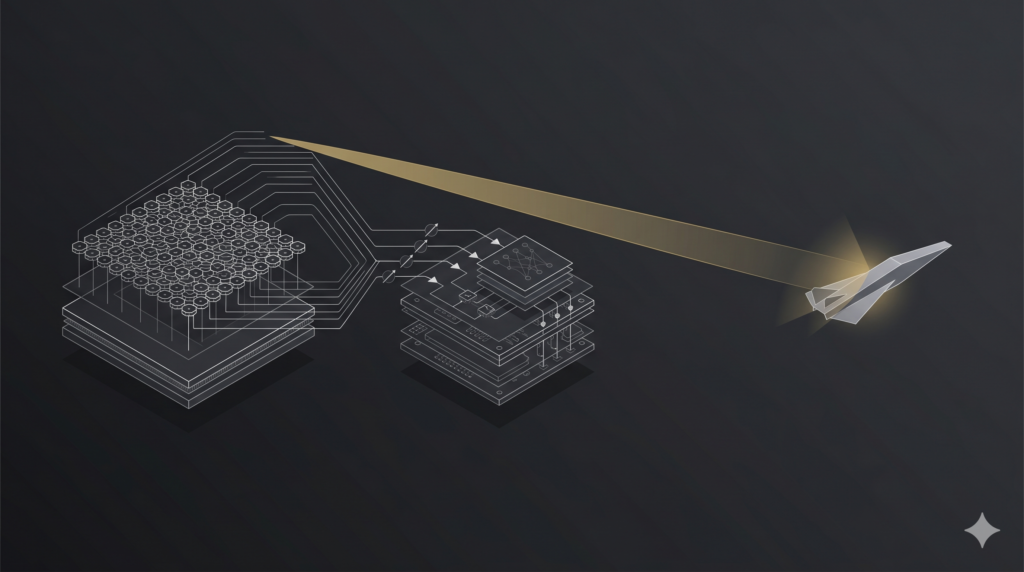
To handle the immense computational load, engineers divide the massive grid into smaller segments called subarrays. Each subarray features its own analog-to-digital converter. The system digitizes the returning signals immediately upon impact with the antenna.
The central processor executes digital beamforming algorithms on these isolated data streams. This code mathematically synthesizes multiple simultaneous beams. It allows the radar to search for new threats and track an incoming missile at the exact same time.
WHY IT MATTERS NOW (THE HUMAN IMPACT)
Hypersonic glide vehicles shatter traditional defensive timelines. They travel at Mach 5 or faster, flying extremely low to the horizon. Mechanical radars physically cannot spin fast enough to track this speed.
A phased array radar updates its target lock in milliseconds. It eliminates the deadly mechanical lag. When a ballistic missile launches, early warning networks rely entirely on this absolute electronic agility to calculate the impact trajectory.
For example, the United States relies on active electronically scanned arrays on its naval destroyers. This system directly protects maritime carrier strike groups from synchronized anti-ship cruise missile attacks. Without this processing speed, the ships simply become sitting targets.
This technology dictates modern geopolitical survival. The hardware represents a multi-billion dollar industrial supply chain. Producing these dense arrays requires absolute mastery of advanced semiconductor manufacturing.
WHAT MOST PEOPLE MISS
Mainstream media treats air and space defense radars like massive, perfect flashlights illuminating the sky. They ignore the brutal reality of the signal-to-noise ratio. The sky inherently contains immense clutter, including rain, birds, commercial aircraft, and ground reflections.
Aggressive Doppler filtering algorithms operate as the hidden mechanism. The radar does not simply look for a shape. It mathematically filters the returning frequency shifts to isolate the specific kinetic signature of a moving object, violently stripping away the static atmospheric noise.
THE TRAJECTORY (12–36 MONTHS)
Over the next thirty-six months, defense contractors will aggressively transition from analog subarrays to element-level digital beamforming. Every single microscopic antenna will house its own dedicated digital receiver. This architecture requires unprecedented computational power to process terabytes of raw data per second.
Supply chain incentives will force a massive shift toward advanced packaging technologies. Foundries will integrate power amplifiers and data converters directly onto the back of the antenna printed circuit boards. This flat-panel integration significantly reduces physical volume and manufacturing costs.
AI-driven cognitive radar systems will dominate the software layer. Algorithms will autonomously rewrite the radar’s transmission waveforms in real-time to bypass advanced electronic warfare jamming. This creates a closed loop where the machine constantly reinvents its own physics to maintain a target lock.
KEY TERMS
- Phased Array: A collection of antenna elements assembled together to electronically steer a combined radiation pattern without mechanical movement.
- Digital Beamforming: A signal processing technique where multiple data streams are digitized to mathematically create and steer simultaneous antenna beams.
- Subarray: A partitioned segment of a larger antenna array that combines the outputs of several individual elements to reduce computational load.
- Doppler Filtering: A mathematical process that isolates moving targets by calculating the specific frequency shift caused by their radial velocity.
SOURCES
- NATO Research and Technology Organisation — Fundamentals of Signal Processing for Phased Array Radar
- Analog Devices — Phased Array Beamforming ICs Simplify Antenna Design
- National Center for Biotechnology Information — Hybrid robust beamforming for enhanced multiple moving object detection with phased array scanning radar
- Radartutorial.eu — Digital Beamforming