
AT A GLANCE
- Concept: Gravitational Storage: Water physically lifted to a higher elevation holds immense kinetic potential energy.
- Concept: Reversible Pump-Turbines: Specialized mechanical rotors spin backward to pump water and forward to generate electricity.
- Concept: Round-Trip Efficiency: Friction, evaporation, and mechanical losses typically consume twenty percent of total energy.
- Concept: Arbitrage Margins: Facilities generate profit by buying cheap solar midday and selling expensive baseload power overnight.
HOW IT WORKS
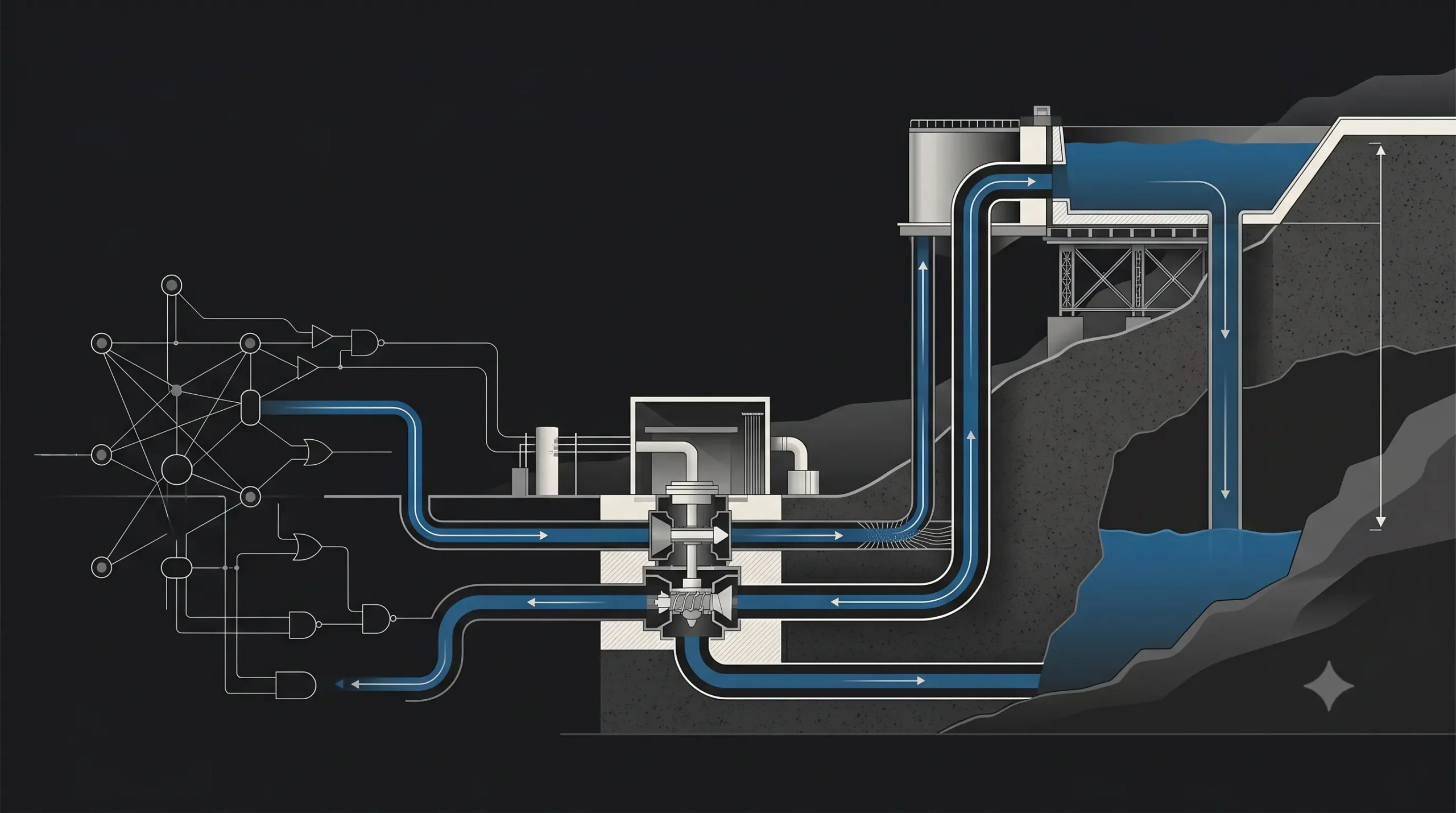
A pumped storage facility requires two massive bodies of water located at different elevations. A steep, steel-lined tunnel called a penstock physically connects the upper and lower reservoirs.
The system utilizes grid electricity to operate a reversible Francis pump-turbine. During periods of low power demand, the facility consumes cheap electricity to pump millions of gallons of water up the penstock into the upper reservoir.
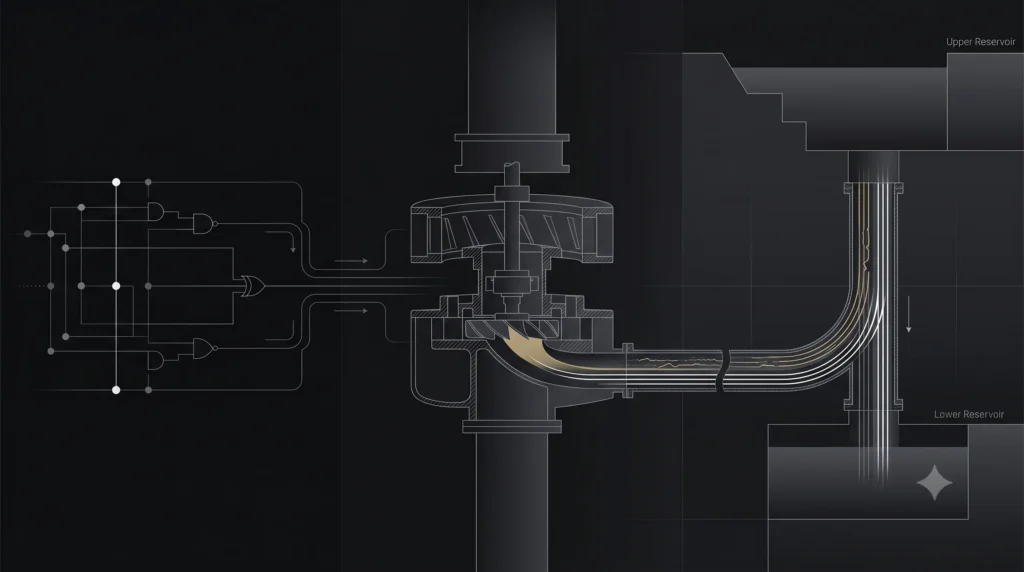
This action mathematically converts electrical energy into physical, gravitational potential energy. The water sits at the higher elevation, acting as a massive kinetic battery waiting for grid deployment.
When regional power demand spikes, operators reverse the machinery. They open the upper gates, allowing gravity to force the water back down the penstock. The falling water strikes the turbine blades, spinning the generator and instantly dumping high-value megawatts back into the local grid.
Pumped Storage Round-Trip Efficiency Simulator
Observe how mechanical, friction, and environmental losses continuously degrade the arbitrage margin of a 100 MWh gravitational battery.
WHY IT MATTERS NOW
The global grid currently suffers from chronic renewable overproduction. Massive utility-scale solar farms flood the network with cheap electricity at midday, frequently driving wholesale energy prices below zero.
Without grid-scale storage, utility operators must physically disconnect these solar arrays to prevent catastrophic voltage spikes. Pumped hydro provides the only proven, gigawatt-scale mechanism to absorb this immense daily surge.
Chemical lithium-ion batteries discharge completely within four hours. Pumped storage reservoirs, like the Bath County Pumped Storage Station in Virginia, can sustain maximum generation output for over ten continuous hours. This provides absolute baseload stability during prolonged weather events.
This physical capability strictly dictates renewable energy economics. By soaking up negative-priced midday solar and discharging it during peak evening demand, pumped hydro operators capture a massive daily financial arbitrage. Without these hydraulic batteries, regional solar infrastructure simply cannot scale efficiently.
WHAT MOST PEOPLE MISS
General grid modeling treats pumped storage as a perfectly efficient, closed-loop battery. Analysts frequently ignore the brutal thermodynamic and physical penalties of moving millions of tons of water through concrete pipes.
The true limiting factor is round-trip efficiency loss. Evaporation slowly drains the upper reservoir, continuously stealing stored megawatt-hours into the atmosphere. Furthermore, sudden changes in water flow create massive hydraulic transient forces—violent pressure waves that crack steel penstocks and force operators to carefully restrict turbine ramp rates, destroying their ability to capture micro-second price spikes.
THE TRAJECTORY
Next 12–36 Months: Permitting delays will dominate grid expansion timelines. Federal licensing applications for new reservoirs will pile up. Regulators will fast-track closed-loop systems built away from natural rivers to bypass severe ecological disputes over aquatic habitats.
Next Five Years: Variable-speed pump-turbines will replace legacy fixed-speed units. This hardware allows facilities to actively regulate grid frequency even while operating in pumping mode, opening entirely new revenue streams in ancillary service markets.
Next Ten Years: Heavy industry will construct subterranean pumped hydro using abandoned deep-shaft coal and gold mines. This perfectly sidesteps surface land-use conflicts and permanently reduces evaporative efficiency losses to zero.
What Could Go Wrong: Extended regional droughts will cripple water levels. If a reservoir cannot draw makeup water to replace natural evaporation, the pump-turbines will suck air and cavitate, instantly destroying the heavy steel rotors.
Most Likely Outcome: Capital markets will accept that chemical batteries cannot economically replace mechanical gravity at a continental scale. Utilities will successfully secure the massive ten-year capital expenditures required to build new closed-loop reservoirs, securing long-term grid survival.
KEY TERMS
- Reversible Pump-Turbine: A dual-purpose mechanical machine that consumes electricity to pump fluid upward and generates electricity when fluid flows downward.
- Penstock: A massive, enclosed steel or concrete pipe that controls the high-pressure flow of water between reservoirs.
- Hydraulic Transient: A violent, destructive pressure wave created inside a pipe when water flow abruptly changes speed or direction.
- Round-Trip Efficiency: The mathematical ratio of electricity generated by discharging a storage system compared to the electricity consumed to charge it.
- Closed-Loop Pumped Storage: A facility utilizing two artificial reservoirs completely separated from naturally flowing rivers or existing municipal water supplies.
SOURCES
- Federal Energy Regulatory Commission (FERC) — Pumped Storage Projects Licensing and Safety
- U.S. Department of Energy — Hydropower Vision: A New Chapter for America’s Renewable Electricity Source
- International Hydropower Association — The World’s Water Battery: Pumped Hydropower Storage
- Voith Hydro Technical Whitepaper — Variable Speed Technology for Pumped Storage Plants