Advertisement
)


Imagine your manufacturing company just shipped $10 million worth of vital components to a massive, globally recognized retail chain. In the world of business-to-business (B2B) commerce, you do not get paid upfront. You extend “trade credit,” giving the retailer 60 to 90 days to pay the invoice. For two months, that $10 million sits on your balance sheet as an unsecured promise. Now, imagine waking up tomorrow to the news that the retail chain has suddenly filed for bankruptcy. They cannot pay their suppliers. Overnight, your healthy manufacturing company is facing total financial ruin through absolutely no fault of your own.
This catastrophic chain reaction is the hidden terror of global commerce. In modern economies, accounts receivable can represent 40% or more of a company’s total assets. To prevent the collapse of one massive company from wiping out thousands of smaller suppliers, the financial system relies on an invisible shield. Why should you care right now? Because as post-pandemic corporate insolvencies reach record highs across global markets, a specialized financial product has become the mandatory bedrock of international trade. By acting as the ultimate counterparty guarantor, this multi-billion-dollar shadow insurance market allows companies to trade across borders with absolute confidence, preventing temporary market shocks from cascading into global economic depressions.
What is Trade Credit Insurance?
Trade credit insurance is a financial risk management tool that protects businesses against the commercial and political risks of customer non-payment, insolvency, or default. By safeguarding a company’s accounts receivable, the insurer guarantees compensation for unpaid invoices, ensuring cash flow stability and enabling secure B2B trade.
At a Glance
- Concept: Purchasing an insurance policy on your outstanding invoices so that if your customer goes bankrupt or refuses to pay, the insurance company pays you instead.
- Why it matters: It prevents the domino effect of corporate bankruptcy. It also allows companies to use their insured invoices as secure collateral to get better financing terms from their banks.
- Who uses it: Multinational exporters, domestic manufacturers, trading firms, and financial institutions.
- Biggest takeaway: The market is dominated by “Whole Turnover Coverage,” meaning businesses typically do not just insure one risky client; they insure their entire client portfolio to spread the risk and lower premium costs.
In Simple Words
If you buy a new car, you buy auto insurance. If you crash the car, the insurance company writes you a check so you can buy a replacement, saving you from financial disaster.
Trade Credit Insurance is exact same concept, but for B2B invoices.
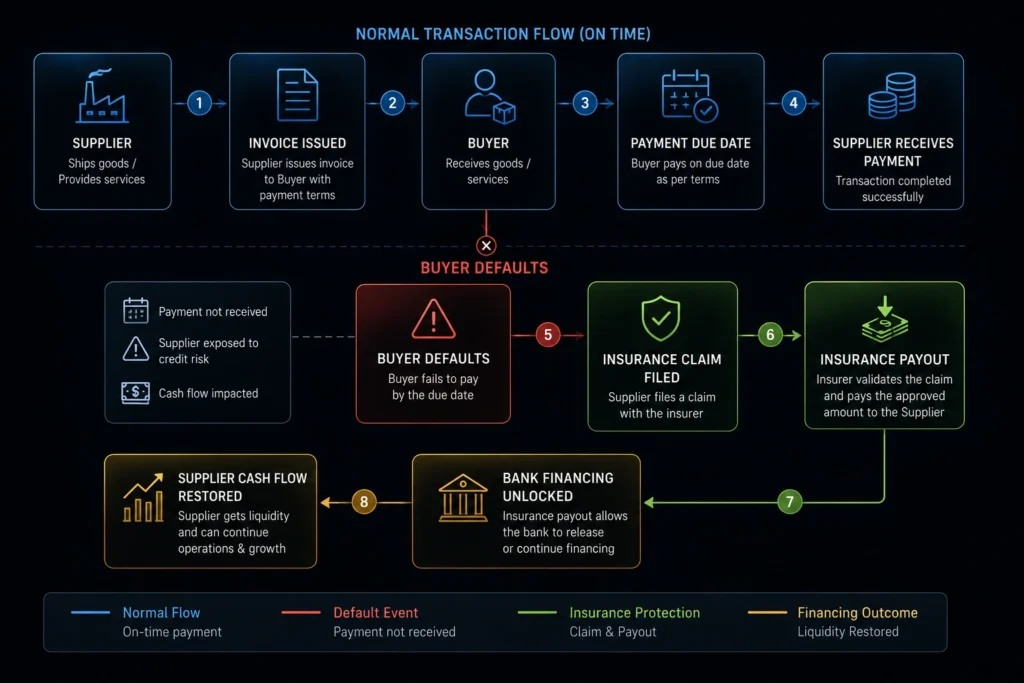
Instead of insuring a physical car, a business is insuring a piece of paper that says, “John’s Company owes us $100,000.” If John’s Company suddenly goes bankrupt and cannot pay the $100,000, the insurance company steps in and pays the supplier the vast majority of the money owed (usually around 90%). This guarantees that the supplier has the cash flow needed to pay their own employees and keep their factory running, even when their clients fail.
Why This Matters
The global macroeconomic environment is currently highly hostile to unsecured debt. Corporate insolvency rates across OECD economies reached post-pandemic highs throughout 2023 and 2024, driven by rising interest rates and supply chain disruptions.
For Corporate Treasurers and Supply Chain Executives, trade credit insurance is no longer a luxury; it is a non-negotiable survival mechanism. The global market for this insurance is valued at over $14 billion in 2026 and is accelerating at a compound annual growth rate (CAGR) of over 11%. Without this insurance, suppliers would be forced to demand “cash in advance” from all foreign buyers to protect themselves. This requirement would instantly drain global working capital and cause international trade volume to collapse.
The Global Landscape of Trade Credit Insurance Providers
The trade credit insurance market is an extreme oligopoly. A vast majority of the world’s commercial risk is underwritten by just a few massive European institutions—namely Allianz Trade, Atradius, and Coface. Because Europe has strong regulatory support and mature insurance networks, the region historically dominates the industry, holding over 43% of the global market share in 2026.
However, the architecture of how this insurance is sold is rapidly changing. It is moving away from standalone, bespoke corporate policies and evolving into embedded digital products. Financial institutions are integrating this insurance directly into their core banking, supply chain finance, and invoice discounting platforms. This embedded infrastructure allows banks to securely fund receivables for small and medium-sized enterprises (SMEs) seamlessly, reshaping the liquidity pipelines of global trade.
How Trade Credit Insurance Works: Whole Turnover and Credit Limits
Protecting billions of dollars in unsecured corporate debt requires ruthless data analysis and continuous monitoring. Here is the first-principles breakdown of the trade credit insurance mechanism.
1. The Fundamental Problem: Unsecured Receivables
In global trade, selling on “open account” terms (where goods are delivered before payment is made) is standard practice. This creates a massive liability, as accounts receivable routinely represent 40% or more of a supplier’s total assets. If a buyer defaults due to bankruptcy, the supplier absorbs a 100% loss.
2. The Insufficiency of Traditional Solutions
Historically, companies tried to manage this risk internally by hiring credit managers to review customer financials, or by demanding Letters of Credit from banks. However, internal teams cannot monitor global geopolitical risks in real-time, and Letters of Credit are incredibly slow, expensive, and cumbersome for routine, high-volume transactions.
3. The Core Mechanism: Whole Turnover Coverage
To solve this, a supplier purchases a trade credit insurance policy. The dominant structure is “Whole Turnover Coverage,” accounting for 57.6% of the market. Instead of cherry-picking just the risky buyers to insure, the supplier insures their entire ledger of customers. This spreads the statistical risk for the insurer, allowing them to offer much lower, more attractive premium rates.
4. Technical Depth: Risk Assessment and Credit Limits
The policy does not give the supplier a blank check. The insurer acts as an outsourced risk department. Using advanced Generative AI models that ingest massive volumes of financial statements, global news, and real-time trade flows, the insurer calculates the exact creditworthiness of every single buyer. The insurer then sets a strict “Credit Limit” for each specific buyer (e.g., “We will insure up to $2 million of debt for Buyer X”).
5. Real-World Consequences: Indemnification and Securitization
If a buyer goes insolvent or simply defaults, the supplier files a claim, and the insurer indemnifies them for the unpaid amount (typically 80% to 90% of the invoice). Crucially, because the receivables are now backed by an investment-grade insurance company, the supplier can take these insured invoices to their local bank and use them as collateral. The bank, knowing the risk of default is removed, provides immediate, low-interest working capital to the supplier, completely unlocking the frozen cash.
Commercial Applications of Trade Credit Insurance in Supply Chain Finance
Trade credit insurance is deployed across multiple vectors to lubricate the friction points of modern commerce.
Supply Chain Finance and Factoring: Lenders use trade credit insurance to secure their factoring operations. In invoice factoring, a business sells its unpaid invoices to a bank at a discount for immediate cash. By wrapping the invoice portfolio in a trade credit policy, the bank guarantees it will not lose money if the end-customer defaults, allowing the bank to offer significantly cheaper financing rates to the business.
Export and Political Risk Mitigation: For companies expanding into emerging markets, foreign buyers present a massive “blind spot.” The domestic supplier cannot accurately gauge the financial health of a distributor in another hemisphere. Export credit insurance protects the supplier not only from the buyer going bankrupt (commercial risk) but also from political risks, such as foreign governments freezing currency transfers or suddenly cancelling import licenses.
Embedded B2B Digital Checkouts: The fastest-growing sector is the digital integration of credit insurance into B2B e-commerce platforms. When a corporate buyer clicks “checkout” on a B2B portal and requests “Net 60” payment terms, an API pings the trade credit insurer. The insurer’s AI assesses the buyer’s risk in milliseconds and approves the credit limit instantly, allowing the supplier to grant credit terms automatically without any human underwriting delay.
Economic & Strategic Impact
The core vulnerability of the trade credit insurance market is Procyclical Limit Cancellations.
Trade credit insurers are highly exposed to macroeconomic volatility. During severe economic downturns or recessions, loss ratios spike as defaults surge. To protect their own profitability, insurers often react by drastically reducing or completely cancelling the credit limits they previously granted to buyers.
This creates a brutal, procyclical economic shock. If insurers cut coverage on a major retailer because it looks financially weak, the retailer’s suppliers immediately demand cash-in-advance because they are no longer insured. The retailer, unable to pay cash upfront for inventory, instantly goes bankrupt—meaning the insurer’s decision to cut coverage actively caused the exact bankruptcy they were trying to avoid. Managing this systemic power is the most heavily scrutinized aspect of the industry.
Advantages
- Cash Flow Protection: Replaces bad debt losses with guaranteed indemnification, ensuring the supplier has the liquidity to survive sudden customer insolvencies.
- Sales Expansion: Allows businesses to safely offer competitive, generous credit terms to new or foreign buyers, accelerating revenue growth without exposing the company to catastrophic risk.
- Access to Cheaper Capital: Insured accounts receivable are viewed as high-quality collateral by financial institutions, directly enabling cheaper factoring and securitization programs.
- Outsourced Intelligence: Suppliers gain access to the insurer’s massive, global database of proprietary corporate health metrics, receiving early warning signs of buyer distress before it hits the public markets.
Limitations
- Volatile Loss Ratios and Premiums: During periods of global economic stress, insurers face massive payouts, which they offset by enforcing stricter underwriting standards and significantly raising premium costs for policyholders.
- SME Awareness Gaps: Many Small and Medium-sized Enterprises (SMEs) perceive trade credit insurance as an unnecessary expense or lack awareness of its benefits, leaving them dangerously exposed to supply chain shocks.
- Compliance Burden: Policies require strict compliance. If a supplier fails to report overdue payments exactly on time, or exceeds the approved credit limit without permission, the insurer can legally deny the claim.
Common Misconceptions
Misconception: Trade credit insurance covers consumer debt (like credit cards).
Reality: It strictly covers Business-to-Business (B2B) transactions. It protects a company when another company fails to pay an invoice for goods or services.
Misconception: You only buy insurance for your bad, risky clients.
Reality: While “Single Buyer” coverage exists, the industry standard is “Whole Turnover” insurance. Insurers require you to insure your entire portfolio—both the risky clients and the ultra-safe clients—to mathematically balance the risk pool and keep premiums affordable.
Misconception: The insurance pays 100% of the lost money.
Reality: Policies almost never cover 100%. To ensure the supplier still exercises caution and shares the risk (“skin in the game”), insurers typically cap indemnification between 80% and 90% of the invoice value, subject to agreed deductibles.
What Most People Miss
The true value of a trade credit insurer is not their balance sheet; it is their Proprietary Data Arbitrage.
Firms like Allianz Trade and Atradius do not just write insurance policies; they are the most sophisticated private intelligence agencies on Earth regarding corporate health. Because they insure trillions of dollars of global trade, they have direct visibility into the real-time payment behaviors of millions of private companies that do not publicly report their financials.
If a mid-sized German auto-parts manufacturer starts paying its steel supplier 15 days late, the insurer knows immediately. The insurer uses that proprietary data point to adjust the credit limits for that manufacturer globally, instantly protecting thousands of other suppliers. What most people miss is that when a company buys trade credit insurance, they are not just buying a financial payout; they are buying access to the world’s most accurate, real-time early warning radar for corporate distress.
Comparison Table
| Feature | Trade Credit Insurance | Invoice Factoring | Letter of Credit (L/C) |
| Primary Function | Risk mitigation against non-payment | Immediate liquidity / Cash advance | Payment guarantee before shipment |
| Coverage Scope | Whole turnover (entire portfolio) | Specific invoices sold to a bank | Single, specific international transaction |
| Cost Structure | Premium based on insured volume | Discount fee (percentage of invoice) | High bank fees per transaction |
| Impact on Buyer | Invisible (Buyer doesn’t usually know) | Buyer is often notified to pay the bank | Highly restrictive, ties up buyer’s credit line |
| Speed of Commerce | Fast (Credit limits pre-approved) | Fast | Very slow and document-heavy |
Case Study
Situation: Following the economic turbulence of the early 2020s, corporate insolvencies across OECD economies spiked to post-pandemic highs. A mid-sized European technology hardware manufacturer was expanding aggressively into the Asia Pacific market. To win contracts against massive competitors, the manufacturer had to offer generous 90-day open credit terms to new distributors.
Challenge: The manufacturer’s accounts receivable ballooned, representing over 40% of their total assets. They had virtually no visibility into the private financial health of these new Asian distributors. If just two of these foreign buyers defaulted, the manufacturer would lack the working capital to make payroll.
Solution: The manufacturer purchased a Whole Turnover Trade Credit Insurance policy. The insurer utilized advanced credit risk analytics to assess the new buyers, granting specific credit limits for the Asia Pacific distributors. Furthermore, the manufacturer took this insured ledger to their bank, securing a bank-embedded supply chain finance facility.
Outcome: When one of the major Asian distributors suddenly entered insolvency due to regional supply chain disruptions, the manufacturer was fully protected. The insurer compensated them for the outstanding debt, preventing a catastrophic cash flow crisis. Simultaneously, the bank-embedded facility allowed them to access immediate working capital at prime rates, as the bank viewed the insured receivables as risk-free collateral.
Lessons Learned: The case study demonstrates that trade credit insurance acts as both a defensive shield and an offensive weapon. It fundamentally decoupled the manufacturer’s sales growth from their counterparty risk, proving that securing the balance sheet is the mandatory prerequisite for aggressive global expansion.
Future Outlook
Next 12–24 Months
The era of Generative AI Risk Underwriting. As the market scales toward $14 billion, manual credit analysis will be entirely phased out. Over the next two years, advanced Generative AI models will dominate the underwriting process. These models will continuously ingest massive volumes of structured financial data and unstructured data—such as global news sentiment and real-time shipping logs—to identify early warning indicators of buyer distress with unprecedented accuracy. This will allow insurers to automate case triage and drastically reduce claim settlement turnaround times.
Next 3–5 Years
The scaling of Bank-Embedded and B2B Platform Integration. The industry is actively shifting away from selling standalone policies. By the late 2020s, the primary growth vector will be the seamless integration of trade credit insurance directly into enterprise resource planning (ERP) systems, B2B e-commerce platforms, and core banking solutions. Financial institutions will increasingly mandate embedded insurance for all factoring and invoice discounting solutions, bringing institutional-grade risk management directly to underserved SMEs with zero operational friction.
Next 10 Years
The Public-Private Export Alliance. As geopolitical volatility fractures global trade routes, commercial insurers will increasingly refuse to underwrite high-risk political corridors alone. By the 2030s, we will see deep, structural partnerships between government-backed Export Credit Agencies (ECAs) and private insurers. By combining the public sector’s geopolitical risk frameworks with the agility of private underwriting, these alliances will unlock massive new trade capacities in emerging markets, ensuring the sustained development of global supply chains in an increasingly unstable world.
Most Likely Scenario
Trade credit insurance is transitioning from a niche treasury product into the foundational operating system of global B2B commerce. As digitalization bridges the gap between insurers, banks, and corporate ERPs, the invisible guarantee of trade credit will become universally embedded, mathematically eliminating the systemic risk of cascading corporate bankruptcies.
Key Takeaways
- Trade credit insurance protects businesses from financial disaster by guaranteeing compensation if a corporate customer goes bankrupt or defaults on an invoice.
- The market is experiencing double-digit growth, driven by rising corporate insolvencies across OECD economies and severe global trade volatility.
- “Whole Turnover” is the dominant policy type, requiring a business to insure its entire customer portfolio to spread risk and lower premiums.
- Insured accounts receivable can be used as high-quality collateral, allowing companies to secure vastly better financing and factoring terms from their banks.
- Generative AI is revolutionizing the industry by analyzing global data sets to predict corporate defaults and automate claims processing in real-time.
- The future of the industry lies in “embedded insurance,” where coverage is automatically integrated into B2B digital checkouts and bank supply-chain finance platforms.
Glossary
Accounts Receivable: The balance of money owed to a firm for goods or services delivered or used but not yet paid for by customers.
Credit Limit: The maximum amount of outstanding debt that a trade credit insurer agrees to cover for a specific, individual buyer based on their financial health.
Embedded Insurance: The real-time integration of insurance products directly into the digital platforms, core banking solutions, or B2B checkouts where a transaction takes place.
Factoring: A financial transaction where a business sells its accounts receivable (invoices) to a third party (a bank) at a discount to secure immediate cash flow.
Insolvency: A state of financial distress in which a company or person is unable to pay their bills and debts as they become due, often triggering bankruptcy proceedings.
Whole Turnover Coverage: A comprehensive trade credit insurance policy that protects a company’s entire ledger of customers against non-payment, rather than insuring just a single risky buyer.
Frequently Asked Questions
Does trade credit insurance cover me if a customer just pays late?
Yes, most policies cover “protracted default,” meaning if a buyer simply fails to pay the invoice within a pre-agreed timeframe (even if they have not formally declared bankruptcy), the insurer will indemnify the supplier.
Can I just buy insurance for my one worst customer?
While “Single Buyer Coverage” exists and is growing, it is often more expensive per dollar insured because of the concentrated risk. Insurers highly prefer “Whole Turnover Coverage” where you insure your entire customer base to balance the risk pool.
How much does trade credit insurance usually cost?
Premiums are typically calculated as a very small fraction of a percentage of your total insured sales turnover. The exact rate depends heavily on the industry you operate in, your historical loss record, and the financial strength of your customer base.
Will the insurance company pay 100% of my lost invoice?
No. To ensure that suppliers maintain good credit management practices and do not engage in reckless selling, policies usually cover a percentage of the debt, typically between 80% and 90%, subject to deductibles.
Do I have to do my own background checks on new clients?
No, that is one of the primary benefits. The insurer essentially acts as your outsourced credit management department. They conduct rigorous financial assessments on your buyers and set the approved credit limits for you.
Sources
- Fairfield Market Research: Trade Credit Insurance Market Size & Future Growth, 2033 (August 03 2026)
- Precedence Research: Trade Credit Insurance Market Size to Hit USD 38.24 Billion by 2035 (July 11 2026)
- Research and Markets: Trade Credit Insurance Market Report 2026
- Fortune Business Insights: Trade Credit Insurance Market Size, Share | Growth [2034] (July 28 2026)
- Fortune Business Insights: Trade Credit Insurance Market Size, Share | Growth [2034] – Drivers & Trends (July 28 2026)
- PIB Insurance: Whole Turnover Trade Credit Insurance | Full Ledger Cover
- PIB Insurance: Whole Turnover Trade Credit Insurance | Full Ledger Cover – Benefits
- TreviPay: Trade Credit Insurance Guide (September 18 2024)
- WTW (Willis Towers Watson): Trade Credit Insurance
- IDFC FIRST Bank: Trade Credit Insurance