Advertisement
)
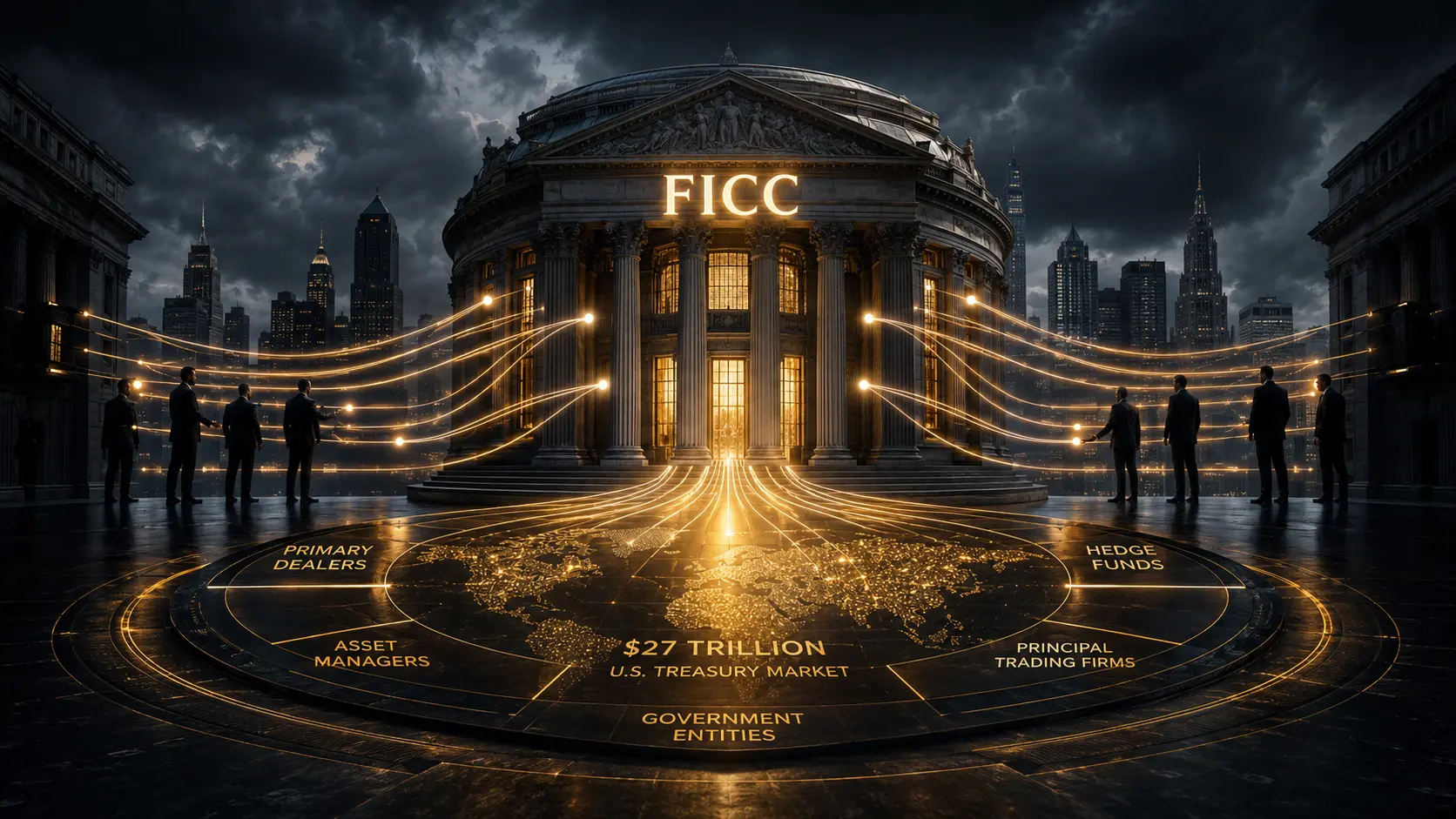

In March 2020, the foundation of the global financial system nearly collapsed. As the pandemic struck, a panicked “dash for cash” triggered an unprecedented sell-off in U.S. Treasury bonds. Hedge funds, utilizing massive, hidden leverage to squeeze pennies out of the Treasury market, were suddenly hit with margin calls they could not pay. Dealers stepped back, and the Treasury market—the $27 trillion bedrock that sets the price of every mortgage, corporate loan, and foreign currency on Earth—violently froze. The Federal Reserve was forced to intervene with trillions of dollars to prevent a global economic depression.
Why should you care right now? Because financial regulators swore they would never let that happen again. To neutralize this hidden risk, the U.S. Securities and Exchange Commission (SEC) has mandated the most aggressive plumbing overhaul in Wall Street history. By 2026, almost every cash and repo trade in the U.S. Treasury market must be routed through a single, centralized clearinghouse: the Fixed Income Clearing Corporation (FICC). This mandate abolishes the shadowy, handshake-driven bilateral deals that hedge funds used to achieve 50-to-1 leverage. It is a forceful, mathematically rigid restructuring of the world’s most important market, permanently altering the cost of capital, the liquidity of government debt, and the balance sheets of every major bank on the planet.
What is FICC Mandatory Central Clearing?
FICC mandatory central clearing is an SEC regulation requiring most U.S. Treasury cash and repurchase agreement (repo) trades to be processed through the Fixed Income Clearing Corporation. Instead of trading directly with each other, the FICC legally steps between buyers and sellers, standardizing margin requirements to prevent systemic defaults.
At a Glance
- Concept: Banning private, bilateral debt trades between banks and hedge funds, forcing everyone to trade through a heavily regulated, central middleman that demands upfront cash (margin) for safety.
- Why it matters: It curtails the extreme leverage used by macro hedge funds. Without this leverage, liquidity in the U.S. debt market could permanently drop, altering how the U.S. government funds its own deficit.
- Who uses it: Primary Dealers (JPMorgan, Goldman Sachs), Macro Hedge Funds, Principal Trading Firms (PTFs), and the Fixed Income Clearing Corporation (FICC).
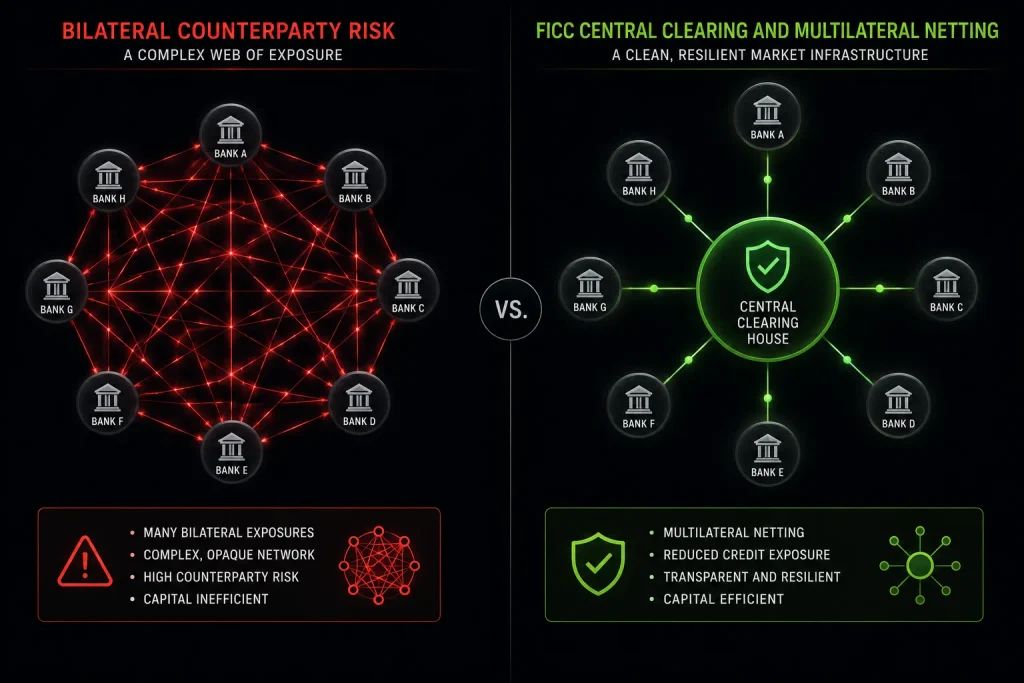
- Biggest takeaway: The mandate replaces a web of interconnected bilateral risk with a single “hub-and-spoke” model. This allows for massive “multilateral netting”—canceling out opposing trades to free up trillions of dollars in bank balance sheet capacity.
In Simple Words
Imagine a massive, chaotic poker game where thousands of players are passing IOU notes back and forth. Bilateral Trading is when Player A owes Player B, Player B owes Player C, and Player C owes Player A. If Player B suddenly goes bankrupt, the chain breaks, panic ensues, and nobody gets paid.
Central Clearing brings a Casino Boss into the room.
The SEC has ruled that players are no longer allowed to hand IOUs to each other. Every single IOU must be handed to the Casino Boss (the FICC). If Player A wants to bet with Player B, they both make the bet with the Boss instead. The Boss guarantees everyone will get paid, but to ensure safety, the Boss demands that every player leave a stack of physical chips (Margin) on the table before they are allowed to play. If a player goes bankrupt, the Boss uses their chips to pay the winner, ensuring the game never stops and the panic never spreads.
Why This Matters
For Fixed Income Traders and Treasury Structurers, the clearing mandate fundamentally rewrites the economics of the Repurchase Agreement (Repo) Market.
The repo market is the plumbing of Wall Street—it is how institutions borrow cash overnight using Treasuries as collateral. In the legacy bilateral market, major dealers often required zero “haircut” (margin) from their best hedge fund clients, allowing those funds to lever up their portfolios massively. The FICC mandate enforces a standardized, non-negotiable margin regime. If a hedge fund now has to post 2% margin on a $1 billion trade instead of 0%, their return on equity collapses. This is permanently altering the profitability of quantitative trading strategies and forcing the buy-side to radically restructure their liquidity buffers just to afford the daily cost of trading government debt.
Why the SEC Targeted the Cash-Futures Basis Trade
The true target of the SEC’s mandate is the Cash-Futures Basis Trade.
This trade involves buying a cash Treasury bond and shorting the equivalent Treasury futures contract to capture tiny price discrepancies. Because the profit margin is microscopic (fractions of a basis point), hedge funds use the bilateral repo market to lever the trade up to 50 times over. In 2020, when volatility spiked, the bilateral repo market seized up. Funds were forced to dump their cash Treasuries simultaneously, crashing the market.
By forcing the cash and repo legs of this trade into the FICC, regulators achieve total visibility. The SEC can now see exactly how much leverage a fund is running, and the FICC will automatically demand higher margins as the position grows, acting as an algorithmic brake on systemic risk.
How FICC Central Clearing and Novation Works
Transitioning $27 trillion from a decentralized web to a centralized hub requires overhauling the legal and mathematical architecture of clearing. Here is the first-principles breakdown of the system.
1. The Fundamental Problem: Bilateral Counterparty Risk
In a bilateral trade, if a broker-dealer executes a massive Treasury purchase with a hedge fund and the hedge fund defaults before settlement, the dealer absorbs the full loss. To protect themselves, dealers consume their own finite regulatory capital (Supplementary Leverage Ratio, or SLR) to backstop these trades, severely capping the total amount of liquidity they can provide to the market.
2. The Insufficiency of Uncleared Margin
While uncleared margin rules (UMR) existed for derivatives, the physical cash Treasury and bilateral repo markets were highly fragmented. Margin was negotiated privately, meaning during times of stress, dealers would suddenly and unpredictably hike margin requirements, triggering the exact liquidity panics they were trying to avoid.
3. The Core Mechanism: Novation to a CCP
Under FICC rules, the moment a trade is matched, it undergoes “Novation.” The original contract between the Buyer and Seller is legally torn up. Two new contracts are instantly created:
- The FICC becomes the Buyer to the Seller.
- The FICC becomes the Seller to the Buyer.The FICC assumes 100% of the counterparty credit risk.
4. Technical Depth: Multilateral Netting
Because the FICC is now the counterparty to every trade, it can execute Multilateral Netting. If a bank buys $10 billion in Treasuries from ten different clients, and sells $9 billion in Treasuries to ten other clients, in a bilateral world, the bank must hold capital against $19 billion in gross exposure. In the FICC, the system nets the trades algebraically. The bank only settles the net difference of $1 billion. This mathematical compression frees up massive amounts of dealer balance sheet capacity.
5. Real-World Consequences: Done-Away Clearing
Historically, buy-side firms executed and cleared with the same bank. Under the new mandate, a hedge fund might execute a trade with Bank A (because they have the best price), but clear the trade through Bank B (because Bank B is their FICC sponsor). This requires a complex “done-away” legal structure. Bank B must accept the risk of a trade they didn’t execute, demanding new legal frameworks (like the FICC Sponsored Service) to manage the give-up process and margin collection.
Impact of the Treasury Clearing Mandate on Hedge Funds
The SEC mandate is forcing a structural rewiring of how institutional capital is managed.
Hedge Fund Margin Optimization: Prior to the mandate, a macro hedge fund could run a basis trade with almost infinite leverage by rolling bilateral repos. Now, they must post initial margin to an FICC clearing member. To survive, quantitative funds are building advanced margin-replication algorithms. These algorithms calculate the exact Value-at-Risk (VaR) the FICC will charge before the trade is executed, allowing the fund to optimize its portfolio to minimize the margin drag on its IRR.
The Rise of Sponsored Clearing: Most hedge funds and asset managers are not direct members of the FICC; it requires too much regulatory capital. Instead, they use the FICC’s “Sponsored Service.” A tier-1 bank (the Sponsor) guarantees the fund’s trades to the FICC. This has created a highly lucrative, but capital-intensive, new revenue stream for Prime Brokerage desks, as they race to onboard hundreds of buy-side clients who are suddenly legally mandated to find a clearing sponsor by 2026.
Real-Money Cross-Margining: Pension funds and asset managers hold massive portfolios of both cash Treasuries and Treasury futures. Historically, these were cleared at different clearinghouses (FICC for cash, CME for futures), meaning the fund had to post margin twice. By forcing cash into the FICC, regulators are pushing for advanced “cross-margining” agreements between the CME and the FICC. If a fund’s cash position perfectly hedges its futures position, the combined margin requirement will drop drastically, saving institutional investors billions in trapped liquidity.
Economic & Strategic Impact
The mandate acts as a massive transfer of risk from the shadow banking sector into a single, heavily regulated chokepoint.
The strategic friction lies in the Cost of Centralization. While the FICC reduces counterparty risk, it demands cash. The industry estimates that the clearing mandate will drain tens of billions of dollars of high-quality liquid assets (HQLA) out of the active market, locking it inside the FICC’s margin vaults.
If hedge funds are forced to hold more cash to satisfy these margin requirements, their return on equity drops. If their returns drop, they will exit the Treasury market. Because Principal Trading Firms (PTFs) and hedge funds currently provide over 50% of the daily liquidity in the U.S. Treasury market, their departure could perversely make the Treasury market less liquid and more volatile, fundamentally increasing the borrowing costs for the U.S. government.
Advantages
- Systemic De-risking: Prevents the domino effect of a major participant defaulting. The FICC’s default management process and massive guarantee fund ensure that trades settle even if a top-tier hedge fund collapses.
- Balance Sheet Relief for Dealers: Multilateral netting drastically reduces the gross exposure of Primary Dealers. By freeing up space under the Supplementary Leverage Ratio (SLR), dealers have more capacity to warehouse Treasuries during market panics.
- Market Transparency: Regulators gain unprecedented visibility. Because every trade passes through a central hub, the SEC and the Federal Reserve can monitor systemic leverage and concentration risks in real-time, ending the opacity of the bilateral repo market.
Limitations
- Concentration Risk: The mandate moves the entire $27 trillion market’s risk onto a single private entity (the FICC). If a catastrophic cyberattack or algorithmic failure halts the FICC, the global financial system instantly flatlines.
- The Onboarding Bottleneck: There are thousands of buy-side funds that must be legally and technologically onboarded to FICC sponsors before the June 2026 deadline. The legal documentation (e.g., Master Repurchase Agreements) is agonizingly slow, threatening a massive operational traffic jam.
- Done-Away Economics: Clearing brokers assume massive risk when clearing trades executed by other dealers. If the clearing broker’s fees are too high, it destroys the economics of the trade for the buy-side; if the fees are too low, the clearing broker refuses to provide the service.
Common Misconceptions
Misconception: The SEC is forcing U.S. Treasuries to trade on a stock exchange.
Reality: Central clearing is not central execution. The U.S. Treasury market remains an Over-The-Counter (OTC) market. Participants still negotiate prices privately via phone or electronic platforms; the FICC only steps in after the trade is agreed upon to handle the settlement.
Misconception: The mandate eliminates all risk in the Treasury market.
Reality: It eliminates counterparty risk, but it significantly increases liquidity risk. By forcing everyone to post rigid cash margin, a sudden market shock will trigger massive, algorithmic margin calls from the FICC, potentially sparking a dash for cash similar to what the rule was meant to prevent.
Misconception: The U.S. Government runs the FICC.
Reality: The FICC is a subsidiary of the Depository Trust & Clearing Corporation (DTCC), which is a private corporation owned by its member financial institutions. It is heavily regulated by the SEC and the Fed, but it is not a government agency.
What Most People Miss
The hidden disruption to the Intraday Liquidity Buffer.
In the bilateral world, a hedge fund executing a repo trade might not have to post collateral until the end of the day. They could freely trade in and out of positions, utilizing massive intraday liquidity provided informally by their dealer.
The FICC operates on strict, heavily automated intraday margin cycles. If a fund’s portfolio value drops at 10:00 AM, the FICC can issue an intraday margin call demanding millions of dollars in cash by 11:00 AM. What most analysts miss is that the buy-side is fundamentally unequipped for this. Asset managers do not hold massive pools of idle cash. The mandate forces the buy-side to completely restructure their treasury operations, keeping billions of dollars in low-yield cash accounts permanently on standby just to survive the FICC’s intraday algorithms.
Comparison Table
| Feature | Legacy Bilateral Treasury Market | SEC Mandated Central Clearing (FICC) |
| Counterparty Risk | Distributed (Bank vs Fund) | Centralized (Everyone vs FICC) |
| Margin Requirements | Negotiated / Often Zero for VIPs | Standardized / Strict VaR Models |
| Dealer Balance Sheet | Highly Constrained (Gross Exposure) | Optimized (Multilateral Netting) |
| Systemic Transparency | Opaque (Shadow Banking) | Highly Transparent to Regulators |
| Buy-Side Capital Cost | Very Low | High (Initial and Variation Margin) |
Case Study
Situation: Following the severe Treasury market dysfunction of March 2020, regulators identified that heavily leveraged Principal Trading Firms (PTFs) and macro hedge funds—operating entirely outside the centrally cleared market—were the primary catalysts of the liquidity freeze. Their uncoordinated liquidation of bilateral repo positions overwhelmed dealer balance sheets.
Challenge: How could the SEC bring these opaque, highly leveraged shadow-banking participants into a regulated risk framework without destroying the fundamental liquidity of the U.S. government debt market?
Solution (The 2023 SEC Mandate): In December 2023, the SEC voted to adopt rules amending the Securities Exchange Act of 1934. The rules mandated that direct participants of a covered clearing agency (the FICC) must submit all eligible secondary market transactions in U.S. Treasury securities for clearance and settlement. This explicitly included all repurchase agreements (repos) and specific cash transactions involving registered broker-dealers.
Outcome: The ruling immediately triggered a frantic restructuring of Wall Street prime brokerage. Because the compliance date for repo clearing was set for June 30, 2026, Tier-1 banks began expanding their FICC Sponsored Service capacity. However, they simultaneously began repricing the cost of leverage for hedge funds to account for the incoming FICC margin requirements, immediately compressing the profitability of the cash-futures basis trade and forcing quantitative funds to deleverage their sovereign debt portfolios.
Lessons Learned: The mandate proved that regulators view systemic transparency as more valuable than peak liquidity. By accepting that the mandate will make trading U.S. Treasuries more expensive and potentially drive some participants out of the market, the SEC prioritized the mathematical certainty of central clearing over the fragile, high-leverage efficiency of the bilateral shadow banking system.
Future Outlook
Next 12–24 Months
The era of The Onboarding Traffic Jam. The lead-up to the December 2025 (Cash) and June 2026 (Repo) deadlines will be defined by severe operational friction. Thousands of buy-side firms must negotiate complex legal agreements (like the SIFMA Master Repurchase Agreement) to establish “done-away” clearing relationships with FICC sponsor banks. Because top-tier banks have limited balance sheet capacity to act as sponsors, they will ruthlessly offboard low-margin clients. Smaller hedge funds and asset managers will struggle to find a clearing sponsor, leading to a temporary reduction in secondary market liquidity.
Next 3–5 Years
The scaling of Cross-Margining and Predictive Analytics. Once the mandate is fully enforced, the industry’s focus will shift from compliance to optimization. The FICC and the CME (Chicago Mercantile Exchange) will expand their cross-margining programs, allowing institutions to offset the risk of their cash Treasuries against their Treasury futures. Simultaneously, third-party fintech platforms will deploy advanced AI tools to offer “Margin-as-a-Service,” allowing hedge funds to algorithmically route their trades to the specific clearing broker that offers the lowest margin requirement for that specific microsecond.
Next 10 Years
The Tokenization of Treasury Collateral. By the mid-2030s, the physical movement of margin into the FICC will become obsolete. The U.S. Treasury market will integrate heavily with Distributed Ledger Technology (DLT). Instead of wiring billions of dollars in cash or transferring physical bonds to satisfy FICC margin calls, institutions will use smart contracts to pledge tokenized Treasury bills or tokenized money market funds. This will allow for instantaneous, atomic settlement and intraday margin processing, effectively solving the liquidity drag created by the 2026 central clearing mandate.
Most Likely Scenario
The FICC clearing mandate is a permanent, irreversible paradigm shift. While it successfully eliminates the catastrophic contagion risk of a major hedge fund default, it fundamentally changes the nature of government debt. The U.S. Treasury market will become safer, more transparent, and vastly more expensive to operate in, permanently lowering the leverage profiles of the global macro trading industry.
Key Takeaways
- The SEC has mandated that by 2026, most U.S. Treasury cash and repo trades must be cleared through a central hub: the Fixed Income Clearing Corporation (FICC).
- Historically, hedge funds and banks traded bilaterally, often allowing funds to use extreme leverage with zero margin, which caused the Treasury market to freeze in March 2020.
- Central clearing replaces this web of risk. The FICC acts as the buyer to every seller, guaranteeing the trade but forcing every participant to post strict cash margin to cover potential losses.
- This process allows for “multilateral netting”—canceling out opposing trades to massively reduce the capital burden on major bank balance sheets.
- The primary challenge is “done-away” clearing, requiring buy-side funds to find a sponsor bank willing to clear their trades, leading to a massive legal and operational bottleneck ahead of the 2026 deadline.
- While making the market mathematically safer, the mandate pulls tens of billions of dollars of liquidity out of the market to be locked up as margin, permanently increasing the cost of trading U.S. debt.
Glossary
Cash-Futures Basis Trade: A highly leveraged arbitrage strategy where a fund sells a Treasury future and buys the underlying cash Treasury, using the repo market to fund the position.
Done-Away Clearing: A trade where the executing broker (who you trade with) and the clearing broker (who guarantees your trade to the FICC) are two different entities.
FICC (Fixed Income Clearing Corporation): The sole central counterparty (CCP) authorized to clear U.S. Treasury securities, acting as the ultimate guarantor of the market.
Multilateral Netting: An algorithmic process used by clearinghouses to offset opposing buy and sell orders across multiple parties, drastically reducing the total amount of money that must actually change hands.
Novation: The legal process where a bilateral contract between a buyer and seller is torn up and replaced by two new contracts, with the clearinghouse stepping in the middle.
Repurchase Agreement (Repo): A short-term borrowing arrangement where one party sells a Treasury bond to another party and agrees to buy it back the next day at a slightly higher price (acting as a secured loan).
Sources
Securities and Exchange Commission (SEC): SEC Adopts Rules to Improve Risk Management in Clearance and Settlement and Facilitate Additional Central Clearing for the U.S. Treasury Market (December 2023)
Depository Trust & Clearing Corporation (DTCC): Understanding the U.S. Treasury Clearing Mandate
SIFMA: U.S. Treasury Clearing Mandate Resource Center
Federal Reserve Bank of New York: The Economics of Central Clearing in the U.S. Treasury Market
Risk.net: Treasury clearing mandate: the buy-side margin challenge