Advertisement
)

AT A GLANCE
- Concept: Independent System Operator (ISO): The neutral organization balancing grid electricity supply and demand instantly.
- Concept: Day-Ahead Market: A financial auction where electricity is bought and sold 24 hours beforehand.
- Concept: Real-Time Market: The physical clearing mechanism that fixes sudden imbalances every five minutes.
- Concept: Locational Marginal Pricing (LMP): The precise cost of delivering one extra megawatt to a specific location.
IN SIMPLE WORDS
Unlike oil or coal, you cannot easily store massive amounts of electricity in a warehouse. It must be generated the exact millisecond you flip a light switch.
To manage this physical impossibility, the power grid operates a continuous financial auction. Every day, power plants submit bids offering to generate electricity at specific prices. Simultaneously, utility companies submit bids to buy that electricity for their local cities.
A central computer matches these bids. It always buys the cheapest power first. However, the computer must also respect the physical limits of the power lines.
If a cheap power plant is blocked by a congested transmission wire, the computer must buy from a more expensive power plant nearby. This auction runs every single day, keeping the grid from collapsing while settling billions of dollars in trades.
HOW IT WORKS
The architecture of a wholesale electricity market is fundamentally an optimization algorithm. It solves a continuous mathematical puzzle known as Security-Constrained Economic Dispatch (SCED).
The process begins in the Day-Ahead Market (DAM). Generating companies submit supply offers, detailing how many megawatts they can produce and at what price. Utilities submit demand bids, estimating how much power their customers will need tomorrow.
The Independent System Operator (ISO) feeds these bids into the SCED engine. The algorithm stacks the supply bids from cheapest to most expensive.
The point where the supply stack intersects with the total demand is the clearing price. Every generator that bid at or below this price is selected to turn on, receiving the final clearing price.
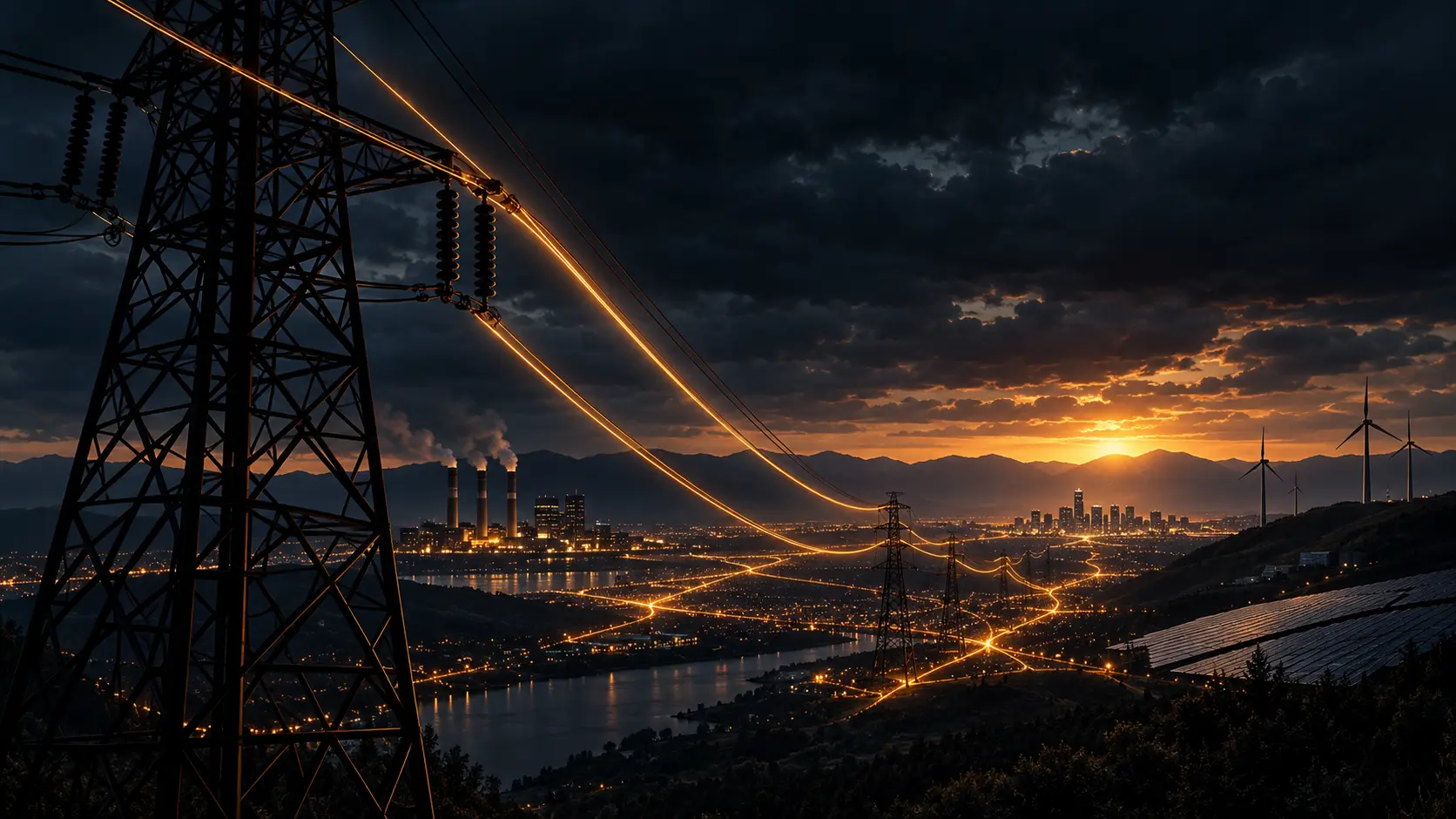
However, electricity does not travel smoothly. It faces physical resistance and transmission limits. If a high-voltage line connecting a cheap wind farm to a city reaches its maximum thermal limit, the line is congested.
To resolve this, the ISO must ignore the cheap wind power and turn on a more expensive, localized gas plant situated closer to the city. This creates Locational Marginal Pricing (LMP).
The LMP is the precise cost of serving one additional megawatt of load at a specific node on the grid. It consists of three components: the base energy price, the cost of transmission congestion, and the cost of line losses.
Because weather forecasts and human behavior are never perfectly accurate, the Day-Ahead Market is never entirely correct. To fix these discrepancies, the ISO operates a Real-Time Market.
This market recalculates the SCED algorithm every five minutes. It instantly sends digital signals to power plants to ramp their output up or down, physically balancing the grid at 60 Hertz.
REAL WORLD EXAMPLE
In February 2021, Winter Storm Uri devastated the Texas ERCOT power grid. Because Texas operates an “energy-only” market, power plants are only paid for the electricity they actually generate. They receive zero compensation for maintaining emergency reserves.
As natural gas wellheads froze and wind turbines iced over, physical supply collapsed. Simultaneously, millions of Texans turned on their electric heaters, causing demand to skyrocket.
The ERCOT clearing engine did exactly what it was programmed to do. To incentivize any remaining power plants to turn on, the algorithm pushed the wholesale price of electricity to its absolute maximum legal limit: $9,000 per megawatt-hour. In a matter of days, the wholesale market settled billions of dollars in trades, bankrupting utility companies that had not hedged their exposure.
WHY IT MATTERS NOW
The modern power grid is undergoing a massive structural transition. We are replacing centralized, highly predictable fossil fuel plants with millions of decentralized, weather-dependent renewable energy sources.
This creates extreme price volatility in the wholesale markets. On a sunny spring afternoon in California, massive solar arrays produce more electricity than the state can consume. Because solar farms cost nothing to operate once built, they bid into the market at zero dollars or even negative prices.
This phenomenon—negative pricing—means the grid operator literally pays power plants to turn off. Alternatively, they pay large factories to consume excess energy to prevent the transmission lines from overloading.
However, when the sun sets, the solar power vanishes while human demand spikes. The grid must instantly replace gigawatts of missing solar power. The wholesale price rockets upward, heavily rewarding natural gas peaker plants and lithium-ion battery arrays that can discharge power instantly.
Mastering this daily pricing curve—known as the duck curve—is highly lucrative. Private equity firms and infrastructure funds are deploying billions of dollars into grid-scale batteries to capture the massive financial spread between free midday power and expensive evening power.
COMMON MISCONCEPTIONS
- “The utility company sets my electricity price.” Your local utility company only sets the retail delivery rate. The actual cost of the energy itself is decided by the invisible auction of the wholesale market, which fluctuates constantly.
- “Renewable energy makes electricity free.” While the fuel is free, the transmission lines required to move that power from remote deserts to dense cities are incredibly expensive, driving up the congestion component of the wholesale price.
- “The grid is a single, national network.” The United States grid is highly fragmented. It is broken into three distinct interconnections and further divided into regional ISOs, meaning the price of electricity in New York has almost no relation to the price in Texas.
WHAT MOST PEOPLE MISS
Financial analysts focus heavily on physical power plants, but they entirely overlook the massive volume of Virtual Bidding.
In many ISOs, financial traders who do not own a single solar panel or power line are legally allowed to bid in the Day-Ahead Market. They act as purely financial speculators.
If a trader believes the ISO is underestimating tomorrow’s weather, they will buy virtual power day-ahead and sell it back in real-time. This synthetic liquidity actually helps the grid by closing the pricing gap between the two markets, forcing physical generators to price their power more accurately.
THE ECONOMIC AND STRATEGIC IMPACT
The primary financial winners of volatile wholesale markets are algorithmic energy trading desks and battery storage operators. These entities possess the advanced software required to ingest terabytes of weather data. This allows them to predict locational marginal price spikes milliseconds before they happen.
For heavy industrial consumers—like aluminum smelters, cloud computing data centers, and Bitcoin miners—understanding the wholesale market is an existential necessity. These companies sign complex Power Purchase Agreements (PPAs). They locate their facilities directly next to specific grid nodes with historically low LMPs to secure cheap power.
Geopolitically, the design of these markets dictates national security. Europe’s pay-as-clear marginal pricing system meant that when Russian natural gas prices spiked in 2022, the price of all electricity skyrocketed. This forced European governments to fundamentally rethink how they design electricity auctions to decouple renewable power from fossil fuel extortion.
THE TRAJECTORY
Next 12–36 Months: The expansion of Virtual Power Plants (VPPs) into wholesale markets. Federal regulators will force grid operators to allow networks of residential solar panels and batteries to bid together as a single, massive power plant, competing directly against coal and gas.
Next Five Years: The implementation of hyper-granular, sub-zero pricing algorithms. As renewable penetration exceeds 60 percent in major markets, negative pricing will shift from an occasional anomaly to a daily structural reality. This will destroy the economics of inflexible nuclear and coal plants that cannot quickly throttle their output.
Next Ten Years: AI-driven autonomous dispatch. Human grid operators will step back from daily market clearing. Artificial intelligence models will directly interface with weather satellites and consumer smart thermostats, bidding, buying, and dispatching power entirely machine-to-machine at the edge of the grid.
What Could Go Wrong: A cascading cyber-physical settlement collapse. If a sophisticated state-sponsored cyberattack corrupts the timing signals or locational marginal pricing data within an ISO’s clearing engine, the algorithm will dispatch the wrong power plants. This would trigger immediate physical transmission line overloads and subsequent multi-state blackouts.
Most Likely Outcome: Wholesale electricity markets will transition from managing physical scarcity to managing extreme abundance. The ability to physically store electricity and computationally shift demand by milliseconds will dictate the ultimate value of energy.
KEY TERMS
- Independent System Operator (ISO): The neutral, highly regulated organization responsible for balancing electricity supply and demand and running the wholesale market.
- Locational Marginal Price (LMP): The exact financial cost of delivering one extra megawatt of electricity to a specific physical location on the grid.
- Day-Ahead Market: A forward financial auction where electricity is bought and sold 24 hours before it is actually produced and consumed.
- Economic Dispatch: The algorithmic process of determining which power plants should run to meet demand at the lowest possible cost.
- Congestion: A bottleneck that occurs when the cheapest electricity cannot be physically delivered to a city because the transmission lines are at maximum capacity.
- Virtual Bidding: A purely financial transaction where traders buy or sell electricity without owning physical power plants, providing liquidity to the market.
BEGINNER FAQ
What is a wholesale electricity market? It is a massive auction where companies that make electricity sell it to the utility companies that deliver it to your home.
Why does electricity price change every five minutes? Because electricity cannot be stored easily. The grid must instantly match the exact amount of power being generated with the exact amount being used. This constant balancing acts like a live stock market.
What is the Day-Ahead market? It is a financial schedule. Grid operators look at tomorrow’s weather forecast and ask power plants to bid on supplying the expected power 24 hours in advance to keep things stable.
What happens if the weather forecast is wrong? The grid uses the Real-Time market. If it is suddenly hotter than expected and people turn on their air conditioners, the grid operator instantly buys emergency backup power, usually at a much higher price.
Why is power cheaper in some places than others? It is due to transmission limits. If a city needs power but the wires from a cheap wind farm are full, the grid has to buy from an expensive local gas plant. This is called a Locational Marginal Price.
Can prices really go below zero? Yes. Sometimes the wind blows hard but nobody needs the power. The grid will actually pay power plants to shut down or pay factories to use the extra energy to prevent the wires from overloading.
How does my local utility company fit into this? Your utility company buys power in these wholesale markets. They then pipe it to your house and charge you a retail rate, which is usually a smoothed-out average of these wild wholesale prices.
Who makes sure these markets are fair? In the United States, the Federal Energy Regulatory Commission (FERC) creates the strict rules governing how these auctions run to prevent companies from manipulating the prices.
SOURCES
- Federal Energy Regulatory Commission (FERC) — Energy Primer: A Handbook of Energy Market Basics
- PJM Interconnection — Locational Marginal Pricing and Day-Ahead Market Operations
- Energy Information Administration (EIA) — Wholesale Electricity Market Dynamics and Renewable Integration
- Institute of Electrical and Electronics Engineers (IEEE) — Security-Constrained Economic Dispatch Algorithms