Advertisement
)

AT A GLANCE
- Concept: Electrolysis: Passing an electrical current through water to separate it into hydrogen and oxygen gases.
- Concept: PEM Electrolyzer: A highly responsive machine using specialized polymer membranes to split water instantly.
- Concept: Hydrogen Embrittlement: The chemical process where tiny hydrogen atoms leak into metal pipes, causing them to crack.
- Concept: Cryogenic Transport: Chilling hydrogen gas to nearly absolute zero to turn it into a dense, shippable liquid.
IN SIMPLE WORDS
Imagine trying to fly a jumbo jet or melt steel using standard batteries. It is physically impossible. Batteries are simply too heavy and hold too little energy for massive industrial jobs.
We need a fuel that burns as hot and powerful as coal or jet fuel, but leaves behind zero pollution. Enter hydrogen. Hydrogen is the most abundant element in the universe. When you burn it, the only exhaust it creates is pure water.
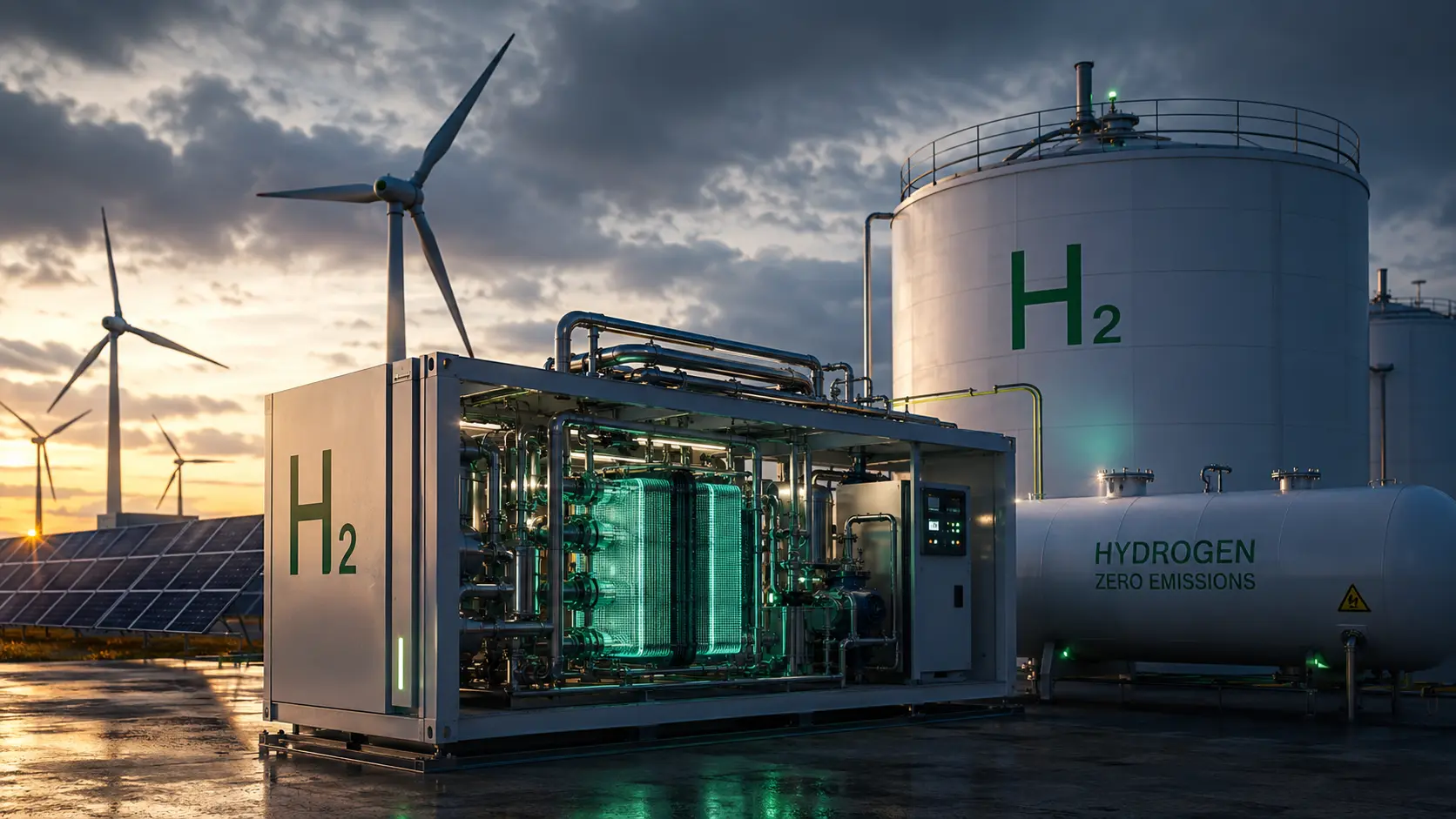
However, hydrogen does not exist on its own on Earth. It is always attached to something else, mostly water (H_2O). Green hydrogen is produced by building massive machines called electrolyzers. These machines use excess electricity from wind and solar farms to shock water, breaking the chemical bonds and harvesting the pure hydrogen gas. It allows us to bottle wind and sunlight into a liquid fuel.
HOW GREEN HYDROGEN PRODUCTION WORKS
Water (H_2O) is a highly stable molecule. Breaking its chemical bonds requires an immense input of energy.
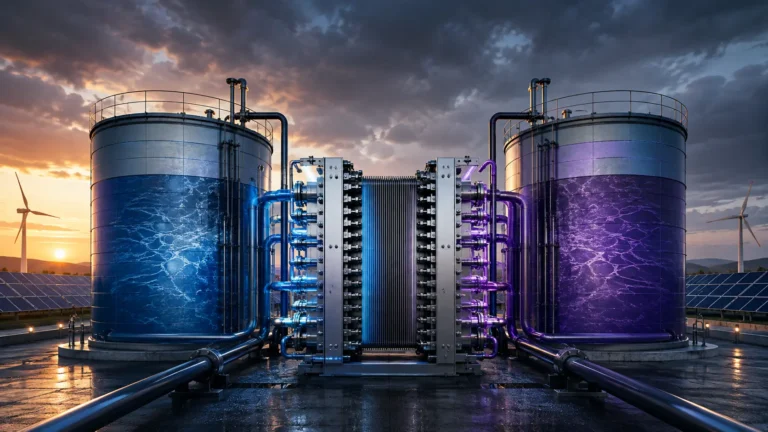
Engineers achieve this using an electrolyzer. The most advanced commercial architecture is the Proton Exchange Membrane (PEM) electrolyzer. Inside a PEM cell, highly purified water flows to the anode, the positive electrode.
When renewable electricity surges into the anode, a catalyst—typically made of rare iridium and platinum—strips the electrons from the water molecules. This reaction splits the water into oxygen gas, positively charged hydrogen ions (protons), and free electrons.
The specialized polymer membrane in the middle of the cell only allows the positively charged protons to pass through it. The electrons must travel around the membrane through an external copper circuit.
When the protons and electrons meet again at the cathode, the negative electrode, they instantly recombine to form pure, stable hydrogen gas (H_2).
Because PEM electrolyzers do not rely on slow-moving liquid chemicals like older alkaline systems, they can ramp up or shut down in seconds. This makes them perfectly suited to pair with wind turbines and solar panels, capturing sudden spikes in renewable energy that the local power grid cannot absorb.
REAL WORLD EXAMPLE
The H2 Green Steel project in Boden, Sweden, represents the largest commercial application of this physics. Traditional steelmaking burns millions of tons of metallurgical coal, emitting massive clouds of carbon dioxide.
Instead of coal, the Boden facility operates massive PEM electrolyzers powered by Sweden’s hydro and wind grids. The electrolyzers strip hydrogen from local water. Engineers then inject this pure hydrogen gas directly into the blast furnace.
The hydrogen reacts with the iron ore, stripping away the oxygen to leave pure sponge iron. The only byproduct exiting the factory smokestack is water vapor. This single chemical substitution eliminates up to 95 percent of the total carbon emissions from one of the dirtiest industries on Earth.
WHY IT MATTERS NOW
The global economy cannot decarbonize using lithium-ion batteries alone. Aviation, oceanic shipping, chemical fertilizer production, and heavy manufacturing require intense, sustained thermal heat and chemical feedstocks.
These “hard-to-abate” sectors account for roughly 30 percent of global emissions. Green hydrogen provides the only mathematically viable pathway to neutralize these industries while maintaining modern industrial output.
Consequently, sovereign capital is flooding the sector. The US Inflation Reduction Act offers a massive production tax credit of up to $3 per kilogram for clean hydrogen. The European Union has mandated that industry replace 42 percent of its gray hydrogen—made from natural gas—with green hydrogen by 2030.
This initiates a brutal, high-stakes infrastructure race. Nations in the Middle East and North Africa are building vast solar farms strictly to export liquid green hydrogen to energy-starved industrial hubs in Germany and Japan. The geopolitical map of energy is shifting from those who extract oil to those who can manufacture cheap molecules.
COMMON MISCONCEPTIONS
- “Hydrogen is a primary energy source.” Hydrogen is not a primary energy source like oil or solar; it is an energy carrier. You must spend electricity to create it.
- “All hydrogen is currently green.” Today, 95 percent of global hydrogen is “gray.” It is stripped from fossil fuels using steam methane reforming, which releases massive carbon pollution.
- “We can easily pipe it into homes.” Hydrogen atoms are tiny. If you pump pure hydrogen into existing natural gas pipelines, the atoms seep into the steel structure, making the pipes brittle and highly prone to shattering.
WHAT MOST PEOPLE MISS
Energy analysts obsess over the cost of electricity, but they completely miss the brutal material physics of the electrolyzer catalysts.
PEM electrolyzers rely on iridium to survive the highly corrosive, highly acidic environment at the anode. Iridium is one of the rarest elements on Earth, found almost exclusively in South Africa and Russia as a byproduct of platinum mining.
If global manufacturers scale PEM production to meet net-zero climate goals, the industry will require vastly more iridium than the Earth physically produces in a year. Without a breakthrough in catalyst chemistry that drastically reduces iridium loading, the green hydrogen revolution hits a hard geological wall.
THE ECONOMIC AND STRATEGIC IMPACT
The financial winners of the hydrogen transition are heavy engineering conglomerates and industrial gas monopolies. Companies like Air Liquide and Linde already possess the highly specialized cryogenic infrastructure required to move explosive gases safely.
Sovereign energy independence is the ultimate strategic prize. Nations like Chile and Australia, which feature massive unpopulated deserts with intense solar irradiance, are positioning themselves as the new Saudi Arabia of green molecules. They intend to export synthetic green ammonia—hydrogen bound with nitrogen—to fuel global shipping fleets.
Conversely, legacy petrostates face an existential threat. They are aggressively pushing “blue hydrogen”—stripping hydrogen from their natural gas reserves and burying the carbon underground. They aim to lock the world into fossil-based hydrogen infrastructure before green hydrogen achieves absolute cost parity.
THE TRAJECTORY
Next 12–36 Months: Industrial hubs will activate localized hydrogen “valleys.” Co-locating electrolyzers directly next to chemical plants and steel mills eliminates the need for expensive long-distance pipelines, proving commercial viability at a localized scale.
Next Five Years: The commercialization of Solid Oxide Electrolyzer Cells (SOEC). These ultra-high-temperature machines use waste industrial heat to pre-boil the water into steam before electrifying it. This requires significantly less electricity than PEM, driving the cost of green hydrogen below the critical threshold of $2 per kilogram.
Next Ten Years: The deployment of global hydrogen shipping fleets. Massive cryogenic tankers will transport liquid hydrogen across the oceans at -253°C. Ports will build specialized receiving terminals to convert this liquid back into gas, fully commoditizing clean energy on the open market.
What Could Go Wrong: Severe hydrogen embrittlement failures. If grid operators prematurely blend high concentrations of hydrogen into legacy natural gas pipelines, the microscopic atoms will stress the steel. A catastrophic pipeline rupture under a major city would instantly destroy public and regulatory support for the fuel.
Most Likely Outcome: Green hydrogen will fail as a fuel for passenger cars and home heating, losing completely to battery electrification. However, it will achieve total dominance as a specialized industrial feedstock and heavy marine fuel, securing its position as the critical missing piece of global decarbonization.
KEY TERMS
- Electrolysis: The chemical process of using electricity to split a molecule into its basic elements.
- Proton Exchange Membrane (PEM): A semi-permeable plastic layer inside an electrolyzer that allows positively charged hydrogen ions to pass while blocking electrons.
- Catalyst: A material, like iridium or platinum, that speeds up a chemical reaction without being consumed by it.
- Hydrogen Embrittlement: A physical phenomenon where small hydrogen atoms penetrate solid metal, causing it to lose its flexibility and crack.
- Cryogenic Transport: The process of chilling a gas to extremely low temperatures until it becomes a dense liquid, making it easier to ship across oceans.
- Green Ammonia: A chemical compound created by combining green hydrogen with nitrogen from the air, often used as a liquid fuel for massive cargo ships.
BEGINNER FAQ
What exactly is green hydrogen? It is pure hydrogen gas made by using renewable electricity, like wind or solar, to split water. Because the electricity is clean, the entire process creates zero pollution.
Why not just use batteries for everything? Batteries are too heavy and do not hold enough dense energy. A cargo ship or an airplane would need batteries so large it could not carry any actual cargo.
What is the difference between green, blue, and gray hydrogen? Gray hydrogen is made from fossil fuels and releases carbon dioxide. Blue hydrogen is made from fossil fuels, but the pollution is captured and buried underground. Green hydrogen uses only water and clean electricity.
Where does the water come from? Electrolyzers require highly purified water. Most projects use local municipal water or build desalination plants to purify seawater before splitting it.
Is hydrogen explosive? Yes, hydrogen is highly flammable. However, it is the lightest element in the universe. If a leak occurs, the gas immediately shoots straight up into the atmosphere and dissipates rapidly, unlike gasoline which pools on the ground.
How much does green hydrogen cost? Currently, it is very expensive—often over $5 per kilogram. The industry goal is to push the cost below $1 or $2 per kilogram to compete directly with dirty fossil fuels.
Can I put hydrogen in my car? There are hydrogen fuel cell cars available, but they are losing the consumer market to electric vehicles. EVs are cheaper to charge and have a massive head start in charging station infrastructure.
Why is it hard to move hydrogen? Hydrogen gas takes up a massive amount of physical space. To move it efficiently, you have to compress it under extreme pressure or chill it to almost absolute zero, both of which require highly expensive infrastructure.
SOURCES
- International Energy Agency (IEA) — Global Hydrogen Review and Electrolyzer Capacity Forecasts
- Department of Energy (DOE) — Hydrogen Shot: Cost Reductions and Infrastructure Pathways
- Massachusetts Institute of Technology (MIT) — Catalyst Degradation and Materials Scarcity in PEM Electrolysis
- National Renewable Energy Laboratory (NREL) — Technical Challenges of Hydrogen Pipeline Blending and Embrittlement