Advertisement
)

At a Glance
Concept: Proving you know a secret without sharing the secret itself.
Why it matters: It eliminates the need to hand over sensitive personal data to third parties.
Who uses it: Blockchain networks, cybersecurity firms, and digital identity providers.
Biggest takeaway: Zero-knowledge proofs solve the core tension of the internet by allowing perfect digital verification alongside absolute personal privacy.
In Simple Words
Imagine you need to prove to a bartender that you are over 21 years old. Today, you hand over your physical driver’s license. The bartender verifies your age, but they also see your home address, exact birth date, full name, and organ donor status. You shared far more information than necessary.
A zero-knowledge proof acts like a magical ID card. When the bartender looks at it, they only see a green checkmark confirming you are legally allowed to drink. All other personal details remain entirely hidden.
In the digital world, this is achieved using advanced mathematics. Instead of giving a website your social security number or bank password to verify your identity, you provide a cryptographic puzzle piece. The website can verify the piece fits, proving your identity is valid without ever seeing the underlying data.
Why This Matters
The modern internet is built on a dangerous exchange. To use digital services, consumers must surrender massive amounts of highly sensitive personal data.
Every time a person applies for a loan, rents an apartment, or opens a financial account, their history and identity documents are stored on a third-party server. These centralized databases are goldmines for hackers. Millions of people suffer from identity theft annually simply because the companies they trusted failed to secure their data. The current system relies on trusting the database administrator, which has proven mathematically and practically flawed.
Zero-knowledge proofs (ZKPs) shift the foundation of digital trust. If a company never collects the raw data in the first place, that data cannot be stolen in a breach. ZKPs allow institutions to verify a user’s credit score, citizenship, or employment status with absolute mathematical certainty, while the raw data never leaves the user’s personal device.
This fundamentally rewrites cybersecurity strategy. Instead of building taller digital walls to protect giant databases of vulnerable information, organizations can simply stop storing the information. For enterprise Chief Information Security Officers (CISOs), adopting ZKPs drastically reduces legal liability and compliance costs associated with global data privacy regulations.
HOW ZERO-KNOWLEDGE PROOFS WORK
A zero-knowledge proof requires complex cryptography to guarantee that no data leaks during a transaction. The architecture relies on strict mathematical rules.
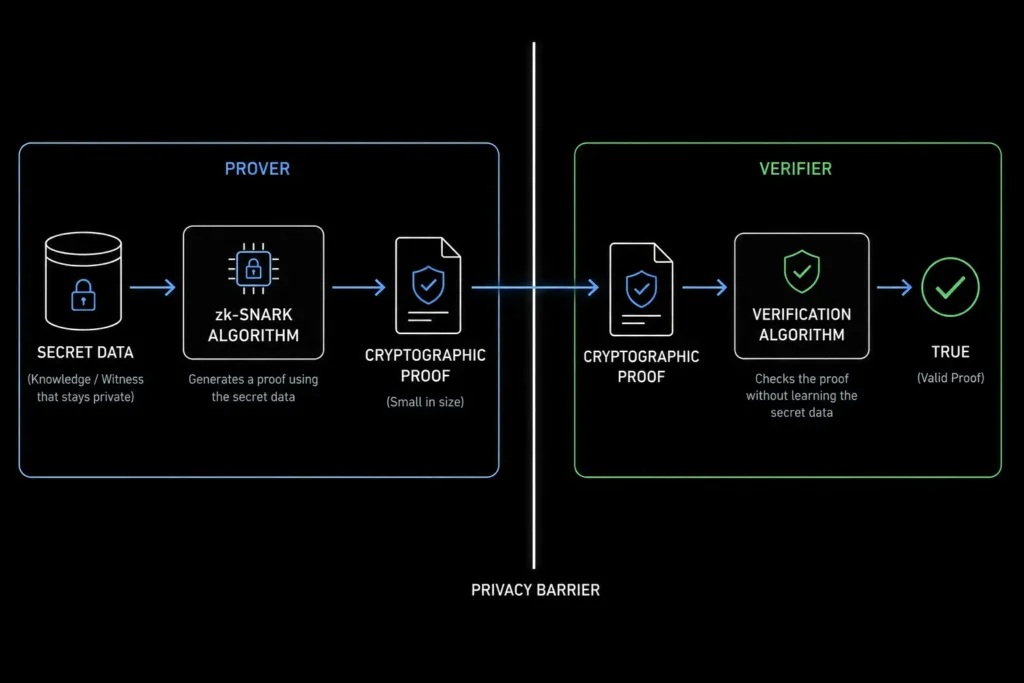
1. The Core Concept: The foundation involves two participants: the Prover and the Verifier. The Prover possesses a secret piece of data and wants to prove a specific claim about it. The Verifier wants to confirm the claim is true without learning the secret data. The system must satisfy three conditions: completeness (if true, an honest Verifier will be convinced), soundness (if false, a cheating Prover cannot trick the Verifier), and zero-knowledge (the Verifier learns absolutely nothing else).
2. The Interactive Challenge: Historically, these proofs required interaction. Imagine a colorblind Verifier holding two balls: one red, one green. The Prover, who can see color, claims the balls are different. The Verifier hides the balls behind their back, optionally swaps them, shows them again, and asks, “Did I swap them?” The Prover answers. If they do this fifty times and the Prover is always correct, the Verifier knows with statistical certainty that the balls are different colors, without ever learning which one is red or green.
3. zk-SNARKs and Non-Interaction: In computer science, executing thousands of interactive challenges is too slow. Engineers developed zk-SNARKs (Zero-Knowledge Succinct Non-Interactive Argument of Knowledge). “Non-interactive” means the Prover and Verifier do not need a back-and-forth conversation. The Prover uses an algorithm to generate a single, tiny mathematical proof and sends it directly to the Verifier.
4. Polynomial Commitments: To prove complex digital logic, the raw data is translated into mathematical equations called polynomials. The Prover mathematically commits to a specific polynomial without revealing it. The Verifier’s algorithm then tests random points on that polynomial. If the points match the expected output perfectly, the Verifier accepts the proof. Because polynomials can represent massive data sets efficiently, this method allows rapid verification.
5. Cryptographic Hash Functions: The integrity of the proof relies on cryptographic hash functions. These algorithms take an input of any size and compress it into a fixed string of characters. It is easy for a computer to verify a hash, but mathematically impossible to reverse-engineer the original data from the hash. This creates the unbreakable one-way street that keeps the Prover’s data hidden.
6. System Limitations: The primary limitation of a zero-knowledge proof is computational intensity. While verifying a proof takes milliseconds, generating the proof requires significant processing power. This can slow down consumer mobile devices or drain smartphone batteries. Additionally, the underlying cryptography is so complex that very few engineers in the world can safely audit the code for hidden vulnerabilities.
Real-World Applications
Zero-knowledge cryptography has moved from academic theory to active deployment.
Blockchain Scalability: Ethereum and other major networks use “zk-Rollups” to process thousands of financial transactions off the main network. A zero-knowledge proof is generated to mathematically guarantee that all the off-chain transactions are valid. Only the tiny proof is sent to the main blockchain. This drastically lowers network fees while maintaining perfect security.
Private Digital Identity: Startups are developing decentralized identity applications. A user stores their government-issued passport securely on their mobile phone. When an online service requires age or citizenship verification, the app generates a ZKP. The service provider receives absolute confirmation without ever collecting a photograph of the passport.
Enterprise Data Sovereignty: Competing financial institutions often need to prove they hold enough reserve capital without revealing their exact balance sheets to rivals. ZKPs allow banks to cryptographically prove their solvency to regulators while maintaining strict corporate secrecy regarding their specific investments.
Economic & Strategic Impact
Zero-knowledge proofs alter the financial liabilities associated with data collection.
For businesses, the cost of securing consumer data is massive. When an enterprise adopts zero-knowledge architecture, they no longer act as a honey-pot for hackers. If a company does not hold the raw data, it cannot be leaked. This eliminates the existential threat of class-action lawsuits and crippling regulatory fines under frameworks like the European Union’s GDPR.
For the financial sector, ZKPs accelerate the institutional adoption of digital assets. Historically, major banks refused to trade on public blockchains because a transparent ledger would reveal their trading strategies to competitors. By using zero-knowledge cryptography, institutions can execute trades on public networks while keeping their wallet balances and transaction histories entirely invisible.
Strategically, governments recognize that digital privacy is becoming a matter of national security. Widespread ZKP adoption prevents hostile intelligence agencies from harvesting massive databases of citizen data, effectively neutralizing large-scale digital espionage.
Advantages
Absolute Privacy: Guarantees that sensitive personal or corporate information is never exposed to third-party servers.
Data Breach Prevention: Eliminates the centralized databases of raw data that hackers typically target.
Efficient Verification: SNARK proofs are incredibly small, allowing massive datasets to be verified by a network in milliseconds.
Regulatory Compliance: Allows companies to verify user eligibility without violating strict global data protection laws.
Limitations
High Compute Costs: Generating the initial mathematical proof takes significant time and electrical energy compared to sending standard unencrypted data.
Trusted Setup Vulnerability: Many older zk-SNARK protocols require a “trusted setup” phase where a master key is created. If this key is not securely destroyed, the entire system can be compromised.
Talent Shortage: The specialized mathematics require PhD-level cryptographers, making development slow, expensive, and difficult to audit.
Irreversibility: If a user loses the private keys to their zero-knowledge identity wallet, there is no central administrator who can recover the data for them.
Common Misconceptions
Misconception: Zero-knowledge means no one knows the data.
Reality: The Prover absolutely knows the raw data. “Zero knowledge” specifically refers to the fact that the Verifier learns nothing new during the transaction.
Misconception: ZKPs are only used to hide illicit cryptocurrency transactions.
Reality: While early iterations were popularized by privacy-focused cryptocurrencies, the primary modern use cases are enterprise data security, digital identity, and scaling global financial networks.
Misconception: The verification process is slow and unscalable.
Reality: Generating the proof is computationally heavy, but verifying the proof takes fractions of a second, making it highly efficient for network processing.
What Most People Miss
Zero-knowledge proofs do not just protect data; they compress it.
When a blockchain network uses a zk-Rollup, the proof is not just hiding who sent money to whom. It is taking the raw data of 10,000 separate transactions and compressing it into a single mathematical guarantee. The main network only needs to read that one tiny proof to know all 10,000 transactions are mathematically legitimate.
This compression factor—not just the privacy feature—is what allows decentralized networks to bypass physical bandwidth limits and scale to global, visa-level processing speeds.
Comparison Table
| Feature | Traditional Verification | Zero-Knowledge Proof (ZKP) |
| Purpose | Confirm identity by sharing raw data. | Confirm identity mathematically without sharing data. |
| Data Storage | Kept on centralized third-party servers. | Remains solely on the user’s personal device. |
| Privacy Risk | Extremely high; vulnerable to database hacks. | Zero; raw data is never transmitted. |
| Computational Cost | Low (simple database check). | High (requires generating cryptographic proofs). |
| Verification Speed | Fast. | Extremely fast (milliseconds). |
| Complexity | Simple software engineering. | Advanced cryptographic mathematics. |
| Best Fit | Legacy internet platforms. | High-security enterprise, blockchain, digital identity. |
Case Study
Situation: The Ethereum blockchain struggled with massive congestion, leading to transaction fees occasionally exceeding $50 per trade during periods of peak network usage.
Challenge: Developers needed a way to process thousands of transactions per second without forcing every computer on the global network to individually verify every single trade, which caused the severe bottleneck.
Solution: Engineering teams introduced zk-Rollups. Thousands of trades are now processed on a secondary computation layer. A massive zero-knowledge proof is generated, mathematically guaranteeing that all the trades were executed correctly according to the network’s rules.
Outcome: Only the final cryptographic proof is published to the main Ethereum network. This reduced transaction fees by over 90% while maintaining the exact same level of security as the main decentralized ledger.
Lessons Learned: Complex cryptography can solve physical network congestion. By substituting heavy raw data transmission with lightweight mathematical proofs, decentralized networks can achieve enterprise-scale operational speed.
Future Outlook
Next 12–24 Months: Zero-knowledge rollups will become the undisputed default standard for scaling public blockchain networks. Enterprise software vendors will begin integrating basic ZKP identity tools for employee logins, slowly replacing vulnerable password databases in high-security sectors.
Next 3–5 Years: The reliance on “trusted setups” will fade as newer protocols, like zk-STARKs (Scalable Transparent Arguments of Knowledge), mature and become computationally cheaper. These advanced protocols eliminate initial security vulnerabilities and offer theoretical protection against future quantum computing attacks.
Next 10 Years: Digital passports, driver’s licenses, and national ID systems will natively use zero-knowledge architecture. Citizens will prove their citizenship at border crossings and online platforms exclusively through cryptographic proofs, rendering the physical handover of ID cards obsolete.
Most Likely Scenario: Zero-knowledge proofs will eventually disappear into the background plumbing of the internet. Just as everyday users do not understand HTTPS encryption but rely on it implicitly for secure web browsing, future users will rely on ZKPs to protect their identity without ever interacting directly with the underlying mathematics.
Key Takeaways
A zero-knowledge proof allows someone to prove a statement is true without revealing the underlying data.
ZKPs eliminate the need for centralized databases to hoard sensitive consumer information.
The technology relies on zk-SNARKs to generate tiny, instantly verifiable mathematical proofs.
Proof generation requires heavy computation, while proof verification happens in milliseconds.
Blockchain networks use ZKPs to compress thousands of transactions into a single proof, scaling the system.
Enterprise adoption of ZKPs drastically reduces cybersecurity liability and compliance costs.
Future digital identities will rely exclusively on zero-knowledge cryptography to prevent identity theft.
Glossary
Cryptographic Hash Function: An algorithm that takes an input of any size and turns it into a fixed, irreversible string of characters.
Polynomial Commitment: A mathematical scheme where a prover commits to a polynomial equation without revealing it, allowing rapid verification of large datasets.
Prover: The party in a zero-knowledge transaction that holds the secret data and generates the mathematical proof.
Trusted Setup: An initial phase in some cryptographic protocols where a master key is generated; if not destroyed, it can compromise the system.
Verifier: The party in a zero-knowledge transaction that checks the mathematical proof without ever seeing the secret data.
zk-Rollup: A blockchain scaling solution that processes thousands of transactions off-chain and submits a single zero-knowledge proof to the main network.
zk-SNARK: Zero-Knowledge Succinct Non-Interactive Argument of Knowledge; a highly efficient protocol for generating tiny cryptographic proofs.
zk-STARK: Scalable Transparent Argument of Knowledge; a newer zero-knowledge protocol that requires no trusted setup and is resistant to quantum computers.
Frequently Asked Questions
How does the verifier know the proof is not faked? The verification relies on advanced cryptographic mathematics. The mathematical probability of generating a valid proof without possessing the actual underlying data is functionally zero.
Are zero-knowledge proofs completely unhackable? The underlying math is secure against current computers. However, if the software code implementing the math has bugs, or if a user loses control of their device, the system can be compromised.
What is the difference between SNARKs and STARKs? SNARKs produce smaller proofs and verify faster but often require a vulnerable “trusted setup” phase. STARKs do not require a trusted setup and are secure against quantum computers, but they require much larger proof sizes.
Can ZKPs be used to hide illegal activity? Yes. Just like cash or encrypted messaging, the technology is neutral. While it protects innocent consumer data, it can also be used to obscure financial transactions on privacy-focused blockchain networks.
Why aren’t banks already using this for everything? The technology is incredibly new and requires highly specialized engineers. Furthermore, integrating complex cryptography into decades-old legacy banking infrastructure is a slow, expensive process.
Do I need a supercomputer to use a zero-knowledge proof? No. Generating complex proofs used to require massive computing power, but algorithms have become efficient enough that modern smartphones can generate basic identity proofs in seconds.
Will quantum computers break zero-knowledge proofs? Standard zk-SNARKs are vulnerable to future quantum computers. However, cryptographers are already transitioning to quantum-resistant protocols like zk-STARKs to ensure long-term security.
Does this replace traditional passwords? Eventually, yes. Instead of typing a password that a server must verify, your device will generate a zero-knowledge proof confirming you hold the correct cryptographic key, preventing intercepted passwords entirely.
Sources
Massachusetts Institute of Technology (MIT) Computer Science and Artificial Intelligence Laboratory
Institute of Electrical and Electronics Engineers (IEEE): Advances in Cryptography
National Institute of Standards and Technology (NIST): Privacy-Enhancing Cryptography
Ethereum Foundation: Zero-Knowledge Rollups Documentation