Advertisement
)

AT A GLANCE
- Concept: Affinity Binding: Engineered proteins grab specific antibody structures while ignoring cellular waste.
- Concept: pH Elution: Lowering the acidity alters chemical bonds, releasing purified antibodies from the resin.
- Concept: Adsorption Kinetics: Conductivity and flow rates dictate how much product binds to the porous beads.
- Concept: Scale Bottleneck: Extremely high resin costs dominate downstream manufacturing expenditures for biological drugs.
HOW IT WORKS
Biomanufacturing begins in massive steel bioreactors where engineered cells secrete monoclonal antibodies (mAbs) into a fluid broth. This harvested cell culture fluid contains the target drug mixed with host cell proteins, DNA, and metabolic waste. Isolating the therapeutic antibody requires a highly specific chemical filter known as downstream processing.
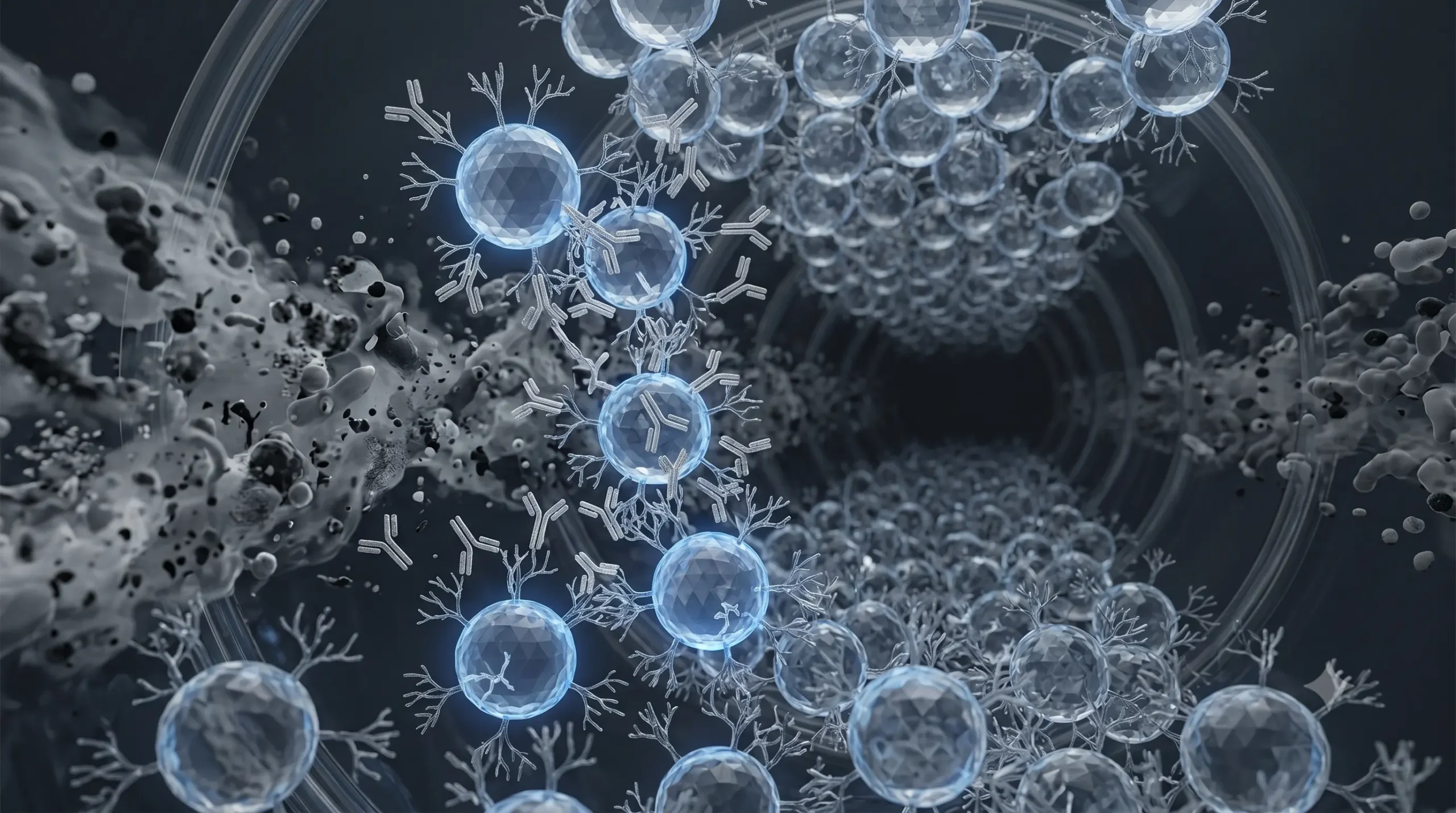
The industry standard for this process is Protein A affinity chromatography. Operators pump the raw biological broth through a large steel cylinder packed with porous agarose beads. These beads are coated with Protein A, a molecule originally derived from Staphylococcus aureus bacteria that naturally binds to the fragment crystallizable (Fc) region of human antibodies.
The binding efficiency relies on strict thermodynamic and chemical conditions. At a neutral pH of 7.0 to 7.4, hydrophobic interactions and hydrogen bonds secure the antibody to the Protein A ligand. Operators carefully manage salt conductivity to minimize electrostatic repulsion between the closely packed antibody molecules, maximizing the total binding capacity.
The fundamental adsorption behavior follows the Langmuir isotherm model:
Langmuir Isotherm Adsorption Model
q
=
qmax
C
Kd
+
C
q
Bound Antibody Concentration The actual amount of monoclonal antibody that has successfully chemically attached to the Protein A resin beads.
qmax
Maximum Binding Capacity The absolute physical limit of the resin—the point where every single Protein A ligand is occupied by an antibody.
C
Unbound Fluid Concentration The concentration of therapeutic antibodies still floating freely in the cell culture fluid moving through the column.
Kd
Equilibrium Dissociation Constant The measure of chemical affinity. A lower number means the antibody binds to the Protein A ligand tightly and efficiently, resisting detachment until triggered by an acidic wash.
The Manufacturing Consequence: As a chromatography column cycles through multiple harsh cleaning phases, the Protein A ligands degrade, permanently reducing qmax. Operators must continuously calculate this curve to know exactly when to replace the multi-million-dollar resin before valuable antibody product bleeds out in the waste stream.
Once the resin reaches maximum capacity, operators wash the column to remove unbound cellular debris. They then flood the cylinder with an acidic buffer, dropping the pH below 3.5. This sudden shift in acidity protonates specific histidine residues on the Protein A molecule, generating a violent electrostatic repulsion that instantly ejects the purified antibody into a collection vessel.
WHY IT MATTERS NOW
Monoclonal antibodies dominate the global pharmaceutical market, providing targeted treatments for oncology, autoimmune disorders, and viral infections. As global demand for these therapies surges, production bottlenecks have shifted from the initial cell growth phase to downstream purification.
Protein A resin is extraordinarily expensive, often exceeding $15,000 per liter. A standard commercial manufacturing column requires hundreds of liters of this resin. This single step accounts for up to 80 percent of the total downstream processing costs for biological therapies.
Suppliers like Danaher and Repligen effectively control the pace of global biomanufacturing. During geopolitical supply chain disruptions or global health emergencies, access to these highly specialized chromatography resins determines whether a nation can physically produce its own biological countermeasures.
The high cost of goods sold translates directly to healthcare systems and patients. The physical limits of adsorption kinetics and resin lifespan establish a strict floor on how cheaply biological drugs can be manufactured, directly impacting national healthcare budgets and global drug pricing structures.
WHAT MOST PEOPLE MISS
General discussions of biotechnology focus almost entirely on the genetic engineering of the drug or the volume of the bioreactor. They assume that brewing a larger batch of cells automatically yields more medicine.
They miss the severe mechanical degradation that occurs during resin cycling. To prevent bacterial contamination between batches, operators must flush the columns with highly caustic sodium hydroxide. Over multiple cycles, this extreme alkalinity chemically destroys the Protein A ligands, steadily lowering the column’s binding capacity until the multi-million-dollar resin must be discarded and replaced.
THE TRAJECTORY
Next 12–36 Months: Biomanufacturers will accelerate the adoption of continuous multi-column chromatography. This system cycles smaller, interconnected columns continuously rather than waiting for large single batches, maximizing resin utilization and reducing upfront capital costs.
Next Five Years: Material scientists will commercialize fully synthetic, non-biological affinity ligands. These engineered chemical alternatives will withstand highly aggressive alkaline cleaning cycles without degrading, dramatically extending column lifespan and lowering drug production costs.
Next Ten Years: The industry will shift toward single-use, pre-packed membrane chromatography systems for specific high-potency drugs. These systems will replace porous beads with engineered polymer webs, enabling faster fluid flow rates and eliminating the need for expensive cleaning validation protocols.
What Could Go Wrong: If raw material shortages affect the specific agarose derivatives required for the base beads, global purification capacity will contract immediately. Biological drug production would stall regardless of available upstream bioreactor capacity.
Most Likely Outcome: Protein A chromatography will remain the non-negotiable anchor of downstream processing due to its unmatched purity yields. However, the operational format will transition from massive stainless-steel columns to highly automated, continuous processing skids to minimize resin volume requirements.
KEY TERMS
- Monoclonal Antibody (mAb): An immune system protein created in a laboratory designed to bind to highly specific targets on cells or pathogens.
- Protein A: A bacterial surface protein that exhibits a highly specific, natural chemical affinity for the Fc region of mammalian immunoglobulins.
- Equilibrium Dissociation Constant (K_d): A specific mathematical value that measures the strength of the chemical binding affinity between a ligand and a target molecule.
- Elution: The chemical process of extracting one material from another by washing with a specific solvent to alter binding conditions.
- Downstream Processing: The recovery and purification phases of biomanufacturing that separate the desired biological product from raw cell culture mass.
SOURCES
- U.S. Food and Drug Administration (FDA) — Quality Considerations for Monoclonal Antibodies
- Journal of Chromatography A — Adsorption Kinetics and Thermodynamics of Protein A Affinity Chromatography
- Cytiva Life Sciences — Downstream Processing and Resin Lifespan Optimization
- Biotechnology and Bioengineering — The Economics of Monoclonal Antibody Manufacturing