Advertisement
)

AT A GLANCE
- Concept: Perfusion Culture: Cells remain inside the reactor while fluid continuously flows in and out.
- Concept: Alternating Tangential Flow: A specialized pump rhythmically pushes fluid across a filter to prevent cellular clogging.
- Concept: Steady-State Metabolism: Constant nutrient resupply and waste removal lock cells into an optimal, unchanging production phase.
- Concept: Footprint Compression: Continuous extraction allows a tiny disposable reactor to output the volume of a massive steel vat.
HOW IT WORKS
Traditional biological drug manufacturing operates like a bakery. Engineers fill a massive steel vat with mammalian cells and sugar, wait two weeks for the cells to produce the target proteins, and then harvest the entire batch at once. This fed-batch method traps the cells inside a deteriorating environment filled with accumulating toxic waste.
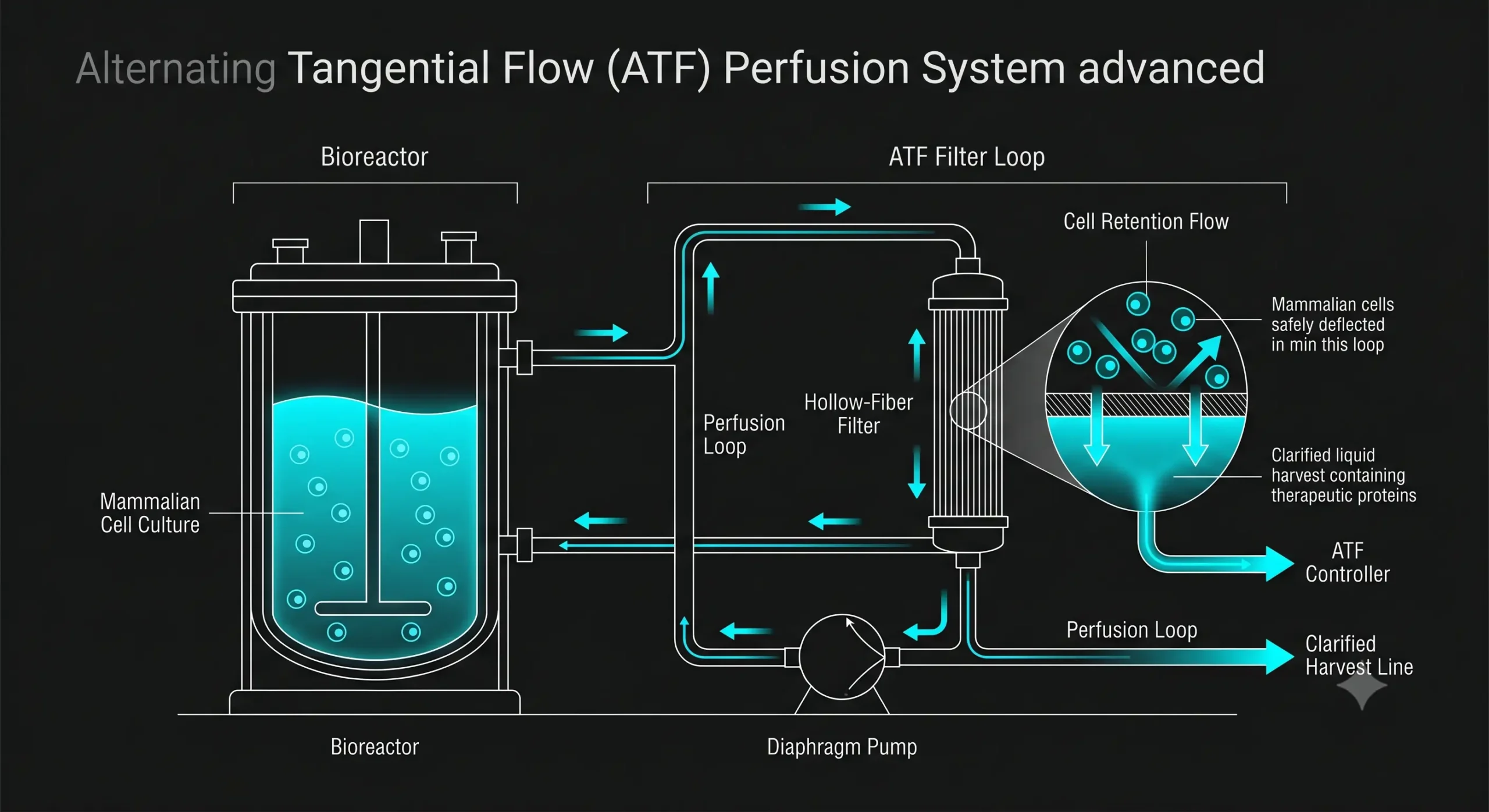
Continuous bioprocessing breaks this cyclical limitation through perfusion. Engineers connect the primary bioreactor to an external cell-retention device, continuously pumping the cellular broth out of the main tank and across a microscopic filter.
The dominant technology driving this loop is the Alternating Tangential Flow (ATF) system. An external diaphragm pump rhythmically pushes and pulls the liquid culture through a hollow-fiber membrane. The alternating pressure physically sweeps the membrane surface clean, preventing sticky mammalian cells from instantly clogging the microscopic pores.
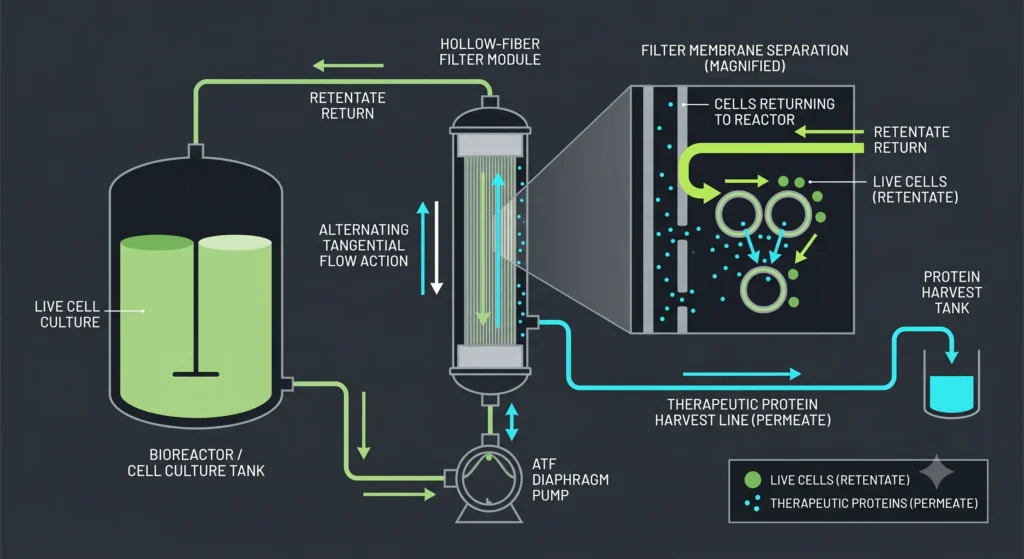
As the fluid crosses the membrane, the system separates the mixture. The filter holds back the living cells and returns them to the main reactor, while the liquid permeate—containing the valuable monoclonal antibodies and toxic cellular byproducts—flows through to the purification stage.
Simultaneously, automated pumps inject fresh, nutrient-dense media into the reactor to replace the exact volume of extracted liquid. This precisely controlled dilution rate mathematically dictates the volumetric productivity of the system:
$$P_v = D \times C_p$$
Where P_v is volumetric productivity, D is the dilution rate, and C_p is the product concentration in the harvest stream. This perfect mass balance locks the living cells into a perpetual, steady-state metabolic engine.
WHY IT MATTERS NOW
The global pharmaceutical industry faces extreme capital constraints. Building a traditional biomanufacturing facility requires installing 10,000-liter stainless steel bioreactors, demanding hundreds of millions of dollars and five years of complex construction time.
Continuous perfusion architecture collapses this physical footprint by up to eighty percent. Because a perfused system constantly extracts the finished product rather than waiting to harvest it all at once, a disposable 50-liter plastic bioreactor can match the total monthly output of a massive legacy steel tank.
This spatial compression fundamentally rewrites the unit economics of Contract Development and Manufacturing Organizations (CDMOs). These third-party manufacturers can now fit highly flexible, multi-drug production lines into standard industrial park warehouses. They no longer need to construct customized, multi-story concrete structures to support the physical weight of massive water tanks.
The United States Food and Drug Administration actively pressures the industry to adopt this continuous architecture. Regulators recognize that legacy batch manufacturing creates severe supply chain vulnerabilities. A single contamination event in a massive batch ruins a national supply of critical medicine instantly.
Perfusion systems mitigate this systemic risk through continuous extraction. If a facility detects a deviation on day twenty of a sixty-day run, the manufacturer only discards the output from that specific day. The previously harvested and purified medicine remains completely safe and commercially viable.
WHAT MOST PEOPLE MISS
Financial analysts assume the shift toward continuous processing is purely a cost-reduction strategy aimed at saving real estate. They miss the severe biochemical reality of protein folding and product quality.
Inside a traditional batch reactor, a cell produces medicine on day two in a pristine environment, but produces medicine on day fourteen while swimming in toxic ammonia and lactic acid. This shifting metabolic stress causes the cells to alter the glycosylation patterns of the final antibody, creating microscopic structural inconsistencies across the pharmaceutical batch.
Steady-state perfusion physically guarantees biological uniformity. By continuously flushing waste and supplying fresh nutrients, the cellular environment remains chemically identical on day one and day fifty. Every single monoclonal antibody folds under the exact same thermodynamic conditions, generating a pharmaceutical product of unparalleled purity.
THE TRAJECTORY
Next 12–36 Months: Contract manufacturers will aggressively retrofit legacy fed-batch suites with bolt-on ATF systems. This capital-efficient upgrade allows older facilities to double their yield without installing new primary bioreactor tanks.
Next Five Years: Facilities will deploy fully integrated, end-to-end continuous suites. The perfusion harvest stream will flow directly into continuous multi-column chromatography systems, completely eliminating intermediate storage bags and manual fluid transfers.
Next Ten Years: Autonomous, artificial intelligence-driven control loops will manage the entire perfusion process. The software will instantly adjust nutrient feed rates and pump velocities based on real-time cellular metabolic sensors, operating the reactors for hundreds of days without human intervention.
What Could Go Wrong: Maintaining absolute sterility for sixty continuous days presents an extreme mechanical challenge. A single microscopic tear in the external tubing or a failing pump seal introduces destructive bacteria, instantly ending the continuous run and forcing a highly expensive total system teardown.
Most Likely Outcome: Perfusion will replace fed-batch processing as the strict regulatory and industrial standard for highly complex or unstable biological molecules. The industry will fully transition from heavy stainless steel engineering to high-velocity, single-use plastic fluid dynamics.
KEY TERMS
- Perfusion Culture: A biomanufacturing method where fresh nutrients are continuously added to a bioreactor while waste and product are simultaneously removed, keeping the cells inside.
- Alternating Tangential Flow (ATF): A cell retention technology that uses a reversing pump mechanism to sweep fluid back and forth across a filter, preventing the pores from clogging.
- Steady-State: A biological condition where the rate of cell growth perfectly matches the rate of cell removal, maintaining constant cellular density and product output.
- Contract Development and Manufacturing Organization (CDMO): A third-party company that provides outsourced drug development and manufacturing services to the pharmaceutical industry.
- Glycosylation: The biochemical process where cells attach specific sugar molecules to proteins, directly determining the physical shape and medical efficacy of an antibody.
SOURCES
- U.S. Food and Drug Administration (FDA) — Quality Considerations for Continuous Manufacturing
- Repligen Corporation — Alternating Tangential Flow (ATF) System Architecture and Perfusion Metrics
- Biotechnology and Bioengineering Journal — Steady-State Cell Culture and Metabolic Profiling in Perfusion Bioreactors
- Sartorius AG — Process Intensification and Single-Use Continuous Biomanufacturing Facilities