Advertisement
)

AT A GLANCE
- Concept: Pre-Cast Chemistry: Fuel and oxidizer mix into a stable rubbery solid, requiring no active pumps or valves.
- Concept: Surface Area Burn: Solid fuel only burns on its exposed surface; it does not detonate all at once.
- Concept: Geometric Core: The shape of the hollow channel running through the fuel controls how much surface burns at any given moment.
- Concept: Thrust Profiling: Star-shaped cores provide high initial acceleration, while simple circular cores provide steady, long-duration flight.
HOW IT WORKS
Liquid rockets rely on complex networks of turbopumps, valves, and cryogenic cooling to mix fuel and oxidizer. Tactical military systems cannot tolerate this complexity or the hours required for fueling. They use solid rocket motors. In these systems, engineers blend a metallic fuel (like aluminum powder) with an oxidizer (like ammonium perchlorate) and a rubbery binder into a single stable substance called the propellant grain.
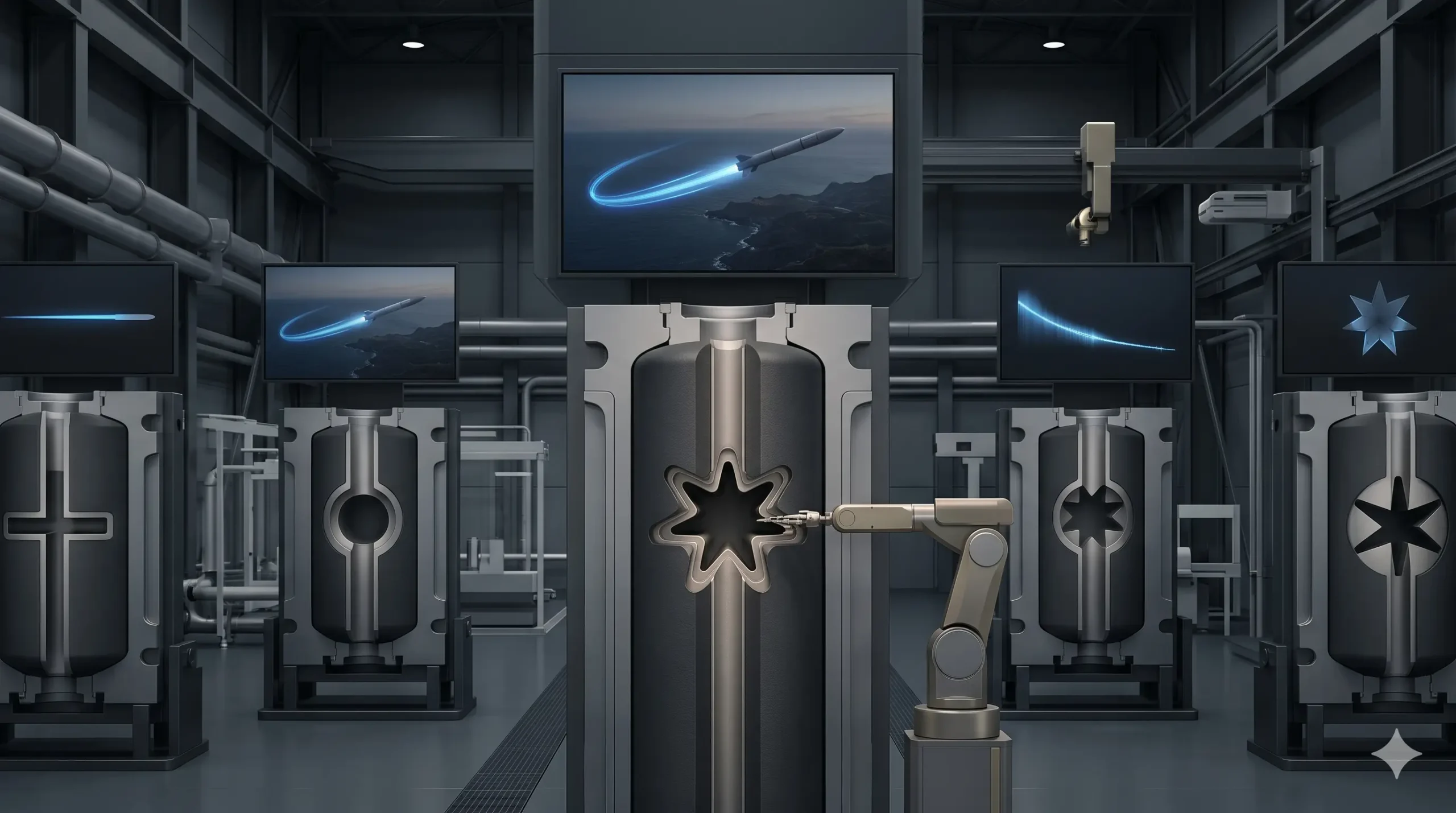
This chemical mixture fills the missile’s steel or composite casing, but it is not a solid block. Engineers cast the grain with a hollow channel running down the center. When an igniter flashes inside this hollow core, the exposed surface area of the propellant begins to burn rapidly, generating high-pressure exhaust gas that escapes through the nozzle to create thrust.
Solid propellant only burns on its exposed surface, burning inward layer by layer perpendicular to the surface. Therefore, the total volume of gas produced at any exact millisecond depends entirely on the total surface area currently on fire. If the surface area increases as the fuel burns, thrust increases. If the surface area shrinks, thrust decreases.
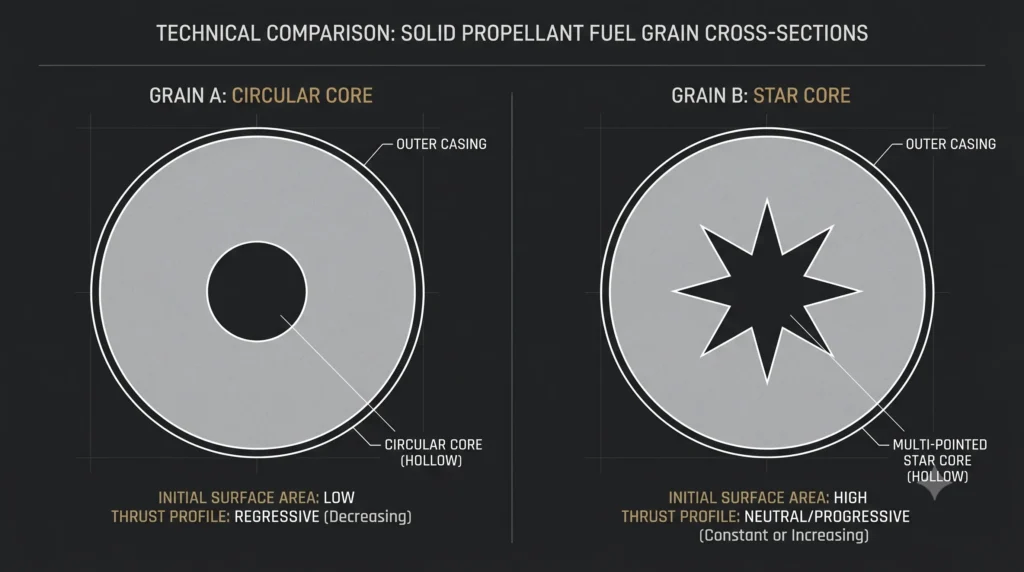
To control acceleration, engineers manipulate the geometry of the hollow core. A simple circular hole creates a progressive burn; as the hole burns wider, the circumference expands, increasing the surface area and generating progressively more thrust over time. Conversely, casting the core as a multi-pointed star creates a neutral or regressive burn. The points of the star burn away quickly, providing massive initial thrust to clear a launch tube, but the surface area eventually rounds out and decreases, preventing the missile from accelerating too fast and destroying its own targeting sensors.
WHY IT MATTERS NOW
Modern warfare operates on a zero-notice timeline. Air defense systems like the Patriot or interceptors like the Standard Missile-3 must launch within seconds of detecting incoming hypersonic threats. Only solid rocket motors can sit dormant in a launch canister for a decade and still fire instantly with absolute reliability.
The global demand for these munitions has vastly outstripped industrial capacity. The war in Ukraine and rising tensions in the Pacific have drained Western stockpiles of precision-guided weapons like GMLRS and Javelin missiles. Every one of these systems relies on a specialized solid rocket motor.
Defense prime contractors like Lockheed Martin and Northrop Grumman face severe bottlenecks not in microchips or steel, but in chemical mixing and curing. Casting solid propellant is a hazardous, slow, batch-level process. The chemical mixers are massive and volatile; a single spark during the blending of ammonium perchlorate can level an entire manufacturing facility.
This industrial bottleneck defines global military readiness. A nation may possess superior radar arrays and advanced artificial intelligence targeting software, but if it cannot physically cast and cure the solid rocket motors fast enough, its air defense networks will quickly run out of ammunition during a sustained, high-intensity conflict.
WHAT MOST PEOPLE MISS
Military observers frequently compare missiles by looking at their top speed, assuming a faster missile is always superior. They completely miss the tactical necessity of tailored acceleration curves, known as thrust profiling.
An air-to-air missile cannot simply burn all its fuel in the first two seconds. If it does, it will coast for the remainder of its flight, losing velocity and maneuverability just as it approaches an evasive fighter jet. Engineers solve this without moving parts by using a dual-thrust grain geometry. They cast a high-surface-area star shape at the rear of the missile for a fast boost phase, and a narrow circular core at the front for a low-thrust, long-duration sustain phase. The geometry dictates the combat tactic.
THE TRAJECTORY
Next 12–36 Months: The Department of Defense will execute the Defense Production Act to aggressively expand the domestic chemical supply chains for ammonium perchlorate and aluminum powder, moving away from reliance on foreign precursors to secure the baseline ingredients of solid propulsion.
Next Five Years: Advanced additive manufacturing will replace traditional pouring and casting methods. Companies will 3D print solid propellant grains, allowing engineers to design mathematically complex, lattice-like internal cores that are physically impossible to create with traditional metal molds, unlocking entirely new acceleration profiles.
Next Ten Years: Tactical missiles will deploy variable-flow solid ducted ramjets. These systems will use a highly fuel-rich solid grain that burns without enough oxygen to fully combust, venting the hot, unburned gas into a secondary chamber where it mixes with atmospheric air, effectively doubling the range of traditional solid rockets.
What Could Go Wrong: Solid propellant degrades slowly over time due to temperature fluctuations and chemical breakdown of the rubber binder. If a military fails to strictly rotate and maintain the climate control of its missile stockpiles, microscopic cracks will form in the fuel grain. Upon ignition, fire will penetrate these cracks, instantly increasing the burn surface area and causing the missile to detonate inside its own launch tube.
Most Likely Outcome: Solid rocket motors will remain the undisputed backbone of all prompt, tactical military engagements. The manufacturing of complex geometric grains will transition into highly automated, robotic facilities, isolating human workers from the extreme volatility of the chemical mixing process.
KEY TERMS
- Propellant Grain: The solid, rubbery mixture of fuel and oxidizer cast inside a rocket motor casing.
- Burn Rate: The speed at which the solid propellant is consumed, moving perpendicularly into the surface of the unburned material.
- Progressive Burn: A thrust profile where the burning surface area naturally increases over time, causing acceleration to rise as the fuel is consumed.
- Regressive Burn: A thrust profile where the initial surface area is large but shrinks as it burns, causing high initial thrust that tapers off.
- Ammonium Perchlorate: An extremely volatile, inorganic chemical compound used universally as the primary oxygen provider in military solid rocket motors.
SOURCES
- Defense Advanced Research Projects Agency (DARPA) — Operational Fires (OpFires) Propulsion Technology Parameters
- National Aeronautics and Space Administration (NASA) — Solid Rocket Motor Grain Design and Internal Ballistics
- Northrop Grumman — Advanced Solid Rocket Propulsion and Tactical Missile Systems
- Journal of Propulsion and Power — Three-Dimensional Grain Design and Burnback Simulation of Solid Rocket Motors