Advertisement
)

AT A GLANCE
- Concept: Tangential Flow: Fluid sweeps parallel across the filter surface rather than pushing directly through it.
- Concept: Transmembrane Pressure: The precise pressure differential that forces targeted solvents through the microscopic pores.
- Concept: Membrane Fouling: Biological proteins accumulate on the filter surface, reducing processing efficiency and drug yield.
- Concept: Hydrodynamic Shear: High-velocity sweeping forces physically scour the membrane, preventing protein accumulation and system failure.
HOW IT WORKS
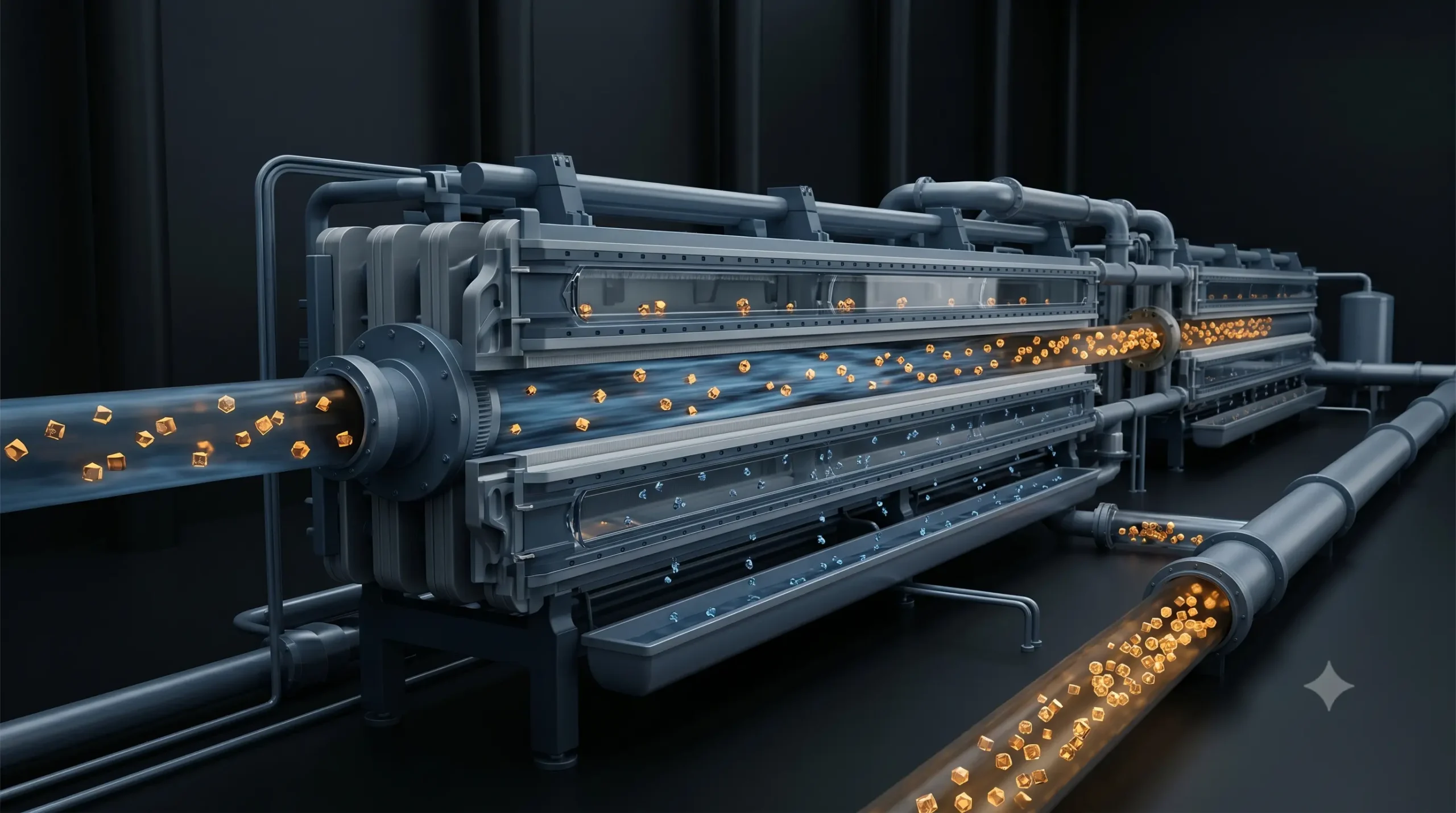
Traditional dead-end filtration pushes fluid directly into a porous barrier. This architecture functions for simple water purification, but it fails instantly in biomanufacturing because sticky, complex proteins immediately block the microscopic pores. Tangential flow filtration (TFF) solves this physical limitation by forcing the biological fluid to flow parallel to the membrane surface.
As the fluid moves tangentially across the specialized polyethersulfone membrane, the high velocity generates intense hydrodynamic shear stress. This sweeping action constantly scours the boundary layer, physically preventing large biological molecules from settling on the surface and causing irreversible membrane fouling.
While the fluid sweeps across the surface, a carefully controlled pressure gradient forces the water and smaller waste molecules through the microscopic pores. Engineers dictate this driving force by calculating the Transmembrane Pressure ($TMP$):
$$TMP = \frac{P_{\text{feed}} + P_{\text{retentate}}}{2} – P_{\text{filtrate}}$$
Where $P_{\text{feed}}$ is the fluid inlet pressure, $P_{\text{retentate}}$ is the exit pressure of the circulating fluid, and $P_{\text{filtrate}}$ is the pressure on the waste side of the membrane.
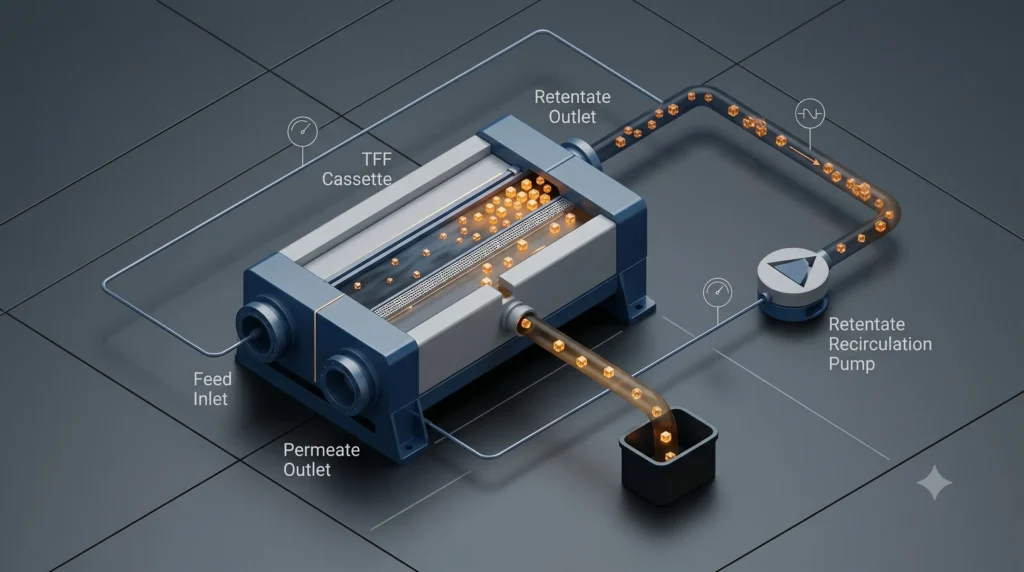
The system continuously recirculates the retained fluid—the retentate—back through the cassette while venting the waste solvent. By perfectly balancing the transmembrane pressure against the cross-flow velocity, operators progressively concentrate the targeted biomolecule into a high-density, therapeutic-grade solution without destroying the active proteins.
WHY IT MATTERS NOW
The pharmaceutical industry is aggressively shifting from synthetic chemical pills to complex biological therapies, including monoclonal antibodies and viral vectors. Manufacturers grow these biomolecules inside massive steel bioreactors, producing heavily diluted cell culture broths.
Before these therapies can reach a patient, manufacturers must extract and concentrate the active ingredient up to a hundredfold. TFF cassettes represent the absolute physical bottleneck in this downstream bioprocessing chain. The fluid dynamics within these cassettes dictate the final yield of the entire manufacturing run.
Financial stakes scale exponentially at this stage. If operators miscalculate the transmembrane pressure and the membrane fouls prematurely, the resulting pressure spike physically shreds the fragile proteins. This shear stress destroys multi-million-dollar batches of medicine instantly, erasing months of upstream cellular cultivation.
Equipment manufacturers like Danaher and Sartorius sell these highly engineered cassettes as single-use consumables. Because biopharmaceutical companies require strictly validated, FDA-approved filtration steps, these suppliers command a permanent, highly profitable monopoly over the physical scaling of modern medicine.
WHAT MOST PEOPLE MISS
Pharmaceutical analysts focus entirely on the genetic code of a new drug, assuming that curing a disease is purely a biological discovery problem. They ignore the mechanical reality that highly concentrated protein solutions become extremely viscous, eventually resembling thick syrup.
The true engineering constraint is managing the boundary layer at the membrane surface under extreme viscosities. As concentration increases, the proteins accumulate near the filter, creating a gel layer that actively resists further filtration. Squeezing the last drop of water out of a highly concentrated antibody formulation is a fluid dynamics problem that dictates whether a drug can be injected quickly under the skin or requires a slow, expensive hospital intravenous drip.
THE TRAJECTORY
Next 12–36 Months: Biomanufacturers will integrate in-line acoustic sensors to measure membrane fouling in real-time. This integration will allow automated pumps to dynamically adjust cross-flow velocity and transmembrane pressure before irreversible protein damage occurs.
Next Five Years: Facilities will transition to fully continuous TFF architectures. Instead of recirculating batches for hours, single-pass tangential flow configurations will concentrate proteins in one continuous fluid motion, drastically reducing processing time and cumulative physical shear stress.
Next Ten Years: Material scientists will commercialize engineered nanomembranes utilizing precisely etched graphene pores. These structures will offer absolute atomic uniformity, rejecting the physical limitations of current random-pore polymer casting and doubling maximum biomolecule concentration limits.
What Could Go Wrong: An acute supply chain shortage of the specialized polyethersulfone polymers used to cast these membranes would instantly halt global biological drug manufacturing. Upstream bioreactors cannot operate if downstream facilities lack the physical cassettes required to concentrate the biological harvest.
Most Likely Outcome: Tangential flow filtration will maintain its structural monopoly as the non-negotiable concentration mechanism for biotherapeutics. The industry will accept the high consumable costs in exchange for the absolute purity and yield predictability required by global health regulators.
KEY TERMS
- Tangential Flow Filtration (TFF): A filtration architecture where fluid flows parallel to the filter surface to prevent continuous pore clogging.
- Transmembrane Pressure (TMP): The average pressure differential across a semi-permeable membrane that drives fluid and small molecules through the pores.
- Hydrodynamic Shear: The physical force generated by fluid velocity that sweeps accumulating proteins off the membrane boundary layer.
- Membrane Fouling: The unwanted deposition and accumulation of biological particles on a filter surface that restricts fluid permeability.
- Retentate: The portion of the biological fluid that does not pass through the membrane and continues circulating through the concentration loop.
SOURCES
- U.S. Food and Drug Administration (FDA) — Process Validation: General Principles and Practices for Biological Products
- Danaher Corporation (Pall) — Tangential Flow Filtration Optimization and Scale-Up Methodologies
- Journal of Membrane Science — Hydrodynamics and Fouling Control in Ultrafiltration of Protein Solutions
- Sartorius AG — Single-Pass Tangential Flow Filtration for High-Concentration Monoclonal Antibodies