Advertisement
)

AT A GLANCE
- Concept: Co-Packaged Optics: Engineers physically fuse the optical transceiver directly onto the silicon compute die.
- Concept: Microdisk Modulators: Sub-micron silicon rings rapidly trap and release light to encode digital data streams.
- Concept: Signal Attenuation: Photons travel kilometers without losing data fidelity, solving copper electrical resistance limits.
- Concept: Thermal Drift Control: On-chip heaters stabilize laser frequencies to prevent optical signals from drifting off-target.
HOW IT WORKS
Current compute clusters rely on copper pins to move data off a processor and into a network switch. Pushing high-frequency electrical signals through physical copper generates immense resistance. This resistance converts valuable computational energy directly into waste heat.
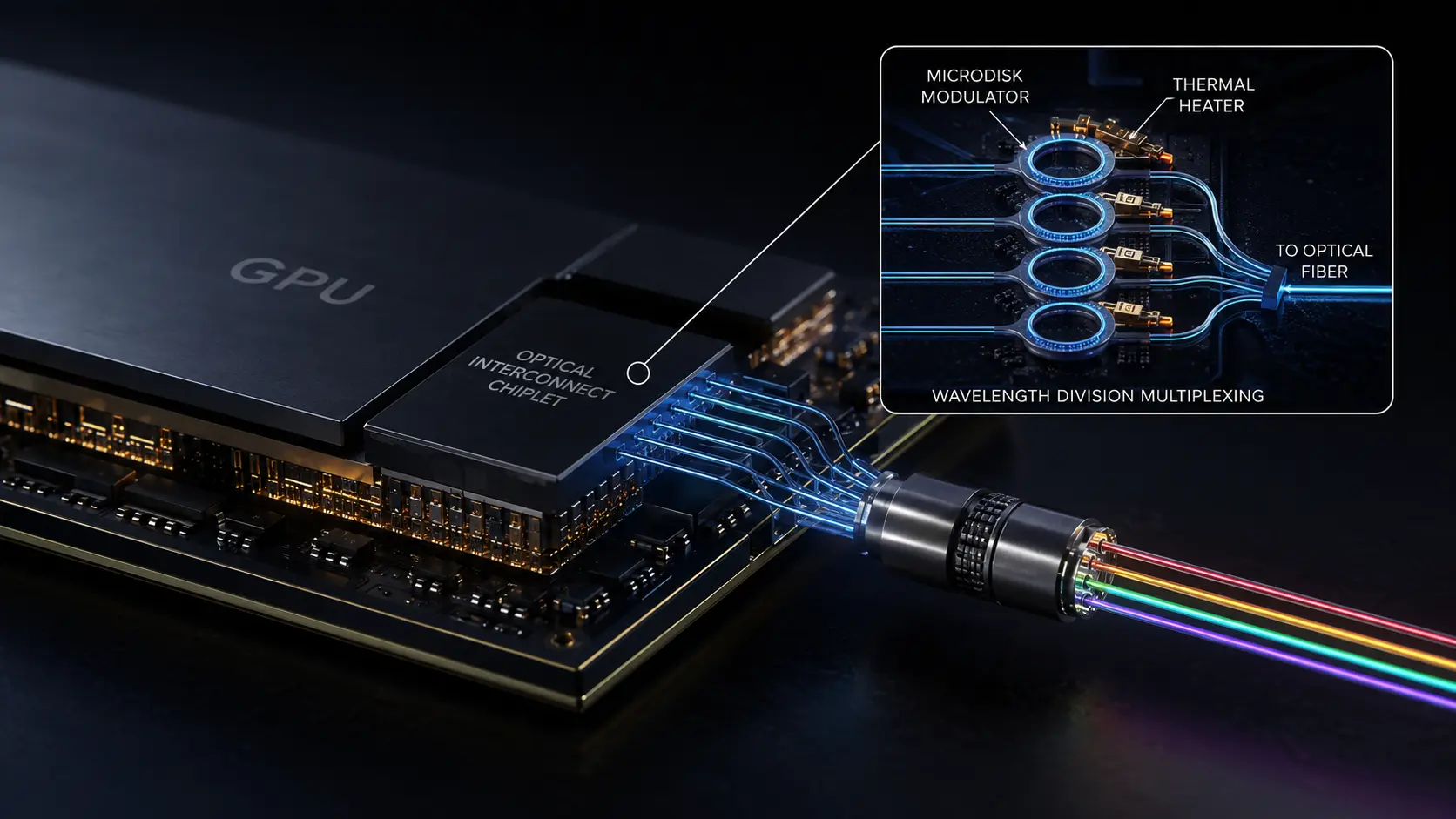
Silicon photonics replaces these copper traces with optical waveguides. Instead of pushing electrons through metal, the system fires continuous infrared laser light into the processor package. An optical compute interconnect chiplet receives this raw light and encodes it with data using a microscopic structure called a microdisk modulator.
These modulators act as high-speed optical turnstiles. When an electrical voltage from the graphics processing unit hits the microdisk, it slightly changes the refractive index of the silicon. This shift either traps the passing light inside a resonant loop or lets it flow freely, perfectly translating ones and zeros into pulses of light.
Multiple modulators operate simultaneously using different wavelengths of light on the exact same physical fiber. This mechanism, known as dense wavelength division multiplexing, allows a single microscopic glass thread to carry terabits of data per second without any signal interference.
WHY IT MATTERS NOW
The physical limits of copper currently dictate the architectural speed limit of artificial intelligence. Training massive neural networks requires networking thousands of graphics processing units together to act as a single logical brain. As data transmission speeds cross the 800-gigabit threshold, copper wires experience extreme signal degradation known as attenuation.
To fight this attenuation, hardware manufacturers must pump massive amounts of electrical current through the copper. Today, pushing data across a data center consumes nearly thirty percent of the facility’s entire electrical budget. This parasitic energy drain leaves less power available for actual mathematical computation.
Co-packaged optics neutralize this power wall. By moving the electrical-to-optical conversion directly onto the same silicon substrate as the processor, engineers eliminate the energy-heavy copper traces entirely. A photonic interconnect transmits data at a fraction of a picojoule per bit, drastically dropping the power consumption of the networking fabric.
Startups like Ayar Labs and foundries like TSMC are racing to commercialize these integrated optical chiplets. Whoever perfects high-yield co-packaged optics will capture the underlying hardware market for the next generation of hyperscale computing, enabling AI clusters to scale from tens of thousands to hundreds of thousands of interconnected nodes.
WHAT MOST PEOPLE MISS
Industry observers treat silicon photonics as a simple miniaturization of standard fiber optic cables. They completely miss the extreme thermodynamic fragility of sub-micron optical routing. Silicon possesses a high thermo-optic coefficient, meaning its physical ability to bend light changes drastically with microscopic temperature fluctuations.
The resonant condition of the microdisk is strictly governed by the physical phase-matching equation:
$$m \lambda = 2 \pi r n_{eff}$$
Where m is the resonant mode integer, λ (lambda) is the operating wavelength, r is the geometric radius, and n_{eff} is the effective refractive index. If the adjacent graphics processing unit heats up by just one degree Celsius, n_{eff} shifts, physically forcing the resonant frequency off-target.
This thermal drift accidentally blocks the laser and instantly corrupts the data stream. To prevent catastrophic signal failure, engineers build dedicated micro-heaters adjacent to every single modulator ring. These heaters continuously inject localized thermal energy to artificially stabilize the refractive index against the chaotic thermal variance of the compute die.
THE TRAJECTORY
Next 12–36 Months: Hyperscale data center operators will deploy the first generation of purely optical GPU-to-GPU memory fabrics. These localized optical domains will allow up to 256 processors to share unified memory pools without traversing a traditional network switch.
Next Five Years: Foundries will standardize the Universal Chiplet Interconnect Express (UCIe) over optical physical layers. This standardization will allow hardware architects to directly mix compute dies from Nvidia and memory dies from Samsung within the same optical package.
Next Ten Years: Centralized data center switches will disappear entirely. Optical compute interconnects will enable fully distributed, all-optical mesh networks, allowing any single processor to communicate with any other processor in a massive facility with near-zero latency.
What Could Go Wrong: The alignment tolerance for attaching a glass optical fiber to a silicon waveguide is less than one micron. If automated packaging robots cannot consistently achieve this sub-micron physical coupling at scale, the manufacturing yield will collapse, keeping co-packaged optics financially unviable for mass production.
Most Likely Outcome: Co-packaged optical interconnects will become the mandatory architectural standard for all high-performance computing. Copper will be systematically eradicated from server architectures, restricting electrons purely to mathematical calculation while designating photons strictly for data transit.
KEY TERMS
- Co-Packaged Optics: The physical integration of optical transceiver components directly onto the same electronic substrate as the main processor.
- Microdisk Modulator: A microscopic silicon ring that uses electrical voltage to rapidly alter the phase and intensity of passing laser light.
- Thermal Drift: The unwanted shift in a silicon photonic component’s resonant frequency caused by temperature-induced changes in the material’s refractive index.
- Wavelength Division Multiplexing: A technique that simultaneously transmits multiple distinct data streams across a single optical fiber using different colors of light.
- Signal Attenuation: The gradual loss of intensity and clarity as an electrical or optical signal travels across a physical distance.
SOURCES
- IEEE Solid-State Circuits Society — Co-Packaged Optics and Silicon Photonics for High-Performance Computing
- TSMC — Advanced Packaging and Silicon Photonics Integration roadmaps
- Ayar Labs — TeraPHY Optical I/O Chiplet Architecture and Modulator Efficiency
- Journal of Lightwave Technology — Thermal Management and Tuning of Silicon Micro-Ring Resonators