Advertisement
)

AT A GLANCE
- Concept: Arithmetic Circuits: Standard computer code compiles into fundamental logic gates consisting strictly of addition and multiplication.
- Concept: Polynomial Translation: Cryptographers mathematically compress these millions of logic gates into a single algebraic equation.
- Concept: Succinct Verification: Checking the final cryptographic proof takes milliseconds, regardless of how massive the original computation was.
- Concept: Enterprise Privacy: Corporations mathematically prove regulatory compliance to auditors without exposing raw proprietary client databases.
HOW IT WORKS
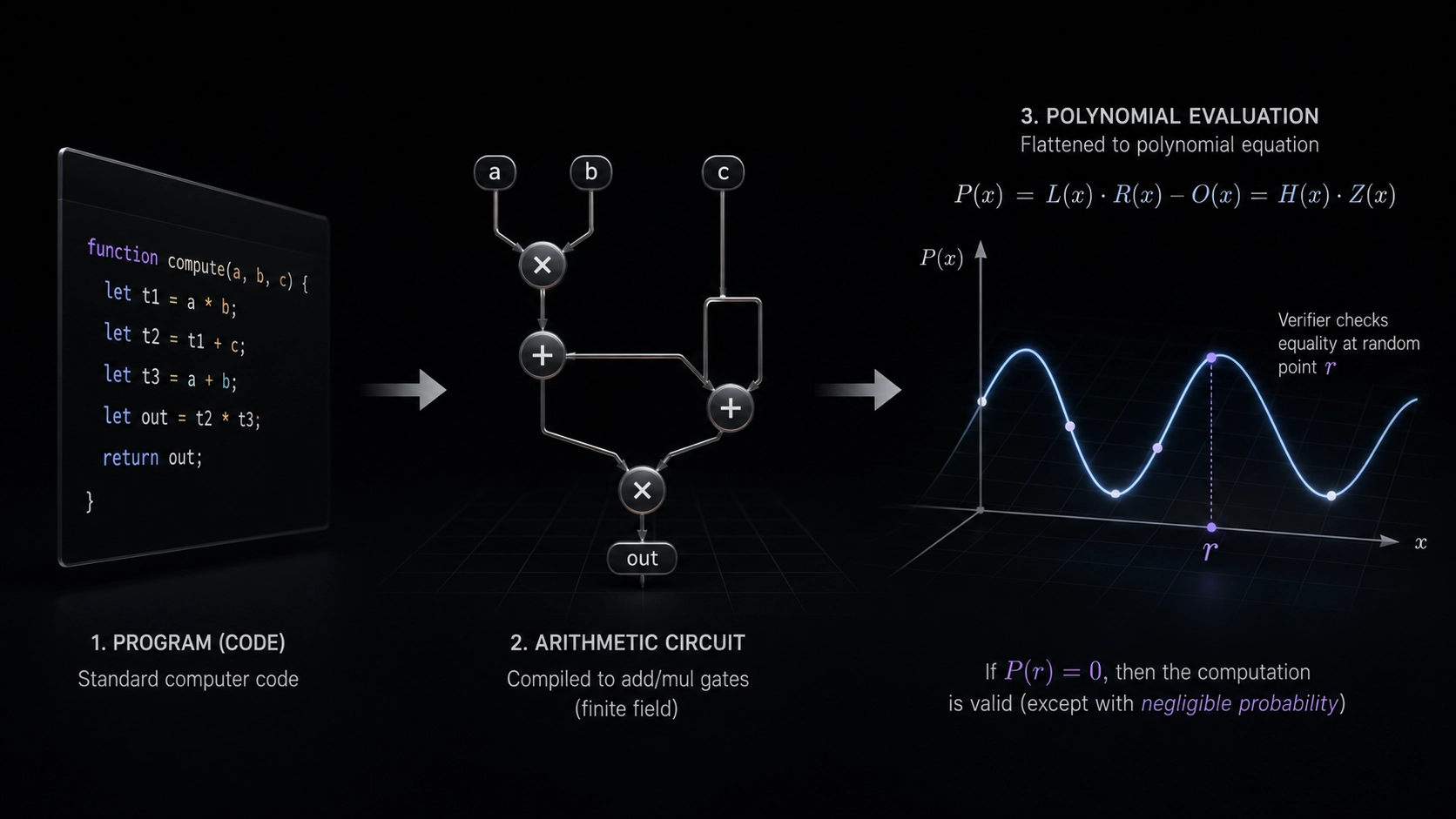
Modern computers execute operations in binary code. To prove a computation happened without revealing the input data, cryptographers must first translate the computer code into pure mathematics. This process begins by converting the program into an arithmetic circuit—a network consisting entirely of addition and multiplication gates operating over a finite mathematical field.
The system flattens this circuit into a Rank-1 Constraint System (R1CS), verifying that every specific gate calculates correctly. Through a process called a Quadratic Arithmetic Program (QAP), engineers mathematically compress these thousands of constraints into continuous polynomials.
The core mathematical validation relies on the relationship between these polynomials. The prover must demonstrate they know a specific polynomial P(x) that perfectly divides by a target polynomial Z(x), yielding a quotient polynomial H(x).
$$P(x) = L(x) \cdot R(x) – O(x) = H(x) \cdot Z(x)$$
Instead of checking every single logic gate individually, the verifying computer simply evaluates this polynomial equality at a single, random, hidden point. The Schwartz-Zippel lemma dictates that if two distinct low-degree polynomials intersect at a randomly chosen point, they are mathematically identical.
If the prover does not actually know the secret data, they cannot construct the correct polynomial. If they attempt to guess it, the mathematical probability of their fake polynomial matching the verifier’s check at the exact random point is practically zero. This non-interactive evaluation generates a succinct cryptographic proof, typically under 300 bytes in size, which any third party can verify in milliseconds.
WHY IT MATTERS NOW
Global enterprise computing relies heavily on third-party cloud infrastructure. When a financial institution asks a centralized server to run a proprietary risk model on millions of client records, the institution must blindly trust that the server executed the code correctly without altering or stealing the data.
Verifiable computation permanently eliminates this blind trust. Using a zk-SNARK, the cloud server executes the heavy calculation and returns the result alongside a microscopic cryptographic proof. The client verifies the proof instantly on a local laptop, gaining absolute mathematical certainty that the server ran the exact requested model accurately.
This mechanism dictates the current financial scaling of public blockchains like Ethereum. Processing thousands of financial transactions per second is physically impossible on a globally decentralized ledger. Instead, secondary network operators process these massive transaction batches off-chain, compress the logic into an arithmetic circuit, and submit a single zk-SNARK proof to the main blockchain. This architecture reduces computational overhead by a factor of ten thousand.
The integration of this cryptographic primitive fundamentally restructures corporate auditing. Regulatory agencies currently demand unfettered access to raw corporate databases to verify compliance, creating massive cybersecurity liabilities. With zero-knowledge proofs, a corporation mathematically proves it holds sufficient capital reserves or adheres to privacy mandates without exposing a single specific client account balance.
WHAT MOST PEOPLE MISS
Mainstream technology reporting lumps zero-knowledge proofs entirely into cryptocurrency speculation and consumer privacy software. They entirely miss the severe computational asymmetry required to generate the proof in the first place.
Translating standard software code into arithmetic circuits incurs a massive thermodynamic penalty. Generating a zk-SNARK proof currently demands up to a million times more processing power than simply executing the calculation normally. The true industrial bottleneck limiting verifiable computing is not the cryptography itself; it is the sheer physical silicon required to generate the proof fast enough for real-time commercial applications.
THE TRAJECTORY
Next 12–36 Months: Hardware manufacturers will deploy dedicated zero-knowledge application-specific integrated circuits (ASICs) and field-programmable gate arrays (FPGAs). This physical silicon acceleration will drastically reduce prover times, commoditizing the generation of arithmetic circuits for basic financial transactions.
Next Five Years: Cryptographers will standardize recursive SNARKs. This architecture allows a zk-SNARK to verify the cryptographic proofs of a hundred other zk-SNARKs, compressing vast operational histories and millions of data points into a single, instantly verifiable byte-string.
Next Ten Years: The traditional concept of the trusted human auditor will dissolve. Regulatory bodies will demand continuous, automated zero-knowledge cryptographic proofs for global financial compliance, embedding verification directly into the internet’s base communication protocols.
What Could Go Wrong: Many legacy zk-SNARK protocols require a “trusted setup” phase to generate the random hidden parameters used to check the polynomials. If the participants who generate these initial parameters collude or fail to destroy their encryption keys, they possess a permanent “toxic waste” backdoor, allowing them to forge perfect, fake mathematical proofs indefinitely.
Most Likely Outcome: zk-SNARKs will become the mandatory plumbing for enterprise cloud compute and sovereign data auditing. The ability to verify complex logic without exposing the underlying inputs will transition from a niche cryptographic novelty into a foundational requirement for all global digital infrastructure.
KEY TERMS
- Arithmetic Circuit: A directed acyclic graph where nodes represent addition or multiplication operations over a specific finite mathematical field.
- Rank-1 Constraint System (R1CS): A mathematical representation of an arithmetic circuit used to verify that internal logic gates function correctly.
- Quadratic Arithmetic Program (QAP): A system that translates the constraint equations of an R1CS into polynomial equations for cryptographic evaluation.
- Schwartz-Zippel Lemma: A fundamental mathematical principle stating that two distinct low-degree polynomials will almost never evaluate to the same value at a randomly chosen point.
- Prover Time: The severe computational overhead and physical processing power required to translate a calculation into a polynomial and generate the cryptographic proof.
SOURCES
- Massachusetts Institute of Technology (MIT) — Verifiable Computation and zk-SNARK Architectures
- Journal of Cryptology — Quadratic Arithmetic Programs: from Zero to Hero
- Ethereum Foundation — Zero-Knowledge Rollups and SNARK Scalability
- Zcash Protocol Specification — Succinct Non-interactive Arguments of Knowledge