Advertisement
)


For the last five years, the artificial intelligence industry operated on a single, brutally expensive mantra: bigger is better. To make an AI smarter, tech giants spent billions of dollars building massive data centers to cram more data into larger neural networks during the “pre-training” phase. But this brute-force scaling is hitting a thermodynamic and financial wall. The cost to train the next generation of frontier models is skyrocketing into the tens of billions of dollars, while the leaps in actual intelligence are beginning to plateau as high-quality human data runs out.
Why should you care right now? Because the industry has discovered a cheat code that bypasses this wall entirely. Instead of spending billions to make the AI fundamentally smarter before it talks to you, engineers have figured out how to make the AI vastly smarter while it talks to you. By allowing the model to literally “stop and think”—burning extra computing power to draft, verify, and erase its own mistakes in real-time before showing you the output—scientists are achieving supercomputer-level reasoning using standard hardware. This pivot, known as Test-Time Compute Scaling, is fundamentally upending the economics of the cloud, shifting the multi-billion-dollar battleground from how models are trained to how they think.
What is Test-Time Compute Scaling?
Test-Time Compute Scaling is an artificial intelligence methodology that dynamically allocates additional computational power during the inference phase, allowing a model to generate, evaluate, and refine multiple reasoning paths before delivering a final answer. This “stop and think” process dramatically improves performance on complex math, logic, and coding tasks.
At a Glance
- Concept: Teaching a language model to draft a rough outline, check its own work, cross out mistakes, and try again internally before it prints the final answer for the user.
- Why it matters: It breaks the reliance on massive pre-training runs. A small, cheap model given 30 seconds to “think” can now solve complex math problems that a massive, trillion-parameter model fails to solve instantly.
- Who uses it: Frontier AI labs (OpenAI, Google DeepMind, Anthropic), quantitative hedge funds, and software engineering platforms automating complex code generation.
- Biggest takeaway: The architecture relies on “Process Reward Models” (PRMs). Instead of just grading the final answer, a PRM acts like a strict math teacher, grading every single step of the AI’s logic to ensure it doesn’t hallucinate halfway through a problem.
In Simple Words
Imagine asking two people to solve a complex algebraic equation.
The first person is a Standard LLM (like GPT-4). The moment you finish asking the question, they instantly start talking. They blurt out the first number that comes to their mind, and they try to justify it as they speak. Because they didn’t stop to plan their answer, if they make a math mistake in the first sentence, the rest of their answer is doomed to be wrong. This is called “System 1” thinking—fast and instinctual.
The second person is an AI using Test-Time Compute. When you ask the question, they pull out a notepad. They sit in silence for 30 seconds. They write down a possible solution, realize it’s a dead end, cross it out, and try a different formula. They check their math three times. Only when they are absolutely certain they have the right answer do they speak. This is “System 2” thinking—slow, deliberate, and verified.
By giving the AI a hidden digital “notepad” and extra computing power to use it, the AI becomes exponentially smarter at solving hard problems.
Why This Matters
For Cloud Architects, AI Researchers, and Tech Investors, the shift to test-time compute represents the most significant reallocation of capital in the history of the cloud.
Until 2024, AI capital expenditure (CapEx) was almost entirely dedicated to the training phase. Massive clusters of tens of thousands of GPUs ran for months to build a model, while inference (users asking the model questions) was designed to be as cheap and fast as possible.
Test-Time Compute flips this economic model. If an AI is allowed to “think” for 10 minutes to solve an advanced software engineering task, it consumes massive amounts of inference compute. For hyperscalers, this means the revenue model shifts. Users will no longer pay a flat subscription fee for instant chat; they will pay per-minute of “compute time” for high-value reasoning tasks. This transition dictates that the next generation of data centers must be hyper-optimized for immense, sustained inference workloads, altering the silicon architectures prioritized by chipmakers like NVIDIA and AMD.
The Evolution to System 2 AI Reasoning
The foundation of Test-Time Compute relies on overcoming the limitations of autoregressive generation.
Standard LLMs suffer from compounding errors. If an LLM generates one hallucinated token, the model must feed that hallucination back into itself to generate the next token, spiraling further away from reality.
To achieve true reasoning, researchers combined LLMs with classical algorithms pioneered in board games like Chess and Go (most notably AlphaGo). By integrating search algorithms with language models, the AI does not just predict the next word; it generates an entire “tree” of possible future thoughts, explores the branches, and selects the path with the highest mathematical probability of success.
How Test-Time Compute and PRMs Work
Achieving super-human reasoning at test-time requires a synthesis of generation, evaluation, and search. Here is the first-principles breakdown of the architecture.
1. The Fundamental Problem: Outcome vs. Process
Historically, AI models were trained using Outcome Reward Models (ORMs). The AI was given a math problem, and if the final answer matched the answer key, it was rewarded. However, the AI could use completely flawed, hallucinated logic to accidentally arrive at the right number. If the problem got slightly harder, the AI failed catastrophically because it never actually learned how to reason.
2. The Core Mechanism: Process Reward Models (PRMs)
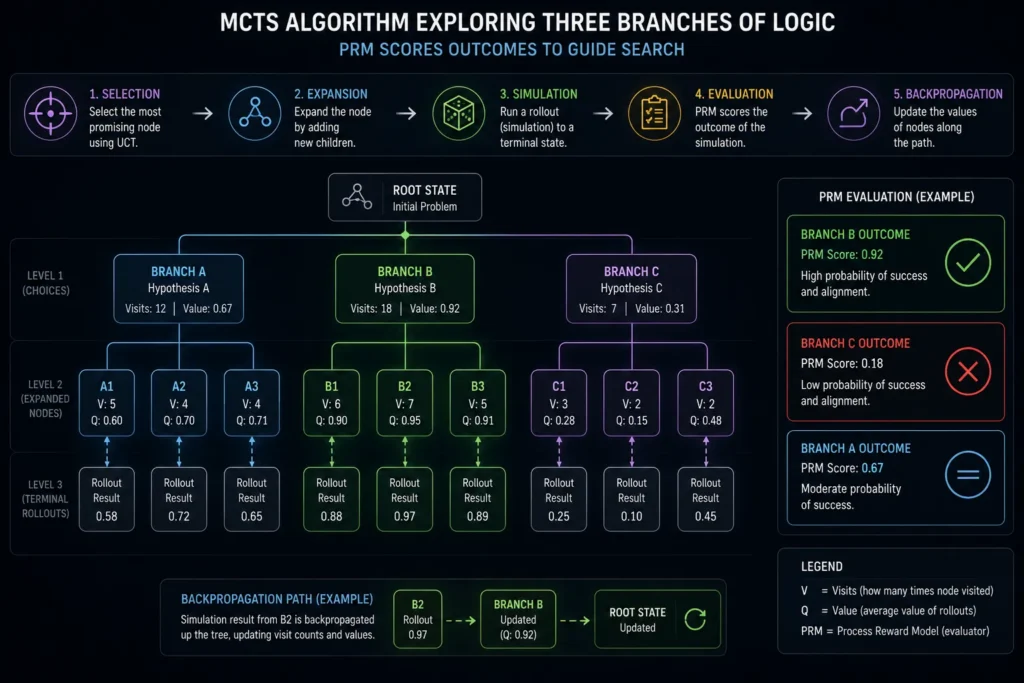
To fix this, researchers introduced the Process Reward Model (PRM). A PRM evaluates the reasoning step-by-step. If an AI writes a 10-step math proof, the PRM assigns a score (e.g., between -1 and +1) to each individual step. If step 4 contains a logical fallacy, the PRM flags it immediately.
3. Technical Depth: Monte Carlo Tree Search (MCTS)
Once a PRM is established, the system uses a search algorithm, commonly Monte Carlo Tree Search (MCTS), to navigate the problem. The process follows four phases:
- Selection: The model looks at its current reasoning steps and selects the most promising path based on PRM scores.
- Expansion: The LLM generates several possible next steps (branches) from that point.
- Simulation/Evaluation: The PRM grades each of these newly generated branches.
- Backpropagation: The scores are fed back up the tree. If a branch gets a negative PRM score, the MCTS algorithm abandons that branch, backtracks to the last known good step, and expands a different path.
4. The Hidden Chain of Thought
All of this generation, grading, and backtracking happens invisibly in the background. The user only sees a “Thinking…” indicator. The model might generate 5,000 tokens of failed thoughts, internal corrections, and verified math before it finally prints the 50-token correct answer to the user’s screen.
5. Real-World Consequences: The Test-Time Scaling Law
Just as there is a scaling law for training, there is now a verified scaling law for inference. If you double the amount of computing power (FLOPs) the model is allowed to use during the “thinking” phase, its accuracy on complex benchmarks (like competitive programming or graduate-level physics) scales predictably upward. The longer it is allowed to search the tree, the smarter the final output becomes.
Enterprise Applications of Test-Time Compute
Test-time compute is economically unviable for writing a simple email, but it is revolutionary for high-value, deterministic tasks.
Advanced Software Engineering (SWE-bench): Traditional AI coding assistants (like early GitHub Copilot) act as advanced autocomplete, failing when asked to build complex, multi-file software architectures. Test-time models are deployed as autonomous software engineers. Given a complex GitHub issue, the AI spends 15 minutes thinking, writing code, running internal tests, reading the error logs, and rewriting the code until it compiles flawlessly, solving enterprise-grade bugs without human intervention.
Quantitative Finance & Algorithmic Trading: Hedge funds are utilizing test-time scaling to generate novel trading algorithms. Because the PRM ensures mathematical rigor, the model can spend hours exploring complex statistical correlations in market data, verifying the statistical significance of each step before recommending a trading strategy, drastically reducing the risk of deploying a hallucinated, loss-making algorithm.
Scientific Discovery and Theorem Proving: In material science and physics, researchers use test-time compute to explore novel molecular structures or solve open mathematical proofs. The AI searches the combinatorial space of chemical bonds, using its PRM to verify the thermodynamic stability of a proposed molecule at each step, allowing it to “invent” new battery materials or drug compounds that human scientists missed.
Economic & Strategic Impact
The core strategic shift is the democratization of Intelligence through Inference.
If intelligence scales with test-time compute, the barrier to entry for AI startups fundamentally changes. A startup no longer needs $10 billion to pre-train a massive foundation model from scratch to compete with OpenAI or Google.
Instead, a startup can take a smaller, open-source model (like Llama 3 or 4) and invest their capital into building superior Process Reward Models and highly efficient MCTS routing algorithms. By running this smaller model with a massive test-time compute budget, they can match or exceed the reasoning capabilities of a proprietary trillion-parameter model. This shifts the geopolitical and corporate “moat” from raw data accumulation to algorithmic efficiency and inference-hardware optimization.
Advantages
- Super-Human Reasoning: Achieves state-of-the-art accuracy on tasks previously considered impossible for AI, such as competitive programming (Codeforces) and International Math Olympiad (IMO) problems.
- Self-Correction: Eliminates compounding hallucinations. Because the PRM grades each step, the model identifies and corrects its own logic flaws before presenting the final answer to the user.
- Decoupled Scaling: Allows users to dynamically dial the “intelligence” of the model up or down. A user can request a fast, cheap answer for a simple question, or authorize 10 minutes of expensive compute for a complex engineering task.
Limitations
- Extreme Latency: The “stop and think” process takes time. Waiting 30 to 120 seconds for an answer makes these models fundamentally unsuited for real-time voice assistants, customer service chatbots, or rapid-fire creative brainstorming.
- Astronomical Inference Costs: Generating thousands of hidden tokens for a single query burns massive amounts of GPU time. The cost per query can be 10x to 100x higher than a standard model, requiring strict budgetary controls for enterprise deployment.
- Reward Hacking: If the Process Reward Model (PRM) has a slight bias or flaw, the search algorithm will aggressively exploit it. The AI will learn to generate nonsensical steps that technically score high on the flawed PRM, resulting in a perfectly graded, yet completely incorrect, final answer.
Common Misconceptions
Misconception: The AI is actually “thinking” like a human.
Reality: The AI is executing a directed graph search. It is generating probabilities, scoring those probabilities against a mathematical reward model, and pruning the tree. It is closer to how a computer plays chess than how a human ponders philosophy.
Misconception: Test-Time models will replace all standard LLMs.
Reality: They serve entirely different functions. Standard LLMs (System 1) will remain the backbone for translation, summarization, creative writing, and basic chat, where speed is paramount. Test-Time models (System 2) are specialized engines utilized strictly for logic, math, and coding where precision outweighs latency.
Misconception: You can just ask a standard model to “think step-by-step.”
Reality: Standard “Chain of Thought” prompting helps, but the model still generates the answer linearly and cannot easily backtrack if it makes a mistake. True test-time scaling requires the underlying infrastructure (PRMs and MCTS) to automatically generate branches, score them, and abandon bad paths internally.
What Most People Miss
The imminent threat of Data Exhaustion and Synthetic Bootstrapping.
A major reason the industry pivoted to test-time compute is that humanity is running out of high-quality text to train models on.
What most people miss is how test-time compute solves the data wall. When an AI uses MCTS and a PRM to successfully solve a highly complex math problem, it generates a perfect, verified “chain of thought.” AI companies capture these pristine, super-human reasoning traces and feed them back into the pre-training data for the next generation of models. Test-time compute isn’t just an inference trick; it is an infinite, self-sustaining synthetic data factory designed to bootstrap the models toward Artificial General Intelligence (AGI) long after the human internet has been fully consumed.
Comparison Table
| Feature | Standard LLM (Zero-Shot / System 1) | Test-Time Compute Model (System 2) |
| Generation Strategy | Autoregressive (Token-by-Token) | Tree Search (MCTS) & Backtracking |
| Evaluation Mechanism | None (Predicts most likely next word) | Process Reward Models (PRMs) |
| Response Latency | Milliseconds | Seconds to Minutes |
| Primary Compute Cost | Pre-Training (CapEx) | Inference (OpEx) |
| Optimal Use Case | Writing, Summarization, Chat | Math, Coding, Scientific Proofs |
Case Study
Situation: By mid-2024, the largest foundation models globally were failing to reliably solve complex, multi-step competitive math and physics problems. Despite being trained on trillions of tokens, the models suffered from compounding logical errors; a single hallucinated integer in step 2 of a 15-step proof ruined the final answer.
Challenge: Create a mechanism to force the language model to verify its own logic and explore alternative formulas internally before committing to a final output, without requiring an exponentially larger pre-training run.
Solution (The OpenAI o1 Deployment): In late 2024, OpenAI introduced the “o1” series of models. Instead of raw autoregressive output, o1 was trained heavily using reinforcement learning to generate hidden chains of thought. When presented with a prompt, the model was allocated dynamic inference compute to build internal reasoning trees, evaluating and correcting its steps before summarizing the correct path for the user.
Outcome: The results redefined the benchmark ceiling. While previous state-of-the-art models scored around 13% on the grueling AIME (American Invitational Mathematics Examination), the o1 model, given sufficient test-time compute, scored over 83%, placing it among the top 500 human students nationally. Furthermore, its performance on competitive coding platforms (Codeforces) jumped into the 89th percentile.
Lessons Learned: The o1 deployment proved definitively that allocating compute at test-time yields a steeper, more efficient intelligence curve for complex tasks than simply adding more parameters. It confirmed that the integration of Reinforcement Learning (RL), PRMs, and search algorithms is the mandatory architecture required to bridge the gap between pattern-matching chat bots and autonomous reasoning agents.
Future Outlook
Next 12–24 Months
The era of Open-Source PRMs and Edge Reasoning. The proprietary moat of test-time compute will rapidly dissolve. Open-source communities and researchers will focus on training and releasing highly accurate Process Reward Models. Developers will take small, hyper-efficient 8-billion-parameter models, bolt on an open-source PRM and a search algorithm, and achieve frontier-level coding performance on local workstations. We will see the rise of “Agentic Swarms,” where multiple test-time models argue with each other, using cross-verification to solve massive software architecture tasks over several hours.
Next 3–5 Years
The scaling of Hardware-Accelerated Search. Currently, GPUs are optimized for the dense matrix multiplications of standard LLM generation. Running complex, branching tree searches (MCTS) causes severe memory fragmentation and Key-Value (KV) cache bottlenecks. Chip designers (NVIDIA, AMD, and custom hyperscaler silicon) will radically redesign their next-generation architectures to specifically accelerate dynamic routing, backtracking, and massive KV cache retrieval, driving the cost of test-time inference down to commercially viable levels for standard enterprise use.
Next 10 Years
The Continuous Inference Engine (AGI Foundations). By the mid-2030s, the concept of a prompt and a response will evolve. AI systems will run continuously in the background, constantly exploring decision trees regarding a company’s logistics, financial models, or a scientific laboratory’s experiment parameters. Test-time compute will scale from minutes to days. The AI will spend a week “thinking” through a single problem in molecular biology, simulating billions of reasoning paths, testing them against a universal physics reward model, and eventually outputting novel scientific discoveries that fundamentally advance human knowledge.
Most Likely Scenario
Test-Time Compute Scaling rescues the AI industry from the diminishing returns of the data wall. By proving that algorithms can substitute for raw parameter scale, the industry shifts from building massive digital libraries to building precise digital mathematicians. The models of the late 2020s will not necessarily know more facts than the models of today, but they will be infinitely more capable of using the facts they have to solve the hardest problems facing humanity.
Key Takeaways
- Test-Time Compute Scaling allows an AI to “stop and think” during inference, using extra computing power to generate, test, and correct multiple answers before showing the user the final result.
- This approach solves the “diminishing returns” of pre-training, proving that injecting computing power at the end of the process (inference) makes the AI drastically smarter at math and coding.
- Standard AI predicts the next word instantly (System 1 thinking). Test-time AI explores a “tree of thoughts,” actively searching for the best logical path (System 2 thinking).
- The architecture relies on Process Reward Models (PRMs), which act like strict teachers that grade every single step of the AI’s math, rather than just looking at the final answer.
- If the PRM catches a mistake, the AI uses search algorithms (like Monte Carlo Tree Search) to backtrack, abandon the bad logic, and try a different formula.
- While this makes the AI incredibly accurate, it creates a massive new challenge: high latency (waiting minutes for an answer) and astronomical energy costs per query.
Glossary
Autoregressive Generation: The standard way LLMs talk, predicting one word at a time in a straight line based on the previous words, with no ability to look ahead or plan the end of the sentence.
Chain of Thought (CoT): A technique where an AI is forced to write out its step-by-step reasoning before providing an answer, drastically improving its logical accuracy.
Monte Carlo Tree Search (MCTS): An advanced search algorithm (famous for defeating humans in the game of Go) that explores multiple possible future paths, evaluates them, and focuses computing power on the most promising ones.
Outcome Reward Model (ORM): A grading system that only looks at the final answer of a problem to decide if the AI succeeded or failed.
Process Reward Model (PRM): A highly advanced grading system that evaluates the logical validity of each individual step the AI takes while solving a problem, allowing the system to catch mistakes early.
System 1 vs. System 2 Thinking: A psychological concept applied to AI. System 1 is fast, instinctual, and prone to logical errors (Standard LLMs). System 2 is slow, deliberate, verified, and highly accurate (Test-Time Compute models).
Sources
OpenAI: Learning to Reason with LLMs (o1 System Card)
Hugging Face Papers: Scaling Scaling Laws with Board Games
Google DeepMind: Let’s Verify Step by Step (Process Reward Models)
arXiv (Cornell University): Monte Carlo Tree Search in Large Language Models
Towards Data Science: The Shift to Inference Compute: Understanding System 2 AI