Advertisement
)

Modern artificial intelligence has a crippling addiction to electricity. If you want a robot to navigate a warehouse or a drone to fly autonomously through a forest, the onboard “brain” (a traditional Artificial Neural Network) must relentlessly calculate millions of math equations every single microsecond. The AI is constantly asking, “What am I looking at now? What about now?” even if the robot is just staring at a blank, unchanging wall. This continuous, brute-force calculation drains massive lithium-ion batteries in a matter of minutes, severely limiting the range and usefulness of untethered robotics.
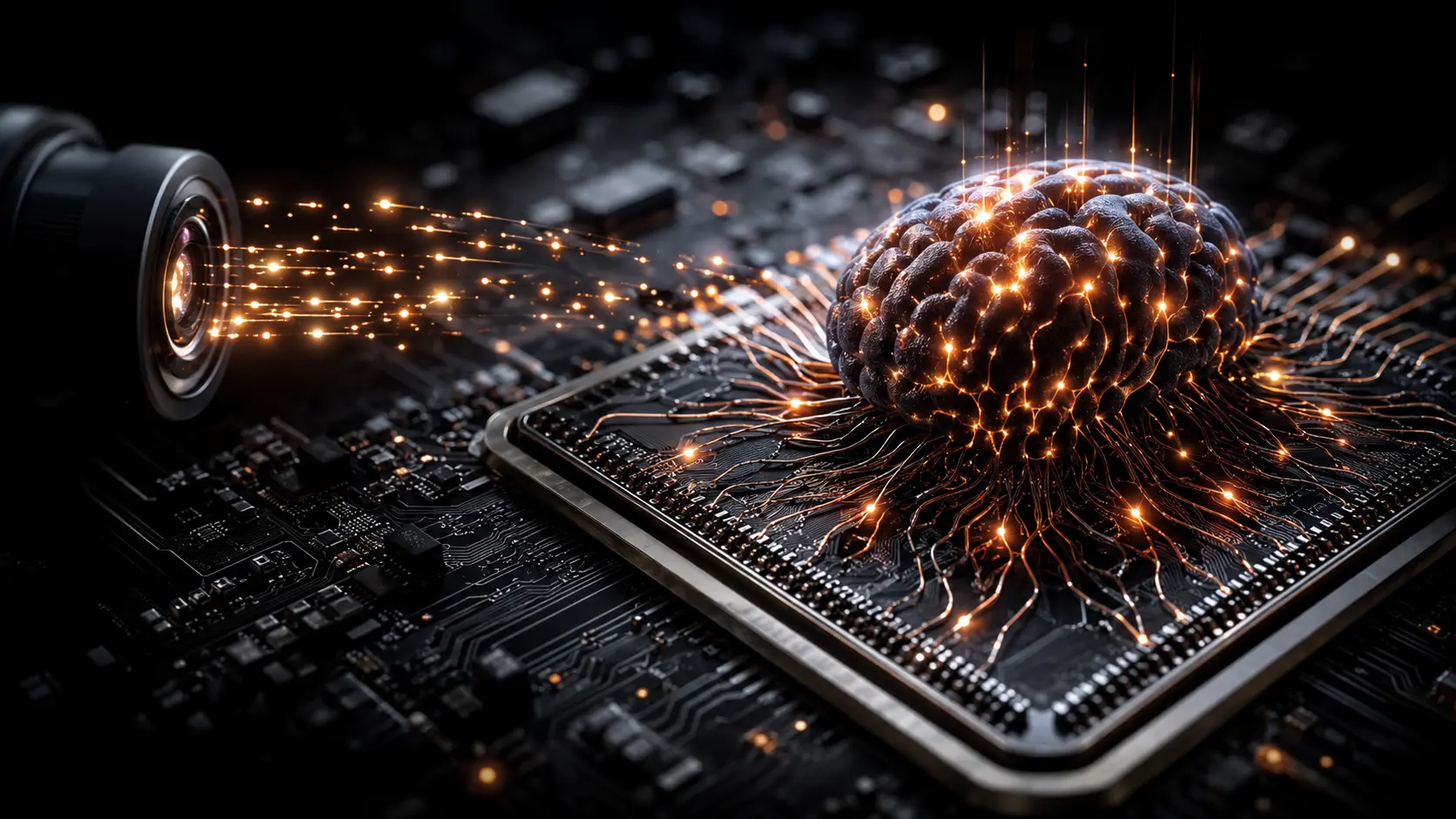
Nature, however, does not work this way. The human brain consumes roughly 20 watts of power—less than a standard lightbulb—yet it is the most advanced supercomputer in the known universe. Why should you care right now? Because the semiconductor industry has successfully reverse-engineered the biological efficiency of the human brain and printed it onto silicon. This breakthrough is known as the Spiking Neural Network (SNN). By utilizing “neuromorphic” processors that remain completely asleep until a specific sensory event triggers them, SNNs are allowing engineers to build autonomous robots, drones, and smart sensors that operate for months on a single battery charge, officially moving advanced AI off the power grid and into the physical world.
What are Spiking Neural Networks (SNNs)?
Spiking Neural Networks (SNNs) are the third generation of neural network models, designed to closely mimic biological neurology. Unlike traditional AI that continuously processes floating-point numbers at a fixed clock speed, SNNs operate asynchronously using discrete, sparse electrical pulses (spikes) that only fire when a specific environmental threshold is crossed, offering extreme energy efficiency.
At a Glance
- Concept: Building an AI that doesn’t “think” in continuous math, but instead talks in short, sharp bursts of electricity, exactly like the neurons in your head.
- Why it matters: It solves the battery life crisis in robotics. An SNN chip uses up to 10,000 times less energy than a standard GPU to perform the exact same sensory task.
- Who uses it: Robotics engineers, autonomous drone manufacturers, and edge-computing researchers utilizing neuromorphic chips like Intel’s Loihi 2 or BrainChip’s Akida.
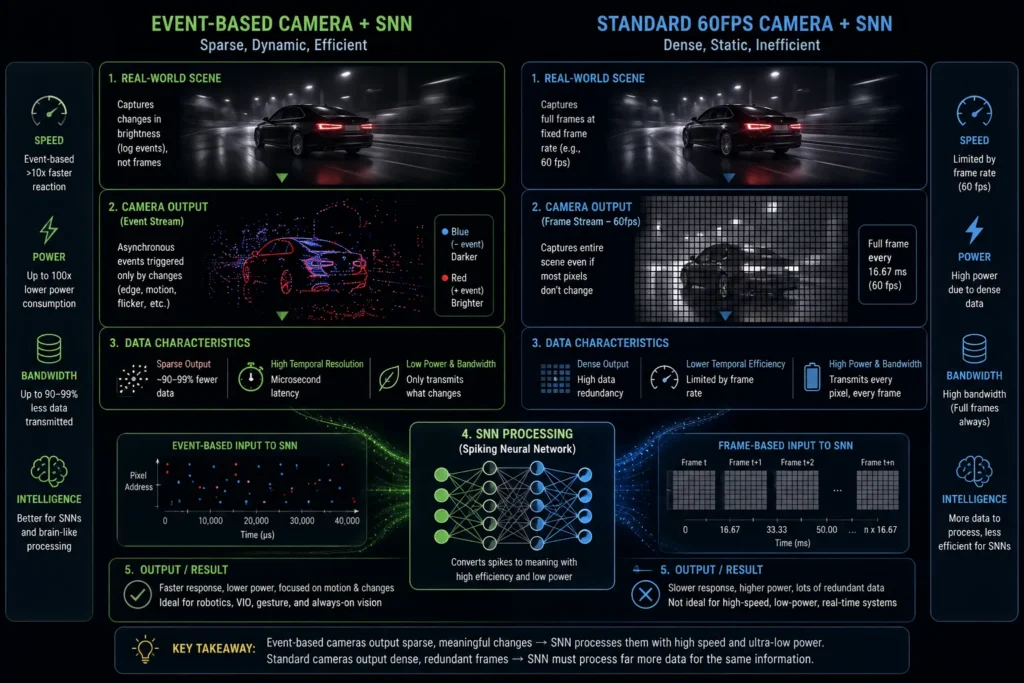
- Biggest takeaway: SNNs are “event-driven.” If a robot with an SNN camera is looking at a static landscape, the chip consumes virtually zero power. The chip only uses energy when a pixel physically changes (e.g., a bird flies across the screen).
In Simple Words
Imagine a traditional security guard (a Traditional Neural Network) watching a CCTV camera. The boss forces the guard to write a complete, detailed report every single second, forever. “Sector clear. Sector clear. Sector clear.” The guard is exhausted, drinking massive amounts of coffee (electricity) just to constantly write down that nothing is happening.
A Spiking Neural Network (SNN) is a lazy, but highly efficient, security guard.
This guard is allowed to sleep in the chair. They consume almost zero coffee. The guard only wakes up and sends a short radio burst (“Spike!”) if someone actually walks onto the screen. Because the guard only exerts energy when a specific event happens, they can guard the facility for months without getting tired.
In robotics, this means the computer chip doesn’t process the entire visual scene 60 times a second; it only processes the specific pixels that moved.
Why This Matters
For Robotics Engineers and Semiconductor VCs, the “Edge” is the new frontier of computing.
“Edge computing” means processing data directly on the device (the robot or the drone) rather than sending it to a massive cloud data center. However, deploying complex AI on the Edge has historically been impossible because high-end GPUs are too heavy, generate too much heat, and require too much power. SNNs running on neuromorphic chips completely obliterate this barrier. By reducing the power envelope from hundreds of watts down to milliwatts, SNNs allow engineers to embed advanced, real-time object detection and autonomous decision-making into micro-drones, prosthetics, and IoT sensors without requiring heavy, tethered power supplies.
The Evolution of Neuromorphic Processors and SNNs
The evolution of Artificial Intelligence is defined by three distinct generations.
The first generation consisted of rules-based expert systems (if/then logic). The second generation—which includes everything from ChatGPT to Tesla’s Autopilot—relies on deep learning and continuous Artificial Neural Networks (ANNs).
SNNs represent the Third Generation. While ANNs were loosely inspired by the brain, they ultimately diverged to favor the rigid, synchronous matrix multiplications that standard silicon chips are good at. SNNs represent a return to raw biology. They abandon the synchronized clock speeds of modern computers entirely, requiring the invention of a completely new class of hardware—”Neuromorphic Processors”—designed from the ground up to route asynchronous, decentralized electrical spikes.
How Spiking Neural Networks (SNNs) Work
Emulating biological cognition requires abandoning continuous mathematics in favor of time-dependent voltage thresholds. Here is the first-principles breakdown of the architecture.
1. The Fundamental Problem: Synchronous Floating-Point Math
In a standard ANN, a neuron receives inputs (e.g., x₁, x₂), multiplies them by continuous weights (w₁, w₂), and uses an activation function (like ReLU) to output a highly precise decimal number (e.g., 0.843). This math occurs continuously, controlled by the computer’s central clock, consuming massive amounts of energy even if the inputs haven’t changed.
2. The Core Mechanism: The Leaky Integrate-and-Fire (LIF) Neuron
An SNN replaces this math with a biological model, most commonly the Leaky Integrate-and-Fire (LIF) model.
An SNN neuron has an internal “membrane potential” (voltage). It receives incoming spikes (1s and 0s). Each spike adds a little bit of charge to the neuron (Integration). However, if no spikes arrive, the charge slowly drains away over time (the Leak).
3. Technical Depth: The Spike Event
The neuron does absolutely nothing until its internal voltage crosses a specific mathematical threshold. The exact moment the threshold is breached, the neuron “fires.” It emits a single, discrete spike (a 1) to the next layer of neurons, and immediately resets its internal voltage back to zero.
The information is not encoded in the size or number of the spike; the information is encoded purely in the Timing (when the spike happened) or the Rate (how fast the spikes are occurring).
4. Hardware Realization: Neuromorphic Chips
Standard CPUs and GPUs are terrible at running SNNs because they are built for synchronous math. To unlock the efficiency of SNNs, companies build Neuromorphic Processors (like Intel’s Loihi 2). These chips physicalize the LIF model. They do not have a central clock. They consist of thousands of decentralized “cores” that operate entirely asynchronously, sitting in deep sleep mode until an electrical spike physically wakes them up.
5. Real-World Consequences: Event-Based Vision
SNNs pair perfectly with Event-Based Cameras (Dynamic Vision Sensors). A normal camera takes 60 full pictures a second. An event camera has no frame rate; each individual pixel operates independently, only sending a “spike” to the SNN chip if the brightness of that specific pixel changes. The SNN processes this sparse stream of moving pixels in real-time, allowing a drone to dodge a thrown object in microseconds using practically zero battery power.
Real-World Deployments of Neuromorphic AI
SNNs are currently exiting the laboratory and entering highly specialized, power-constrained commercial environments.
High-Speed Drone Obstacle Avoidance: Traditional drones struggle to fly through dense forests at high speeds because processing 60 high-definition frames per second causes motion blur and compute lag. By equipping a drone with an event camera and a neuromorphic SNN chip, the drone only processes the edges of trees as they shift in the visual field. This allows the drone’s flight controller to react to obstacles in less than a millisecond, enabling autonomous, high-speed flight through complex environments that would crash a standard AI drone.
Smart Prosthetics and Brain-Computer Interfaces (BCI): Robotic limbs require real-time processing to interpret the erratic electrical signals coming from a patient’s residual nerves. Because SNNs operate on the exact same “spiking” language as human biology, they act as the perfect translator. Neuromorphic chips embedded inside a robotic hand can process nerve spikes instantly, providing fluid, lifelike movement without requiring a heavy backpack of batteries.
Always-On Audio Keyword Spotting: Smart speakers (like Alexa or Echo) must constantly listen for their “wake word.” Running a continuous neural network 24/7 is a massive energy drain. By utilizing a tiny, low-parameter SNN, the microphone can stay in ultra-low-power mode, ignoring background noise. The SNN only triggers the main processor to wake up when the precise temporal spike pattern of the wake word is detected, drastically extending the battery life of portable smart devices.
Economic & Strategic Impact
The primary economic barrier facing SNNs is the Training Algorithm Gap.
Traditional AI achieved global dominance because of an algorithm called “Backpropagation.” Backpropagation requires taking the mathematical derivative of the network to correct errors. You can easily take the derivative of a smooth, continuous curve (an ANN).
You cannot take the derivative of a cliff. A spike is a sudden, discontinuous event (it is either a 0 or a 1). Because the math breaks, training an SNN is incredibly difficult.
To solve this, researchers either train a standard ANN first and then awkwardly “convert” it into an SNN, or they use complex workarounds like “Surrogate Gradients.” For software developers, this means building SNNs is highly frustrating, lacking the seamless, easy-to-use software libraries (like PyTorch or TensorFlow) that made standard AI a multi-trillion-dollar industry. The company that successfully builds a flawless, developer-friendly software compiler for SNNs will unlock the next era of edge computing.
Advantages
- Extreme Energy Efficiency: By only calculating data when a specific event occurs, SNNs reduce the power consumption of AI inference by 10x to 1000x compared to standard GPUs.
- Ultra-Low Latency: Because SNNs process information asynchronously the exact millisecond a spike arrives, they bypass the “frame-by-frame” waiting periods of standard cameras and chips, reacting to fast-moving environments instantly.
- Biological Compatibility: The temporal (time-based) nature of spikes makes SNNs inherently superior at processing sequential, time-series data like audio, radar, and biological brain waves.
Limitations
- Lower Accuracy on Static Data: If you show an SNN a static photograph of a dog, it struggles. SNNs are built to detect changes over time. They underperform traditional ANNs on basic image classification tasks (like ImageNet).
- The “Dead Neuron” Problem: If an SNN neuron never receives enough input spikes to cross its threshold, it never fires. During training, this creates a “dead” neuron that learns nothing, effectively breaking the learning process of the network.
- Hardware Scarcity: Standard cloud infrastructure is useless for SNNs. Taking full advantage of the architecture requires buying highly specialized, expensive neuromorphic hardware (like BrainChip Akida or Intel Loihi) which currently lacks mass-market economies of scale.
Common Misconceptions
Misconception: SNNs will replace ChatGPT and Large Language Models.
Reality: SNNs are currently terrible at processing language. Language models require analyzing massive, static blocks of text simultaneously. SNNs are strictly optimized for real-time, dynamic sensory processing (vision, audio, touch) on edge devices.
Misconception: Any computer can run an SNN efficiently.
Reality: You can simulate an SNN on a standard CPU or GPU, but it will actually run slower and use more power than a standard AI. The energy savings only manifest when the SNN is mapped directly onto a physical Neuromorphic chip that lacks a central clock.
Misconception: The brain is a perfect computer to copy.
Reality: The brain is incredibly slow (neurons fire at roughly 100-200 Hz). SNN engineers do not want to perfectly copy the brain; they want to steal the brain’s sparse routing architecture but run it on silicon that can fire at millions of Hertz, merging biological efficiency with digital speed.
What Most People Miss
The disruptive synergy between SNNs and Space Exploration.
Most analysts view SNNs purely through the lens of terrestrial robotics. What they miss is the critical application of neuromorphic chips in deep space.
Spacecraft (like Mars rovers or deep-space probes) operate under the strictest power constraints known to engineering; their solar panels provide only a trickle of electricity. Furthermore, the immense distance from Earth means they cannot rely on cloud computing; they must process hazard avoidance autonomously. By integrating SNNs, space agencies can deploy rovers with advanced, autonomous hazard-avoidance vision systems that consume only milliwatts of power, drastically expanding the operational capabilities and lifespan of interplanetary exploration vehicles.
Comparison Table
| Feature | Artificial Neural Network (ANN) | Spiking Neural Network (SNN) |
| Information Carrier | Continuous floating-point numbers | Discrete binary pulses (Spikes) |
| Processing Style | Synchronous (Clock-driven) | Asynchronous (Event-driven) |
| Power Consumption | Extremely High (Constant calculation) | Extremely Low (Dormant until spiked) |
| Optimal Hardware | Graphics Processing Units (GPUs) | Neuromorphic Processors |
| Optimal Data Type | Static Images, Massive Text Blocks | Dynamic Vision, Audio, Time-Series |
| Training Difficulty | Easy (Standard Backpropagation) | Very Difficult (Non-differentiable) |
Case Study
Situation: Autonomous drones used for high-speed search and rescue or military reconnaissance faced a severe operational limit. To navigate complex, cluttered environments (like a dense forest) at high speeds, the drones required heavy GPUs to process the high-definition video feeds. The weight and power drain of these GPUs restricted the drones’ flight time to less than 20 minutes.
Challenge: Develop a visual processing architecture capable of reacting to obstacles in sub-milliseconds without relying on heavy, continuous-calculation processors that drained the battery.
Solution (The Neuromorphic Drone): Researchers integrated a Dynamic Vision Sensor (an event camera) directly with an Intel Loihi neuromorphic research chip. Instead of passing full video frames, the camera only passed “spikes” to the Loihi chip when a pixel’s contrast changed (e.g., when the edge of a tree rapidly approached the camera).
Outcome: The Loihi chip ran a custom Spiking Neural Network that processed the incoming spikes asynchronously. The system successfully calculated the optical flow and depth of the approaching obstacles in under a millisecond. Crucially, the neuromorphic chip consumed only a few milliwatts of power during the flight—orders of magnitude less than a standard GPU—while enabling the drone to aggressively dodge obstacles at high speeds.
Lessons Learned: The experiment validated that “event-driven” architecture is the definitive solution for high-speed edge robotics. By ignoring the static background and only processing the pixels that moved, the SNN decoupled autonomous navigation from heavy power consumption, proving that the future of robotics relies on mimicking the sparse efficiency of biological vision.
Future Outlook
Next 12–24 Months
The era of Commercial IoT Integration. While true neuromorphic robotics are still maturing, the immediate future will see SNNs dominate the Internet of Things (IoT). Companies will aggressively deploy tiny SNN chips into industrial sensors (for vibration and acoustic monitoring on factory floors) and wearable health devices. Because these sensors spend 99% of their time waiting for an anomaly, the “sleep mode” efficiency of SNNs will allow smart factories to deploy thousands of wireless sensors that run for 5 to 10 years on a single coin-cell battery.
Next 3–5 Years
The scaling of Surrogate Gradient Training Tools. The primary software bottleneck will break. By the late 2020s, the AI research community will release standardized, highly optimized software libraries (similar to TensorFlow or PyTorch) specifically built for SNNs. These libraries will perfect “surrogate gradient descent,” allowing everyday developers to train complex SNNs natively without needing a Ph.D. in computational neuroscience. This software democratization will trigger a massive influx of robotic startups utilizing neuromorphic chips for autonomous navigation.
Next 10 Years
The Neuromorphic Edge Singularity. By the mid-2030s, the hardware architecture of autonomous systems will be bifurcated. Massive cloud data centers will continue to rely on dense Transformers and GPUs for deep reasoning and language. However, the physical “Edge”—every humanoid robot, autonomous vehicle, and smart prosthetic—will run almost entirely on Spiking Neural Networks. The ability to process dynamic, real-world sensory inputs instantly on a milliwatt power budget will make neuromorphic processors the undisputed physical brain of the robotic revolution.
Most Likely Scenario
Spiking Neural Networks represent the inevitable convergence of biology and silicon. Standard AI is mathematically brilliant but thermodynamically foolish. As humanity attempts to deploy millions of intelligent, untethered robots into the physical world, the battery life constraints of traditional GPUs will become insurmountable. SNNs, by ruthlessly eliminating computational waste, offer the only physically viable path to achieving true, persistent autonomy at the Edge.
Key Takeaways
- Spiking Neural Networks (SNNs) are brain-inspired AI models that communicate using discrete electrical pulses (spikes) rather than continuous, heavy mathematical equations.
- They are “event-driven,” meaning the microchip stays completely asleep and consumes virtually zero power until a specific sensory event (like a moving pixel or a sound) forces a neuron to fire.
- This biological efficiency allows SNNs to run on specialized “Neuromorphic Processors” (like Intel Loihi), slashing the power consumption of AI by up to 99% compared to traditional GPUs.
- SNNs are perfect for high-speed drones and edge robotics because they react instantly to changes in their environment without waiting to process full “frames” of video.
- The primary weakness of SNNs is that they are incredibly difficult to train. Because a “spike” is a sudden mathematical cliff (not a smooth curve), traditional AI training methods (backpropagation) frequently break.
- SNNs are not replacing ChatGPT; they are specialized for real-time sensory processing (vision, audio, touch) on battery-powered robots, not heavy language analysis.
Glossary
Artificial Neural Network (ANN): The traditional, dominant form of AI (used in ChatGPT and computer vision) that relies on continuous, heavy mathematical calculations and consumes massive amounts of power.
Backpropagation: The standard mathematical algorithm used to train AI by calculating the error and working backward to fix it. It struggles to work on SNNs because spikes are discontinuous.
Edge Computing: Processing data directly on the physical device (like a robot or a drone) rather than sending the data across the internet to be processed in a cloud data center.
Event Camera (Dynamic Vision Sensor): A specialized camera that does not take standard picture frames. Instead, each individual pixel only sends a signal (a spike) when the brightness of that specific spot changes.
Leaky Integrate-and-Fire (LIF): The mathematical model of how an SNN neuron works. It slowly collects electrical charge (Integrates), slowly loses charge over time (Leaks), and emits a spike when it gets too full (Fires).
Neuromorphic Processor: A specialized computer chip physically designed to mimic the human brain. It lacks a central clock and routes asynchronous electrical spikes to maximize energy efficiency.
Sources
Intel: Neuromorphic Computing – Loihi 2
BrainChip: Akida Neuromorphic Processor Architecture
Frontiers in Neuroscience: Spiking Neural Networks for Computer Vision
Nature Machine Intelligence: The future of neuromorphic edge computing
arXiv / Cornell University: Surrogate Gradient Learning in Spiking Neural Networks