Advertisement
)

AT A GLANCE
- Concept: The Dispatch Stack: Grid operators always turn on the cheapest power plants first, followed by increasingly expensive ones until demand is met.
- Concept: Physical Congestion: Electricity obeys physics, not markets; cheap power cannot reach consumers if the connecting wire is physically maxed out.
- Concept: Shadow Pricing: The algorithm mathematically calculates exactly how much money it would save the system if a congested wire was just slightly thicker.
- Concept: Locational Marginal Pricing (LMP): Electricity prices vary wildly by geographic node, heavily penalizing consumers trapped behind congested infrastructure.
HOW IT WORKS
Electricity is the only commodity on Earth that is manufactured and consumed in the exact same millisecond. To manage this, Independent System Operators (ISOs) like PJM Interconnection operate massive wholesale energy markets.
Every power plant submits a bid indicating the lowest price they will accept to generate a megawatt-hour of electricity. The ISO stacks these bids from cheapest to most expensive. The algorithm starts turning on the cheapest plants—usually wind, solar, and nuclear—and moves up the stack until the total supply exactly matches the instantaneous consumer demand.
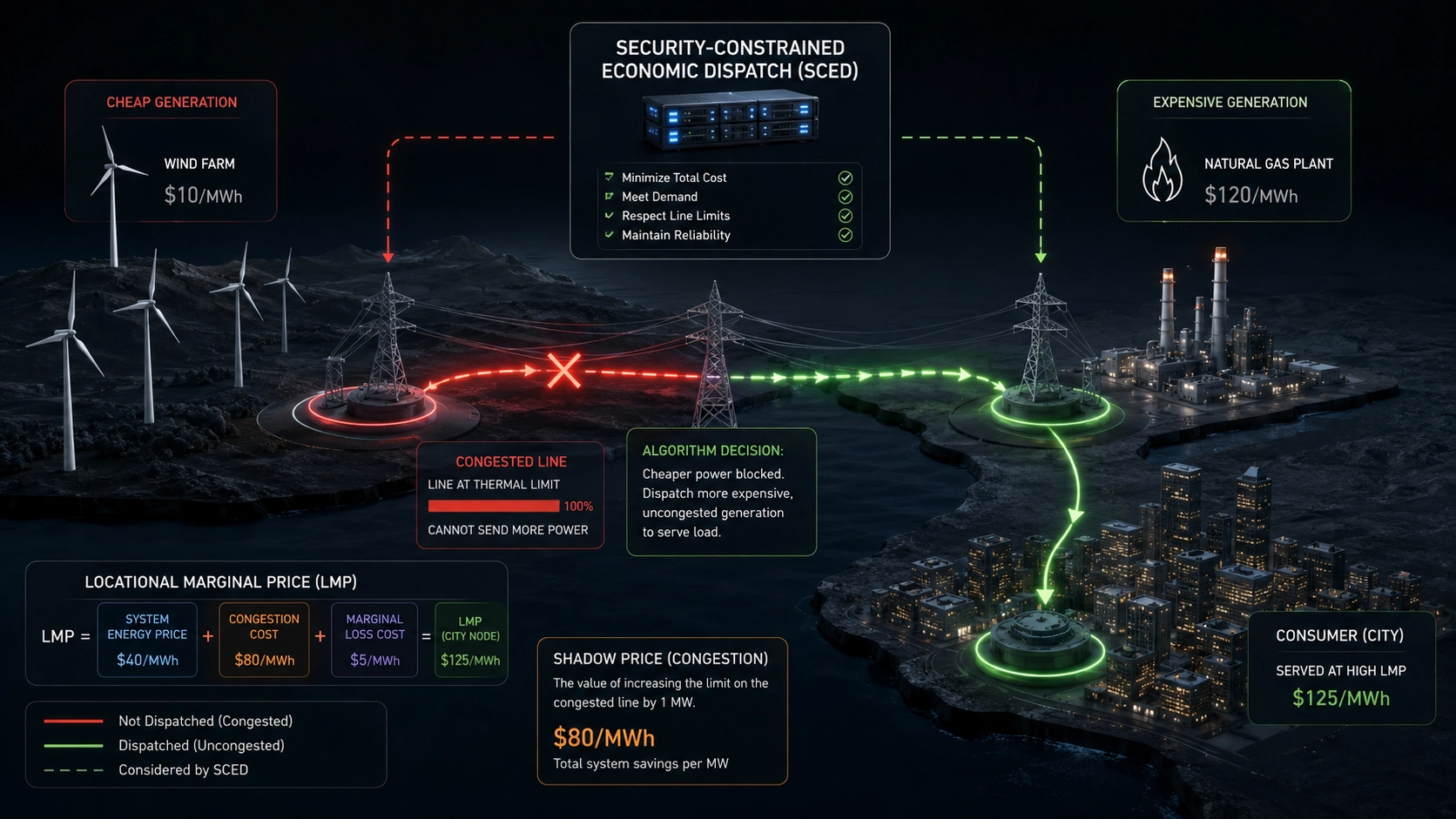
This pure economic stacking breaks down upon contact with physical reality. The cheapest power plant might be a wind farm in Texas, but if the high-voltage transmission line connecting that wind farm to a city in Ohio is physically full, the ISO cannot send the power.
If operators push too much current through a congested wire, the electrical resistance generates extreme heat. The metal wire physically expands, sags into trees, and triggers a cascading, multi-state blackout.
To prevent this, the ISO runs the Security-Constrained Economic Dispatch (SCED) algorithm. This software solves a massive linear programming problem every five minutes. It looks at the cheapest available power, checks the thermal limits of every single wire on the grid, and mathematically forces the system to skip the cheap, blocked wind farm. Instead, the algorithm orders a much more expensive, but geographically unblocked, natural gas plant located right next to the city to turn on.
This physical rerouting dictates Locational Marginal Pricing (LMP). The price of electricity is not uniform; it is calculated separately for thousands of specific geographic nodes. The LMP is defined by three components:
$$LMP = \text{System Energy Price} + \text{Congestion Cost} + \text{Marginal Loss Cost}$$
The congestion cost is derived mathematically from the algorithm’s “shadow price.” The shadow price represents exactly how much total money the entire grid would save if the thermal limit on a congested wire was increased by exactly one megawatt. Consumers physically located behind that congested bottleneck are forced to pay this localized premium directly on their utility bills.
WHY IT MATTERS NOW
The transition to renewable energy is violently disrupting the SCED algorithm. Historically, power flowed predictably from massive, stable coal plants located near major cities. Today, cheap solar and wind generation is highly concentrated in remote, unpopulated geographic areas with extremely weak transmission infrastructure.
When a massive solar farm overproduces at noon, the local transmission lines instantly congest. The SCED algorithm recognizes the blockage and mathematically isolates that specific geographic node. Because the solar farm cannot physically export its power, the local price crashes to zero. Often, the price goes negative, meaning the solar farm actively pays the grid operator to take its electricity just to avoid shutting down its inverters.
Simultaneously, a city just one state over might be experiencing a heatwave. Because the cheap solar power is trapped behind congested wires, the SCED algorithm forces the city to buy power from expensive local natural gas “peaker” plants. The city pays an astronomical LMP premium while cheap, clean energy goes entirely to waste a few hundred miles away.
This algorithmic reality dictates billions of dollars of institutional capital allocation. Infrastructure investors do not build new power plants where land is cheap; they build them based on SCED nodal pricing models. Financial trading firms execute highly complex basis trades, betting hundreds of millions of dollars on the future mathematical probability of a specific transmission line congesting during a winter storm.
WHAT MOST PEOPLE MISS
Public discourse assumes that building more solar panels automatically lowers consumer electricity bills. They completely miss the reality that generation is economically meaningless if the SCED algorithm cannot mathematically clear the transmission path.
Grid congestion functions as an invisible tax. If a state aggressively builds new wind farms without simultaneously upgrading the physical high-voltage cables, the SCED algorithm will simply curtail (shut off) the new wind farms whenever the wind blows hard. The capital spent on the wind farm yields zero economic return, and the consumer continues to pay the premium congestion pricing. The true battleground of the energy transition is not the production of clean electrons, but the algorithmic right-of-way required to physically move them.
THE TRAJECTORY
Next 12–36 Months: ISOs will rapidly integrate Dynamic Line Rating (DLR) sensors directly onto high-voltage transmission towers. Instead of the SCED algorithm using conservative, static, seasonal thermal limits, these sensors will feed real-time wind speed and ambient temperature data into the software, actively increasing the legal carrying capacity of the wire on cold, windy days to reduce artificial congestion.
Next Five Years: Grid-scale battery storage will completely arbitrage the LMP market. Developers will build massive battery parks directly adjacent to highly congested transmission nodes. The batteries will absorb the trapped, negative-priced solar energy during the day and discharge it locally during the evening peak, mathematically erasing the SCED congestion penalty.
Next Ten Years: The SCED algorithm will shift from a five-minute clearing window to continuous, sub-second autonomous dispatch. Machine learning models will bypass traditional linear programming, utilizing neural networks to instantaneously predict and route power flows around transient transmission bottlenecks before the thermal limits are ever physically threatened.
What Could Go Wrong: If a sophisticated cyberattack successfully manipulates the telemetry data feeding into the SCED software, the algorithm will receive false thermal readings. The system could be tricked into believing a clear transmission line is heavily congested, forcing the algorithm to unnecessarily shut down cheap nuclear plants and trigger rolling blackouts across entire states without a single physical wire actually failing.
Most Likely Outcome: The Security-Constrained Economic Dispatch algorithm will become the undisputed, primary financial engine of the global energy transition. The mathematical calculation of nodal congestion will single-handedly dictate the physical location, profitability, and survival of all future energy infrastructure investments.
KEY TERMS
- Security-Constrained Economic Dispatch (SCED): An optimization algorithm used by grid operators to determine the lowest-cost mix of power generation while strictly respecting the physical thermal limits of the transmission network.
- Locational Marginal Pricing (LMP): The precise, mathematically calculated price of wholesale electricity at a specific geographic node, reflecting the cost of energy, transmission congestion, and line losses.
- Shadow Price: A mathematical value representing the exact total system savings that would occur if a specific, congested transmission constraint was relaxed by one unit.
- Independent System Operator (ISO): An independent, federally regulated organization that coordinates, controls, and monitors the operation of the electrical power system within a specific geographic region.
- Curtailment: The forced, deliberate reduction in electrical output below what a power plant is physically capable of producing, typically ordered by the SCED algorithm due to grid congestion.
SOURCES
- Federal Energy Regulatory Commission (FERC) — Security-Constrained Economic Dispatch: Definitions and Operational Principles
- PJM Interconnection — Locational Marginal Pricing and Wholesale Market Algorithms
- IEEE Power and Energy Society — Linear Programming Applications in Optimal Power Flow and Grid Dispatch
- Department of Energy (DOE) — The Economic Impacts of Transmission Congestion and Nodal Pricing