Advertisement
)

The global transition to a clean economy rests on a single, highly inefficient chemical process: splitting water into hydrogen and oxygen. Governments and heavy industries are betting trillions of dollars on green hydrogen to power cargo ships, manufacture zero-carbon steel, and store renewable energy. But traditional electrolyzers operate at room temperature and rely entirely on brute-force electricity to rip the water molecules apart. Because electricity is expensive, the resulting hydrogen is astronomically priced, stalling the energy transition and keeping the world dependent on cheap, heavily polluting fossil fuels.
To make clean hydrogen economically viable, engineers had to figure out how to cheat the physics of electrolysis. Why should you care right now? Because a new generation of high-temperature machines, known as Solid Oxide Electrolyzer Cells (SOECs), has commercialized that exact thermodynamic cheat code. By capturing the 800°C waste heat naturally venting out of steel mills, ammonia plants, and nuclear reactors, SOECs effectively boil the water into superheated steam before applying an electrical current. This high-temperature environment drastically reduces the electrical energy required to break the molecular bonds, slashing the cost of green hydrogen and transforming industrial exhaust from a liability into a high-value manufacturing asset.
What is Solid Oxide Electrolyzer Cells (SOEC)?
Solid Oxide Electrolyzer Cells (SOEC) are high-temperature electrochemical devices that split superheated steam (H₂O) into hydrogen gas and oxygen using a solid ceramic electrolyte. By operating at temperatures between 700°C and 850°C, SOECs leverage external thermal energy to significantly reduce the electrical power required for hydrogen production.
At a Glance
- Concept: Instead of using pure electricity to snap a cold water molecule in half, SOECs use extreme industrial waste heat to severely weaken the molecule first, requiring only a gentle electrical “tap” to finish the job.
- Why it matters: Electricity accounts for roughly 70% of the cost of green hydrogen. By cutting electrical consumption by up to 30%, SOECs drastically lower the Levelized Cost of Hydrogen (LCOH), making it competitive with fossil fuels.
- Who uses it: Mega-tier industrial operators (steel, ammonia, petrochemicals), nuclear power plants, and advanced electrolyzer manufacturers like Bloom Energy, Topsoe, and Sunfire.
- Biggest takeaway: SOECs are made of solid ceramics, not liquid acids or delicate polymer membranes. This makes them highly efficient and independent of rare-earth metals like iridium, but also physically fragile if heated or cooled too quickly.
In Simple Words
Imagine trying to pull apart two perfectly interlocked, freezing-cold Lego bricks. It requires a massive amount of physical strength (electricity) to force them apart. This is how traditional, low-temperature electrolyzers work.
Now, imagine taking those same two Lego bricks and placing them in a hot oven. The heat causes the plastic to soften, expand, and loosen. When you finally go to pull them apart, it requires barely any physical effort at all.
A Solid Oxide Electrolyzer Cell (SOEC) applies this exact logic to water molecules. Instead of relying purely on expensive electricity to break the bond between hydrogen and oxygen, the machine borrows free, blistering waste heat from a nearby factory. This heat “loosens” the bonds of the water molecule, turning it into superheated steam. The machine then applies a small fraction of the electricity normally required to successfully snap the molecule in half, harvesting the pure hydrogen gas.
Why This Matters
For Clean-Tech Investors and Energy Planners, the commercialization of SOEC dictates the bankability of heavy industry decarbonization.
Traditional green hydrogen facilities are built as standalone “giga-factories” in the desert next to massive solar farms. SOECs represent a structural pivot toward co-location. An SOEC is fundamentally symbiotic; it must be built physically adjacent to a high-temperature industrial facility (like a steel furnace or a nuclear reactor) to harvest its waste steam. This allows industrial giants to produce their own cheap, captive green hydrogen on-site, immediately feeding it back into their own manufacturing processes, entirely bypassing the multi-billion-dollar logistical nightmare of transporting explosive hydrogen gas across the country in pipelines.
The Link Between SOEC and Solid Oxide Fuel Cells (SOFC)
The foundation of SOEC technology is actually the Solid Oxide Fuel Cell (SOFC).
For the past twenty years, companies have built SOFCs to generate electricity by combining hydrogen (or natural gas) with oxygen. An SOEC is literally just an SOFC run in reverse. Instead of putting fuel in to get electricity out, you put electricity and steam in to get fuel out.
Because the core architecture—solid ceramic plates made of yttria-stabilized zirconia—has been rigorously tested in the commercial fuel cell market for decades, the transition to electrolysis did not require inventing a new material science. It only required the geopolitical and economic incentive of the 2020s climate mandates to flip the switch into reverse.
The Thermodynamics of SOEC High-Temperature Electrolysis
Extracting hydrogen from steam at 800°C requires exploiting the precise thermodynamics of endothermic reactions. Here is the first-principles breakdown of the architecture.
1. The Fundamental Problem: The Enthalpy of Formation
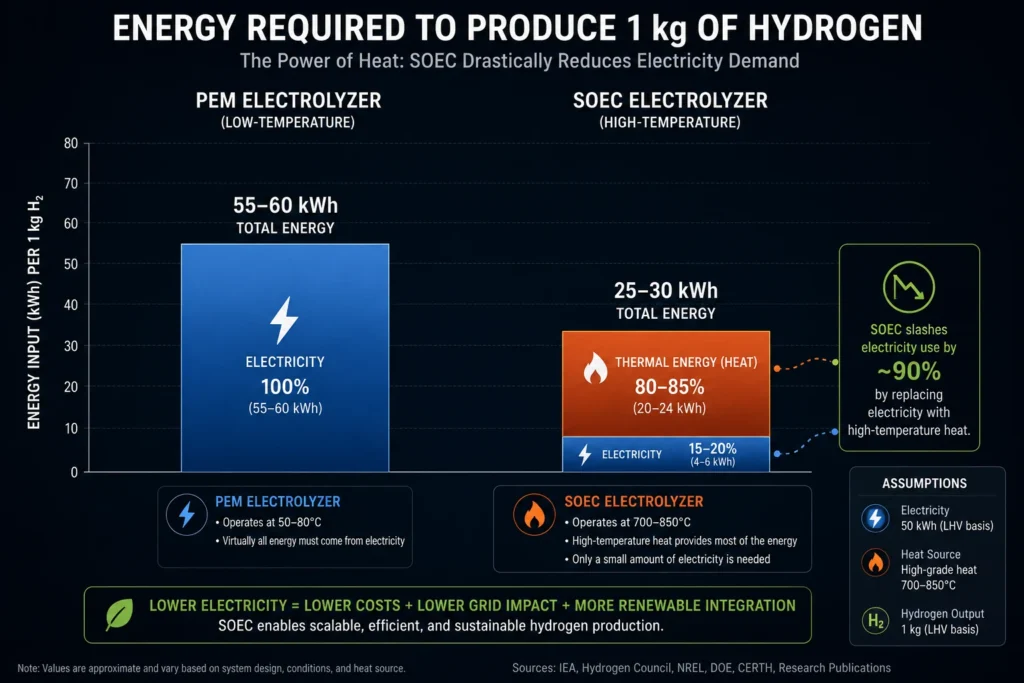
Splitting water is an endothermic process; it requires the addition of energy. The total energy required (Enthalpy, ΔH) is the sum of electrical energy (Gibbs free energy, ΔG) and thermal energy (TΔS):
ΔH = ΔG + TΔS
In a traditional PEM electrolyzer running at 80°C, the thermal energy (TΔS) is practically zero, meaning expensive electricity (ΔG) must do 100% of the work.
2. The Core Mechanism: High-Temperature Substitution
An SOEC operates between 700°C and 850°C. At these extreme temperatures, the thermal energy component (TΔS) becomes massive. Because the total energy required (ΔH) remains relatively constant, injecting massive amounts of heat mathematically forces the electrical energy requirement ΔG) to plummet.
3. Technical Depth: Yttria-Stabilized Zirconia (YSZ)
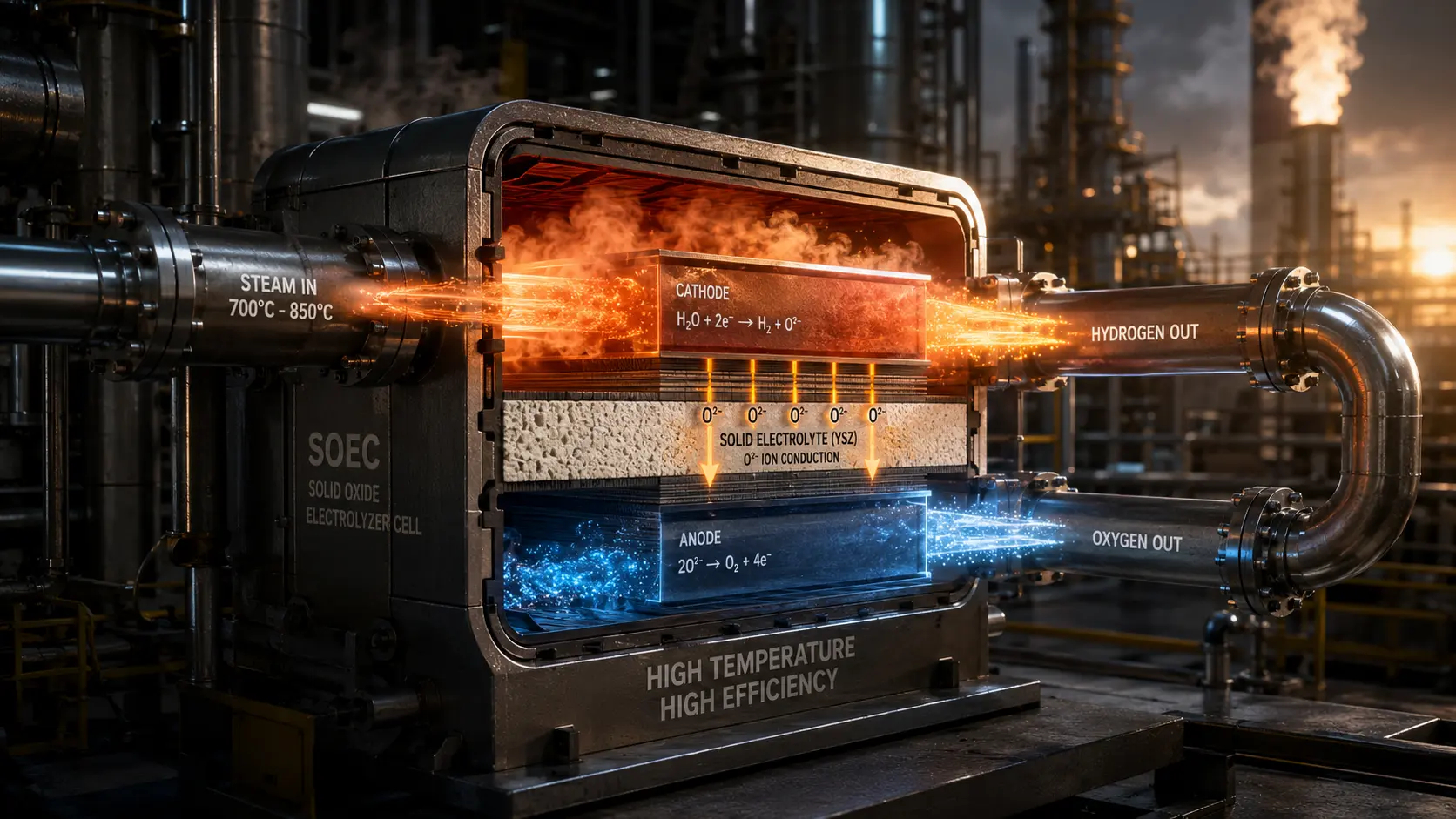
The SOEC consists of an anode and a cathode separated by a dense, solid ceramic electrolyte, almost universally made of Yttria-Stabilized Zirconia (YSZ).
At 800°C, YSZ becomes a highly conductive super-highway, but only for oxygen ions. It completely blocks electrons and hydrogen.
4. The Electrochemical Reaction
- Cathode (Steam Input): Superheated steam (H₂O) and electrons (e⁻) are fed into the porous cathode. The high heat and electrical current split the steam into pure Hydrogen gas (H₂) and negatively charged Oxygen ions (O²⁻).
H₂O + 2e⁻ → H₂ + O²⁻ - Electrolyte Transport: The pure
H₂gas is harvested from the cathode side. The negatively charged O²⁻ ions are physically pulled through the solid ceramic YSZ membrane. - Anode (Oxygen Output): When the O²⁻ ions reach the anode, they release their electrons and combine to form pure Oxygen gas (O₂) which is vented or captured for industrial use.
5. Real-World Consequences: Exothermic Balancing
If you run an SOEC at an incredibly high electrical current, the electrical resistance of the ceramic naturally generates its own heat (I²R heating). Advanced SOECs are engineered to run at the “thermoneutral voltage.” At this precise operational sweet spot, the heat generated by electrical resistance exactly matches the heat consumed by the water-splitting reaction, allowing the machine to sustain its blistering 800°C operating temperature with minimal external thermal input after the initial startup.
Industrial Deployments for SOEC Green Hydrogen
SOECs are aggressively targeting the heavy, “hard-to-abate” industrial sectors that low-temperature electrolyzers cannot serve economically.
Green Ammonia (Haber-Bosch Integration): Producing ammonia for global fertilizer requires massive amounts of hydrogen and produces intense exothermic waste heat. Companies like Topsoe are deploying gigawatt-scale SOEC manufacturing to co-locate with ammonia plants. The SOEC captures the waste heat from the ammonia synthesis loop to vaporize its own steam, creating a perfectly symbiotic, closed-loop zero-carbon fertilizer refinery.
Nuclear “Pink” Hydrogen: Nuclear power plants generate massive amounts of high-pressure, high-temperature steam. Instead of running all that steam through turbines to make electricity, utilities can route a portion of it directly into an adjacent SOEC facility. This allows nuclear plants to seamlessly transition between generating baseload electricity and producing massive volumes of clean “pink” hydrogen during periods of low grid demand.
Green Steel Manufacturing: Traditional steelmaking uses coal to strip oxygen away from iron ore. “Green steel” replaces coal with pure hydrogen (Direct Reduced Iron, or DRI). Because steel furnaces generate ambient temperatures well above 1,000°C, routing that extreme waste heat into an SOEC battery slashes the cost of the hydrogen required to run the DRI process, making fossil-free steel economically viable.
Economic & Strategic Impact
The deployment of SOECs fundamentally disrupts the Levelized Cost of Hydrogen (LCOH).
For green hydrogen to outcompete fossil-fuel-derived gray hydrogen, the LCOH must drop below approximately $2.00 per kilogram. In a traditional PEM electrolyzer, electricity costs account for roughly 70% of the LCOH.
Because an SOEC requires only ~39 kWh of electricity to produce one kilogram of hydrogen (compared to ~50-55 kWh for PEM/Alkaline systems), it mathematically protects the project developer from high electricity prices. This thermodynamic efficiency allows SOEC operators to achieve a profitable LCOH even in regions with mediocre renewable energy resources, completely shifting the geographic map of where green hydrogen mega-projects can be successfully financed.
Advantages
- Unmatched Electrical Efficiency: By substituting expensive electricity with cheap or free industrial waste heat, SOECs achieve near 100% electrical efficiency, heavily reducing operational expenditures (OpEx).
- No Precious Metals: Unlike PEM electrolyzers that require hyper-expensive, rare-earth platinum and iridium catalysts, SOECs are built using abundant ceramics (zirconium) and common metals (nickel), protecting the supply chain from geopolitical bottlenecks.
- Reversible Operation (rSOC): An SOEC can be run backwards as a Solid Oxide Fuel Cell (SOFC). It can use excess solar power to make hydrogen during the day, and then burn that exact same hydrogen at night to generate electricity back into the grid, acting as a massive seasonal energy battery.
Limitations
- Thermal Shock and Brittleness: The solid ceramic plates are exceptionally fragile. If the machine heats up or cools down too quickly, the ceramics will physically crack, destroying the cell. An SOEC cannot easily be turned on and off to match the volatile, second-by-second output of a wind farm.
- Material Degradation: Operating continuously at 850°C in a highly oxygen-rich environment causes severe thermal degradation and oxidation of the interconnect metals, shortening the lifespan of the cell stacks compared to lower-temperature technologies.
- Prolonged Startup Times: Bringing a massive ceramic battery up to 800°C without cracking it takes days of careful, gradual heating. They are designed for continuous, unwavering baseload operation, not rapid-response peaking.
Common Misconceptions
Misconception: SOECs boil liquid water inside the machine.
Reality: Liquid water would instantly thermally shock and shatter the 800°C ceramics. The water must be completely vaporized into high-quality steam by an external industrial boiler before it is ever injected into the electrolyzer cell.
Misconception: SOECs are a brand-new, untested technology.
Reality: The exact same high-temperature ceramic architectures have been used commercially for over two decades by companies like Bloom Energy as fuel cells to power data centers and hospitals. The innovation is the scale and the reversal of the chemical process.
Misconception: They can only make hydrogen.
Reality: SOECs are uniquely capable of Co-Electrolysis. By feeding both steam (H₂O) and carbon dioxide (CO₂) into the cathode simultaneously, the machine splits both, producing “Syngas” (a mixture of hydrogen and carbon monoxide). Syngas is the foundational building block for manufacturing synthetic, zero-carbon jet fuels and diesel.
What Most People Miss
The strategic value of Exothermic Synergy.
Most analysts view the electrolyzer as a standalone machine. What they miss is that industrial chemistry is a game of heat trading.
When you synthesize green ammonia or synthetic aviation fuel, the chemical reaction releases massive amounts of heat (exothermic). When you split water with an SOEC, it consumes massive amounts of heat (endothermic). The ultimate breakthrough in industrial engineering is placing these two machines next to each other. The heat released by creating the fuel perfectly satisfies the heat required by the SOEC to make the hydrogen. This creates a deeply integrated, highly efficient thermal loop where virtually zero energy is wasted to the surrounding environment.
Comparison Table
| Feature | Alkaline Electrolyzer | PEM Electrolyzer | Solid Oxide Electrolyzer (SOEC) |
| Operating Temperature | 60°C – 80°C | 50°C – 80°C | 700°C – 850°C |
| Electrolyte Material | Liquid Potassium Hydroxide | Solid Polymer Membrane | Solid Ceramic (YSZ) |
| Electrical Efficiency | Moderate (~65-70%) | Moderate (~60-65%) | Extremely High (~85-100%) |
| Dynamic Response Time | Slow to Moderate | Very Fast (Seconds) | Very Slow (Days to start) |
| Precious Metals Needed | No | Yes (Platinum, Iridium) | No (Nickel, Zirconia) |
| Primary Use Case | Legacy industrial H2 | Intermittent Wind/Solar | Heavy Industry / Nuclear Integration |
Case Study
Situation: The Idaho National Laboratory (INL), a premier U.S. Department of Energy facility, recognized that generating green hydrogen using purely solar and wind electricity was too expensive to decarbonize heavy industry. Nuclear power plants generate massive, continuous amounts of high-grade heat and electricity, making them theoretical super-hubs for hydrogen production.
Challenge: Validate that a commercial-scale, high-temperature electrolyzer could safely and efficiently integrate directly with the steam systems of a nuclear facility to drastically lower the electrical demand of hydrogen production.
Solution (The INL Bloom Energy Demonstration): In 2023, Bloom Energy deployed a massive 4-megawatt Solid Oxide Electrolyzer platform at the INL testing facility. The system was dynamically tested to simulate integration with a nuclear power plant’s thermal and electrical output.
Outcome: The demonstration shattered previous efficiency records. The SOEC produced hydrogen utilizing only 37.7 kWh of electricity per kilogram of hydrogen produced—significantly lower than the 50 to 55 kWh/kg typical of low-temperature PEM electrolyzers. The system successfully operated continuously, leveraging the simulated nuclear waste heat to generate massive volumes of hydrogen without experiencing the thermal cracking associated with legacy ceramic architectures.
Lessons Learned: The deployment definitively proved the thermodynamic arbitrage of SOECs. It validated that connecting high-temperature electrolyzers to continuous thermal baseload sources (like nuclear or heavy manufacturing) is not merely a laboratory theory, but a commercially deployable pathway to achieving the aggressive $1/kg green hydrogen target mandated by global climate initiatives.
Future Outlook
Next 12–24 Months
The era of Mega-Factory Commissioning. Throughout 2026 and 2027, the primary bottleneck of SOEC—manufacturing capacity—will break. Giants like Topsoe are finalizing construction on multi-gigawatt SOEC manufacturing facilities in Europe, moving the technology out of boutique assembly lines and into mass-automated production. As these production lines scale, the massive upfront capital cost of the machines will compress, triggering the first wave of commercial off-take agreements from steel and fertilizer conglomerates.
Next 3–5 Years
The scaling of Reversible Grid Buffering (rSOC). As power grids reach 70%+ renewable penetration, the problem of seasonal energy storage will become acute. By 2030, utilities will deploy reversible Solid Oxide Cells. During the summer, excess solar power will run the SOEC to produce massive underground caverns of hydrogen. During the winter, the exact same machine will be run in reverse as a fuel cell, consuming the stored hydrogen to provide baseload electricity back to a cold, sunless grid, solving the multi-month storage crisis that lithium-ion batteries cannot mathematically address.
Next 10 Years
The Synthetic Fuel Integration. By the mid-2030s, pure hydrogen will be viewed largely as an intermediate step. SOECs will be deployed explicitly for “Co-Electrolysis.” By pumping captured industrial CO2 and steam into the 800°C ceramic cells, global energy firms will mass-produce synthetic, drop-in replacement jet fuel and maritime diesel. This will completely decouple global aviation and shipping from crude oil, utilizing the extreme heat of the SOEC to rewrite the chemical building blocks of the transportation sector.
Most Likely Scenario
Solid Oxide Electrolyzer Cells will not replace PEM or Alkaline systems; they will bifurcate the market. PEM will dominate the decentralized, highly volatile “green” grid, capturing the erratic spikes of wind and solar. SOECs will dominate the centralized, “heavy iron” industrial grid. Wherever there is a massive chimney venting waste heat, an SOEC will be bolted to it, serving as the relentless, ultra-efficient workhorse of global industrial decarbonization.
Key Takeaways
- Solid Oxide Electrolyzer Cells (SOEC) split superheated steam into hydrogen and oxygen by utilizing high-temperature industrial waste heat, drastically cutting electrical costs.
- By operating at 800°C, SOECs cheat the thermodynamics of electrolysis. The extreme heat weakens the water molecule, requiring 20% to 30% less electricity to break the bond than low-temperature systems.
- The architecture relies on a solid ceramic membrane (Yttria-Stabilized Zirconia) that becomes a super-highway for oxygen ions at extreme temperatures.
- SOECs are highly fragile to rapid temperature changes. They cannot quickly turn on and off to match volatile solar power; they require steady, constant baseload operations.
- The ultimate business model for SOECs is co-location. They must be physically integrated next to steel mills, ammonia plants, or nuclear reactors to harvest free waste heat.
- Unlike PEM systems, SOECs use zero expensive, rare-earth precious metals like iridium or platinum, relying instead on abundant ceramics and nickel.
Glossary
Co-Electrolysis: The process of feeding both steam H₂O) and carbon dioxide (CO₂) into an SOEC simultaneously to produce “syngas,” the building block for synthetic jet fuels.
Endothermic Reaction: A chemical reaction that absorbs heat from its environment. Splitting water into hydrogen is heavily endothermic, which is why SOECs perform better when bathed in industrial waste heat.
Levelized Cost of Hydrogen (LCOH): The primary financial metric used to evaluate electrolyzers. It represents the total cost to build and operate the machine, divided by the total kilograms of hydrogen it produces over its lifetime.
PEM (Proton Exchange Membrane): The leading low-temperature electrolyzer technology. It runs on pure electricity and liquid water, is highly responsive to wind and solar fluctuations, but is less electrically efficient than an SOEC.
Solid Oxide Fuel Cell (SOFC): The exact same hardware as an SOEC, but run in reverse. It takes in hydrogen and oxygen to produce electricity and heat.
Yttria-Stabilized Zirconia (YSZ): A highly advanced, durable ceramic material used as the solid electrolyte in SOECs. It perfectly blocks electrons but allows oxygen ions to pass through it at high temperatures.
Sources
Bloom Energy: Solid Oxide Electrolyzer (SOEC) Platform & INL Demonstration
Topsoe: Solid Oxide Electrolyzer Cell (SOEC) Technology and Gigafactory Expansion
U.S. Department of Energy (DOE): Hydrogen and Fuel Cell Technologies Office – Electrolysis
International Energy Agency (IEA): Global Hydrogen Review – Electrolyser Technologies
ScienceDirect / Joule: Thermodynamic and economic analysis of high-temperature solid oxide electrolysis cells