Advertisement
)
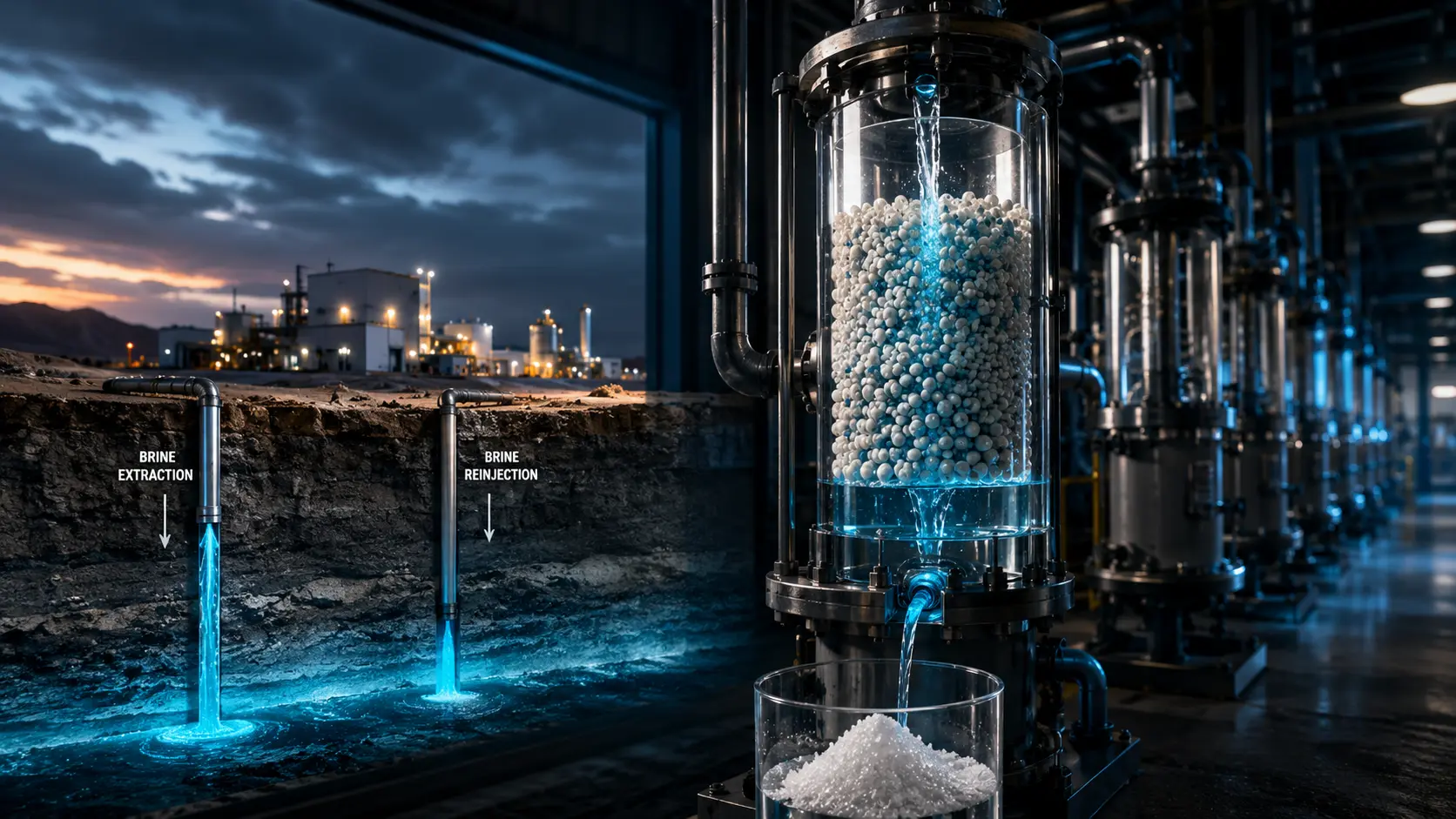

The global electric vehicle transition was built on a staggering environmental paradox. To save the atmosphere from carbon emissions, the automotive industry relies on lithium—a metal predominantly harvested by pumping billions of gallons of ancient, subterranean saltwater into the driest deserts on Earth, and simply waiting up to two years for the sun to evaporate it. This legacy process, centered in the “Lithium Triangle” of South America, is devastatingly slow, recovers barely half of the targeted metal, and drains the local water tables. As automakers scale up gigafactory capacity and governments demand secure, domestic supply chains, the 24-month delay of solar evaporation has become the single greatest bottleneck in the global energy transition.
Why should you care right now? Because the mining sector is undergoing a multi-billion-dollar chemical revolution. Backed by over $3 billion in recent venture and corporate capital, engineers have commercialized “Direct Lithium Extraction” (DLE). By deploying advanced chemical sponges and electrodialysis membranes, DLE pulls lithium out of raw brine in a matter of hours, returning the cleaned water safely back into the ground. This technology does not just speed up the supply chain; it geographically untethers it. It allows energy giants to extract lithium from oilfields and geothermal wells in North America and Europe, unlocking a $5.7 billion extraction market and fundamentally rewriting the geopolitics of battery manufacturing.
What is Direct Lithium Extraction (DLE)?
Direct Lithium Extraction (DLE) is an advanced hydrometallurgical process that isolates and captures lithium ions from subterranean brine using chemical adsorption, ion exchange, solvent extraction, or membrane separation. It replaces traditional solar evaporation ponds, producing battery-grade lithium in hours while allowing the lithium-depleted brine to be safely reinjected underground.
At a Glance
- Concept: Acting as a highly selective “molecular sieve,” DLE targets only lithium atoms in a complex soup of underground saltwater, pulling them out and throwing the rest of the water back.
- Why it matters: It increases lithium recovery rates from roughly 50% to over 90% and slashes production timelines from 18 months to 24 hours.
- Who uses it: Mega-miners (Albemarle, Eramet, SQM) and aggressive clean-tech extraction startups (Standard Lithium, EnergyX, ElectraLith, Lilac Solutions).
- Biggest takeaway: DLE unlocks previously “un-minable” geographies. Because it does not require a hot, dry desert to evaporate water, lithium can now be extracted from rainy, humid regions like Arkansas, Texas, and Central Europe.
In Simple Words
Imagine you have a giant swimming pool filled with a mixture of salt, sand, dirt, and exactly 100 tiny gold coins.
The Traditional Mining (Evaporation) method is to drain the entire pool, let all the water dry up under the sun for two years, and then sift through the massive pile of dry dirt to find the gold coins. It takes forever, requires massive amounts of land, and wastes all the water.
The Direct Lithium Extraction (DLE) method is like tossing a highly specialized, magnetic sponge into the full pool. This sponge is chemically designed to ignore the salt, the dirt, and the sand, but it perfectly absorbs the 100 gold coins. You pull the sponge out a few hours later, squeeze the gold coins into a bucket, and leave the water perfectly intact in the pool. It is incredibly fast, vastly more efficient, and leaves the surrounding environment almost completely undisturbed.
Why This Matters
For Clean-Tech Investors and Supply Chain Analysts, DLE is the definitive technology separating the winners from the losers in the 2020s commodities boom.
As global electric car sales surge—expected to hit 40 million units by 2030—the demand for lithium-ion batteries is compounding rapidly. Evaporation ponds cannot scale fast enough to meet this demand, and hard-rock spodumene mining is incredibly carbon-intensive. DLE represents the holy grail of ESG (Environmental, Social, and Governance) investing: it enables massive industrial output with a negligible ecological footprint. Companies that hold proprietary DLE intellectual property (IP) are securing massive off-take agreements from automakers desperate for inflation-proof, domestically sourced battery metals.
The Smackover Formation: North America’s DLE Hub
The true strategic value of DLE is the activation of the Smackover Formation.
Stretching from Texas to Florida, the Smackover is a massive underground limestone aquifer famous for its history in oil, gas, and bromine production. For decades, the lithium trapped in this brine was ignored because the American South is far too humid for traditional evaporation ponds to work.
DLE completely circumvents the weather. By operating in closed-loop, indoor chemical facilities, DLE transforms the Smackover from an exhausted oilfield into North America’s premier lithium reserve. With billions of dollars pouring into the region, the U.S. is utilizing DLE to decouple its electric vehicle industry from South American and Chinese supply chain dominance, turning the technology into a pillar of national security.
How Direct Lithium Extraction (DLE) Works
Extracting a few hundred parts per million (ppm) of lithium from a chaotic brine containing thousands of ppm of magnesium, calcium, and sodium requires mastering molecular geometry. Here is the first-principles breakdown of the dominant DLE architecture: Adsorption.
1. The Fundamental Problem: Ionic Competition
Brine is a complex chemical soup. Lithium (Li+) is a tiny ion. Traditional chemical precipitation struggles because other ions, particularly magnesium (Mg2+) and sodium (Na+), chemically mimic lithium or bond to it, making it extremely difficult to isolate the lithium without bringing impurities along.
2. The Insufficiency of Solar Evaporation
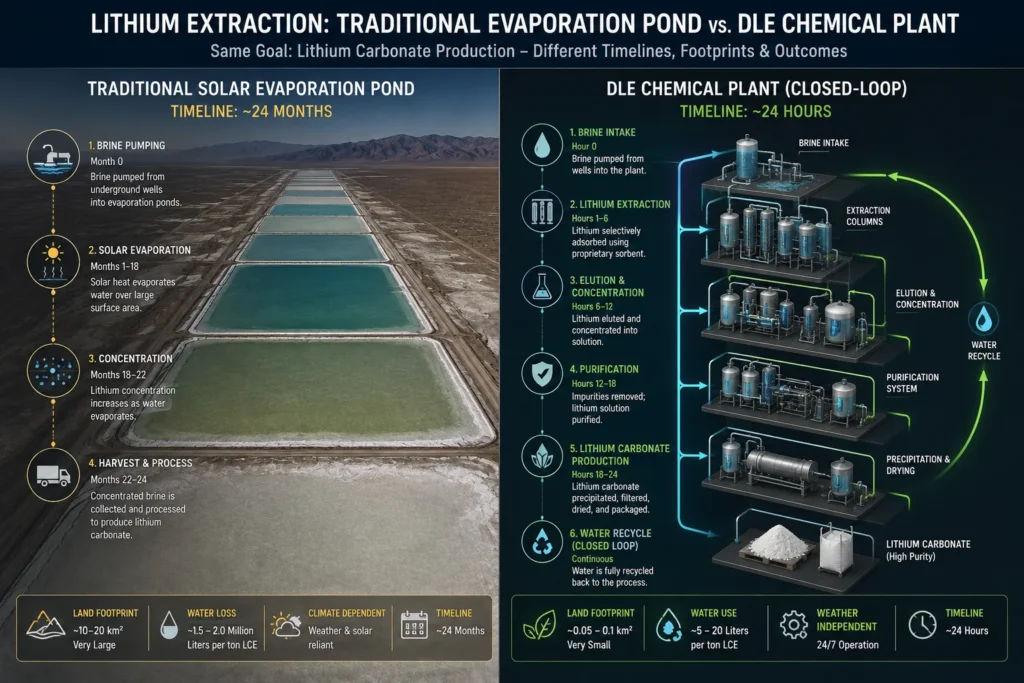
Evaporation relies on sequential precipitation. As water evaporates, different salts crystallize and fall to the bottom of the pond at different concentrations. This requires transferring the brine across dozens of different ponds over 18 months, exposing the process to rain delays and recovering only ~50% of the original lithium.
3. The Core Mechanism: Aluminum-Based Sorbent Adsorption
The most commercially advanced DLE method uses specialized sorbents, typically Aluminum Hydroxide (Al(OH)3) matrices. These sorbents are engineered at the crystalline level to possess lattice vacancies that perfectly match the ionic radius of a lithium ion (roughly 0.76 Ångströms).
4. Technical Depth: Intercalation and Elution
When the raw brine is pumped through a column filled with these sorbent beads, the lithium ions physically slip into the crystalline vacancies (intercalation), while the larger sodium and potassium ions bounce off.
Once the sorbent is fully saturated with lithium, the raw brine flow is stopped. Engineers then perform Elution (or desorption)—flushing the column with a weak acid or simple fresh water. The change in chemical gradient forces the pure lithium out of the sorbent, creating a highly concentrated Lithium Chloride (LiCl) solution.
5. Real-World Consequences: Closed-Loop Reinjection
Because the raw brine never evaporated, it retains all of its original volume and geological pressure (minus the lithium). This spent brine is piped directly to an injection well and pumped back into the deep subterranean aquifer. This maintains the hydrostatic pressure of the geological formation, preventing surface subsidence (sinkholes) and entirely protecting the local freshwater tables from contamination.
Commercial Applications for DLE Technology
DLE is fracturing the traditional geographic monopolies of the mining sector.
The Smackover Commercialization: Standard Lithium operates the only active commercial-scale DLE facility in North America, continuously extracting lithium from the Smackover Formation in Arkansas for nearly four years using a proprietary sorption technology in partnership with Aquatech. Competitor EnergyX is actively scaling hybrid extraction platforms nearby in Texarkana, backed by a massive $450 million investment to dominate the regional output.
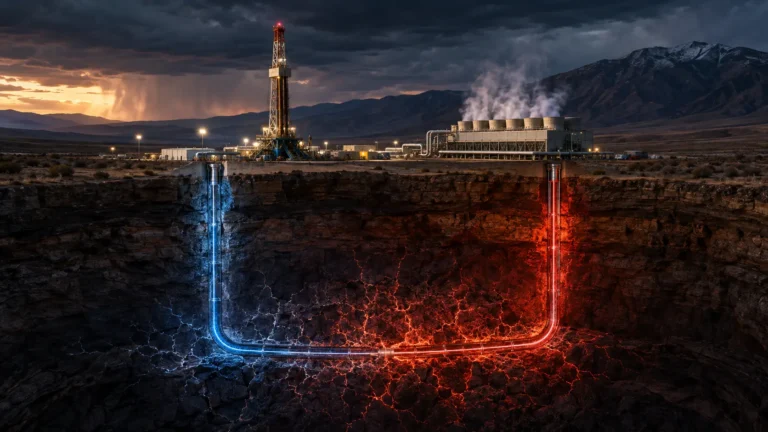
Geothermal Lithium Extraction (The Salton Sea): Geothermal power plants pump boiling hot brine from deep underground to spin electricity-generating steam turbines. Historically, this cooled brine was just pumped back underground. Now, companies in California’s Salton Sea are installing DLE modules directly onto the power plant’s exhaust pipes. They extract the lithium from the hot brine before it is reinjected, simultaneously producing zero-carbon electricity and battery-grade lithium from the exact same hole in the ground.
Next-Generation Membrane Electrodialysis: Australian spinout ElectraLith is pioneering a DLE technique that combines extraction and refining into a single step. Utilizing proprietary membranes running entirely on renewable energy, the system processes raw brine to directly output battery-grade lithium hydroxide, skipping the intermediate lithium chloride and carbonate conversion steps that plague legacy operations, achieving zero chemical inputs and zero water consumption.
Economic & Strategic Impact
The financial transition to DLE hinges on the CapEx vs. OpEx Arbitrage.
Traditional evaporation ponds require moderate Capital Expenditure (CapEx) to build, but they lock up massive amounts of working capital. A mining company must pump brine for two years before they have a single ton of product to sell, exposing them to massive commodity price volatility.
DLE flips this economic model. Building a highly engineered DLE chemical plant requires significantly higher upfront CapEx. However, the Operational Expenditure (OpEx) is tightly controlled, and the “time-to-market” is instantaneous. A DLE plant can begin selling high-purity lithium carbonate a few days after commissioning. For mining executives, this rapid cash-flow generation drastically improves the Net Present Value (NPV) of the project and de-risks the investment against the wild price swings of the global battery metals market.
Advantages
- Unprecedented Speed: Condenses the extraction cycle from an agonizing 12 to 24 months down to a continuous process measured in hours or days.
- High Recovery Rates: While evaporation loses massive amounts of lithium to the pond walls and chemical precipitation, DLE targets 70% to 90%+ recovery, doubling the yield of the exact same geological asset.
- Minimal Ecological Footprint: Reduces the land footprint by replacing thousands of acres of toxic evaporation pools with a single, warehouse-sized chemical processing plant, and drastically limits freshwater consumption.
Limitations
- Massive Power/Water Requirements for Elution: While DLE saves the brine water, washing the sorbents (elution) and powering the massive pumps to force liquid through the columns requires intense electrical power and fresh water, shifting the environmental burden from land use to grid consumption.
- Sorbent Degradation: The chemical sponges do not last forever. Sorbents physically degrade over thousands of extraction cycles, requiring expensive, continuous replacement that inflates long-term OpEx.
- Bespoke Engineering Constraints: There is no “one-size-fits-all” DLE machine. Every underground aquifer has a completely unique chemical signature. A DLE sorbent designed for the high-calcium Smackover brine will completely fail if deployed in the high-magnesium brines of the Chilean Atacama, requiring intense, custom R&D for every single new mine.
Common Misconceptions
Misconception: DLE is a single, standardized technology.
Reality: DLE is a broad umbrella term. It encompasses aluminum-based adsorption, ion exchange resins, liquid-liquid solvent extraction, and advanced electro-membrane separations. Each technology behaves entirely differently and carries unique cost profiles.
Misconception: DLE eliminates the need for any chemical processing.
Reality: DLE only accomplishes the extraction. The resulting output is usually a highly concentrated Lithium Chloride solution. It still must be sent to a heavy chemical plant to be reacted with soda ash or converted via electrolysis into the final battery-grade Lithium Carbonate or Lithium Hydroxide.
Misconception: All lithium is mined from brine.
Reality: While brine is vital, the largest share of the current global lithium market (driven heavily by Australia and China) actually comes from “Spodumene”—traditional hard-rock mining where stones are blown up, crushed, and roasted in massive kilns. DLE is explicitly designed to revolutionize the brine sector, not hard rock.
What Most People Miss
The invisible risk of Reservoir Dilution Telemetry.
In traditional evaporation, the brine is removed from the earth permanently. In DLE, the lithium-depleted brine is pumped right back into the ground adjacent to the extraction well.
What most analysts miss is the fluid dynamics of the aquifer. If an operator pumps billions of gallons of “empty” brine back into the rock, that empty brine can eventually migrate horizontally and mix with the “full” brine that hasn’t been mined yet. Over a 10-to-20-year mine lifespan, this risks severely diluting the extraction well, steadily crashing the mine’s output. Successful DLE isn’t just about chemistry; it requires incredibly sophisticated 3D geological telemetry and precisely mapped reinjection wells to ensure the clean water and the rich brine never cross paths underground.
Comparison Table
| Feature | Solar Evaporation Ponds | Hard Rock Mining (Spodumene) | Direct Lithium Extraction (DLE) |
| Time to Extraction | 12 to 24 Months | Days to Weeks | Hours to Days |
| Recovery Rate | 40% – 50% | 60% – 70% | 70% – 90%+ |
| Land Footprint | Massive (Thousands of acres) | Massive (Open-pit mines) | Small (Warehouse facility) |
| CapEx Profile | Moderate | High | High |
| Environmental Threat | Severe water table depletion | High carbon emissions | High power demand (for pumps) |
Case Study
Situation: The Smackover Formation in North America contains world-class lithium brine concentrations, but decades of regional exploration failed to yield commercial lithium because the local climate is entirely unsuitable for solar evaporation ponds.
Challenge: Develop a highly scalable extraction method that could successfully isolate lithium from the complex, deep brine of the Smackover while seamlessly integrating with the region’s legacy oil and gas brine-handling infrastructure.
Solution (The Standard Lithium Deployment): Standard Lithium partnered with Aquatech to deploy a proprietary Li-Pro™ Lithium Selective Sorption technology. Bypassing evaporation entirely, they built a continuous DLE facility at their South West Arkansas project site, running the complex brine through specialized extraction columns.
Outcome: Standard Lithium established the first continuously operating commercial-scale DLE facility in North America. They successfully processed raw brine into battery-quality lithium compounds and verified the production of domestic LFP battery cells using their extracted materials. The success triggered a major expansion, including a partnership with Equinor and a $225 million award from the U.S. Department of Energy to scale the South West Arkansas project.
Lessons Learned: The operation proved that DLE is not a laboratory anomaly. By applying tailored sorbent chemistry to a specific geographical challenge, Standard Lithium validated that historically “un-minable” brines could be converted into highly lucrative, domestic battery assets, triggering a massive corporate land grab across the Gulf Coast.
Future Outlook
Next 12–24 Months
The era of Demonstration to Commercial Scaling. Through 2025 and 2026, the DLE market will witness the transition of heavily funded pilot plants into full commercial production. Companies like EnergyX, with their 250 tpa facility in Texarkana, will push to validate their hybrid extraction metrics at scale. The industry will aggressively optimize the water recovery ratios of the elution phase, aiming to prove to strict environmental regulators in Chile and Argentina that DLE truly merits the “zero water loss” designation required to secure new mining permits in the Lithium Triangle.
Next 3–5 Years
The scaling of Integrated Membrane Electrodialysis. The current two-step process of DLE (extracting Lithium Chloride, then trucking it to a separate chemical plant to make Lithium Carbonate) is inefficient. Over the next five years, advanced technologies like ElectraLith’s membrane separation will reach maturity. By using electricity and proprietary membranes to extract and refine the lithium simultaneously in a single facility, the industry will bypass the heavy chemical reagent supply chain entirely, achieving massive OpEx reductions and directly outputting battery-ready precursor materials from the wellhead.
Next 10 Years
The Phase-Out of the Evaporation Pond. By the mid-2030s, as the DLE market surges toward a multi-billion-dollar valuation, the construction of new solar evaporation ponds will be effectively banned by international environmental regulators. Geopolitical blocs will mandate DLE for all new continental brine projects. Major oil and gas conglomerates, leveraging their supreme expertise in subterranean fluid dynamics and massive balance sheets, will acquire the leading DLE startups, officially absorbing the global lithium supply chain into the traditional petrochemical infrastructure network.
Most Likely Scenario
Direct Lithium Extraction is the definitive mechanical pivot of the energy transition. The sheer mathematical superiority of an extraction method that yields 90% recovery in 24 hours over one that yields 50% recovery in two years guarantees its absolute market dominance. The companies that successfully engineer sorbents capable of surviving tens of thousands of cycles without degrading will control the chokepoint of the 21st-century automotive industry.
Key Takeaways
- Direct Lithium Extraction (DLE) bypasses slow, toxic evaporation ponds by using chemical sorbents or membranes to extract lithium from brine in mere hours.
- The DLE market is scaling aggressively, projected to grow from $1.54 billion in 2026 to $5.72 billion by 2036, backed by immense automotive and government demand.
- Aluminum-based sorbents work by “intercalation”—they contain microscopic pores precisely sized to catch tiny lithium ions while ignoring larger salt and magnesium ions.
- After the lithium is captured, the depleted brine is safely reinjected back into the earth, preventing land sinkholes and preserving local water tables.
- The technology unlocks new geographies like the Smackover Formation in the U.S., allowing lithium to be mined in humid environments where solar evaporation is impossible.
- While DLE boasts higher recovery rates (up to 90%+), it faces limitations in the form of massive electrical power requirements and the high cost of continuously replacing degraded chemical sorbents.
Glossary
Adsorption: A surface-based process where lithium ions physically stick to the microscopic pores of a highly engineered chemical sorbent bead.
CapEx / OpEx: Capital Expenditure (the massive upfront cost of building the chemical plant) versus Operational Expenditure (the day-to-day costs of electricity, water, and replacement sorbents to run it).
Elution (Desorption): The process of flushing a saturated DLE sorbent with water or a weak acid to strip the pure lithium out of the sponge and collect it.
Lithium Carbonate Equivalent (LCE): The standard unit of measurement used by the global mining industry to compare the output of different lithium mines, regardless of whether they produce carbonate, hydroxide, or chloride.
Smackover Formation: A massive geological limestone aquifer stretching from Texas to Florida, rich in high-grade lithium brine, currently serving as the epicenter of U.S. DLE commercialization.
Spodumene: A hard-rock mineral containing lithium. Mined heavily in Australia, it is the primary competitor to brine-based extraction methods.
Frequently Asked Questions
Does DLE completely eliminate the need for water?
No. While DLE reinjects the raw underground brine (saving the aquifer), the “elution” phase—washing the lithium off the sponge—can require significant amounts of fresh water, though advanced closed-loop systems are aggressively recycling this wash water to approach net-zero consumption.
Is DLE technology currently being used in commercial cars?
Yes. Companies like Standard Lithium have produced battery-quality lithium utilizing DLE, and these materials have been successfully tested in North American LFP battery cells intended for automotive supply chains.
Why do oil companies care about DLE?
Because pumping liquid out of the ground, running it through a chemical separation plant, and pumping the waste liquid back underground is exactly what the oil and gas industry has done for a century. Oil giants view DLE as a seamless way to pivot their existing drilling expertise into the clean-tech sector.
Can DLE extract lithium from the ocean?
Theoretically yes, but the concentration of lithium in seawater is incredibly low (about 0.2 parts per million). DLE is currently optimized for subterranean brines that have hundreds or thousands of parts per million. Filtering the entire ocean is currently mathematically and economically unviable.
What happens if the sorbent breaks down?
Sorbents degrade over time due to the mechanical stress of constant fluid pressure and acid washing. Mining companies must continuously purchase and swap in fresh sorbent beads, creating a massive, recurring operational cost (OpEx) that directly impacts the mine’s profitability.
Sources
[1.1.1] Dimension Market Research: Direct Lithium Extraction Market Size worth $7.0 Bn by 2035
[1.1.2] Grand View Research: Lithium Extraction Market Size And Share Report, 2026-2033
[1.1.3] Grand View Research: Lithium Extraction Market Overview & Insights (June 2026)
[1.1.4] NatureTech Memos: Top 7 Direct Lithium Extraction Startups in 2026 (April 2026)
[1.1.5] Business Research Insights: Direct Lithium Extraction Technology Services Market Size, Trend, 2035
[1.2.1] Smackover Lithium: South West Arkansas and East Texas Project Overview
[1.2.2] Standard Lithium: Direct Lithium Extraction Technology & Q2 2026 Results (August 2026)
[1.2.4] Standard Lithium Ltd.: Smackover Formation Resource Analysis (August 2026)
[1.2.5] Smackover Lithium: About Direct Lithium Extraction Operations