Advertisement
)
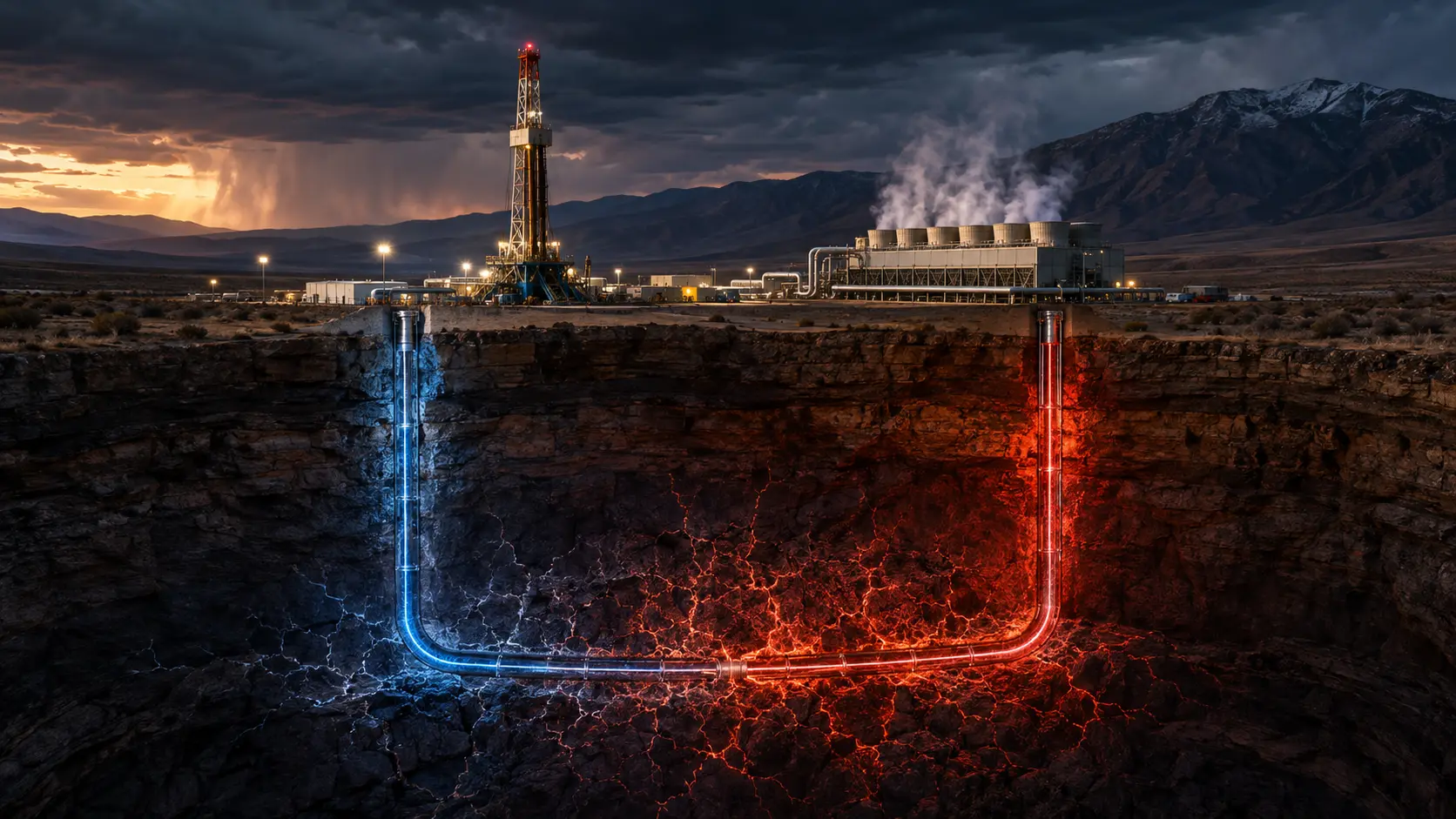

Tech giants are locked in a historic arms race to build artificial intelligence, but they are hitting a hard, physical wall: electricity. AI data centers consume so much power that they are beginning to destabilize regional grids. While solar and wind power are clean, they are fundamentally intermittent; they turn off when the sun sets or the wind dies. But an AI supercomputer cannot sleep. It requires massive, unwavering, 24/7 “baseload” power. Traditionally, the only clean baseload power sources were nuclear (which takes a decade to build) or legacy geothermal (which only works if your data center sits directly on top of a rare, natural hot spring).
But what if you could build a geothermal power plant almost anywhere on the planet? Why should you care right now? Because energy companies have effectively merged with the oil and gas industry to do exactly that. By borrowing the exact horizontal drilling and “fracking” technologies that ignited the U.S. shale boom, engineers are drilling miles into solid, hot granite, artificially cracking the rock, and pumping water through the Earth’s crust to harvest limitless, boiling heat. This technology, called Enhanced Geothermal Systems (EGS), is commercializing at a blinding pace. Backed by multi-billion-dollar investments and massive 2026 off-take agreements from Google and Meta, EGS is officially unlocking the holy grail of the energy transition: carbon-free, always-on power that scales.
What is Enhanced Geothermal Systems (EGS)?
Enhanced Geothermal Systems (EGS) are engineered reservoirs created to extract economical amounts of heat from underground rock resources that lack natural fluid or permeability. By utilizing advanced horizontal drilling and hydraulic fracturing, water is injected into hot dry rock, heated, and extracted to generate 24/7 carbon-free electricity.
At a Glance
- Concept: Building an artificial underground radiator. You drill two deep holes, crack the rock between them, pump cold water down one hole, and harvest boiling water out of the other.
- Why it matters: It provides the missing puzzle piece for a 100% renewable grid. It generates clean power 24 hours a day, 365 days a year, unaffected by weather, clouds, or wind speeds.
- Who uses it: Cutting-edge geothermal developers like Fervo Energy, Sage Geosystems, and Eavor, backed heavily by hyperscalers (Google, Microsoft, Meta) desperate for data center power.
- Biggest takeaway: EGS completely repurposes the controversial technology of fracking. Instead of cracking rock to extract toxic hydrocarbons, EGS cracks rock to extract pure, zero-carbon thermal energy.
In Simple Words
Imagine you have a giant, blistering hot rock buried two miles under your backyard, but it is completely solid and dry.
Traditional Geothermal relies on getting lucky. You have to find a hot rock that already has natural cracks in it and already has an underground river flowing through it, so you can just drill a straw into the river and suck up the steam. These spots are incredibly rare.
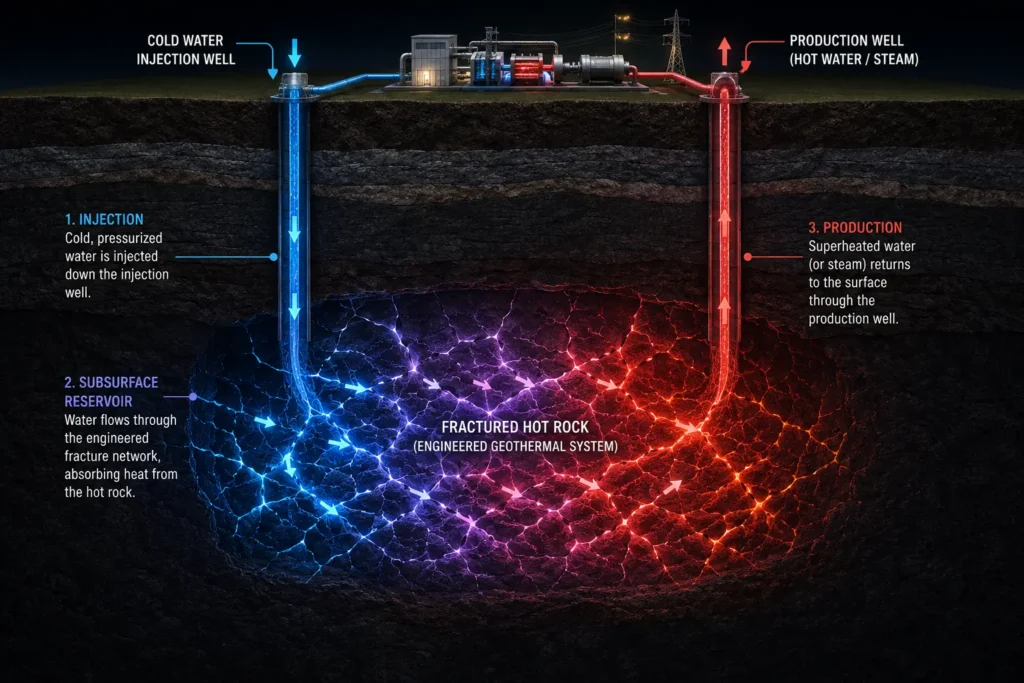
Enhanced Geothermal (EGS) doesn’t rely on luck; it uses brute force. You drill a hole down to the solid hot rock. You pump water down at massive pressure to forcefully crack the rock like a spiderweb. You then drill a second hole nearby to intersect that spiderweb. Finally, you pump cold water down the first hole. The water flows through the freshly cracked, scorching hot rock, instantly boils, and shoots up the second hole as high-pressure steam. You use that steam to spin a turbine and generate electricity, effectively building a massive, custom-made boiler inside the Earth’s crust.
Why This Matters
For Utility Planners and Energy Investors, EGS destroys the geographic constraints of baseload power.
The U.S. Geological Survey (USGS) estimates that the Great Basin of the U.S. Southwest alone holds 135 gigawatts (GW) of potential EGS electric-power generation. If successfully scaled, the Department of Energy estimates EGS could provide 90 GW of firm, flexible power to the U.S. grid by 2050. This represents a massive shift in capital allocation. Oil and gas workers, drilling rigs, and steel casing manufacturers can seamlessly pivot from fossil fuels directly into the EGS supply chain. It offers a mathematically proven off-ramp for the fossil fuel workforce while directly solving the gigawatt-scale deficit facing the AI sector.
The Evolution of Enhanced Geothermal Systems (EGS)
EGS is the ultimate benefactor of the 21st-century oil and gas boom.
Twenty years ago, attempting to drill horizontally through extremely hard, 400°F (200°C) crystalline basement rock (like granite) would instantly melt the drill bits and bankrupt the project. However, the U.S. shale revolution forced the petroleum industry to invent incredibly durable Polycrystalline Diamond Compact (PDC) drill bits, high-temperature directional steering sensors, and advanced multi-stage fracking techniques. The geothermal industry simply inherited billions of dollars of R&D from the oil sector for free, allowing EGS startups to immediately deploy commercial-scale rigs to map and shatter deep thermal reservoirs.
How EGS Geothermal Fracking Works
Creating an artificial subterranean heat exchanger requires extreme mechanical engineering. Here is the first-principles breakdown of the architecture.
1. The Fundamental Problem: Hot Dry Rock (HDR)
To make geothermal power, you need three things: Heat, Fluid, and Permeability (pathways for the fluid to flow). In 99% of the Earth’s crust, there is massive heat, but zero fluid and zero permeability. The rock is a solid, dry vault.
2. The Core Mechanism: Induced Permeability
EGS operators solve this using hydraulic stimulation. An injection well is drilled vertically, and then curved to run horizontally for thousands of feet through the hot rock layer. High-pressure water is pumped into the well. This massive pressure shears the rock along pre-existing micro-faults, creating a vast, complex web of permeable fractures.
3. Technical Depth: The Doublet System
A second well (the production well) is drilled parallel to the first, intersecting the newly created fracture web. This forms a “doublet.” Cold water is pumped continuously down the injection well, forced through the hot fractured rock (absorbing the thermal energy), and extracted up the production well as superheated brine.
4. Surface Generation: The Binary Cycle Power Plant
Because the water coming out of an EGS well is often not hot enough to turn into pure, high-pressure steam on its own (or contains corrosive minerals), it is rarely used to spin a turbine directly. Instead, modern EGS sites use Binary Cycle Power Plants (specifically, the Organic Rankine Cycle).
The hot geothermal brine passes through a heat exchanger on the surface. It transfers its heat to a secondary “working fluid” (like isobutane) that has a much lower boiling point than water. The isobutane flashes into high-pressure vapor, spins the electrical turbine, and condenses back into a liquid.
5. Real-World Consequences: Closed-Loop Zero Emissions
After the original geothermal brine passes its heat to the isobutane, it is completely cooled down. It is then pumped right back down the injection well to start the cycle over. This means an EGS plant operates as a perfect closed loop. It emits zero greenhouse gases, consumes practically zero fresh water once primed, and produces firm, uninterrupted baseload power.
EGS Deployments: Powering AI Data Centers
EGS is transitioning from theoretical pilot projects into massive, utility-scale infrastructure.
Fervo Energy’s Cape Station (Utah): Currently the vanguard of commercial EGS, Fervo Energy is commissioning the first phase of its massive Cape Station project in Beaver County, Utah. Applying 3.0 well designs—which feature longer laterals and larger-diameter casing to increase flow rates and drive down costs to an expected $5,500 per kilowatt—Fervo expects to generate 100 megawatts by late 2026/early 2027. The project scales to 500 MW by 2028 to fulfill major power purchase agreements (PPAs) with Southern California Edison and other regional aggregators.
Hyperscaler AI Data Center Hubs: Tech giants cannot wait a decade for small modular nuclear reactors (SMRs) to clear regulatory hurdles. Google signed a historic Geothermal Framework Agreement (GFA) with Fervo for up to 3 gigawatts of EGS capacity by 2033. Similarly, Meta partnered with Sage Geosystems for 150 MW of clean, firm geothermal power located east of the Rocky Mountains—proving that EGS can be deployed in diverse geographies far outside traditional volcanic zones.
Grid Firming and Energy Storage: EGS reservoirs can operate as massive underground batteries. By throttling the production well but continuing to pump water down the injection well, engineers can build up immense pressure inside the rock fractures. When the grid experiences peak demand (e.g., when the sun sets and solar power dies), the pressure is released, surging superheated brine to the surface to generate a massive, dispatchable spike of electricity.
Economic & Strategic Impact
The financial viability of EGS hinges on a steep Cost-Curve Decline.
Drilling a single, multi-mile horizontal geothermal well costs tens of millions of dollars; well construction accounts for roughly 50% of the entire capital expenditure (CapEx) of an EGS project.
However, because EGS utilizes the exact same hardware as the oil industry, it benefits from “learning by doing.” Fervo recently reported that by standardizing their PDC drill bits and mud cooling systems, they slashed their drilling times from 71 days per well down to just 21 days for highly complex 19,500-foot wells. This ruthless optimization is crushing the Levelized Cost of Energy (LCOE) for EGS. As costs drop, the massive $2.2 billion IPO raised by Fervo in mid-2026 signals to Wall Street that geothermal is no longer an expensive niche, but a highly scalable, bankable asset class capable of absorbing institutional infrastructure capital.
Advantages
- Firm, Baseload Power: Runs continuously with capacity factors exceeding 90%, providing the reliable power grid stability that solar and wind inherently lack.
- Geographic Flexibility: Standard geothermal requires natural hot springs. EGS can theoretically be built anywhere on Earth where drilling technology can reach sufficiently hot basement rock.
- Minimal Surface Footprint: Because the reservoir is miles underground, an EGS plant generates massive amounts of power while taking up a fraction of the land required by sprawling solar farms or wind turbine arrays.
- Oil and Gas Transition: Directly absorbs the workforce, drilling rigs, and specialized engineering talent of the petroleum industry, offering a seamless, high-paying transition into the clean energy economy.
Limitations
- Induced Seismicity (Earthquakes): Pumping water at extreme pressures to shatter subterranean rock creates micro-earthquakes. If an EGS project is sited near an active fault line, this hydraulic stimulation can trigger noticeable, damaging tremors, causing severe regulatory backlash and project cancellations (as famously happened in Basel, Switzerland, and Pohang, South Korea).
- Massive Upfront CapEx: Unlike solar, which is cheap to install, an EGS developer must spend hundreds of millions of dollars drilling miles into solid granite before knowing definitively if the rock will fracture correctly to support a profitable flow rate.
- Thermal Drawdown: Pumping cold water through hot rock eventually cools the rock down. Modeling exactly how many decades it will take for an artificial reservoir to lose its heat—and thus its profitability—is an intense, complex geological challenge.
Common Misconceptions
Misconception: EGS fracking pollutes groundwater like oil and gas fracking.
Reality: Oil and gas fracking injects toxic chemicals and sand (proppants) to keep the rock open so fossil fuels can escape. EGS fracking generally uses pure water, and it happens miles below the shallow, freshwater aquifers used for human drinking water. Because EGS is a closed loop, the risk of chemical groundwater contamination is near zero.
Misconception: EGS will completely replace solar and wind.
Reality: Solar and wind remain vastly cheaper to build per megawatt. EGS is not meant to replace them; it is meant to complement them. EGS provides the firm, baseload anchor for the grid that takes over instantly when weather-dependent renewables falter.
Misconception: We are running out of geothermal energy.
Reality: The heat trapped inside the Earth’s crust is practically infinite, constantly replenished by the slow radioactive decay of elements in the mantle. If EGS technology is perfected, humanity could theoretically run the entire global economy on geothermal energy until the sun burns out.
What Most People Miss
The disruptive architecture of Advanced Closed-Loop Systems (AGS).
While EGS relies on cracking the rock to let water touch it, a parallel technology known as Advanced Geothermal Systems (AGS)—pioneered by companies like Eavor and Greenfire Energy—is emerging.
Instead of fracking, AGS acts like an underground radiator. Engineers drill an absolutely massive, sealed underground loop of steel casing (the “Eavor-Loop”). They pump proprietary working fluids (like supercritical CO2) through the sealed pipe. The fluid absorbs the ambient heat of the rock through the steel walls and returns to the surface entirely via the thermosiphon effect, requiring zero fracking and zero water pumps. While more expensive to drill, closed-loop systems completely eliminate the risk of induced earthquakes, potentially allowing geothermal power to be deployed directly underneath densely populated urban cities.
Comparison Table
| Feature | Conventional Geothermal | Enhanced Geothermal (EGS) | Advanced Geothermal (AGS / Closed-Loop) |
| Heat Source | Natural Hot Springs | Deep Hot Dry Rock | Deep Hot Dry Rock |
| Water / Permeability | Naturally Occurring | Artificially Injected & Fracked | Sealed inside steel pipes |
| Geographic Location | Restricted to volcanic zones | Flexible (Where hot rock exists) | Highly Flexible |
| Induced Seismicity Risk | Low | Moderate to High | Zero |
| Current Market Status | Mature & Stagnant | Scaling Rapidly (Cape Station) | Pilot / Early Commercial |
Case Study
Situation: The U.S. electrical grid was facing a paradox. Hyperscalers required gigawatts of new, carbon-free power to fuel their AI data centers, but conventional renewable sources were too intermittent. Deep, hot rock existed throughout the U.S. West, but previous attempts to harvest it were economically unviable due to the sheer cost and time required to drill through granite.
Challenge: Prove that modern, oil-and-gas-style horizontal drilling could drastically lower the capital expenditure of geothermal well creation, and successfully connect multiple wells via hydraulic fracturing to create a highly profitable, utility-scale power plant.
Solution (Fervo Energy’s Cape Station): Fervo Energy launched the multi-phase Cape Station development in Beaver County, Utah. Rather than drilling traditional vertical geothermal wells, Fervo deployed highly advanced horizontal drilling techniques. They rapidly completed “Sawtooth 7,” pushing the limits with a 19,500-foot well in 460°F rock in just 21 days. They stimulated the wells to create a massive subterranean heat exchanger.
Outcome: By the second quarter of 2026, Fervo achieved mechanical completion on its first GeoBlocks and successfully moved geothermal brine through the heat exchangers and turbines. Validated by massive off-take agreements and a successful $2.2 billion IPO in May 2026, Cape Station Phase I locked in its target to deliver initial power to the grid by late 2026.
Lessons Learned: Cape Station definitively proved that the technological advancements of the shale boom are perfectly transferable to geothermal energy. By relentlessly optimizing drill times and pushing down the capital cost toward a target of $3,000 per kilowatt, Fervo demonstrated that EGS is not a science experiment—it is a hyper-scalable infrastructure asset uniquely positioned to solve the AI energy crisis.
Future Outlook
Next 12–24 Months
The era of Commercial Validation and Hyperscaler Funding. As Fervo’s Cape Station officially connects to the grid in late 2026, the physical proof of concept will trigger a massive influx of Wall Street capital. Google and Meta’s early PPAs will force competing hyperscalers (Amazon, Microsoft) to secure their own EGS pipelines to satisfy corporate net-zero pledges while fueling their AI infrastructure. The Department of Energy’s FORGE (Frontier Observatory for Research in Geothermal Energy) laboratory in Utah will release critical open-source data on optimal fracture management, drastically de-risking the geology for new market entrants.
Next 3–5 Years
The scaling of Brownfield Repurposing and Supercritical CO2. The industry will expand beyond greenfield drilling. Startups like Sage Geosystems will commercialize “brownfield” EGS, taking abandoned, dry oil and gas wells and retrofitting them into geothermal batteries. Simultaneously, the industry will experiment aggressively with using supercritical carbon dioxide (sCO2) instead of water as the heat-transfer fluid. Supercritical CO2 absorbs heat more efficiently than water and expands powerfully, which could increase turbine generation efficiency by 20% to 30% while permanently sequestering carbon underground.
Next 10 Years
The Ultra-Deep Plasmabit Revolution. The ultimate constraint of EGS is the drill bit. By the mid-2030s, standard mechanical drilling will be augmented or replaced by radical new technologies like millimeter-wave directed energy drilling (developed by MIT spin-out Quaise Energy). By vaporizing rock with high-power microwaves, operators will bypass the mechanical wear-and-tear of solid granite, drilling up to 12 miles (20 kilometers) deep. At this depth, the rock exceeds 500°C everywhere on the planet. If millimeter-wave drilling succeeds, EGS will decouple entirely from geography, allowing humanity to plug a baseload power plant directly into the Earth anywhere on the globe.
Most Likely Scenario
Enhanced Geothermal Systems represent the industrial synthesis of fossil-fuel engineering and zero-carbon aspirations. Driven by the voracious energy appetite of artificial intelligence, EGS will transition from a niche renewable into the foundational baseload pillar of the global electrical grid. The nations and companies that master subterranean thermal extraction will secure a limitless, domestic energy supply entirely insulated from geopolitical fuel shocks and erratic weather patterns.
Key Takeaways
- Enhanced Geothermal Systems (EGS) create artificial geothermal power plants by drilling into hot, dry rock and using hydraulic fracturing (fracking) to pump water through it.
- The technology solves the primary flaw of wind and solar by providing clean, unwavering “baseload” power 24 hours a day, 365 days a year.
- EGS leverages the exact same horizontal drilling and PDC drill-bit technology that fueled the U.S. oil and gas shale revolution, drastically lowering drilling costs.
- Because the water harvested from the Earth is often corrosive, EGS uses a “Binary Cycle” plant, where the hot brine transfers its heat to a secondary fluid (like isobutane) to spin the turbine in a closed, zero-emission loop.
- The AI industry is the primary catalyst for EGS. Hyperscalers like Google and Meta are signing multi-gigawatt power purchase agreements to fuel their data centers.
- The primary risks to EGS are the massive upfront capital costs of deep drilling and the potential to trigger localized micro-earthquakes (induced seismicity) during the high-pressure fracking phase.
Glossary
Baseload Power: The minimum amount of electrical power needed to be supplied to the electrical grid at any given time. EGS provides clean baseload, unlike intermittent solar or wind.
Binary Cycle Power Plant: A type of geothermal plant where the hot water from the Earth never touches the turbine. Instead, it heats a secondary fluid with a lower boiling point, which flashes into vapor to spin the turbine.
Capacity Factor: The ratio of a power plant’s actual electrical output compared to its maximum possible output. EGS has a capacity factor of ~90%+, while solar is typically ~25%.
Enhanced Geothermal System (EGS): A man-made geothermal reservoir created by artificially fracturing deep, hot, dry rock and injecting water to harvest the heat.
Levelized Cost of Energy (LCOE): A metric used to compare the lifetime cost of building and operating a power plant against the total amount of electricity it will produce.
Polycrystalline Diamond Compact (PDC) Drill Bit: An extremely durable, high-technology drill bit developed by the oil and gas industry, uniquely capable of carving through the hard granite required for EGS.
Sources
Fervo Energy: Fervo Energy Reports Second Quarter 2026 Results (August 12, 2026)
Fervo Energy: Fervo Energy Reports First Quarter 2026 Results
U.S. Energy Information Administration (EIA): Enhanced geothermal systems could expand geothermal power generation (February 19, 2026)
Carbon Direct: The new geothermal energy: How EGS unlocks clean, firm power at scale (January 20, 2026)
Journal of Petroleum Technology (JPT): AI Data Center Growth Pushes Enhanced Geothermal Into the Energy Spotlight (May 6, 2026)
Cape Station (Fervo Energy): Development & Operations Overview (2026)