Advertisement
)

AT A GLANCE
- Concept: Thermodynamic Conversion: Civilization survives by locating concentrated raw energy and mathematically converting it into work.
- Concept: Baselines and Peaks: Power grids balance massive continuous baseload generation against highly volatile localized human demand.
- Concept: The Storage Deficit: Electrons must be consumed instantly upon generation unless captured via heavy chemical battery infrastructure.
- Concept: Sovereign Security: Nations lacking localized fuel reserves depend entirely on maritime choke points to avoid systemic collapse.
WHY THIS SYSTEM MATTERS
Energy is the singular absolute currency of the physical universe. Without it, the illusion of modern society collapses into darkness within hours. Every other economic sector—computing, finance, agriculture, logistics—exists entirely downstream of the thermodynamic baseload.
When analysts evaluate a nation’s sovereign strength, they measure its kinetic output. A country cannot project military power, manufacture silicon, or feed a metropolis without burning massive continuous volumes of fuel. This physical reality forces governments to treat energy infrastructure not as a commercial market, but as a matter of ultimate national survival.
Global GDP correlates perfectly with global energy consumption. You cannot decouple economic growth from thermodynamic expenditure. To lift a billion people out of poverty requires an astronomical increase in total planetary power generation.
The global system is currently undergoing the most violent architectural transition in human history. We are shifting from a paradigm of concentrated fossil combustion to a paradigm of distributed electromagnetic capture. This requires rebuilding the entire nervous system of human civilization from scratch while it remains completely live and operational.
If the global energy system experiences a localized failure, the compounding effects are immediate and catastrophic. A blackout does not simply turn off the lights. It shuts down municipal water pumps, disables telecommunications routing centers, and freezes international electronic payment clearinghouses.
Modern artificial intelligence represents a new, unprecedented thermodynamic drain on the system. Hyperscale data centers require gigawatts of constant, uninterrupted electrical flow. We are rapidly approaching a physical limit where the cognitive scaling of computers is entirely restricted by the thermal limits of local power grids.
Energy systems dictate the physical geography of human development. Historically, industrial cities formed near massive coal deposits and navigable rivers. Today, hyperscale computing infrastructure migrates toward remote regions with massive hydroelectric dams or trapped geothermal potential.
The transition to electrification replaces an addiction to liquid fuels with an addiction to critical minerals. Instead of securing oil shipping lanes, superpowers now fight for control over lithium brine pools, cobalt mines, and copper refinement facilities. The physical volume of metal required to electrify the globe defies current mining capacities.
This infrastructure requires capital expenditure on a civilizational scale. Trillions of dollars must flow into subsea cables, high-voltage transmission towers, and utility-scale battery farms over the next decade. Financial markets act as the clearinghouse for this transition, pricing the mathematical risk of stranded fossil assets against the high upfront costs of renewable deployment.
Energy physics ignores political ideology. A solar panel only works when photons strike it. A wind turbine only spins when atmospheric pressure differentials occur. Managing these intermittent physical realities requires a grid of extreme complexity, balancing supply and demand across continents down to the exact millisecond.
Because the system must remain perfectly balanced, electricity markets operate unlike any other commodity exchange. Grid operators buy and sell power in real-time, executing high-frequency mathematical algorithms to prevent the physical transmission wires from melting.
Understanding the global energy system is a prerequisite for understanding the future of civilization. It is the ultimate physical constraint. Every technological ambition, from interplanetary colonization to artificial general intelligence, is fundamentally a question of securing and distributing sufficient thermodynamic power.
HOW THE SYSTEM WORKS
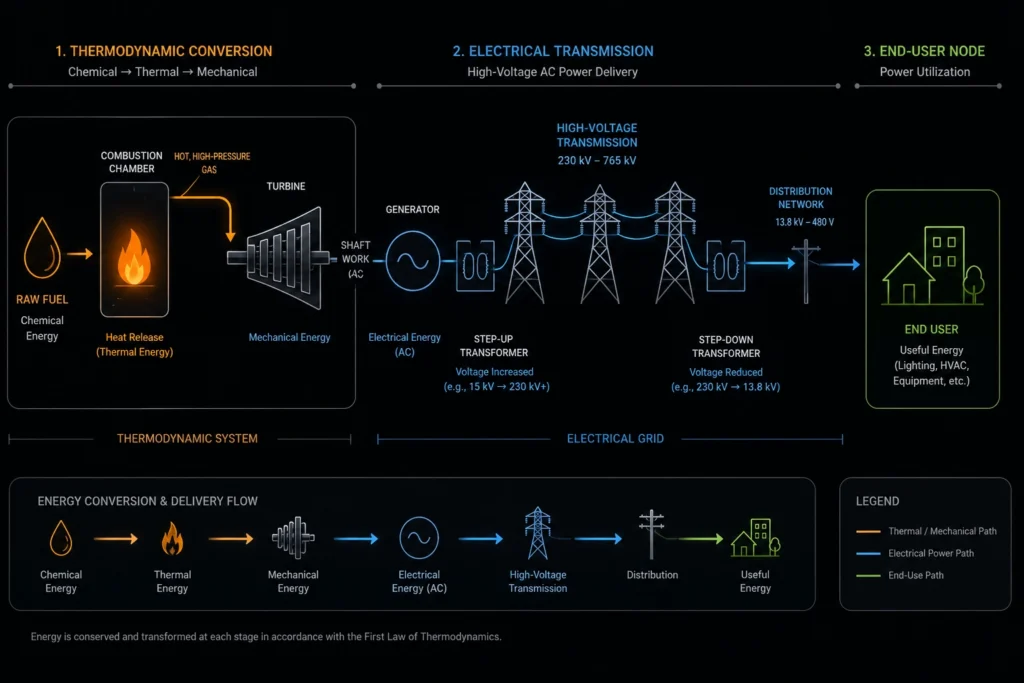
The universe stores energy in physical and chemical bonds. Human civilization operates by breaking those bonds to release heat, which we convert into kinetic motion or electrical current. This conversion process defines the physical mechanics of the global energy stack.
The legacy baseline of this system is thermal generation. A power plant burns a hydrocarbon, typically coal or natural gas, to boil water. The boiling water expands into high-pressure steam, which physically spins a massive magnetic turbine.
As the magnets spin inside coils of copper wire, they force electrons to move. This movement induces an alternating electrical current. The fundamental physics of this induction process, governed by Faraday’s Law, remains the primary mechanism for generating the vast majority of human electricity.
Nuclear energy follows this exact same thermal model, substituting fossil combustion for atomic fission. Engineers split uranium atoms, capturing the resulting kinetic energy to boil water without releasing atmospheric carbon. The massive spinning mass of these thermal turbines provides “rotational inertia,” a critical physical force that naturally stabilizes the entire grid against sudden shocks.
Renewable energy bypasses the thermal boiling cycle entirely. Photovoltaic solar panels rely on the photoelectric effect, where incoming photons physically knock electrons loose from a silicon lattice to create a direct current. Wind turbines utilize aerodynamic lift to spin a generator directly, harvesting the kinetic energy of the atmosphere.
Because electricity travels near the speed of light, it must be consumed the exact millisecond it is generated. To transport this energy over vast distances without extreme thermal loss, operators utilize step-up transformers. These transformers drastically increase the voltage, pushing the electricity onto massive high-voltage alternating current (HVAC) or direct current (HVDC) transmission lines.
The transmission grid operates as a massive, synchronized physical machine. If generation exceeds demand for even a fraction of a second, the grid frequency spikes, threatening to physically destroy connected industrial equipment. If demand exceeds generation, the frequency drops, triggering automated relays that execute rolling blackouts to save the physical wires from melting.
Grid operators manage this precise balance through highly sophisticated telemetry and economic dispatch algorithms. They constantly monitor consumer demand, predicting exact usage spikes based on weather patterns and industrial schedules. The operators then sequentially command different power plants to ramp up or spin down to perfectly match the load.
Intermittent renewable sources completely disrupt this historical control architecture. A grid operator cannot command the wind to blow or the sun to shine. When a massive cloud bank covers a gigawatt-scale solar farm, the grid instantly loses power, forcing the operator to instantly fire up fast-acting natural gas “peaker” plants to cover the sudden deficit.
To mitigate this volatility, the system increasingly relies on utility-scale battery energy storage systems (BESS). Massive arrays of lithium-ion or sodium-ion cells sit directly on the grid, chemically absorbing excess solar power during the day. When the sun sets and consumer demand spikes, the batteries discharge, feeding the stored electrons back into the system to maintain stability.
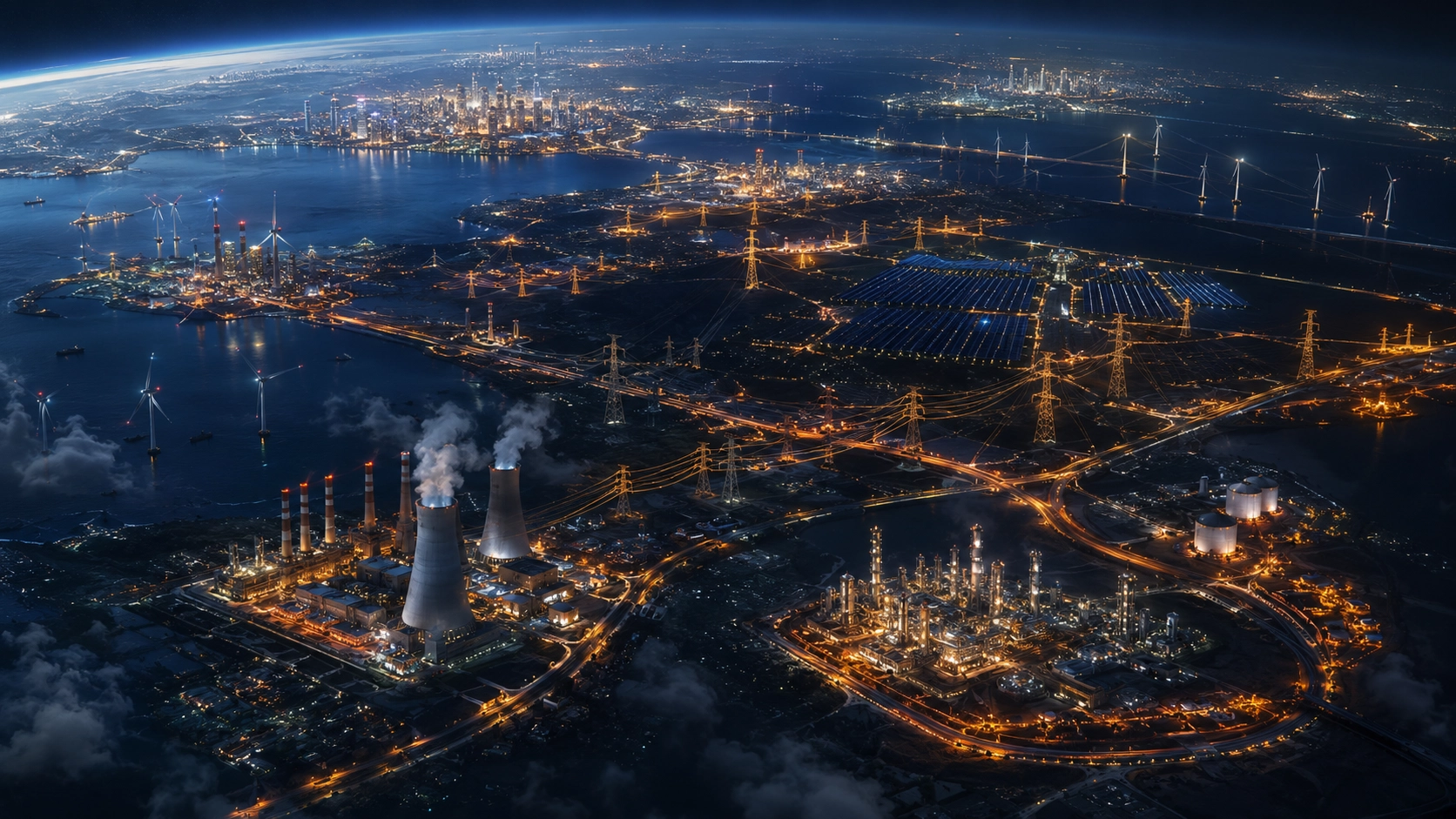
The entire global energy system is therefore a continuous, high-stakes physical balancing act. It connects deep-sea oil rigs, subterranean uranium mines, offshore wind farms, and lithium chemical processing plants into a single, highly tuned nervous system. Managing this architecture requires the most complex real-time mathematical coordination of any human endeavor.
MAJOR COMPONENTS
Energy Systems and Grid Topologies: An energy system encompasses the entire physical lifecycle of power, from primary extraction to terminal consumption. Modern grids operate hierarchically. High-voltage transmission lines form the continental arteries, carrying massive bulk power across thousands of miles.
These lines feed into localized distribution networks, where step-down transformers reduce the voltage to safe levels for municipal and residential use. The architecture is shifting from a one-way centralized model to a decentralized, bi-directional mesh. End-users now possess their own rooftop solar and home batteries, physically injecting power back into the system and forcing grid engineers to manage complex, multi-directional power flows.
Continental grids use High-Voltage Direct Current (HVDC) interconnectors to link massive, geographically isolated regions. These subsea and terrestrial cables operate as the physical backbone of global energy trading. They allow nations to export excess hydroelectricity to neighboring countries experiencing severe wind droughts, physically hedging the volatility of regional weather systems.
Battery Technology and Electrochemistry: Batteries do not store electricity; they store chemical potential energy. The dominant architecture relies on lithium-ion cells, where lithium ions physically migrate between a graphite anode and a metal-oxide cathode during charge and discharge cycles.
This migration forces electrons to travel through an external circuit, providing power. The physical limit of this technology is energy density—the amount of power a battery can hold relative to its physical weight. While lithium-ion dominates the automotive and short-duration grid storage sectors, it suffers from severe supply chain constraints and the physical risk of thermal runaway.
To bypass these limits, the industry is rapidly commercializing solid-state and sodium-ion architectures. Solid-state batteries replace the flammable liquid electrolyte with a rigid ceramic matrix, completely eliminating the fire risk and drastically increasing energy density. Sodium-ion batteries replace expensive lithium with highly abundant seawater salt, trading a slight reduction in energy density for an absolute collapse in baseline manufacturing costs.
Electricity Markets and Economic Dispatch: Electricity cannot be easily stockpiled in warehouses like oil or wheat. This physical constraint forces the creation of highly complex, real-time wholesale electricity markets.
Independent System Operators (ISOs) run algorithmic auctions every five minutes to clear the market. Generators submit bids indicating the exact price they require to turn on their power plants. The algorithm stacks these bids from cheapest to most expensive, selecting the optimal mix of generation to meet demand while strictly respecting the thermal limits of the physical transmission wires.
This process utilizes Security-Constrained Economic Dispatch (SCED). If a cheap wind farm is blocked by a congested transmission line, the algorithm mathematically forces the system to buy expensive local natural gas power instead. This creates Locational Marginal Pricing (LMP), where the wholesale cost of electricity fluctuates wildly across different geographic nodes based entirely on physical infrastructure bottlenecks.
Grid Storage and Load Balancing: Grid storage acts as the massive physical shock absorber for modern energy systems. As intermittent renewables saturate the market, the grid requires deep reservoirs of power to bridge periods of low generation.
Utility-scale battery farms currently provide short-duration storage, typically discharging for two to four hours to cover the evening demand peak. However, managing multi-day weather anomalies requires long-duration energy storage (LDES). Pumped hydro remains the dominant LDES technology. Operators use excess daytime electricity to pump water up a mountain into a reservoir, then release it through a turbine to generate power when demand spikes.
Emerging grid storage solutions utilize compressed air, molten salt thermal reservoirs, and massive iron-air flow batteries. These technologies prioritize absolute scale and low material costs over physical size. They sit adjacent to major industrial hubs, mathematically arbitraging the daily fluctuations in wholesale electricity prices to generate massive financial returns while physically preventing grid collapse.
Nuclear Energy and Fission Dynamics: Nuclear energy provides absolute, baseload thermodynamic stability without emitting atmospheric carbon. Inside a reactor core, a neutron strikes a Uranium-235 atom, splitting it and releasing massive amounts of kinetic energy alongside additional neutrons.
This process sustains a controlled chain reaction. The intense heat boils water into pressurized steam, which spins a traditional turbine generator. Traditional light-water reactors are massive, highly customized civil engineering projects that suffer from extreme capital cost overruns and decades-long construction timelines.
To regain commercial viability, the sector is pivoting to Small Modular Reactors (SMRs). SMRs shrink the physical footprint of the reactor, allowing factories to mass-produce standardized core modules and ship them to the site on commercial flatbed trucks. Advanced variants utilize high-temperature gas or molten salt cooling, relying on passive physics rather than active electrical pumps to guarantee absolute meltdown immunity during catastrophic grid failures.
Oil & Gas and Hydrocarbon Extraction: Fossil fuels remain the highly dense, foundational energy currency of human logistics. The global economy relies on burning complex hydrocarbon molecules extracted from deep subterranean reservoirs.
Modern extraction utilizes horizontal drilling and hydraulic fracturing. Drillers navigate a pipe two miles horizontally through dense shale rock, then inject high-pressure water and sand to physically crack the stone and release the trapped oil and gas. This specific engineering breakthrough completely shifted the global geopolitical balance, turning the United States into the absolute largest hydrocarbon producer on Earth.
Natural gas acts as the critical bridge fuel for the energy transition. Its combustion releases significantly less carbon than coal, and natural gas “peaker” plants can spool up in minutes to stabilize the grid when wind generation suddenly drops. Liquefied Natural Gas (LNG) infrastructure allows nations to supercool the gas into a liquid state and ship it globally, creating a highly fungible, maritime-based energy market that heavily dictates the industrial survival of Europe and Asia.
Renewable Energy and Electromagnetic Capture: Renewable infrastructure attempts to capture the ambient energy of the planetary environment. Photovoltaic systems utilize doped silicon wafers to execute the photoelectric effect, silently generating direct current electricity from incoming solar radiation.
Wind generation relies on massive aerodynamic blades, often exceeding one hundred meters in length, to harvest kinetic atmospheric energy. The physics of wind power dictate that doubling the wind speed increases the energy output by a factor of eight. This mathematical reality forces developers to build massive offshore wind farms, utilizing deep-ocean platform engineering to capture the highly consistent, high-velocity wind currents found over open water.
While the marginal fuel cost of renewable energy is zero, the capital cost of deployment is massive. Furthermore, the extreme spatial footprint required for wind and solar farms creates severe land-use conflicts. Replacing a single megawatt of dense nuclear or gas generation requires paving acres of open land with silicon and steel, shifting the environmental burden from atmospheric carbon to terrestrial material extraction.
THE ECONOMICS: Energy economics dictates the baseline cost of all physical goods and digital services on Earth. It operates strictly on the principle of Levelized Cost of Energy (LCOE).
LCOE calculates the total lifetime cost of building, operating, and fueling a power plant, divided by the total electrical output it generates. Historically, coal and natural gas dominated this metric. Today, the mass production of Chinese silicon and battery cells has pushed the LCOE of utility-scale solar and onshore wind significantly below fossil fuels in most major geographic markets.
However, LCOE ignores the systemic cost of intermittency. When a solar farm produces power at noon, it crashes the wholesale electricity price, generating minimal revenue. To survive financially, renewable developers now mandate the co-location of grid-scale battery storage. By storing the cheap midday electrons and selling them during the highly expensive evening peak, developers physically arbitrage the volatility of the grid.
The transition requires staggering, front-loaded capital expenditure. Nations must mobilize trillions of dollars to physically upgrade aging high-voltage transmission networks. This capital flows through complex project finance structures, utilizing specialized tax credits, sovereign loan guarantees, and long-term Power Purchase Agreements (PPAs) to de-risk the massive upfront construction costs for institutional investors.
GEOPOLITICAL IMPORTANCE: Energy determines sovereign autonomy. A nation that relies on foreign fuel imports operates at the absolute mercy of its suppliers and the maritime choke points required for delivery.
Historically, this vulnerability forced global superpowers to heavily militarize the Persian Gulf and the Strait of Malacca to secure the uninhibited flow of crude oil. The shale revolution temporarily insulated the United States from this dynamic, but the transition to electrification replaces the geopolitics of liquid fuels with the geopolitics of critical minerals.
China completely dominates the global supply chain for solar panels, lithium-ion battery cells, and the chemical refinement of rare earth elements. While a nation can source raw lithium from Australia or Chile, they must almost entirely send it to China for processing into battery-grade chemicals. This total supply chain capture grants Beijing unprecedented economic leverage over the global energy transition.
In response, Western nations are executing aggressive industrial policy. The US Inflation Reduction Act injects hundreds of billions of dollars directly into the domestic manufacturing base, attempting to forcefully onshore the production of battery cells and advanced nuclear fuels. This fractures the globalized energy market into heavily subsidized, regionalized blocs, prioritizing physical supply security over pure economic efficiency.
CURRENT CHALLENGES: The modern energy system faces an acute crisis of transmission capacity. Engineers can build a gigawatt-scale wind farm in eighteen months, but securing the federal permits and right-of-way to build the high-voltage transmission lines required to export that power takes over a decade.
This gridlock strands massive amounts of capital. Hundreds of gigawatts of clean generation sit idle in the interconnection queue, physically ready to build but legally prohibited from connecting to the grid. Without aggressive regulatory reform, the physical wires will act as an absolute bottleneck on global decarbonization.
Simultaneously, the grid faces severe supply chain constraints for foundational electrical components. The lead time for procuring a massive step-up power transformer now exceeds three years. These components rely on highly specific grain-oriented electrical steel, a material produced by only a handful of global mills, creating a severe physical limitation on how fast grid operators can replace aging infrastructure or expand capacity.
WHAT MOST PEOPLE MISS
The public perceives the energy transition as a simple one-to-one replacement of fossil fuels with solar panels. They entirely miss the brutal physical reality of industrial process heat.
Electricity accounts for barely twenty percent of total global energy consumption. The vast majority of the world’s energy burns directly in heavy industrial processes. Manufacturing steel, smelting aluminum, synthesizing fertilizer, and pouring concrete requires generating sustained, continuous temperatures exceeding 1,500°C.
You cannot practically achieve these temperatures using solar panels and lithium-ion batteries. This specific thermodynamic barrier forces heavy industry to rely continuously on coal and natural gas. Decarbonizing this specific layer of the economy requires completely novel engineering, such as utilizing green hydrogen combustion, advanced high-temperature nuclear reactors, or highly experimental electromagnetic smelting arcs.
THE FUTURE
- Next 12–36 Months: Global energy storage installations will surge past 350 GWh annually. This massive injection of battery capacity will heavily stabilize wholesale electricity markets, smoothing out the pricing spikes traditionally exploited by natural gas peaker plants. The artificial intelligence sector will bypass grid queues entirely by directly co-locating hyperscale data centers at the physical site of nuclear power plants, legally securing dedicated “behind-the-meter” gigawatt power flows.
- Next Five Years: The commercialization of solid-state sodium-ion batteries will physically detach global grid storage from the lithium supply chain. These fireproof, hyper-cheap architectures will dominate stationary utility markets. Virtual Power Plants (VPPs) will reach massive scale. Grid operators will utilize complex software algorithms to aggregate millions of residential home batteries and electric vehicles, commanding them simultaneously to discharge power back to the grid and eliminating the need to build physical backup power plants.
- Next Ten Years: Small Modular Reactors (SMRs) will reach standardized factory production. These micro-reactors will be deployed directly within heavy industrial parks, providing localized, zero-carbon electricity and extreme process heat for chemical refinement. Advanced High-Voltage Direct Current (HVDC) subsea supergrids will permanently link continents, allowing massive solar arrays in North Africa to instantly power the evening demand peaks of Northern Europe.
- What Could Go Wrong: The physical expansion of the global grid is mathematically tethered to the mining of copper. If global copper production stagnates due to geological depletion and strict environmental permitting, the price of copper will skyrocket. This extreme raw material cost inflation will completely break the economic models of renewable deployment, freezing global grid expansion and triggering a severe, prolonged era of structural energy scarcity and persistent industrial blackouts.
- Most Likely Outcome: The global energy system will bifurcate into two distinct architectural layers. The macro layer will rely on massive, highly localized nuclear and offshore wind installations feeding dense urban centers. The micro layer will consist of highly resilient, autonomous microgrids utilizing distributed solar and battery storage. This hybrid architecture will sacrifice pure economic efficiency in exchange for extreme physical redundancy against extreme weather events and sophisticated cyber warfare.
FREQUENTLY ASKED QUESTIONS
- What is the difference between alternating current (AC) and direct current (DC)? Alternating current periodically reverses its physical direction of flow, allowing engineers to easily step voltages up or down using magnetic transformers. Direct current flows continuously in one direction, making it highly efficient for storing energy in batteries or transmitting power over massive underwater cables.
- What exactly does a power grid do? A power grid is a synchronized physical network that instantly balances the generation of electricity with the exact consumption demand of every connected device. It continuously routes high-voltage electrons from power plants through transmission lines directly to industrial and residential meters.
- Why can’t we just store all renewable energy in batteries? Current lithium-ion batteries are physically too heavy and chemically too expensive to store the massive terawatt-hours of power required to run a continent for days without wind or sun. They excel at short-duration balancing but fail economically at seasonal, multi-month energy shifting.
- What is a megawatt (MW) versus a megawatt-hour (MWh)? A megawatt is a measure of instantaneous power capacity, indicating the maximum amount of electricity a system can generate or consume at one exact moment. A megawatt-hour is a measure of total energy volume, indicating that one megawatt of power flowed continuously for one full hour.
- How does a nuclear reactor work? A nuclear reactor splits heavy uranium atoms inside a secure core, a process called fission. This fission releases immense kinetic energy in the form of heat, which boils water into high-pressure steam that physically spins a massive electrical turbine.
- What is the duck curve? The duck curve is a mathematical graph showing the severe imbalance in modern power grids. It illustrates how massive daytime solar generation drives grid demand to near zero at noon, followed by a violent, dangerous spike in demand the moment the sun sets and people return home.
- What does “baseload” power mean? Baseload refers to the absolute minimum amount of continuous electrical power required by a grid at any given moment, 24 hours a day. Historically, grid operators met this demand using massive, slow-reacting coal and nuclear plants that run constantly without interruption.
- Why is lithium so important for the energy transition? Lithium is the lightest metal on the periodic table and possesses extreme electrochemical potential. This physical reality makes it the absolute optimal material for building lightweight, highly energy-dense batteries for electric vehicles and mobile electronics.
- What is hydraulic fracturing (fracking)? Fracking is an industrial extraction process that injects millions of gallons of highly pressurized water, sand, and chemicals directly into deep shale rock formations. This physically shatters the stone, allowing previously trapped, inaccessible oil and natural gas molecules to flow to the surface.
- What is a smart grid? A smart grid integrates advanced two-way digital communication and real-time telemetry sensors into the physical electrical wires. This allows grid operators to instantly detect localized failures, automatically reroute power around damaged infrastructure, and dynamically command residential appliances to consume less power during peak hours.
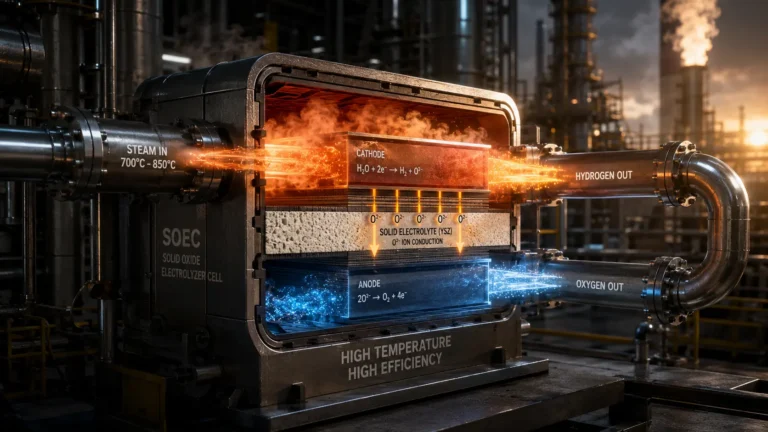
- What is green hydrogen? Green hydrogen is a highly combustible gas created by running pure renewable electricity through an electrolyzer to physically separate water molecules into hydrogen and oxygen. It acts as a zero-carbon chemical fuel that can be burned to generate extreme industrial heat or stored in massive subterranean salt caverns.
- Why are electricity prices so volatile? Because electricity must be consumed the exact millisecond it is generated, the market possesses zero physical buffer. If a major power plant unexpectedly trips offline during a heatwave, the grid operator must instantly buy emergency replacement power at any price required to prevent a localized blackout.
- What is levelized cost of energy (LCOE)? LCOE is a standardized financial metric that mathematically divides the total lifetime cost of building, maintaining, and fueling a power plant by the total megawatt-hours of electricity it will generate. It allows investors to directly compare the economic viability of a solar farm against a natural gas plant.
- How do high-voltage transmission lines work? High-voltage lines intentionally increase the electrical pressure (voltage) to extreme levels, which mathematically decreases the electrical current (amperage). Because lower amperage generates significantly less heat, the grid avoids wasting massive amounts of energy to thermal resistance over long physical distances.
- What is a microgrid? A microgrid is a localized network of distributed energy sources—like rooftop solar, diesel generators, and battery banks—that normally connects to the main traditional grid. During a systemic blackout, the microgrid physically disconnects (islands) and continues to autonomously power a specific hospital, military base, or neighborhood.
KEY TERMS
- Thermodynamics: The branch of physical science governing the exact mathematical relationship between heat, work, temperature, and energy conversion.
- Baseload: The minimum level of continuous electricity demand required on a power grid over a 24-hour cycle.
- Capacity Factor: The ratio of the actual electrical energy produced by a power plant over a period of time compared to its absolute maximum possible output.
- Inverter: An essential electronic device that physically converts the direct current (DC) generated by solar panels and batteries into the alternating current (AC) required by the grid.
- Locational Marginal Pricing (LMP): The localized, real-time wholesale price of electricity calculated for a specific geographic node based heavily on physical transmission wire congestion.
- Intermittency: The severe operational challenge caused by renewable energy sources that only generate power when exact atmospheric conditions allow.
- Thermal Runaway: A highly dangerous chemical chain reaction inside a lithium-ion battery cell that generates uncontrollable internal heat, leading to violent fires.
- Peak Load: The specific, brief periods of the day when consumer demand for electricity reaches its absolute maximum physical level.
- Virtual Power Plant (VPP): A cloud-based software network that aggregates millions of decentralized home batteries and electric vehicles to act collectively as a single massive grid resource.
- Supergrid: A proposed wide-area electrical network spanning continents, utilizing highly advanced HVDC technology to route massive volumes of power globally.
- Electrolyzer: A specialized industrial apparatus that utilizes raw electricity to drive a chemical reaction, specifically splitting water into hydrogen and oxygen.
- Curtailment: The forced, deliberate shutdown of active renewable energy generation because the local transmission wires are too congested to physically export the power.
- Rotational Inertia: The massive kinetic energy stored in the heavy, physically spinning turbines of thermal power plants that naturally dampens violent frequency shocks on the grid.
- Power Purchase Agreement (PPA): A long-term legal contract where an entity agrees to buy electricity directly from a generator at a fixed price, securing the financial revenue required to construct the plant.
- Smart Meter: An advanced digital device attached to residential and commercial properties that records precise electrical consumption data and transmits it continuously to the utility operator.
SOURCES
- International Energy Agency (IEA) — Electricity 2026: Supply, Demand, and Grid Flexibility Analysis
- Federal Energy Regulatory Commission (FERC) — Security-Constrained Economic Dispatch and Wholesale Market Mechanics
- Department of Energy (DOE) — National Transmission Needs Study and High-Voltage Infrastructure Assessment
- Wood Mackenzie — Global Energy Storage Market Surpasses 100 GW Annual Installation Milestone Outlook 2026
- Institute of Electrical and Electronics Engineers (IEEE) — Linear Programming Applications in Optimal Power Flow and Grid Dispatch
Explore the Energy Ecosystem
⚡ Electricity Markets → link
☀️ Renewable Energy → link
🛢️ Oil & Gas → link
🔋 Energy Storage → link
⚛️ Nuclear Energy → link
🏭 Energy Infrastructure → link