Advertisement
)

AT A GLANCE
- Concept: The Isotope Ratio: Natural uranium contains less than 1% of the combustible U-235 isotope; standard reactors require 5%, while advanced modular reactors require nearly 20%.
- Concept: Centrifuge Cascades: Because isotopes are chemically identical, engineers must use physical gravity to separate them, spinning uranium hexafluoride gas at extreme supersonic speeds.
- Concept: The 20% Threshold: International non-proliferation treaties strictly classify any uranium enriched above 20% as highly enriched (weapons-grade), forcing HALEU to top out mathematically at 19.75%.
- Concept: The Transport Bottleneck: Highly concentrated fuel emits more radiation, requiring specialized, geometrically spaced steel shipping casks to prevent a spontaneous fission reaction on a commercial highway.
HOW HALEU ENRICHMENT WORKS
Raw uranium extracted from the Earth consists almost entirely of the heavy, stable Uranium-238 isotope. Less than one percent is Uranium-235 (U-235), the lighter, unstable isotope that physically sustains a nuclear chain reaction. Standard commercial nuclear power plants require fuel enriched to about 5% U-235. Next-generation Small Modular Reactors (SMRs) require fuel enriched to between 5% and 19.75% U-235, known as High-Assay Low-Enriched Uranium (HALEU).
Because U-235 and U-238 are the same chemical element, you cannot separate them using a chemical reaction. You must separate them mechanically using their microscopic difference in physical mass.
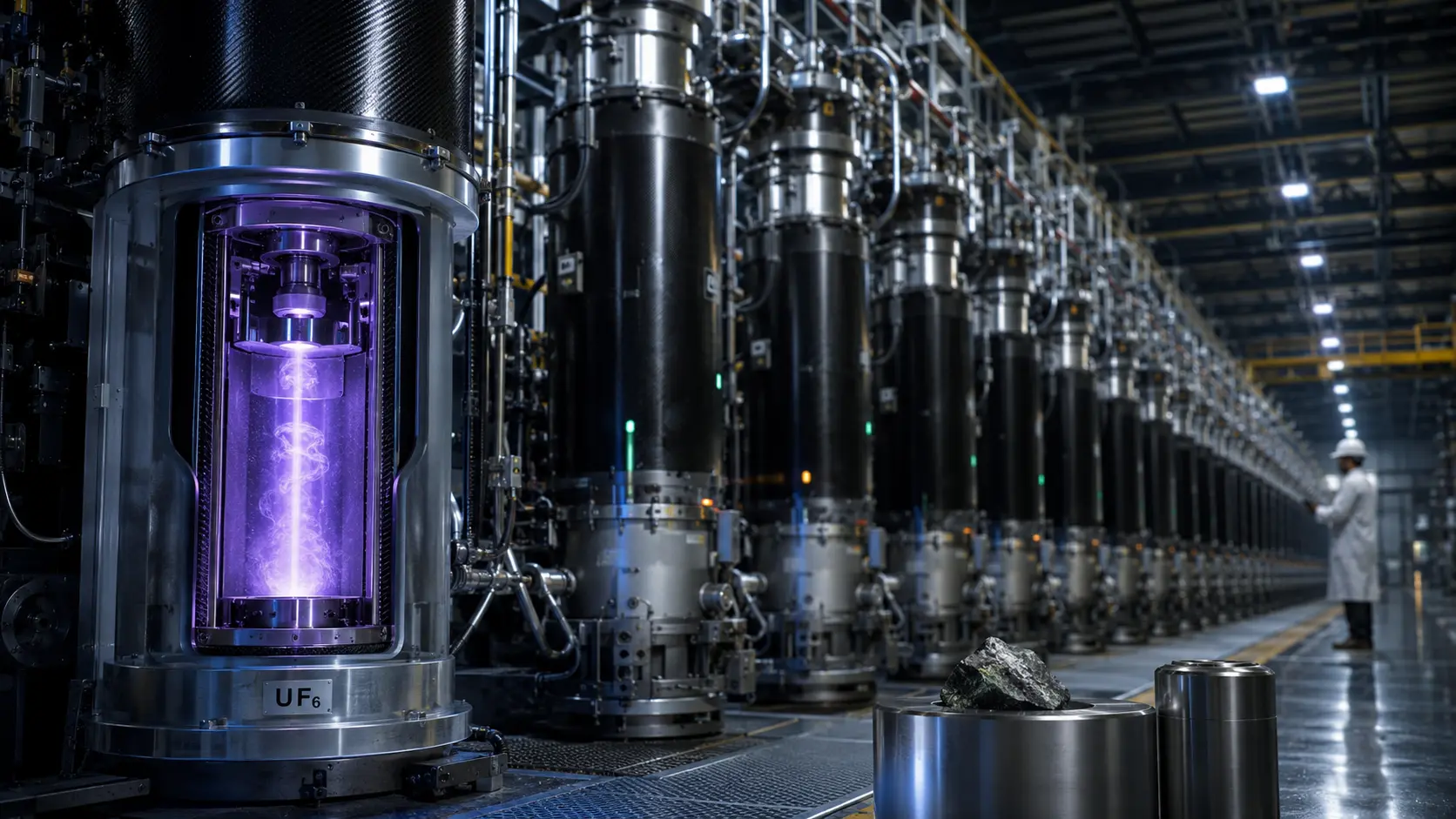
The uranium is converted into a highly corrosive gas called uranium hexafluoride UF6. This gas is piped into a carbon-fiber centrifuge spinning at tens of thousands of revolutions per minute. The extreme centrifugal force pushes the slightly heavier U-238 atoms to the outer wall of the cylinder, while the slightly lighter U-235 atoms remain closer to the center.
A single centrifuge can only alter the concentration by a fraction of a percent. Therefore, the centrifuges are wired together in a massive serial network called a cascade. The slightly enriched gas from the center of the first machine is pumped into the second machine to be spun again, repeating the process hundreds of times.
To reach 19.75% enrichment, the cascade must physically run longer and consume vastly more electrical power than producing standard 5% fuel. Once enriched, the gas is chemically converted back into a solid powder, formed into metal alloys or ceramic pellets, and loaded into specialized transport casks engineered to prevent the highly concentrated fuel from physically interacting and triggering a criticality event during highway transit.
WHY IT MATTERS NOW
The entire future of the global nuclear renaissance is mathematically bottlenecked by HALEU production. Advanced reactors—like TerraPower’s Natrium reactor or X-energy’s high-temperature gas reactor—are significantly smaller than legacy nuclear plants. To generate massive amounts of energy from a small physical core, the fuel itself must be vastly more concentrated. Without HALEU, these highly subsidized climate technologies physically cannot operate.
This creates a severe, immediate geopolitical crisis. Currently, the only entity on Earth capable of producing and exporting commercial quantities of HALEU is TENEX, a subsidiary of the Russian state-owned nuclear corporation, Rosatom.
Western nations aggressively designing SMRs have inadvertently engineered a reactor architecture that mathematically requires fuel sourced exclusively from a geopolitical adversary. If Russia embargoes the export of HALEU, the deployment schedule for every advanced reactor in North America and Europe instantly freezes.
Recognizing this absolute dependency, the United States Department of Energy (DOE) is executing emergency capital deployment to domesticate the supply chain. Companies like Centrus Energy are slowly bringing American centrifuge cascades online in Ohio to break the Russian monopoly. However, building an enrichment facility requires navigating the most stringent, highly classified nuclear regulatory frameworks on Earth. You cannot build a centrifuge plant quickly; it requires years of precision manufacturing to source materials capable of surviving supersonic rotational stress and highly corrosive uranium gas.
WHAT MOST PEOPLE MISS
Climate advocates frequently promote SMRs for their ability to run for ten or twenty years without refueling. They completely miss the mechanical trade-off of that longevity.
You cannot make a nuclear fuel bundle last twenty years simply by building a better metal casing. The only way to extend a reactor’s core life is to physically cram exponentially more combustible U-235 atoms into the exact same physical space. A twenty-year reactor core is not just an energy storage device; it is a highly concentrated, localized stockpile of near-weapons-grade nuclear material. The transition to HALEU permanently alters the global security calculus, forcing civilian utility companies to manage fuel concentrations previously reserved for military nuclear submarines.
THE TRAJECTORY
Next 12–36 Months: The United States and European Union will finalize massive, state-backed purchase guarantees for domestically produced HALEU. By legally committing to buy billions of dollars of fuel at a fixed price, governments will de-risk the capital expenditure required for companies like Centrus to physically scale their centrifuge cascades.
Next Five Years: The industry will standardize the Type B transport casks specifically designed for HALEU. Current shipping containers are legally certified for 5% enriched fuel. Shipping 19.75% enriched fuel requires completely new, massively expensive steel and lead containers geometrically engineered with neutron-absorbing boron plates to satisfy updated international transport regulations.
Next Ten Years: The deployment of laser enrichment technology (SILEX). Instead of using mechanical centrifuges to spin the gas, engineers will fire precisely tuned lasers into the uranium hexafluoride. The laser will specifically excite only the U-235 atoms, allowing them to be separated magnetically. This will reduce the physical footprint of a HALEU production facility by over 70 percent, drastically cutting the capital cost of next-generation fuel.
What Could Go Wrong: If a nation successfully masters the production of 19.75% HALEU, the physical effort required to push that exact same cascade to 90% weapons-grade uranium is mathematically trivial. The global proliferation of HALEU enrichment facilities drastically shortens the “breakout time” required for a rogue state to successfully manufacture a nuclear weapon under the guise of commercial energy production.
Most Likely Outcome: The HALEU supply chain will become the most heavily subsidized and strictly monitored industrial sector in the Western world. True commercial deployment of SMRs will remain delayed until domestic centrifuge capacity can guarantee a sovereign, closed-loop fuel cycle physically independent of Russian or Chinese enrichment infrastructure.
KEY TERMS
- HALEU (High-Assay Low-Enriched Uranium): Uranium that is enriched so that the concentration of the U-235 isotope is between 5% and 19.75%.
- Isotope: Variants of a particular chemical element which differ in neutron number, and consequently in nucleon number; U-235 is fissile (splits easily), while U-238 is not.
- Centrifuge Cascade: A highly synchronized, massive network of thousands of spinning cylinders used to gradually separate heavier isotopes from lighter isotopes based on mass.
- Criticality Event: An uncontrolled, spontaneous nuclear chain reaction that can occur if highly concentrated nuclear fuel is not physically spaced or moderated correctly during transport.
- Breakout Time: The calculated time required for a nation to physically enrich its existing stockpile of commercial uranium into weapons-grade material.
SOURCES
- Department of Energy (DOE) — HALEU Availability Program and Domestic Enrichment Capacity
- International Atomic Energy Agency (IAEA) — Non-Proliferation Safeguards and the Transport of High-Assay Low-Enriched Uranium
- World Nuclear Association — Uranium Enrichment Technologies and the Global Nuclear Fuel Cycle
- Centrus Energy — American Centrifuge Technology and HALEU Production Economics