Advertisement
)

AT A GLANCE
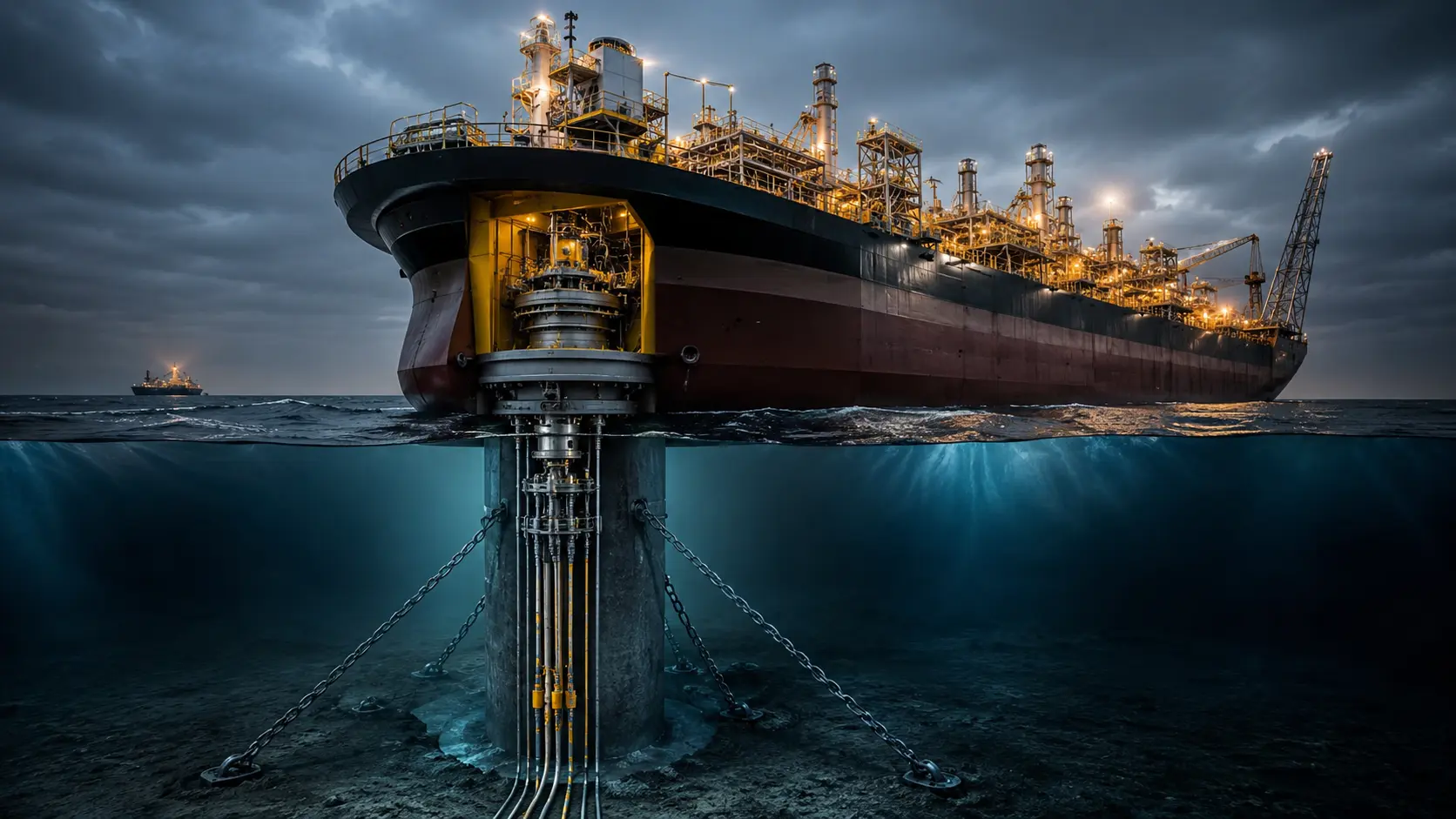
- Concept: Weathervaning: The ship naturally rotates around the stationary turret to face oncoming wind and waves.
- Concept: The Swivel Stack: Mechanical seals transfer highly pressurized oil from the static turret to the rotating hull.
- Concept: Flexible Risers: Reinforced thermoplastic pipes transport raw hydrocarbons thousands of feet vertically from the ocean floor.
- Concept: Asset Mobility: Unlike fixed platforms, an FPSO can physically disconnect and sail to a new continent.
HOW THE TURRET MOORING SYSTEM WORKS
Extracting oil two miles below the ocean surface requires a floating production facility. Engineers use a Floating Production Storage and Offloading (FPSO) vessel, a specialized supertanker acting as a self-contained offshore refinery.
Keeping a 300,000-ton steel vessel stationary during a Category 5 hurricane presents a severe hydrodynamic challenge. If the ship sits sideways to massive rogue waves, the structural stress will snap the anchor lines and capsize the hull.
To solve this, naval architects engineer a cylindrical cavity completely through the bow of the ship. They insert a massive steel cylinder called the turret. Heavy steel chains anchor the turret directly to the seafloor, rendering the cylinder physically immobile.
The hull of the ship connects to this stationary turret using massive roller bearings. This allows the entire FPSO to naturally “weathervane” or spin 360 degrees around the turret. The ship automatically rotates its narrow bow into the oncoming wind and waves, mathematically minimizing the hydrodynamic profile and surviving cyclonic sea states.
The primary mechanical friction occurs at the fluid transfer point. Flexible pipes, called risers, pump raw, highly pressurized oil from the seabed directly up through the center of the stationary turret.
To move this oil into the storage tanks of the rotating ship, engineers utilize a complex swivel stack. This stack uses precision-machined mechanical seals to maintain a leak-proof, high-pressure fluid connection between the static cylinder and the spinning hull, operating continuously under extreme mechanical shear.
WHY IT MATTERS NOW
The center of gravity for global oil production is moving rapidly into ultra-deep water. Terrestrial shale fields face rapid depletion rates, forcing major energy companies to seek massive, untapped reservoirs far off the coasts of South America and West Africa.
Constructing traditional fixed-leg oil platforms in 10,000 feet of water is physically impossible. Pumping the oil back to shore via subsea pipelines is economically unviable across deep ocean trenches.
The FPSO physically bypasses both limitations. Because the vessel extracts, refines, and stores the oil onboard, it functions as an entirely sovereign, untethered infrastructure node. Offtake tankers simply pull up alongside the FPSO, load the refined crude, and sail directly to global markets.
This architecture dictates the current economic explosion in Guyana. The country lacks the domestic pipeline infrastructure to process raw hydrocarbons. ExxonMobil bypassed the need for onshore facilities entirely by deploying a fleet of turret-moored FPSOs directly over the Stabroek block, transforming a nation with zero oil infrastructure into a top global exporter in less than five years.
Specialized marine engineering firms like SBM Offshore and MODEC control the proprietary designs for these massive turret systems. Securing a manufacturing slot for a new FPSO turret requires billions in upfront capital and dictates the exact timeline for when a nation can monetize its offshore reserves.
WHAT MOST PEOPLE MISS
Energy economists frequently evaluate offshore oil fields based on the fixed cost of platform construction. They completely miss the liquidity premium created by a disconnectable turret mooring system.
A traditional offshore rig is a stranded asset; when the well runs dry, the platform becomes worthless scrap. An FPSO can simply drop its mooring lines, sail across the Atlantic to a newly discovered oil field off the coast of Namibia, and immediately resume production. This mobility turns deepwater extraction infrastructure from a sunk cost into a highly liquid, relocatable capital asset.
THE TRAJECTORY
Next 12–36 Months: Energy conglomerates will aggressively standardize FPSO hull designs. By separating custom turret engineering from the ship’s primary construction, builders will shave years off delivery schedules and crash capital expenditure costs.
Next Five Years: The partial electrification of the FPSO fleet. Operators will replace onboard gas turbines with high-voltage subsea cables connected to onshore renewable grids, eliminating the vessel’s parasitic emissions and maximizing the volume of gas available for commercial export.
Next Ten Years: The deployment of fully subsea factories. Engineers will move the processing and separation equipment from the floating hull directly to the seafloor, utilizing the turret purely for transferring finished fluids to transport ships.
What Could Go Wrong: If a swivel stack seal fails under extreme high pressure during a cyclonic rotation, it will trigger a catastrophic hydrocarbon blowout. Because the oil transfers directly at the surface interface, the spill would vent instantly into the open ocean, bypassing traditional subsea blowout preventers.
Most Likely Outcome: The turret-moored FPSO will remain the dominant infrastructure model for deepwater oil. It acts as the primary geopolitical tool for establishing offshore energy sovereignty in regions devoid of terrestrial pipeline networks.
KEY TERMS
- Floating Production Storage and Offloading (FPSO): A specialized marine vessel used by the offshore oil and gas industry to process and store raw hydrocarbons at sea.
- Weathervaning: The physical tendency of a moored ship to rotate freely around a fixed point to align its bow with the prevailing wind and ocean currents.
- Swivel Stack: A highly engineered mechanical joint that allows high-pressure fluids to transfer safely between a stationary pipe and a rotating structure.
- Flexible Riser: A reinforced, multi-layered pipe that transports raw oil and gas from the high-pressure seabed up to a floating surface vessel.
SOURCES
- Society of Petroleum Engineers (SPE) — Hydrodynamic Responses and Turret Mooring Dynamics in FPSO Design
- SBM Offshore — Technical Specifications of Internal Turret Mooring Systems
- Bureau of Ocean Energy Management (BOEM) — Deepwater FPSO Operational Safety and Swivel Stack Integrity
- Oxford Institute for Energy Studies — The Geopolitics of Deepwater Basins and FPSO Deployment Economics