Advertisement
)

AT A GLANCE
- Concept: Supersonic Combustion: Igniting fuel in an airstream moving faster than the speed of sound.
- Concept: The Isolator: A specific geometric tunnel inside the engine that stabilizes incoming airflow before it hits the fuel.
- Concept: Shock Train: A complex series of “X” shaped pressure waves that compress the air without using moving parts.
- Concept: Aerodynamic Unstart: A catastrophic failure where internal pressure blows the shock wave out the front of the intake.
How the Scramjet Engine Powers Hypersonic Flight
Standard jet engines use spinning turbine blades to compress incoming air before mixing it with fuel. When an aircraft exceeds Mach 3, these physical blades become a catastrophic liability. They melt or shatter under the extreme kinetic heat and atmospheric pressure.
To fly faster, aerospace engineers remove the moving parts entirely. A traditional ramjet uses the sheer forward speed of the aircraft to ram air into a narrowing funnel, slowing the air down to subsonic speeds for combustion. Slowing air from Mach 5 down to subsonic speeds generates massive thermodynamic drag, permanently capping the top speed of a standard ramjet.
A scramjet—supersonic combustion ramjet—bypasses this physical limit by keeping the airflow supersonic throughout the entire engine block. Igniting fuel in a supersonic airstream is mathematically identical to keeping a match lit inside a Category 5 hurricane. To prevent the flame from blowing out, engineers insert a specialized geometric section called the isolator duct just before the combustion chamber.
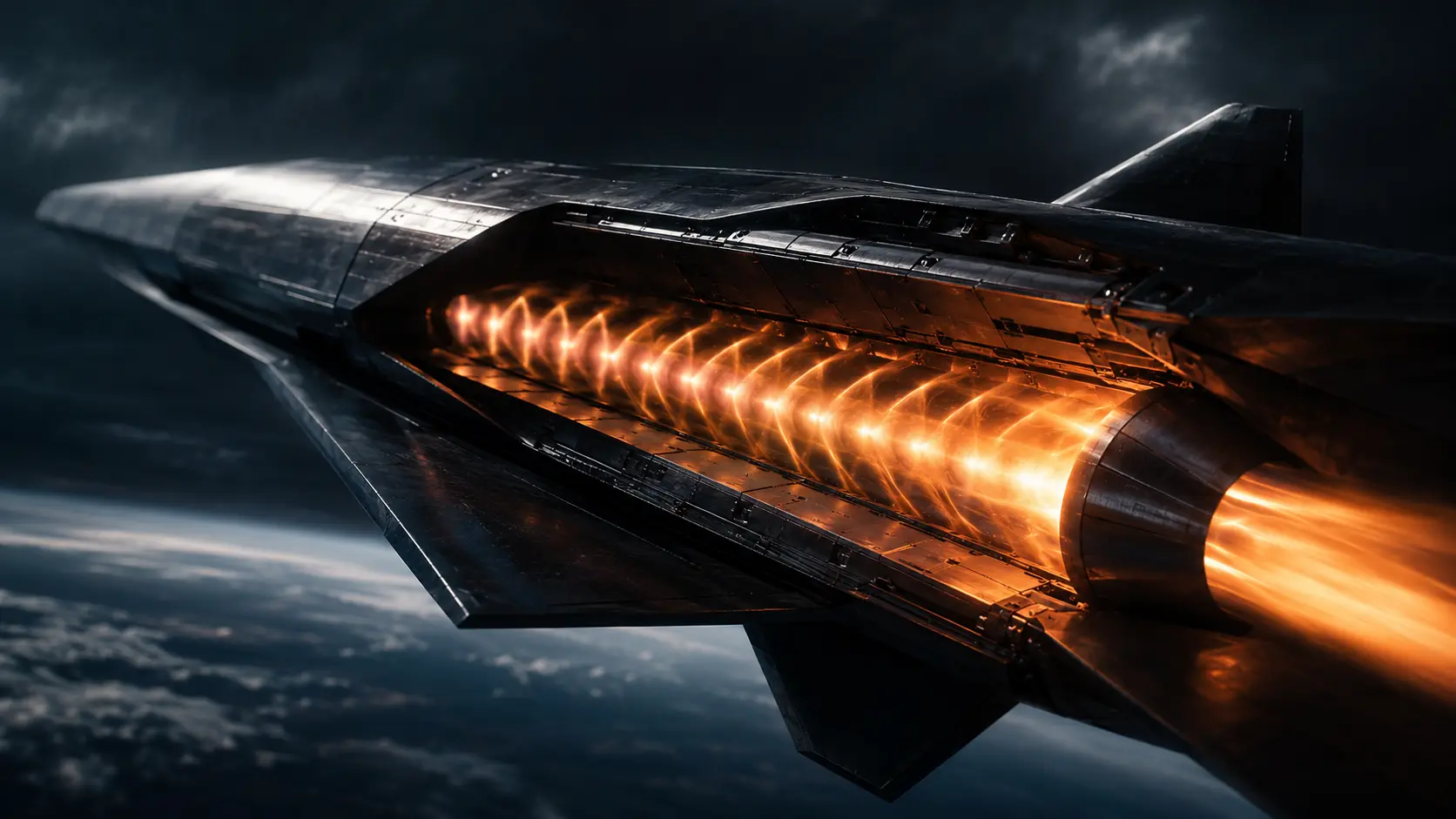
Inside the isolator, the physical geometry forces the incoming air to bounce off the interior walls. This generates a sequence of overlapping compression waves known as a shock train. This shock train carefully compresses the oxygen and slows it to a lower supersonic velocity, creating the exact pressure conditions required for continuous fuel ignition.
Why Hypersonic Cruise Missiles Matter Now
Global military powers are locked in a race to field hypersonic weapons capable of evading modern air defense networks. While hypersonic glide vehicles rely on massive, expensive rocket boosters to reach space before gliding back down, scramjet-powered cruise missiles operate entirely within the Earth’s atmosphere.
Because a scramjet breathes atmospheric oxygen, it does not need to carry heavy, volatile liquid oxidizer tanks. This structural efficiency allows defense contractors to build hypersonic missiles that are significantly smaller, cheaper, and lighter than ballistic alternatives.
A smaller physical footprint allows existing tactical aircraft, like the F-15EX or F/A-18, to carry these weapons in high quantities. This fundamentally shifts the geopolitical arithmetic of power projection. A single carrier strike group can now ripple-fire dozens of hypersonic cruise missiles, instantly overwhelming adversary radar networks.
Programs like the Defense Advanced Research Projects Agency (DARPA) Hypersonic Air-breathing Weapon Concept (HAWC) actively demonstrate this capability. These systems maintain sustained Mach 5 flight at low altitudes, flying underneath the tracking horizon of early-warning ballistic missile radars and granting targets mere seconds of reaction time.
WHAT MOST PEOPLE MISS
Aerospace commentators frequently measure hypersonic success purely by top-speed telemetry. They entirely ignore the microscopic fluid dynamics happening millimeters away from the interior engine wall, where the supersonic boundary layer dictates the survival of the aircraft.
As air flows through the scramjet, friction causes the air touching the metal walls to slow down, creating a sluggish boundary layer. If the combustion process in the back of the engine creates too much pressure, it forces this slow boundary layer to reverse direction and flow backward toward the intake.
This pressure reversal triggers a catastrophic event known as an aerodynamic unstart. The internal shock train violently detaches and spits out the front of the engine intake. The scramjet instantly loses all thrust, transforming the multi-million-dollar missile into a dead, unpowered aerodynamic brick in a fraction of a millisecond.
The Future Trajectory of Scramjet Engine Technology
Next 12–36 Months: Defense contractors will move from isolated flight tests to integrated weapons system evaluations. Early air-breathing hypersonic missiles will enter limited initial production, prioritizing software that dynamically adjusts fuel injection rates to actively manage isolator pressure and prevent unstarts.
Next Five Years: The integration of advanced high-temperature ceramics. Scramjet combustion creates thermal loads exceeding 2000°C. Manufacturers will deploy carbon-silicon carbide composite engine walls to survive prolonged hypersonic friction without relying on heavy active liquid cooling loops.
Next Ten Years: The commercialization of dual-mode propulsion systems. Engineers will combine traditional turbine engines with scramjet flow paths in a single reusable vehicle. This architecture will allow space planes to take off from a standard runway, accelerate to Mach 6, and reach low earth orbit without dropping booster stages into the ocean.
What Could Go Wrong: Severe high-altitude atmospheric variance. Scramjet shock trains require highly predictable air density to function safely. If a missile flies through an unexpected pocket of low-density upper-atmospheric air, the shock train geometry will instantly collapse, causing a high-speed unstart and vehicle destruction.
Most Likely Outcome: Scramjet propulsion will become the standard architecture for atmospheric high-speed strike platforms. The sheer cost advantage of utilizing atmospheric oxygen guarantees that air-breathing systems will eventually outnumber highly expensive rocket-boosted glide vehicles.
Key Terms in Hypersonic Flight
- Scramjet: A supersonic combustion ramjet engine that maintains supersonic airflow throughout its entire internal geometry to enable extreme high-speed flight.
- Isolator Duct: A physical section of a scramjet engine designed to generate shock waves that compress and stabilize incoming air before it reaches the fuel.
- Shock Train: A complex series of overlapping, stationary pressure waves that slow down supersonic air and increase its pressure without using moving parts.
- Boundary Layer: The thin layer of air immediately touching the interior surface of the engine, which moves slower than the main airflow due to mechanical friction.
- Aerodynamic Unstart: A severe engine failure where internal combustion pressure forces the shock waves out the front of the intake, resulting in an immediate loss of thrust.
SOURCES
- United States Air Force Research Laboratory (AFRL) — Scramjet Propulsion and Isolator Duct Dynamics
- National Aeronautics and Space Administration (NASA) — Hypersonic Air-Breathing Propulsion Mechanics
- Defense Advanced Research Projects Agency (DARPA) — Hypersonic Air-breathing Weapon Concept (HAWC) Flight Data
- American Institute of Aeronautics and Astronautics (AIAA) — Boundary Layer Separation and Engine Unstart in Scramjet Flowpaths