
AT A GLANCE
- Concept: Acoustic Decoupling: Trailing arrays kilometers astern escapes the deafening mechanical noise of the towing ship.
- Concept: Breathing Waves: Fluid-filled hoses suffer from internal physical vibrations caused by high-speed towing.
- Concept: Digital Beamforming: Algorithms delay and sum sensor inputs to steer a virtual listening cone.
- Concept: Flow Noise Rejection: Wavenumber filtering mathematically deletes slow-moving physical vibrations from true acoustic signals.
HOW IT WORKS
Submarines and surface warships emit constant acoustic energy into the water. Propellers cavitate. Nuclear reactor pumps hum.
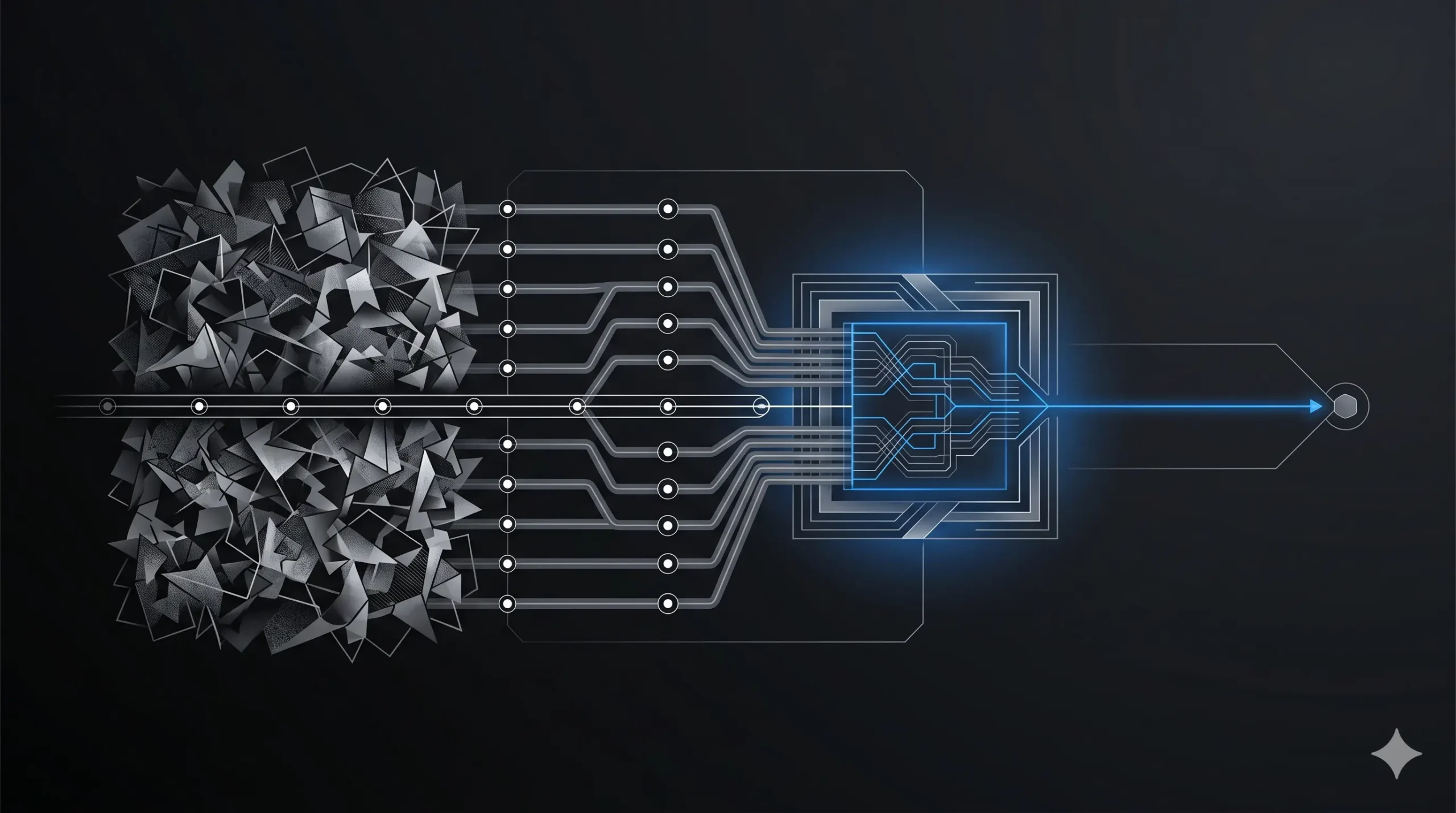
To hunt these targets passively, naval vessels deploy linear hydrophone towed arrays. They unspool a fluid-filled, flexible hose containing hundreds of piezoelectric sensors up to several kilometers behind the ship. This massive physical separation acts as an acoustic buffer, isolating the sensors from the towing vessel’s own mechanical noise.
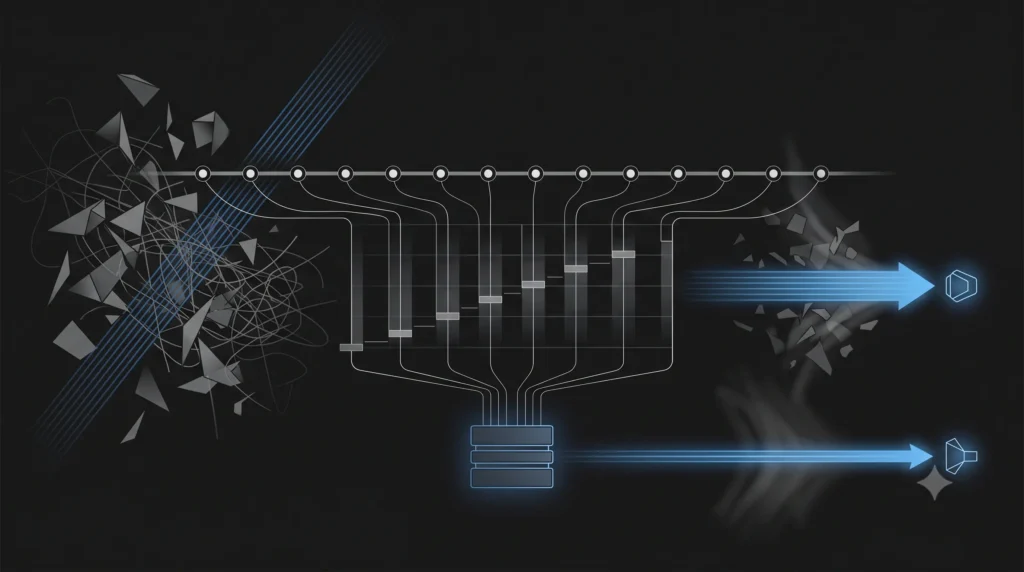
The system relies on beamforming algorithms. Sound waves from a distant enemy submarine strike the array at an angle, hitting each hydrophone at a slightly different microsecond. By mathematically delaying the signals from the closer sensors and summing them together, the central processor creates a highly focused, highly directional listening beam.
The true engineering challenge is separating true acoustics from hydrodynamic drag. Towing a massive cable creates turbulent boundary layers and physical breathing waves inside the fluid-filled hose.
Advanced signal processors apply wavenumber-frequency filtering to solve this problem. Because physical vibrations travel down the cable at a different phase speed than sound travels through water, the algorithm mathematically deletes the drag noise while preserving the faint enemy signature.
WHY IT MATTERS NOW
Modern undersea warfare operates entirely in the dark. Radar and optical sensors cannot penetrate deep water. Acoustic superiority dictates absolute maritime dominance.
In recent years, adversarial navies drastically reduced the acoustic signatures of their ballistic missile submarines. They deploy advanced anechoic hull coatings and magnetic bearings that eliminate metal-on-metal pump friction. This acoustic stealth renders traditional active pinging sonars obsolete, as pinging instantly gives away the hunter’s own location.
Navies must rely on passive listening over immense distances to maintain their nuclear deterrents. A U.S. Virginia-class submarine dragging a thin-line array can silently track a target hundreds of miles away simply by analyzing microscopic, narrow-band frequency disturbances in the water.
This creates an intense, multi-billion-dollar industrial arms race. Top-tier defense contractors like Lockheed Martin and Thales Group continually refine digital signal processing architectures. The nation that successfully isolates the faintest narrow-band frequencies from turbulent ocean clutter effectively controls the world’s shipping lanes.
WHAT MOST PEOPLE MISS
Mainstream defense analysis fixates on hull shapes, pump-jet propulsors, and reactor quietness. Analysts mistakenly assume that the quietest submarine automatically wins a subsurface engagement.
The hidden operational reality lies entirely in the fluid dynamics of the towed array itself. To listen effectively, a submarine must physically slow down.
Dragging a miles-long array at sprint speeds induces catastrophic turbulent boundary layer noise, blinding the acoustic sensors entirely. A commander must constantly trade physical evasion speed for the acoustic clarity required to acquire a target.
THE TRAJECTORY
Next 12–36 Months: Navies will aggressively deploy unmanned surface vessels dragging miniaturized linear arrays. These drone fleets will form massive, networked acoustic tripwires across contested maritime choke points like the South China Sea.
Next Five Years: Processing architecture will shift from central submarine mainframes directly to the sensor nodes. Individual hydrophones will feature embedded AI chips that run local flow-noise rejection algorithms. They will send only compressed, high-fidelity targeting data back up the tow cable to preserve bandwidth.
Next Ten Years: Quantum magnetometers and laser-based optical hydrophones will begin to replace traditional piezoelectric sensors. These materials will physically ignore hydrodynamic flow noise entirely. This allows submarines to maintain perfect acoustic tracking while moving at flank speed.
What Could Go Wrong: Underwater thermal layers act as physical mirrors, bouncing and hiding sound waves. If global ocean temperatures fluctuate unpredictably due to climate shifts, legacy beamforming algorithms trained on historical salinity models will completely fail to track deep-water targets.
Most Likely Outcome: The acoustic advantage will permanently shift from the physical submarine to the software processing layer. The navy with the most advanced supercomputing capacity to process immense, real-time Fourier transforms will systematically eliminate adversarial submarines from the battlespace.
KEY TERMS
- Hydrophone: An underwater acoustic microphone that converts changes in water pressure into electrical voltages.
- Beamforming: A signal processing technique that mathematically delays and sums sensor inputs to create a highly focused, directional listening capability.
- Flow Noise: The non-acoustic interference generated by the turbulent physical friction of water dragging against a moving sensor array.
- Wavenumber-Frequency Filtering: A mathematical algorithm used to separate slow-moving mechanical cable vibrations from high-speed acoustic sound waves.
- Anechoic Coating: Specialized rubber or synthetic tiles applied to a submarine hull to absorb active sonar pings and dampen internal mechanical noise.
SOURCES
- IIT Palakkad — An Axisymmetric Model for Predicting Turbulent Flow Noise in Towed Sonar Arrays
- NAUN — Identification and Removal of Non-Acoustic Noise in Towed Array Sonar Using F-K Transform
- TNO Defence Research — Nature and Causes of Flow-Induced Noise on a Sonar with a Towed Triplet Array Receiver
- U.S. Patent and Trademark Office — Patent US6408978B1: Non-Acoustic Self-Noise Canceller for Sensor Arrays