
AT A GLANCE
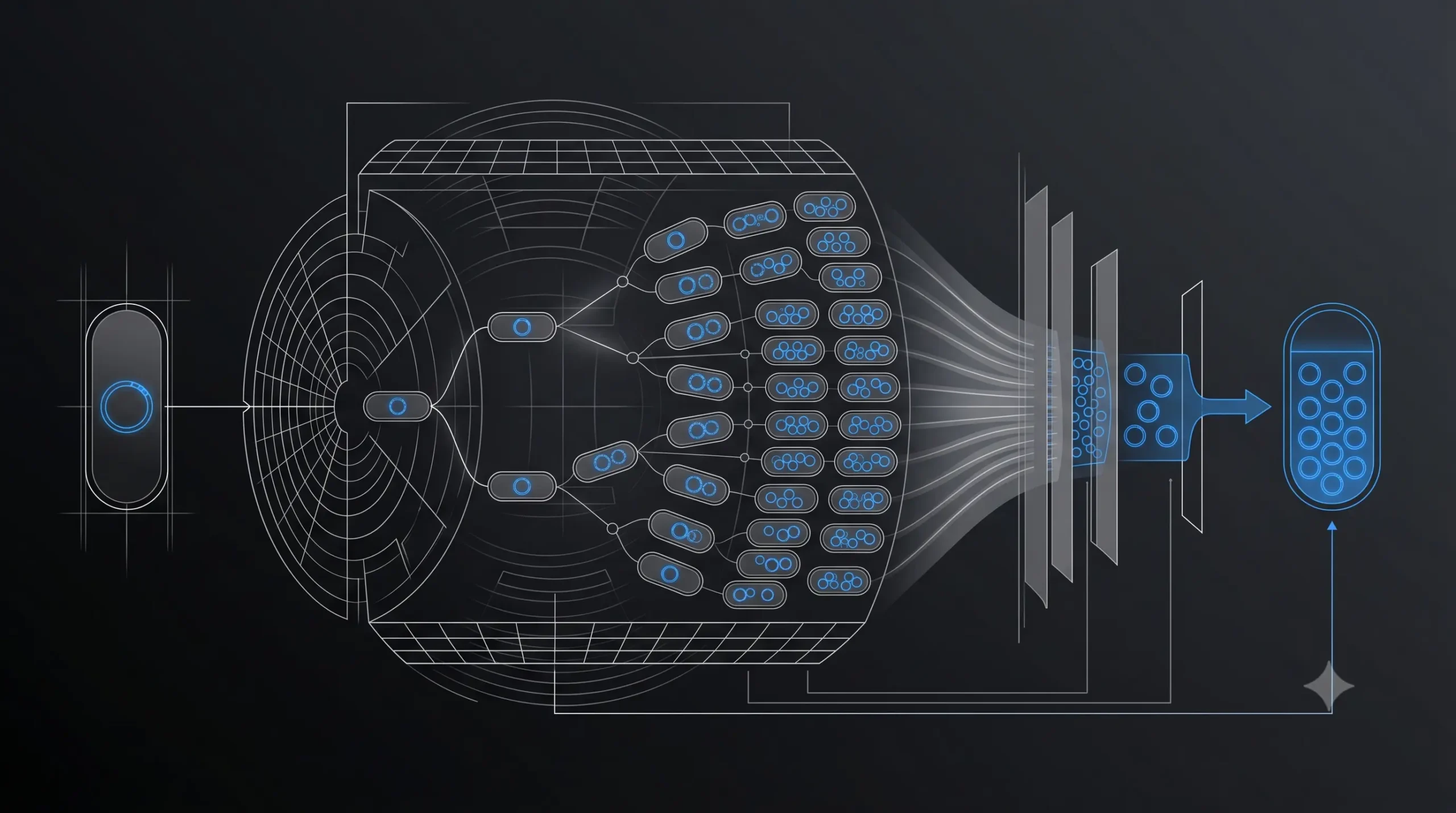
- Concept: Plasmids: Small, circular rings of double-stranded DNA separate from the main bacterial chromosome.
- Concept: Fermentation: Stainless steel bioreactors cultivate optimized strains of Escherichia coli to replicate these DNA rings.
- Concept: Alkaline Lysis: Corrosive chemicals physically shatter the bacterial cell walls to release the genetic material.
- Concept: The Supply Choke: Clinical-grade gene therapies face severe production limits due to low upstream bacterial yields.
HOW IT WORKS
Modern genetic medicine requires a physical blueprint. Whether engineers manufacture an mRNA vaccine or a viral vector for CAR-T cell therapy, the process begins with a plasmid. A plasmid is a closed loop of synthetic double-stranded DNA carrying the specific therapeutic code.
You cannot print this code at a commercial scale using pure chemistry. You must grow it using biology. Engineers insert the synthetic plasmid into a host organism, universally a highly characterized strain of Escherichia coli.
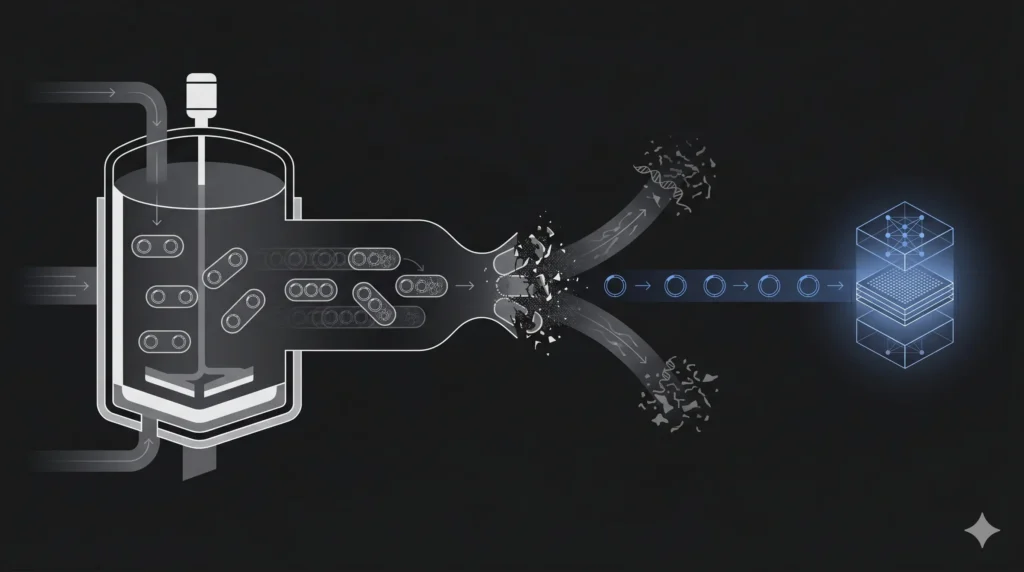
They place these engineered bacteria into a stainless steel fermentation bioreactor. A highly controlled broth provides exact ratios of carbon, nitrogen, and trace minerals. The bacteria consume the nutrients, multiplying exponentially while continuously copying the foreign plasmid.
The core objective is maximizing the plasmid copy number. Engineers manipulate temperature and oxygen transfer rates to force a single bacterial cell to produce hundreds of identical copies of the DNA ring before it divides.
Once the bioreactor reaches maximum density, the extraction phase begins. The system harvests the bacteria and subjects them to alkaline lysis. This aggressive chemical step uses sodium hydroxide and sodium dodecyl sulfate to dissolve the cell membranes entirely.
The alkaline environment denatures the bacterial proteins and chromosomal DNA. The smaller, supercoiled plasmid DNA remains intact. By neutralizing the solution with acidic potassium acetate, engineers precipitate the cellular garbage into a solid mass, leaving the purified liquid plasmid DNA ready for downstream filtration.
WHY IT MATTERS NOW
Public markets fixate on the clinical success of advanced gene editing and personalized medicine. They ignore the industrial plumbing required to deliver these treatments. Plasmid DNA serves as the absolute baseline raw material for the entire genetic medicine industry.
Without bulk plasmid DNA, you cannot manufacture the viral vectors that deliver CRISPR sequences. You cannot transcribe the mRNA used in next-generation oncology vaccines. The physical capacity to brew these bacterial templates dictates the total output of global genetic therapeutics.
A single dose of a rare disease gene therapy often requires billions of viral vectors. Producing those vectors requires massive quantities of clinical-grade plasmid DNA. Because standard E. coli fermentation yields historically max out at a few grams of DNA per hundred liters of culture, production facilities operate at a constant deficit.
This biological deficit directly impacts global healthcare costs. When a single-dose gene therapy prices at two million dollars, a significant percentage of that cost stems directly from the complex Good Manufacturing Practice (GMP) requirements of plasmid bioprocessing. Major contract manufacturers like Danaher and Merck KGaA command absolute pricing power because they control the limited steel bioreactors capable of achieving clinical purity.
WHAT MOST PEOPLE MISS
Analysts look at software scaling models and assume biological manufacturing scales identically. They assume a thousand-liter bioreactor simply produces ten times more DNA than a hundred-liter bioreactor. The physics of fluid dynamics strictly forbid this.
As you increase the size of the bioreactor, the mechanical impellers must spin harder to distribute oxygen. This creates massive shear stress that physically rips the bacterial cells apart before they finish replicating the DNA.
Furthermore, scaling the alkaline lysis step requires mixing hundreds of liters of thick, highly viscous cellular sludge with corrosive bases. If the mixing takes even a few seconds too long, the chemicals irreversibly destroy the target therapeutic plasmids, instantly ruining a multimillion-dollar batch.
THE TRAJECTORY
Next 12–36 Months: Contract development and manufacturing organizations will push the physical limits of fed-batch fermentation. They will adopt highly tuned metabolic E. coli strains designed specifically to survive high shear stress environments, slightly easing the immediate clinical bottleneck.
Next Five Years: The industry will actively attempt to bypass the bacterial host entirely. Enzymatic, cell-free DNA synthesis technologies will reach commercial scale. These methods use purified polymerases to amplify DNA in a sterile tube, eliminating the need for living bacteria, toxic lysis chemicals, and massive stainless steel tanks.
Next Ten Years: Regulatory agencies will begin mandating the transition to cell-free continuous manufacturing for synthetic genetic templates. Legacy bacterial fermentation will relegate to producing low-grade, high-volume agricultural and veterinary biologics, while human medicine shifts entirely to rapid enzymatic printing.
What Could Go Wrong: Cell-free DNA amplification currently struggles to handle massive, complex genetic sequences without introducing critical transcription errors. If synthetic enzymes fail to replicate these complex sequences accurately, the industry will remain permanently tethered to the slower biological fidelity of living E. coli.
Most Likely Outcome: The market will permanently bifurcate. Simple, short-sequence vaccines will transition to rapid cell-free manufacturing architectures. Complex, multi-gene therapeutics will remain chained to optimized bacterial fermentation, forcing pharmaceutical companies to absorb the persistent high costs of alkaline lysis infrastructure.
KEY TERMS
- Plasmid DNA: A small, circular, double-stranded DNA molecule that is distinct from a cell’s chromosomal DNA and can replicate independently.
- Alkaline Lysis: A chemical extraction method that uses highly basic solutions and detergents to break open bacterial cells and separate plasmid DNA from cellular proteins.
- Copy Number: The specific number of identical plasmid DNA molecules contained within a single bacterial host cell.
- Good Manufacturing Practice (GMP): A system of strict regulatory standards ensuring that medicinal products consistently meet the quality requirements for human use.
- Viral Vector: A modified virus used as a biological vehicle to deliver engineered genetic material into a patient’s cells.
SOURCES
- BioProcess International — Overcoming Bottlenecks in Plasmid DNA Manufacturing
- Nature Technology Corporation — Optimization of E. coli Fermentation for Plasmid DNA Production
- Food and Drug Administration (FDA) — Chemistry, Manufacturing, and Control (CMC) Information for Human Gene Therapy Investigational New Drug Applications
- Biotechnology and Bioengineering — Scale-up of alkaline lysis for plasmid DNA purification