
AT A GLANCE
- Concept: Grain Orientation: Steel atoms align chemically during cold rolling to create a frictionless magnetic path.
- Concept: Lamination: Slicing the solid core into microscopic, insulated sheets physically prevents massive eddy currents.
- Concept: Winding: Technicians physically wrap thousands of pounds of pure copper wire by hand over several months.
- Concept: Material Monopoly: A severe global shortage of specialized core steel strictly dictates grid expansion timelines.
HOW IT WORKS
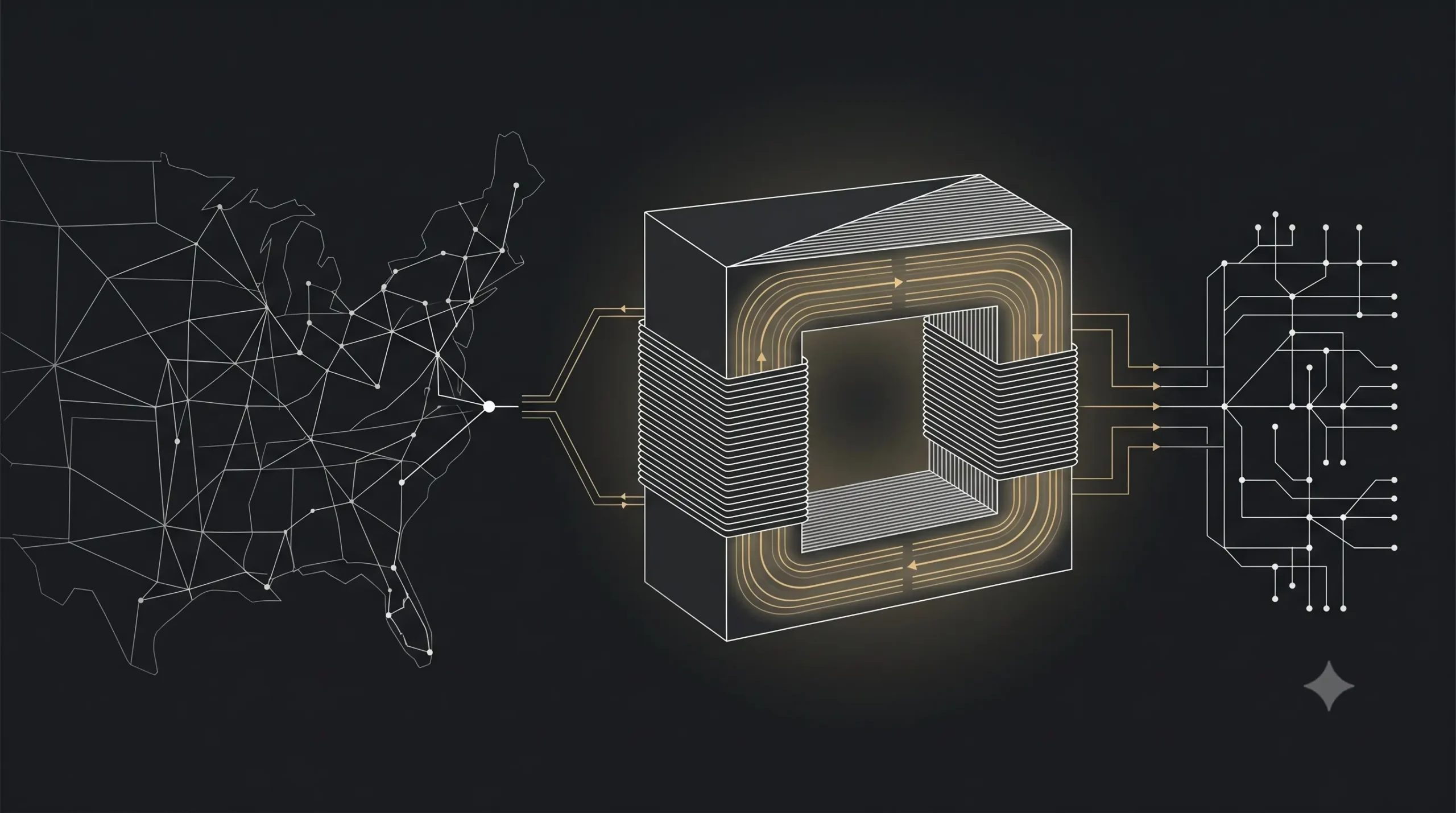
Electricity travels hundreds of miles from massive power plants to urban centers. To push current that far efficiently, grid operators raise the voltage to extreme levels, often exceeding 500,000 volts. Before this electricity enters a local neighborhood, it must hit a large power transformer to step down the voltage safely.
The process relies entirely on electromagnetic induction. The high-voltage input current runs through a primary copper coil, generating a massive, fluctuating magnetic field. A secondary copper coil sits nearby, capturing that magnetic field and converting it back into a lower-voltage electric current.
Air transmits magnetism poorly. To transfer the magnetic flux between the two coils without losing energy, engineers connect them with a physical bridge made of steel. This bridge is the transformer core.
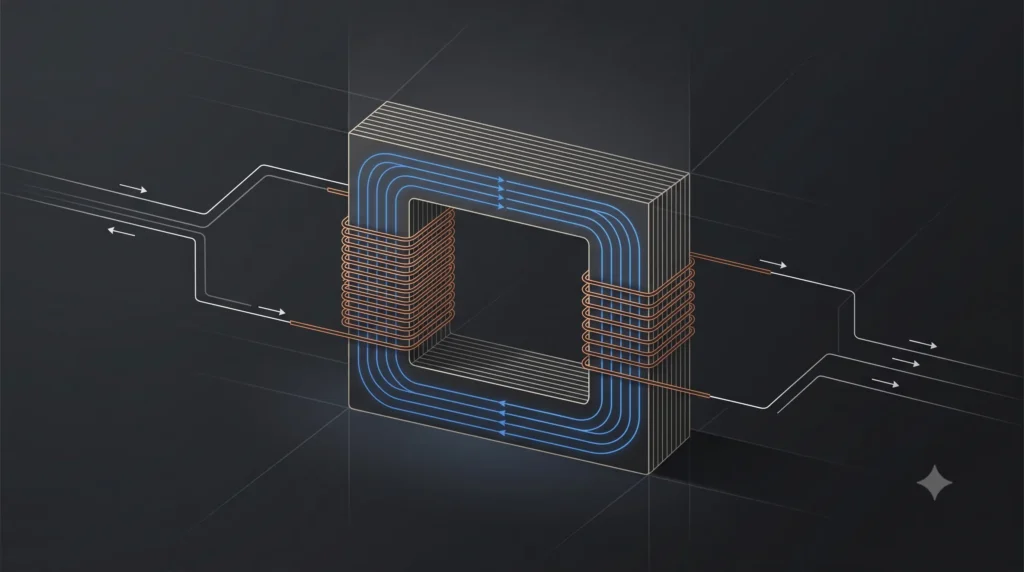
If the core consisted of a solid block of standard steel, the fluctuating magnetic field would induce swirling “eddy currents” inside the metal, turning the entire unit into a massive furnace. To stop this, metallurgists slice the core into thousands of paper-thin sheets, insulating each layer to trap the eddy currents. Engineers strictly utilize Grain-Oriented Electrical Steel (GOES). By cold-rolling the steel, they physically force the atomic crystal structure of the metal to align in one exact direction, eliminating atomic friction as the magnetic flux flows through the core.
WHY IT MATTERS NOW
Artificial intelligence data centers require gigawatt-scale electrical loads. A single modern hyperscale cluster demands the same baseload electricity as a mid-sized city. Feeding this extreme localized demand requires massive new substations, triggering a global run on large power transformers.
Before 2020, a utility could order a high-voltage transformer and receive it in 12 to 18 months. Today, the lead time averages 128 to 144 weeks. Major grid equipment manufacturers like Hitachi Energy and Siemens Energy have booked their entire factory capacities out past 2029.
This equipment backlog dictates the physical speed of the artificial intelligence boom. You can possess unlimited capital and acquire thousands of advanced graphics processing units, but you cannot energize the building without a physical step-down transformer.
This delay directly threatens national security. According to the North America Electric Reliability Corporation (NERC), over 70 percent of large power transformers in the United States exceed 25 years of age. Extreme weather events increasingly destroy these aging units. When a localized grid fails, the replacement parts simply do not exist in domestic inventory, forcing emergency rerouting that leaves adjacent infrastructure dangerously overstressed.
WHAT MOST PEOPLE MISS
Analysts observe the grid crisis and assume manufacturers simply need to automate more factories. They misunderstand the brutal physical reality of transformer manufacturing. You cannot mass-produce an extra-high-voltage transformer on an automated assembly line.
Every unit is a custom-engineered, multi-ton machine requiring intense manual labor. Workers must precisely cut, stack, and align thousands of ultra-thin GOES laminations entirely by hand to preserve the microscopic magnetic pathways. This painstaking manual construction, coupled with an extreme global monopoly on the production of the underlying GOES material, makes rapid capacity expansion physically impossible.
THE TRAJECTORY
Next 12–36 Months: Hyperscale cloud providers will bypass municipal utility queues entirely. They will acquire smaller electrical component manufacturers outright or sign decade-long, multi-billion-dollar supply agreements to monopolize future production slots.
Next Five Years: Foundries will push the physical limits of GOES thinness, deploying advanced laser-scribing techniques across the steel surface to physically force grain domain refinement. This mathematically reduces core losses further, marginally increasing the capacity of existing grid footprints without requiring larger physical substations.
Next Ten Years: Solid-state transformer architectures using advanced silicon carbide semiconductors will begin entering the grid. These digital units will convert voltages electronically rather than magnetically, slowly reducing the grid’s absolute dependence on heavy iron cores and specialized steel monopolies.
What Could Go Wrong: Cleveland-Cliffs operates the sole remaining GOES manufacturing facility in the United States. If an industrial accident or labor strike halts production at this specific Pennsylvania plant, the entire domestic supply of high-voltage core material drops to zero overnight, immediately stalling all American infrastructure projects.
Most Likely Outcome: The global grid will experience chronic, rolling development delays. Power transformer availability will replace capital funding and land acquisition as the absolute, inescapable bottleneck limiting heavy industrial electrification for the rest of the decade.
KEY TERMS
- Grain-Oriented Electrical Steel (GOES): A specialized silicon alloy cold-rolled to align its atomic crystal structure, significantly reducing magnetic friction in transformer cores.
- Eddy Currents: Unwanted electrical currents induced within a solid metal core by alternating magnetic fields, wasting massive amounts of energy as heat.
- Lamination: The manufacturing process of slicing a metal core into hundreds of thin, insulated sheets to physically restrict the formation of eddy currents.
- Generator Step-Up Transformer (GSU): A massive electrical unit placed directly outside a power plant to immediately elevate generated voltage for long-distance transmission.
- Hysteresis Loss: The energy wasted at the atomic level when the magnetic domains inside a steel core constantly reverse direction along with the alternating electric current.
SOURCES
- International Energy Agency (IEA) — Building the Future Transmission Grid
- North American Electric Reliability Corporation (NERC) — State of Reliability Report
- Wood Mackenzie — Large Power Transformer Supply Chain Analysis
- Department of Energy (DOE) — Supply Chain Deep Dive Assessment for Large Power Transformers