Advertisement
)

AT A GLANCE
- Concept: Mach 5: The velocity threshold exceeding 3,800 miles per hour where air physically turns to plasma.
- Concept: Glide Vehicle: An unpowered warhead that detaches from a rocket to surf the upper atmosphere.
- Concept: Scramjet: An engine that forces supersonic air into a funnel to ignite fuel without moving parts.
- Concept: Aerothermodynamics: The physics of managing extreme heat generated by atmospheric friction at extreme speeds.
IN SIMPLE WORDS
When a traditional ballistic missile fires, it travels like a baseball thrown high into the air. It follows a massive, predictable arc into space and falls back down. Because the path is predictable, an advanced radar can calculate exactly where it will land and shoot an interceptor to destroy it.
A hypersonic missile acts like a flat stone skipping across a pond. Instead of flying into deep space, it stays low within the Earth’s atmosphere. It maneuvers left, right, up, and down at thousands of miles per hour.
Because it never travels in a straight line, defense systems cannot predict where it is going. By the time a radar successfully tracks its location, the missile has already changed course and struck its target. It is a weapon designed specifically to bypass every existing defensive shield on Earth.
HOW IT WORKS
Engineers divide hypersonic weapons into two distinct architectural categories: Hypersonic Glide Vehicles (HGVs) and Hypersonic Cruise Missiles (HCMs). Both systems operate within the upper atmosphere to maintain aerodynamic lift, but they achieve their velocity through different physical mechanisms.
An HGV launches atop a traditional ballistic rocket. Once it reaches the edge of space, the glide vehicle physically detaches from the booster. Instead of falling in a predictable arc, it aggressively pitches its nose down to re-enter the atmosphere.
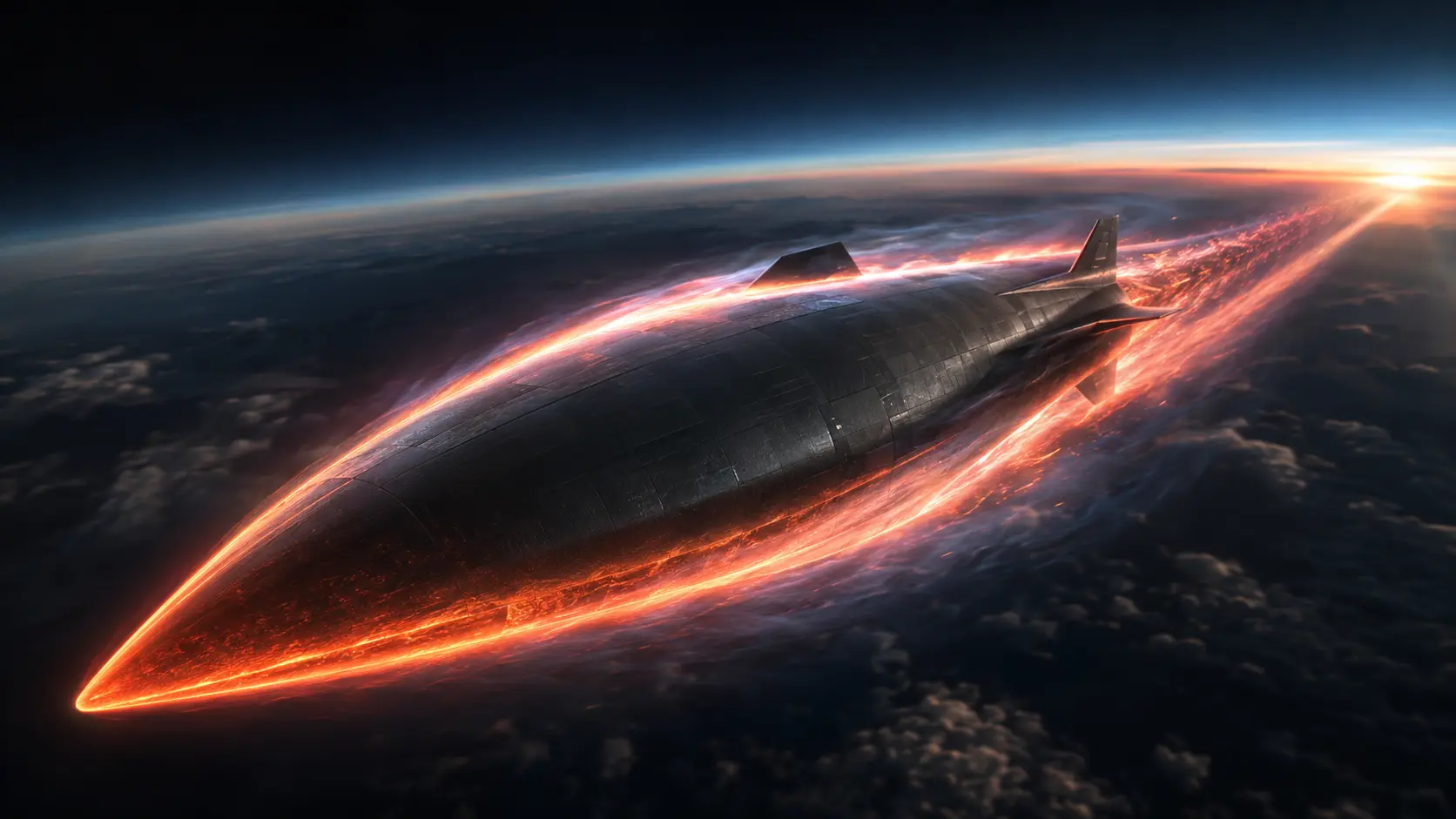
Upon hitting the dense air, the flat bottom of the vehicle generates immense aerodynamic lift. It “surfs” the shockwaves it creates, gliding toward its target at Mach 10 to Mach 20. Internal computers constantly adjust tiny control fins, steering the weapon through complex evasive maneuvers to spoof interceptor calculations.
Hypersonic Cruise Missiles operate entirely differently. They rely on an air-breathing engine known as a supersonic combusting ramjet, or scramjet. Traditional jet engines use spinning metal blades to compress incoming air before mixing it with fuel. At Mach 5, metal blades create too much drag and instantly melt.
A scramjet contains zero moving parts. It utilizes the extreme forward velocity of the missile itself to ram air into a precisely shaped internal funnel. This geometric funnel creates intersecting shockwaves—known as a shock train—that compress the air naturally.
The compressed air flows through the combustion chamber at supersonic speeds. Injecting and igniting liquid hydrocarbon fuel in this environment is mathematically equivalent to keeping a match lit in a hurricane. Advanced computational fluid dynamics ensure the fuel mixes and burns in milliseconds, generating continuous thrust entirely through geometric design.
REAL WORLD EXAMPLE
China currently operates the DF-17, a medium-range ballistic missile equipped with a hypersonic glide vehicle known as the DF-ZF. Traditional US early warning satellites detect the initial rocket launch instantly using infrared sensors.
However, once the DF-ZF detaches and begins its atmospheric glide, it drops below the radar horizon of naval ships. It travels at Mach 5 through the upper stratosphere, maneuvering unpredictably across the Pacific.
By the time a carrier strike group’s Active Electronically Scanned Array (AESA) radar picks up the incoming threat, the weapon is just minutes away from impact. The ship’s defense computers lack the mathematical certainty required to plot a successful intercept trajectory, rendering standard anti-missile batteries obsolete.
WHY HYPERSONIC WEAPONS MATTER NOW
Hypersonic weapons force a total rewrite of global deterrence theory. Legacy air defense networks, such as Patriot and THAAD batteries, rely on mathematical prediction. They track an incoming ballistic arc and fire an interceptor to meet the warhead at a specific future coordinate.
When an incoming weapon maneuvers horizontally at a mile per second, those predictive algorithms fail. This physical reality creates severe strategic instability. If a nation knows its defensive shields cannot stop a hypersonic strike, its only logical recourse is to strike first, vastly increasing the risk of immediate nuclear or conventional escalation.
Financially, this technology initiates a massive capital reallocation within the defense sector. Militaries are abandoning terrestrial radar upgrades to fund low-Earth orbit satellite constellations. Only a dense, space-based infrared tracking layer can maintain a continuous lock on a maneuvering glider skipping across the atmosphere.
This shift directly threatens power projection capabilities, specifically the aircraft carrier. The ability to sink a multi-billion-dollar supercarrier with a highly maneuverable, unstoppable kinetic strike creates an absolute Anti-Access/Area Denial (A2/AD) zone. Navies must push their fleets thousands of miles offshore, drastically reducing their operational effectiveness.
COMMON MISCONCEPTIONS
Many people assume hypersonics are the fastest weapons ever built. Intercontinental Ballistic Missiles (ICBMs) actually travel much faster in the vacuum of space, reaching Mach 25. The specific threat of a hypersonic weapon is its maneuverability inside the atmosphere, not its absolute top speed.
Observers frequently think scramjets can launch from a standstill on a runway. A scramjet physically cannot operate until it is already moving at Mach 4. It requires a separate solid-rocket booster to accelerate the weapon to the exact velocity where the internal shockwaves begin to function.
The public often views hypersonic missiles strictly as nuclear delivery systems. Militaries increasingly design them to carry conventional high-explosive warheads. The kinetic energy of an object striking a target at Mach 5 is so immense that it frequently destroys reinforced bunkers without requiring a nuclear payload.
WHAT MOST PEOPLE MISS
Geopolitical analysts focus heavily on the destructive capability of the missile, but they completely overlook the severe navigational blindness caused by the plasma sheath. When an object travels through the atmosphere at Mach 5, the friction heats the surrounding air to thousands of degrees.
This extreme heat physically strips electrons from the air molecules, creating a cloud of ionized plasma around the missile.
This plasma sheath acts as an impenetrable electromagnetic shield. It blocks GPS signals and external radar telemetry from reaching the weapon’s internal computers. To hit a moving target like a ship, the missile must rely on highly complex internal inertial navigation systems until the final seconds of flight when it slows down enough for the plasma to dissipate.
THE ECONOMIC AND STRATEGIC IMPACT
The primary economic beneficiaries of the hypersonic arms race are advanced material science corporations. The outer skin of these missiles must survive 2,000°C temperatures for sustained periods. Companies that manufacture ultra-high-temperature ceramics and carbon-carbon composites secure absolute pricing power in defense procurement.
Shipbuilding industries face a structural risk. If a single two-million-dollar missile can reliably penetrate the defenses of a fourteen-billion-dollar aircraft carrier, naval procurement will inevitably shift. Navies will redirect capital toward smaller, dispersed, unmanned surface vessels that distribute risk across a wider geographic area.
Control over hypersonic testing infrastructure also dictates industrial success. Developing these weapons requires massive, specialized wind tunnels capable of simulating Mach 10 airflow and extreme thermal stress. Nations that cannot afford to construct these highly specialized aerodynamic testing facilities will remain permanently reliant on foreign allies for hypersonic deterrence.
THE TRAJECTORY
Next 12–36 Months: Major defense contractors will scale the mass production of air-launched hypersonic cruise missiles. Fighters and bombers will carry scramjet-powered weapons, extending their strike ranges to thousands of miles while remaining safely outside enemy air defense bubbles.
Next Five Years: The deployment of targeted directed-energy defense systems. Traditional kinetic interceptors are too slow to hit a maneuvering glider. Navies will deploy megawatt-class laser weapons that move at the speed of light to physically burn through the carbon skin of incoming hypersonic threats.
Next Ten Years: The commercialization of scramjet architecture for space launch logistics. Private aerospace companies will adapt supersonic combustion to build single-stage-to-orbit spaceplanes. These craft will take off like airplanes and use atmospheric oxygen to reach orbit, heavily reducing the cost of delivering cargo to space.
What Could Go Wrong: Catastrophic thermal failure. The leading edges of a hypersonic vehicle endure extreme thermal stress. If a microscopic flaw exists in the ceramic matrix composite coating, the 2,000°C friction will physically eat through the missile’s nose in seconds, completely disintegrating the weapon mid-flight.
Most Likely Outcome: Hypersonic glide vehicles and scramjets will become the mandatory baseline for all strategic strike forces. The mathematical inability of physical interceptors to calculate maneuvering, high-speed trajectories ensures these weapons will define global deterrence for the next generation of warfare.
KEY TERMS
- Mach Number: A measurement of speed relative to the speed of sound; Mach 5 equates to roughly 3,800 miles per hour at sea level.
- Hypersonic Glide Vehicle (HGV): An unpowered, maneuverable warhead that detaches from a rocket to glide through the upper atmosphere toward its target.
- Scramjet: A supersonic combusting ramjet; an engine that uses the vehicle’s forward speed to compress air and burn fuel without spinning compressor blades.
- Aerothermodynamics: The branch of physics dealing with the extreme heating and physical forces generated when an object moves through a gas at high velocities.
- Plasma Blackout: A phenomenon where the intense heat of atmospheric friction ionizes the air, creating an electromagnetic shield that blocks communications and GPS.
- Shock Train: A complex series of intersecting shockwaves inside a scramjet engine used to slow and compress incoming air to the correct pressure for combustion.
BEGINNER FAQ
What does Mach 5 actually mean? Mach 1 is the speed of sound, which is about 760 miles per hour. Mach 5 means an object is traveling five times faster than the speed of sound, or roughly 3,800 miles per hour.
How is a hypersonic missile different from an ICBM? An Intercontinental Ballistic Missile (ICBM) shoots into deep space and falls in a predictable arc. A hypersonic missile stays low in the atmosphere and maneuvers unpredictably, making it much harder to shoot down.
Can current air defenses shoot them down? Most current air defenses cannot. Traditional systems like the Patriot rely on predicting where the missile will be. Because hypersonic missiles change direction constantly, the defense computer cannot calculate the correct intercept path.
What is a glide vehicle? It is a heavy, aerodynamic warhead containing explosives. A rocket boosts it to the edge of space, and then it detaches, surfing on top of the atmosphere to glide toward its target.
What is a scramjet? A scramjet is an advanced jet engine with no moving parts. It moves so fast that it rams air into an internal funnel, compressing and heating it enough to burn fuel instantly.
How hot does a hypersonic missile get? Flying through the atmosphere at Mach 5 creates extreme friction. The front edges of the missile can easily reach temperatures exceeding 2,000 degrees Celsius, which melts normal metals like steel or titanium.
Why do they create a plasma shield? The extreme heat literally rips electrons away from the air molecules surrounding the missile. This creates a highly charged layer of plasma that blocks radar and radio signals from getting in or out.
Who currently has hypersonic weapons? Russia and China have both actively deployed hypersonic weapons into their military arsenals. The United States and several European nations are currently testing and developing their own systems.
Are aircraft carriers obsolete now? Not entirely, but their role is changing. Because a hypersonic missile can bypass an entire carrier group’s defenses, navies will have to keep their expensive ships much further away from hostile shores to remain safe.
How will militaries defend against them? Militaries are building massive networks of satellites in low-Earth orbit to track the heat signatures of the missiles. To destroy them, navies are developing high-powered lasers that strike at the speed of light.
SOURCES
- Department of Defense (DoD) — Hypersonic Weapons: Background and Issues for Congress
- Defense Advanced Research Projects Agency (DARPA) — Hypersonic Air-breathing Weapon Concept (HAWC) and Scramjet Thermodynamics
- Center for Strategic and International Studies (CSIS) — Complex Air Defense and the Hypersonic Threat Landscape
- American Institute of Aeronautics and Astronautics (AIAA) — Thermal Protection Systems and Aerothermodynamic Heating in Mach 5+ Flight