Advertisement
)


If a government feeds its most sensitive military logistics, citizen health records, and electrical grid schematics into an artificial intelligence model, that AI becomes the ultimate national security asset. Yet, for the first half of the 2020s, countries blindly uploaded this exact data into massive, opaque public clouds owned by a handful of tech corporations based in California. This created an unprecedented vulnerability: an adversary or a foreign regulator could theoretically access, throttle, or shut down a nation’s foundational intelligence simply by issuing a corporate subpoena or flipping a server switch halfway across the globe.
That era of blind trust is over. Driven by an intense realization that AI supremacy is synonymous with geopolitical survival, nations are aggressively pulling their data back inside their own borders. They are spending billions to build “Sovereign AI Clouds“—localized supercomputers and custom-built algorithms physically locked within their own legal jurisdictions. Why should you care right now? Because the weaponization of data has completely fragmented the global internet. As new regulations mandate that citizens’ data cannot cross borders, the seamless, borderless cloud computing industry is fracturing into dozens of highly defended, nationalized digital fortresses.
What are Sovereign AI Clouds?
Sovereign AI clouds are localized artificial intelligence computing environments where the physical hardware, data storage, and model operations reside strictly within a specific geopolitical boundary. They are designed to comply with local data privacy laws and explicitly prevent foreign governments and extraterritorial entities from accessing national data.
At a Glance
- Concept: Building domestic data centers, importing localized hardware, and training native Large Language Models (LLMs) to ensure a country’s AI capabilities are legally and physically insulated from foreign interference.
- Why it matters:The U.S. CLOUD Act allows the American government to compel U.S.-based hyperscalers (like AWS, Google, or Microsoft) to hand over data, even if the servers are physically located in Europe. Sovereign clouds block this extraterritorial reach.
- Who uses it: Nation-states (e.g., France, Japan, UAE, Saudi Arabia), defense contractors, and highly regulated industries like FinTech and HealthTech complying with strict regional laws.
- Biggest takeaway:The global Sovereign AI Infrastructure market hit USD 24.8 billion in 2026. It is no longer just a government initiative; massive commercial sectors are being forced into sovereign clouds by overlapping global compliance mandates.
In Simple Words
Imagine a city deciding it needs a massive water purification plant.
Initially, it seems cheaper and easier to just run a long pipe to a giant purification plant in a neighboring country. For a few years, everything is great. But suddenly, the neighboring country threatens to cut off the water supply due to a political disagreement, or demands the right to monitor exactly who is drinking the water. The city realizes that relying on someone else for its most critical resource is a massive vulnerability.
In the 2020s, data became that critical resource, and AI became the purification plant.
Instead of sending their citizen data to massive data centers located in the US or China, countries are deciding they must build their own AI “plants” on their own soil. A Sovereign AI Cloud ensures that the computers running the AI, the data feeding the AI, and the people maintaining the AI are all bound by local laws. If a foreign government asks to see the data, the sovereign cloud operator can legally refuse, keeping the nation’s digital resources completely independent and secure.
Why This Matters
The infrastructure powering artificial intelligence is officially recognized as critical national infrastructure.
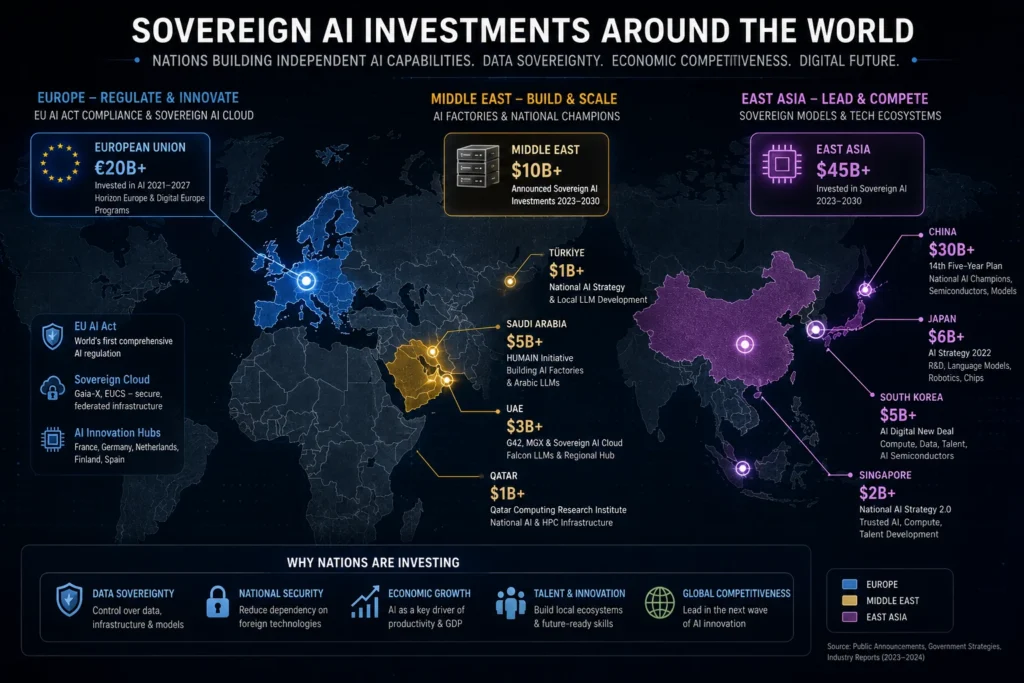
For tech policy makers and cloud executives, the shift to localized compute rewrites the rules of the global digital economy. Over 80 percent of tracked, publicly disclosed sovereign AI investments are currently pouring into the Middle East and East Asia, where governments are spending tens of billions on sovereign GPU clusters.The hardware requirement is massive, with physical compute infrastructure capturing 46 percent of the $24.8 billion sovereign AI market in 2026.
Simultaneously, the European Union’s aggressive regulatory environment—spearheaded by the August 2026 full application of the EU AI Act—is punishing non-compliance with fines of up to 7 percent of global annual turnover. For global corporations, operating a single, unified global cloud is no longer legally viable. Multinationals are being forced to deploy highly complex, multi-region cloud architectures, significantly driving up operating costs but ensuring their AI models do not violate local data sovereignty laws.
The Pursuit of Full-Stack Sovereign AI Infrastructure
Sovereignty is no longer just about where the server sits; it is about “full-stack” independence.
True AI sovereignty requires control over four distinct layers: the data, the foundation models, the computing hardware (GPUs), and the energy required to run them. Currently, the United States exercises massive influence over the hardware supply chain via export controls on cutting-edge silicon.
To break this dependency, nations are partnering aggressively with hardware manufacturers. Tech giants like NVIDIA have shifted their strategies to directly court nation-states, transitioning from simply selling chips to offering comprehensive “sovereign AI factory” enablement. However, while many countries can buy the hardware and localize the data, the ability to build advanced foundation models from scratch remains heavily concentrated in the US and China, exposing the reality that true “full-stack” sovereignty is currently an illusion for most of the world.
How a Sovereign AI Cloud Architecture Works
Achieving a sovereign cloud environment requires a strict combination of physical isolation, cryptographic barriers, and legal firewalls. Here is the first-principles breakdown.
1. The Fundamental Problem: Extraterritorial Jurisdiction
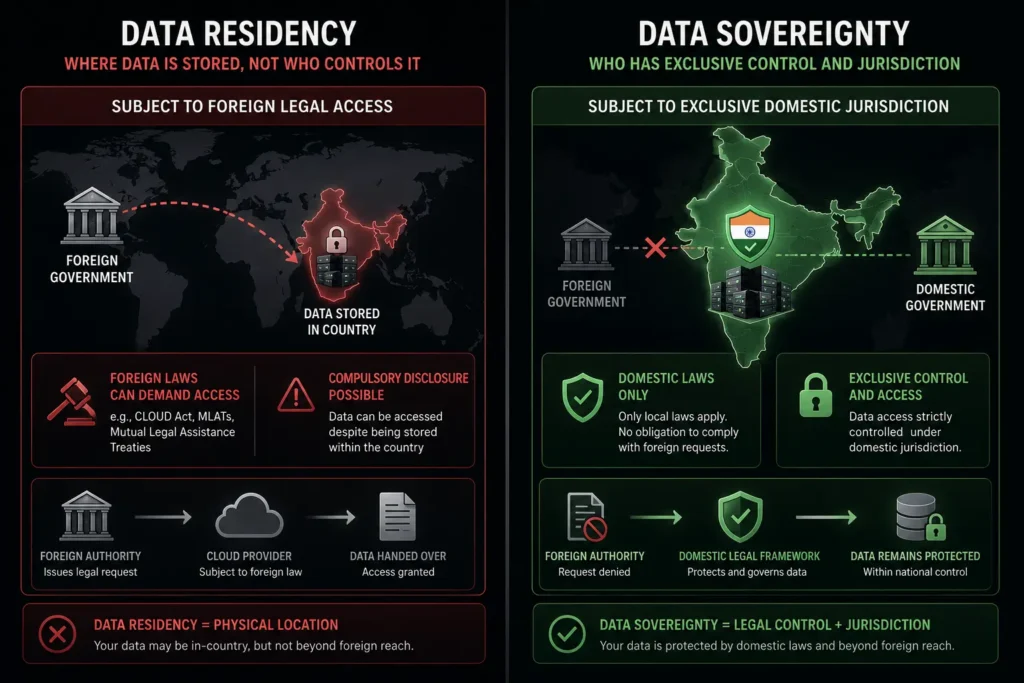
When a hospital in Paris uses a public cloud owned by a US company, the data might physically reside in a French data center (Data Residency). However, under laws like the US CLOUD Act or FISA, US intelligence or law enforcement can legally compel the US parent company to hand over that data. Because the legal jurisdiction extends across borders, simple data residency does not guarantee data sovereignty.
2. The Insufficiency of Standard Encryption
Companies tried to solve this by encrypting the data before sending it to the public cloud. However, to run an AI model, the data must usually be decrypted in the server’s memory to be processed. The moment it is decrypted, it becomes vulnerable to both hackers and foreign subpoenas.
3. The Core Mechanism: The Sovereign Architecture
A Sovereign AI Cloud completely severs the foreign legal link. It requires that the physical data centers are owned and operated by a domestic entity. Furthermore, the software stack is often “air-gapped” (physically disconnected from the public internet) or highly restricted. Operations, maintenance, and support are handled exclusively by citizens holding security clearances within that specific country.
4. Technical Depth: Sovereign Cloud Frameworks
To guarantee immunity from foreign access, governments establish strict certification frameworks. For example, France utilizes the “SecNumCloud” certification. A provider holding this certification guarantees both operational security and absolute legal sovereignty—proving mathematically and legally that no foreign entity can access the data, compelling U.S. hyperscalers to form joint ventures with local telecom giants to legally separate their infrastructure.
5. Real-World Consequences: Localized Foundation Models
With the hardware legally secured, nations are training customized Large Language Models (LLMs) on local datasets.By training models in the sovereign cloud, countries ensure the AI reflects their specific language, cultural nuances, and regional laws—something generic global models from Silicon Valley frequently fail to do. This ensures that when a local government queries the AI, the intelligence generated never leaves the sovereign perimeter.
Global Examples of Sovereign AI Infrastructure
The theoretical push for sovereignty is aggressively reshaping the physical map of global data centers.
European Regulatory Compliance: In August 2026, the EU AI Act reached full application, imposing massive data governance requirements on high-risk AI systems. Concurrently, the Digital Operational Resilience Act (DORA) forced financial entities to guarantee they can exit a cloud provider without disrupting service. Because standard hyperscaler shared environments cannot provide the strict data lineage documentation required, European FinTech and critical infrastructure companies are migrating workloads en masse to certified sovereign clouds to avoid crippling penalties.
Middle Eastern “AI Factories”: The UAE and Saudi Arabia are pouring tens of billions into localized computing to pivot their economies away from oil. By building massive “AI factories,” they are creating localized infrastructure required to train Arabic-native LLMs (like the Falcon and Jais models). This massive regional investment accounts for a significant portion of global sovereign AI growth, attracting heavy partnerships from global chipmakers.
Canada’s National Compute Strategy: In April 2026, Canada launched a major sovereign compute program, realizing that relying on American infrastructure posed a strategic risk. By subsidizing domestic supercomputing clusters, Canada ensures local researchers and healthcare providers have dedicated, high-performance computing access that cannot be throttled or surveilled by neighboring jurisdictions.
Economic & Strategic Impact
Sovereign AI mandates are triggering a massive fragmentation of the hyperscale business model.
For the past decade, AWS, Google Cloud, and Microsoft Azure achieved astronomical profit margins through global scale—building identical infrastructure anywhere and managing it from a central hub. Data localization mandates destroy this efficiency. Hyperscalers must now build bespoke, walled-off data centers in individual countries, partner with local telecom operators (like Orange or Deutsche Telekom) to hand over legal control, and hire entirely new local maintenance teams.
Despite this friction, the market is too lucrative to abandon. The GPU Cloud Platform market is projected to reach $236 billion by 2035. To capture this, hyperscalers are offering “Sovereign Cloud as a Service”—packaging their advanced AI software but running it on physically localized, legally insulated servers, fundamentally conceding that the era of the borderless global internet is dead.
Advantages
- Absolute Data Privacy: Ensures that highly sensitive citizen data (healthcare, genomics, financial records) is mathematically and legally shielded from foreign intelligence agencies and corporate data mining.
- Cultural Representation:Training AI models on localized sovereign infrastructure ensures the resulting intelligence accurately reflects regional languages, customs, and ethical frameworks, rather than adopting a homogenized Western bias.
- Economic Independence:Forces the development of a localized ecosystem. Building a sovereign cloud requires training domestic hardware engineers, cybersecurity experts, and data scientists, boosting high-tech job creation and reducing “technological colonization.”
Limitations
- Inferior Performance and High Cost: Achieving sovereignty is incredibly expensive. Fragmenting data centers prevents economies of scale. Furthermore, local sovereign clouds frequently lack the bleeding-edge services and rapid updates available on massive, centralized US public clouds.
- The Semiconductor Chokehold: A nation can build a sovereign data center, but it still must import the GPUs from NVIDIA or AMD, which are manufactured in Taiwan. If the US enforces export controls, a nation’s “sovereign” AI capabilities can be crippled overnight.
- Data Scarcity: AI models require massive amounts of data to train. By strictly localizing data, smaller countries may find they simply do not generate enough domestic data to train a world-class foundation model, severely limiting the intelligence of their localized AI.
Common Misconceptions
Misconception: Data Residency is the same thing as Data Sovereignty.
Reality: Data Residency simply means the server is physically located in your country. Data Sovereignty means the data is entirely subject to your country’s laws, and no foreign entity has the legal or technical ability to access it. Location alone does not guarantee legal protection.
Misconception: Sovereign clouds cannot use American technology.
Reality: Most sovereign clouds still use American hardware (like NVIDIA GPUs) and American software architectures. The “sovereignty” is achieved by strictly controlling the licensing, operation, and legal ownership of the facility, often through joint ventures with local telecom providers.
Misconception: Sovereign AI is only for governments and the military.
Reality: While initiated by governments, the rollout of regulations like DORA and NIS2 in Europe means that private hospitals, banks, and energy companies must use sovereign infrastructure for their regulated workloads.
What Most People Miss
The critical role of Hardware Trust and Supply Chain Provenance.
Most sovereign cloud debates focus entirely on software and legal contracts. What deeply terrifies national security agencies is the physical hardware itself.
A data center is comprised of thousands of servers, switches, and optical transceivers manufactured across global supply chains. What most people miss is that true AI sovereignty requires proving that the physical silicon contains no hardware-level backdoors or embedded espionage chips. As the geopolitical friction deepens, countries are increasingly demanding absolute supply chain provenance—forcing manufacturers to prove exactly where and how a chip was fabricated before allowing it to be installed inside a sovereign AI factory.
Comparison Table
| Feature | Standard Public Cloud | Sovereign AI Cloud | Air-Gapped Supercomputer |
| Data Residency | Global or Regional | Strictly Local/Domestic | Strictly Local |
| Legal Jurisdiction | Subject to foreign laws (e.g., US CLOUD Act) | Exclusive domestic jurisdiction | Exclusive domestic jurisdiction |
| Internet Connectivity | Open / Shared | Restricted / Secure Gateways | Completely Disconnected |
| Operational Control | Managed by foreign hyperscaler | Managed by cleared domestic citizens | Managed by cleared domestic citizens |
| Primary Use Case | Commercial SaaS, standard web hosting | Regulated FinTech, Healthcare, Gov AI | Classified military intelligence, nuclear modeling |
Case Study
Situation: The European Union implemented a flurry of regulations (GDPR, DORA, NIS2, EU AI Act) designed to protect European data. However, over 70 percent of the EU cloud market remained controlled by US hyperscalers (AWS, Microsoft, Google).
Challenge: European banks and hospitals needed access to the world-class AI tools developed by Silicon Valley, but using standard US public clouds legally exposed their sensitive data to US intelligence agencies via extraterritorial laws.
Solution (The “Bleu” Joint Venture): To bridge the gap, the French telecom giant Orange and the IT consulting firm Capgemini launched a sovereign cloud joint venture called “Bleu.” Bleu licensed the highly advanced cloud software from Microsoft Azure but built it on completely independent, French-owned data centers.
Outcome: Microsoft has absolutely zero operational control over Bleu. Only French citizens manage the servers. Because the legal and physical separation is absolute, Bleu qualifies for the strict “SecNumCloud” certification.
Lessons Learned: The Bleu case study proved that sovereign AI does not mean reinventing the wheel. Nations do not have to build their own cloud software from scratch. By forcing US hyperscalers into restrictive licensing agreements with local champions, countries can achieve absolute data sovereignty without sacrificing access to cutting-edge artificial intelligence tools.
Future Outlook
Next 12–24 Months
The era of the Regulatory Enforcement Shock. Following the full application of the EU AI Act in August 2026, regulators will begin aggressively auditing multinational corporations. We will see major fines levied against companies utilizing shared hyperscaler managed AI services that fail to provide complete, localized data lineage. This will trigger a massive, panicked migration of enterprise workloads from standard public clouds into heavily certified, localized sovereign enclaves.
Next 3–5 Years
The rise of Federated Sovereign Learning. As nations realize their localized datasets are too small to train elite models independently, they will adopt Federated Learning. This allows allied countries (e.g., the “Five Eyes” intelligence alliance or the EU bloc) to train a massive, shared AI model without ever physically moving data across borders. The AI model will travel to the sovereign data, learn from it, and leave, preserving absolute sovereignty while pooling intelligence.
Next 10 Years
The push for Silicon Sovereignty. The final frontier of the sovereign cloud is the microchip itself. As long as the world relies on Taiwanese fabrication (TSMC) and American design (NVIDIA, AMD), true independence is impossible. Over the next decade, massive national subsidies (like the US and EU CHIPS Acts) will attempt to establish domestic semiconductor manufacturing. By the late 2030s, the most powerful nations will possess truly “full-stack” sovereign AI—where the data, the software, and the silicon itself are entirely immune to foreign disruption.
Most Likely Scenario
The concept of a single, unified global internet is permanently finished. The future is “Balkanization”—a splintered digital landscape where AI compute is heavily regulated and walled off by geographic borders. Sovereign AI clouds will become the standard requirement for any industry handling critical data, fundamentally increasing the cost of global business but succeeding in preserving national security in the AI era.
Key Takeaways
- Sovereign AI clouds are localized data centers ensuring a nation’s artificial intelligence infrastructure and data remain immune to foreign access and extraterritorial laws.
- The market is exploding globally, valued at $24.8 billion in 2026, driven heavily by massive infrastructure investments in the Middle East and East Asia.
- Data Residency (where the server is located) is not Data Sovereignty. If a US company owns the server in Europe, the US government can still theoretically compel access.
- Regulations like the EU AI Act, DORA, and NIS2 have transformed sovereign clouds from a government preference into a strict compliance mandate for banks and hospitals.
- True AI sovereignty requires “full-stack” control: domestic data, localized foundation models, secure data centers, and an independent hardware supply chain.
- To maintain market share, US hyperscalers are licensing their technology to local telecom companies, creating joint ventures that satisfy strict national security certifications.
Glossary
Air-Gapped: A computer network that is physically isolated from unsecured networks, such as the public internet, to ensure absolute security against remote cyberattacks.
CLOUD Act (Clarifying Lawful Overseas Use of Data Act): A US federal law that compels US-based technology companies to provide requested data stored on their servers to US law enforcement, regardless of whether the servers are physically located in the US or on foreign soil.
Data Localization: A strict regulatory mandate requiring that specific categories of data (e.g., health or tax records) must be physically stored and processed within a country’s borders.
EU AI Act: A comprehensive European Union regulation, fully applied in August 2026, that strictly governs the use and data lineage of high-risk artificial intelligence systems.
Extraterritorial Jurisdiction: The legal ability of a government to exercise authority beyond its normal geographic boundaries (e.g., compelling data from a foreign server).
SecNumCloud: A rigorous certification standard in France that guarantees a cloud service provider possesses high operational security and absolute legal immunity from non-European laws.
Frequently Asked Questions
Why can’t countries just build their own AI models?
They are trying, but it is incredibly difficult and expensive. Building a world-class foundation model requires massive datasets, thousands of highly scarce GPUs, and elite engineering talent. Most countries currently adapt commercial or open-source models (like Meta’s Llama) and fine-tune them on local data.
Does Sovereign AI mean the internet will stop working globally?
No. You will still use the public internet for standard browsing and streaming. Sovereign clouds are specifically reserved for highly sensitive, regulated workloads—like processing tax returns, military intelligence, and banking algorithms.
How does NVIDIA benefit from this?
NVIDIA is a primary beneficiary. As countries refuse to share centralized cloud resources, every individual nation must buy its own massive cluster of GPUs to build its own localized AI factory, creating explosive, redundant global demand for AI hardware.
What happens if a company violates data sovereignty laws?
Under regulations like the EU AI Act or GDPR, the financial penalties are catastrophic, often reaching up to 7 percent of a company’s total global annual revenue, alongside immediate bans from operating in the offending region.
Is true AI sovereignty actually possible today?
Currently, no. Even if a country isolates its data and software, it is still entirely dependent on foreign nations for the physical microchips (GPUs) required to perform the AI calculations. Until a nation controls its own silicon fabrication, true full-stack sovereignty remains a geopolitical illusion.
Sources
[1] Roots Analysis: Sovereign AI Infrastructure Market Share and Insights 2040 (2026)
[2] Cambridge University Press: Sovereign AI in 2025 (August 2025)
[3] SNS Insider: GPU Cloud Platform Market Size, Share & Growth, 2026-2035 (August 2026)
[4] NVIDIA Blog: How Nations Are Deploying AI for Strategic Priorities (July 2026)
[5] Center for a New American Security (CNAS): Sovereign AI Index (April 2026)
[6] SoftwareSeni: DORA, NIS2, and the EU AI Act Are Making Sovereign Cloud Mandatory for Some Workloads (February 2026)