Advertisement
)
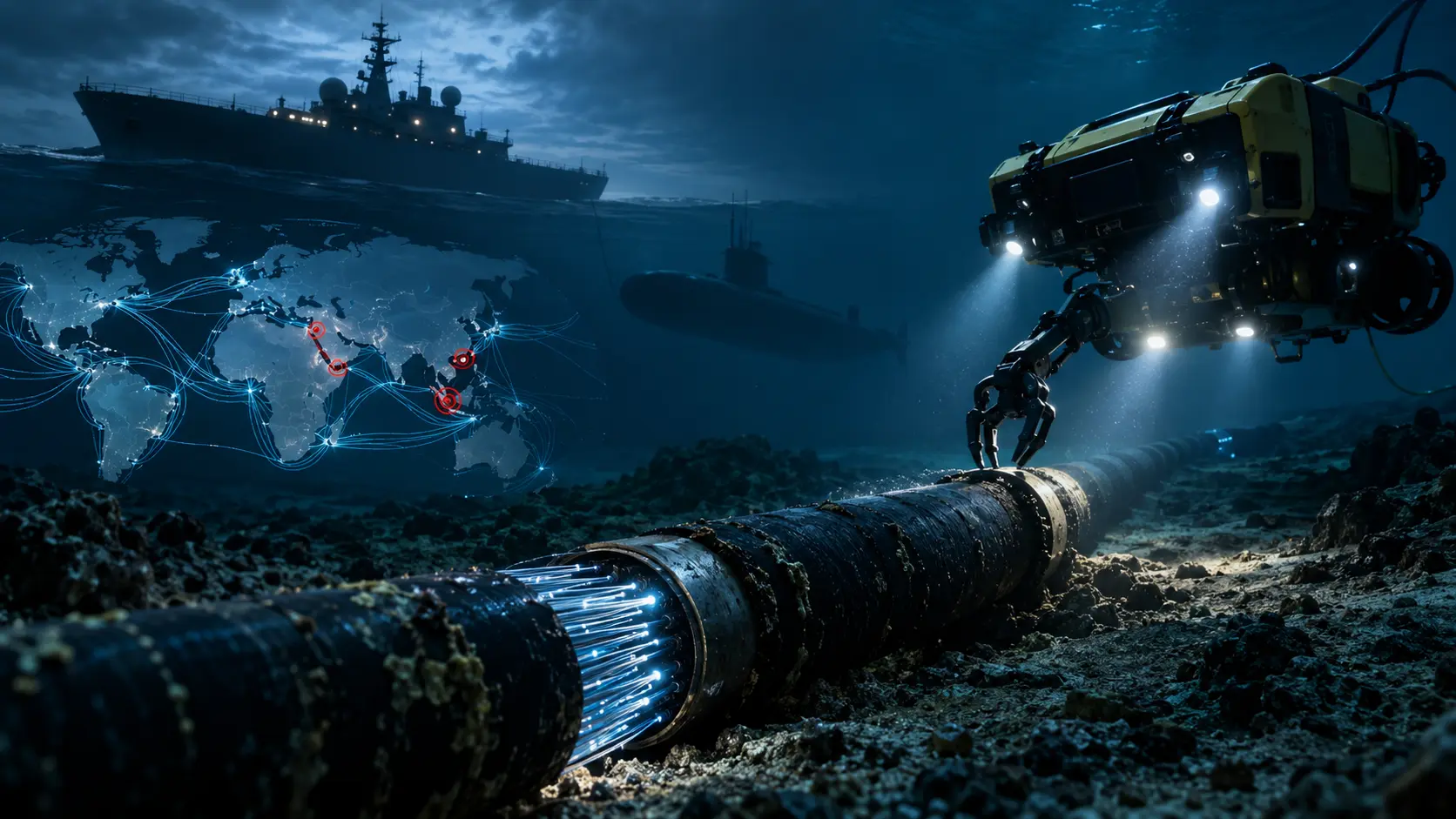

The “cloud” does not exist in the sky. It lives at the bottom of the ocean. Right now, over 99 percent of all intercontinental internet traffic, classified military communications, and trillions of dollars in daily SWIFT banking transfers travel through garden-hose-sized cables resting completely undefended on the dark, freezing seabed. For decades, the global economy operated under the naive assumption that the depth and darkness of the ocean provided a natural defensive shield. That assumption was shattered with the targeted sabotage of the Nord Stream gas pipelines in 2022 and subsequent, mysterious cable cuts in the Red Sea and Baltic regions.
We are witnessing the weaponization of the ocean floor. Adversary nations recognize that they do not need to launch a nuclear weapon or execute a complex cyberattack to cripple a Western economy; they simply need to drag a heavy anchor across a physical glass tube. Why should you care right now? Because the world’s leading navies are aggressively pivoting away from surface fleets and pouring billions into “Seabed Warfare“—deploying specialized surveillance ships, autonomous deep-sea drones, and acoustic arrays to blindly hunt for saboteurs in the abyss. The next great power conflict will not start with a missile in the sky; it will start with a silent cut in the dark.
What is Seabed Warfare?
Seabed warfare refers to military operations conducted on the ocean floor to protect, tap, or destroy critical undersea infrastructure, primarily fiber-optic communication cables and energy pipelines. It utilizes specialized submarines, Autonomous Underwater Vehicles (AUVs), and acoustic sensor arrays to secure the physical backbone of the global digital economy.
At a Glance
- Concept: The shift of geopolitical military focus from the surface of the ocean down to the benthic zone (the ocean floor) to target the physical hardware of the internet.
- Why it matters: If an adversary severs the three or four main cables connecting a country to the global network, that nation’s stock market, banking sector, and military logistics instantly go dark.
- Who uses it: Elite naval forces (US Navy, Russian GUGI, UK Royal Navy), advanced telecommunications consortiums, and subsea robotics contractors like Oceaneering and Kongsberg.
- Biggest takeaway: Seabed warfare is the ultimate “gray zone” conflict. It is incredibly cheap to drop a commercial ship’s anchor and “accidentally” sever a cable, but incredibly expensive and technologically difficult to prove it was an act of state-sponsored sabotage.
In Simple Words
If you want to read a website hosted on a server in Europe while sitting in New York, that data doesn’t bounce off a satellite. It travels as a pulse of light through a glass thread stretching thousands of miles across the floor of the Atlantic Ocean.
There are roughly 500 of these cables connecting the continents. They are the arteries of the modern world. However, they are shockingly fragile—most are no thicker than a soda can and have zero armor.
Seabed Warfare is the military realization that cutting these cables is the easiest way to destroy a country. Because the ocean is massive and dark, hiding a submarine or a robotic drone next to a cable is very easy. Defending a cable that is 4,000 miles long is mathematically impossible. Therefore, navies are building underwater drones and dropping listening devices across the ocean floor to try and hear enemy submarines before they can snip the wires or tap into them to steal secrets.
Why This Matters
The strategic doctrine of “Chokepoint Vulnerability” keeps national security advisors awake at night.
Cables do not take straight paths; they cluster together based on the underwater topography and commercial landing rights. For example, almost all internet traffic between Europe and Asia is squeezed through a tiny, shallow geographic bottleneck in the Red Sea and the Suez Canal. If a hostile actor drops a few sea mines or drags a specialized anchor through that specific 20-mile stretch of water, they can sever a dozen cables simultaneously, instantly blinding entire continents.
For defense contractors and robotics investors, this vulnerability translates to massive Capital Expenditure (CapEx). Navies are desperately procuring Multi-Role Ocean Surveillance (MROS) vessels and long-endurance Autonomous Underwater Vehicles (AUVs). The strategic imperative has shifted from building massive aircraft carriers that project power on the surface, to deploying autonomous swarms that secure the economic lifelines hidden in the abyss.
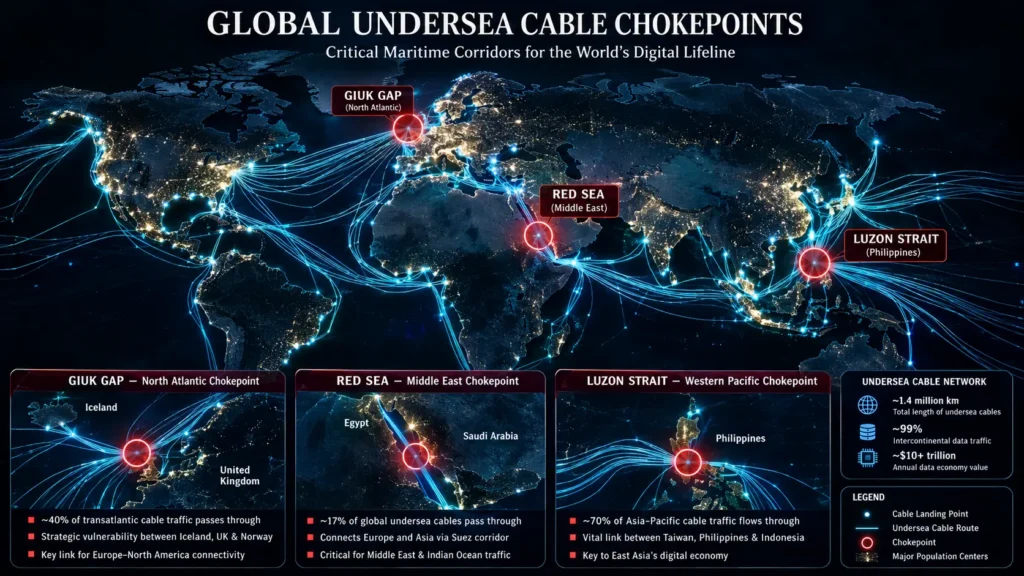
The Asymmetric Threat to Undersea Internet Cables
Seabed warfare is an asymmetric domain.
Russia recognized this asymmetry decades ago, creating the Main Directorate of Deep-Sea Research (GUGI). GUGI operates highly specialized, nuclear-powered spy submarines (like the Losharik) specifically designed to dive to extreme depths, loiter over Western fiber-optic cables, and deploy robotic arms to tap or cut them.
The West is playing a massive game of catch-up. Because the ocean floor is largely unmapped—we have better topographical maps of Mars than we do of our own seabed—detecting these deep-sea incursions requires blanketing the ocean with acoustic hydrophones and magnetic anomaly detectors. This is forcing a complete rewrite of maritime law and naval strategy, blurring the line between defending commercial telecom assets and waging full-scale naval warfare.
How Cable Sabotage and Seabed Warfare Work
Tampering with a glass thread thousands of meters underwater requires extreme engineering. Here is the first-principles breakdown of seabed warfare mechanics.
1. The Fundamental Problem: Pressure and Opacity
The deep ocean is the most hostile environment on Earth. At a depth of 4,000 meters, the water pressure exceeds 5,800 pounds per square inch. Radio waves and GPS do not penetrate water. Therefore, remote-controlled drones cannot communicate with the surface, and human divers are physically crushed. To interact with a cable, you must rely on autonomous, pressure-hardened robotics and acoustic (sound) signaling.
2. The Insufficiency of Satellites
Why not just use Starlink or satellites if the cables are cut? Bandwidth. A single modern undersea cable (like the MAREA cable) can transmit over 200 Terabits per second. The entire global satellite network combined can only handle a fraction of a single percent of that volume. If the cables are cut, satellites will immediately crash under the congestion. The global economy physically cannot exist wirelessly.
3. The Core Mechanism: The Fiber-Optic Tap
Adversaries do not always want to cut the cable; often, they want to listen to it. A specialized deep-sea submarine deploys an ROV (Remotely Operated Vehicle) to clamp onto the cable. The ROV gently bends the glass fibers inside the cable. When fiber-optic glass is bent at a specific, microscopic angle, a tiny fraction of the light (the data) leaks out of the side of the fiber without breaking the main connection. The spy device collects this leaked light, records the exabytes of data, and stores it for retrieval.
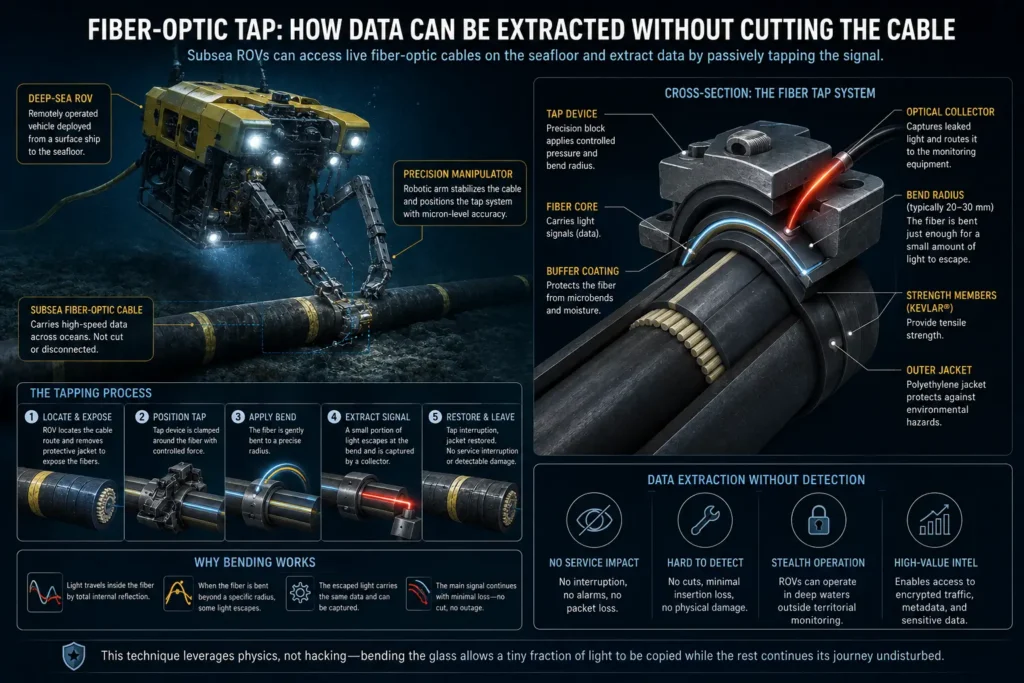
4. Technical Depth: Autonomous Underwater Vehicles (AUVs)
To combat this, defenders use AUVs. These are untethered, torpedo-shaped robots that patrol the cable routes. Equipped with Synthetic Aperture Sonar (SAS) and laser bathymetry, AUVs fly a few meters above the seabed, taking microscopic 3D scans of the sand. Artificial Intelligence algorithms compare today’s scan of the cable with last month’s scan. If the AI detects a new, unnatural lump attached to the cable (a potential tap or explosive charge), it flags the coordinates for a military response.
5. Real-World Consequences: SMART Cables
Because deploying thousands of AUVs is expensive, the telecom industry is redesigning the cables themselves. “SMART” (Science Monitoring And Reliable Telecommunications) cables embed environmental sensors directly into the optical repeaters that amplify the light signal every 50 kilometers. These sensors act as a massive, continuous burglar alarm. If an enemy submarine approaches, the SMART cable detects the seismic vibration or temperature shift and instantly alerts naval command before the sabotage can occur.
Recent Undersea Cable Sabotage Incidents
Seabed warfare transitioned from theory to violent reality in the early 2020s.
The Svalbard Cable Incident: In 2022, one of the two massive fiber-optic cables connecting the global Svalbard Satellite Station in the Arctic to the Norwegian mainland was mysteriously severed. The cables were highly reinforced, designed to withstand massive icebergs. The precision of the cut and the strategic timing highlighted a “gray zone” operation, proving that Arctic deep-sea infrastructure was entirely exposed to untraceable kinetic disruption.
Red Sea Chokepoint Disruption: In early 2024, during geopolitical unrest involving Houthi rebels in Yemen, several critical submarine cables in the Red Sea (handling 25% of global internet traffic) were severed. While attributed to the dragging anchor of a distressed, sinking cargo ship rather than a high-tech submarine, the event proved the catastrophic vulnerability of shallow-water chokepoints. Internet traffic was throttled globally, forcing telecom consortiums into frantic, highly expensive re-routing protocols.
The UK’s MROS Deployment: Realizing their entire financial sector was naked, the United Kingdom rapidly accelerated the procurement of the RFA Proteus. This Multi-Role Ocean Surveillance vessel serves as a dedicated mothership for deep-water ROVs and AUVs, tasked explicitly with patrolling the North Sea and the Atlantic approaches to detect and deter Russian deep-sea espionage activities.
Economic & Strategic Impact
The threat of seabed warfare fundamentally alters the economics of global telecommunications.
Historically, tech giants (Google, Meta, Amazon)—who now own or heavily invest in the majority of new undersea cables—laid lines based purely on the shortest distance and lowest cost. Today, spatial redundancy is mandatory. Hyperscalers are actively funding highly inefficient, circuitous cable routes specifically to avoid contested geopolitical waters (like the South China Sea or the Red Sea).
This massive requirement for redundancy is driving an unprecedented boom in the subsea cable manufacturing and installation market. However, the insurance industry is simultaneously pulling back. As attribution for cable cuts becomes impossible in the “gray zone,” insurance carriers are aggressively raising premiums for subsea infrastructure or introducing strict “act of war” exclusions, forcing tech giants to self-insure their multi-billion-dollar deep-sea assets.
Advantages (of AUV & Sensor Defense)
- Persistent Surveillance: Unlike surface ships that must return for fuel and crew rest, nuclear-powered submarines or seafloor-docked AUVs can monitor cable nodes continuously for months.
- Acoustic Stealth: Modern seabed drones operate with near-zero acoustic signatures, allowing defenders to passively listen for the mechanical whir of an adversary’s cutting tools without revealing their own position.
- Dual-Use Commercial Value: The same SMART cables and AUVs used to hunt adversary submarines provide highly lucrative, real-time oceanographic data (tsunami warnings, temperature shifts) for climate scientists and the commercial fishing industry.
Limitations
- The Attribution Problem: If a cable goes dark, the ocean washes away the evidence. Distinguishing between a deliberate, state-sponsored sabotage by a disguised fishing trawler and a genuinely accidental anchor drag is forensically nearly impossible, legally paralyzing military retaliation.
- Vast Geographic Scale: The Atlantic Ocean is 41 million square miles. Attempting to physically patrol the entire length of the transatlantic cables with slow-moving AUVs is mathematically impossible; defenders can only realistically guard the shallow “landing points” near the coast.
- Maintenance and Power: AUVs require immense power to fight deep-sea currents. If an AUV runs out of battery 3,000 meters down, retrieving it is an extremely costly and complex recovery operation.
Common Misconceptions
Misconception: The internet is beamed through space using satellites like Starlink.
Reality: Satellites lack the bandwidth to support the global economy. Less than 1 percent of all global data is transmitted via satellite. The remaining 99+ percent travels through physical cables resting on the dirt at the bottom of the ocean.
Misconception: Cables are wrapped in thick, indestructible steel armor.
Reality: Cables are only heavily armored near the shoreline to protect them from boat anchors and shark bites. Once they reach the deep ocean (where human activity is rare), the cables are completely unarmored and are roughly the thickness of a garden hose.
Misconception: If a cable is cut, it takes months to fix.
Reality: The telecom industry employs specialized “cable repair ships” stationed globally on high alert. If a cable is severed, a ship sails to the GPS coordinates, drops a grappling hook, pulls both ends of the cable to the surface, splices the glass fibers back together in a clean room on the ship, and drops it back down. The repair usually takes days, not months.
What Most People Miss
The strategic integration of SOSUS and Acoustic “Tripwires”.
During the Cold War, the U.S. Navy laid a massive, secret network of underwater microphones across the Atlantic floor called the Sound Surveillance System (SOSUS) to listen for Soviet nuclear submarines.
What most people miss is that this architecture is being entirely reinvented for the 21st century. Instead of laying separate military microphones, intelligence agencies are actively looking to tap into the commercial telecom cables themselves. By utilizing a technology called Distributed Acoustic Sensing (DAS), an entire standard commercial internet cable can be turned into a 4,000-mile-long continuous microphone. If a submarine drives anywhere near the internet cable, the microscopic vibrations in the glass fibers alert naval intelligence, turning the very infrastructure being targeted into an active military radar system.
Comparison Table
| Feature | Space Warfare (Satellites) | Seabed Warfare (Undersea Cables) |
| Global Data Volume Carried | < 1% | > 99% |
| Physical Vulnerability | Trackable, visible in orbit | Untrackable, hidden in the dark abyss |
| Cost to Attack/Sabotage | High (Requires ASAT missiles/lasers) | Extremely Low (Requires a dragged anchor) |
| Attribution / Forensics | Easy (Radar confirms missile launch) | Near Impossible (Easily disguised as an accident) |
| Environmental Hostility | Vacuum, Radiation | Crushing pressure, saltwater corrosion |
Case Study
Situation: The global internet backbone heavily relies on the “GIUK Gap”—the stretch of ocean between Greenland, Iceland, and the United Kingdom. This narrow passage is the primary route for transatlantic cables connecting North America to Northern Europe.
Challenge: Russian deep-sea research vessels and “oceanographic” ships were observed loitering with unexplained frequency directly over the precise GPS coordinates of these critical communication lines, operating in the “gray zone” where their activities were highly suspicious but legally ambiguous.
Solution (The Naval Pivot): Recognizing the existential threat of a coordinated cable severing, the UK Ministry of Defence fundamentally altered its naval procurement strategy. They sidelined traditional surface ship investments to rapidly convert and launch the RFA Proteus, a commercial oil-rig support vessel refitted with advanced military ROVs, submersibles, and acoustic mapping gear.
Outcome: The deployment of the Proteus and the integration of allied NATO maritime patrol aircraft established a persistent, visible deterrent over the GIUK gap. While it cannot physically stop a submarine 3,000 meters down, the constant surface surveillance removes the adversary’s cloak of plausible deniability, escalating any future cable tampering from a “mysterious accident” directly into an undeniable act of kinetic aggression.
Lessons Learned: The case study demonstrates that deterrence in seabed warfare relies entirely on removing anonymity. If an adversary knows they are being actively watched by an MROS vessel or a SMART cable sensor, they lose the ability to disguise sabotage as a commercial accident, effectively neutralizing the primary advantage of gray zone seabed operations.
Future Outlook
Next 12–24 Months
The era of Commercial-Military Sensor Integration. As the vulnerability of chokepoints like the Red Sea becomes critical, governments will mandate that all new commercial undersea cables must be fitted with Distributed Acoustic Sensing (DAS) or SMART environmental sensors. Telecom giants will form unprecedented data-sharing alliances with naval intelligence agencies, turning private internet cables into the primary early-warning acoustic radar system for the global maritime domain.
Next 3–5 Years
The deployment of Subsea Resident Drone Garages. Currently, AUVs are limited by their battery life and must be recovered by a surface ship. By the late 2020s, defense contractors will deploy “Resident AUVs.” These are robotic drones that live permanently on the ocean floor. They will patrol a section of cable, return to a heavy steel “garage” attached to the seabed, wirelessly recharge their batteries via induction from the internet cable itself, and upload their surveillance data directly to military servers without ever surfacing.
Next 10 Years
The Balkanization of the Ocean Floor. By the mid-2030s, the “open ocean” concept for digital infrastructure will collapse. Allied nations will establish heavily defended, physically segregated “Sovereign Cable Corridors.” Transcontinental lines will completely bypass high-risk geopolitical zones, opting for massive, inefficient, but secure routes (such as running cables through the melting Arctic Circle to connect Asia and Europe, avoiding the Middle East entirely). Seabed warfare will formalize into a permanent standoff of autonomous underwater drones silently guarding parallel, competing digital networks in the dark.
Most Likely Scenario
As the world transitions to a fully digitized, AI-driven economy, the physical glass tubes at the bottom of the ocean will become the most valuable real estate on Earth. The failure to establish international legal frameworks to protect them will result in a shadowy, ongoing cold war. Sabotage will become common, disguised seamlessly as commercial fishing accidents, forcing hyperscalers and navies to spend trillions on spatial redundancy and deep-sea robotic defense to keep the global economy from going offline.
Key Takeaways
- Seabed warfare is the strategic military focus on the ocean floor to protect or attack the 500+ undersea fiber-optic cables that carry over 99% of global internet traffic.
- Because cables are entirely exposed and highly concentrated in shallow chokepoints (like the Red Sea), they are exceptionally vulnerable to both intentional sabotage and accidental anchor drags.
- Adversaries do not always cut cables; specialized deep-sea submarines can bend the glass fibers to “tap” the line and steal petabytes of data without breaking the connection.
- Navies and telecom companies are defending these lines using Autonomous Underwater Vehicles (AUVs) and SMART cables, which act as seismic and acoustic burglar alarms.
- The primary challenge is “Attribution”—it is forensically impossible to prove if a severed cable was an intentional state-sponsored attack or a clumsy commercial fishing boat, preventing military retaliation.
- To secure their networks, tech giants are abandoning the shortest, cheapest cable routes and actively building massive, redundant lines that bypass hostile geopolitical waters.
Glossary
Autonomous Underwater Vehicle (AUV): An untethered, robotic submarine that is pre-programmed to navigate the ocean floor autonomously, using sonar to map cables and detect threats.
Benthic Zone: The ecological region at the lowest level of a body of water, such as the ocean floor, where undersea cables physically rest.
Chokepoint: A narrow, shallow geographic waterway (e.g., the Suez Canal, Strait of Malacca) where dozens of critical undersea cables are bundled together, creating a massive single point of failure.
Distributed Acoustic Sensing (DAS): A technology that uses laser pulses to turn a standard commercial fiber-optic cable into a continuous, highly sensitive microphone capable of detecting submarines or earthquakes.
Gray Zone Warfare: Military or state-sponsored aggressive actions that remain below the threshold of an act of war, allowing the attacker to maintain plausible deniability (e.g., “accidentally” dragging an anchor over a cable).
SMART Cables: Science Monitoring And Reliable Telecommunications cables; next-generation internet lines equipped with environmental sensors to measure ocean temperature, seismic activity, and acoustic threats.
Sources
[1] Center for Strategic and International Studies (CSIS): Undersea Cables and the Future of Submarine Competition (2025)
[2] Royal Navy: Deployment of RFA Proteus for Multi-Role Ocean Surveillance (2023/2026 Fleet Updates)
[3] NATO Cooperative Cyber Defence Centre of Excellence: Seabed Warfare and the Protection of Critical Undersea Infrastructure (March 2026)
[4] TeleGeography: Submarine Cable Map and Global Bandwidth Analysis (2026)
[5] Journal of Ocean Engineering and Marine Energy: Distributed Acoustic Sensing for Subsea Security