Advertisement
)

AT A GLANCE
- Concept: Asymmetric Warfare: Defeating expensive military hardware using vastly cheaper, disposable weapons.
- Concept: Loiter Time: The ability of a weapon to circle an area for hours waiting for a target to appear.
- Concept: Sensor Fusion: Combining acoustic, thermal, and optical data to identify targets without human help.
- Concept: Mesh Network: A communication web where drones talk to each other to coordinate a swarm attack.
IN SIMPLE WORDS
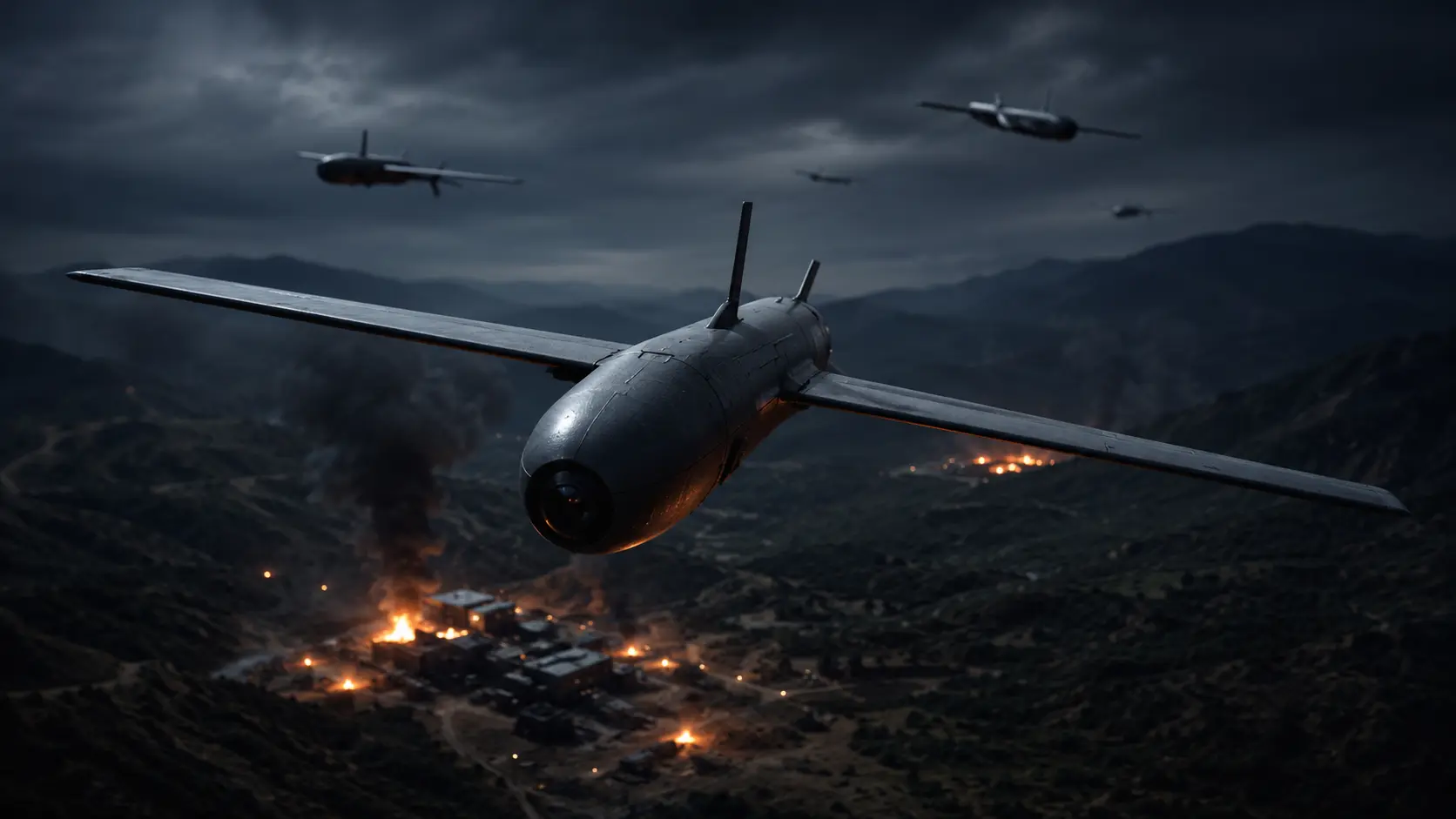
Imagine firing a sniper rifle, but the bullet has a camera, a brain, and wings. Instead of flying straight, the bullet circles the enemy base for hours waiting for the general to step outside.
Once it spots him, the bullet dives and explodes. This is exactly how a loitering munition, often called a kamikaze drone, operates. Traditional missiles are incredibly expensive and must be fired at a specific, known target. Loitering munitions are cheap and can be fired blindly into a general area.
They hunt for targets on their own. By launching thousands of these cheap drones simultaneously, smaller militaries and proxy groups can completely overwhelm the expensive, sophisticated defense systems of global superpowers.
HOW IT WORKS
A loitering munition blurs the line between a cruise missile and a surveillance drone. The system consists of an aerodynamic airframe, an electric or piston engine, a high-explosive warhead, and an advanced optical payload. Soldiers launch the weapon via a pneumatic tube or a mobile catapult.
Once airborne, the drone flies to a designated geographical box and enters a holding pattern. It uses on-board sensor fusion to scan the ground below. Optical cameras search for the geometric shapes of tanks, while radio-frequency (RF) sensors scan for the electromagnetic emissions of enemy radars.
When a target is verified, the drone calculates a kinematic intercept vector. It tucks its wings and enters a terminal dive, using its own kinetic energy and the internal explosive payload to destroy the target.
Advanced variants operate in autonomous swarms. These drones utilize a decentralized mesh network to communicate. If an enemy shoots down the lead drone, the remaining drones instantly recalculate their flight paths to ensure total coverage of the battlefield.
REAL WORLD EXAMPLE
During the 2020 Nagorno-Karabakh War, the Azerbaijani military used Israeli-made Harop loitering munitions to systematically dismantle Armenian armored forces.
Armenian troops relied on traditional Soviet-era air defense systems designed to shoot down large fighter jets. These radar systems could not accurately track small, slow-moving drones made of composite plastics. The Harop drones circled the battlefield, locked onto the radio emissions of the air defense radars, and destroyed them. This cleared the airspace entirely, allowing Azerbaijan to quickly dominate the conventional ground war.
WHY IT MATTERS NOW
The fundamental economic math of modern warfare has broken. Superpowers build multi-million-dollar main battle tanks and billion-dollar aircraft carriers. Defending these massive assets requires firing interceptor missiles that cost roughly four million dollars each.
Insurgencies and regional powers are now attacking these assets using loitering munitions that cost less than twenty thousand dollars. If an attacker launches one hundred cheap drones, the defender must fire one hundred expensive missiles to survive. The defender mathematically bankrupts themselves simply by trying to stay alive.
This severe cost asymmetry forces a total redesign of global military procurement. Governments are realizing that stockpiling small numbers of exquisite, highly complex weapons is a fatal strategy. The defense industrial base must rapidly transition to mass-producing tens of thousands of cheap, attritable autonomous platforms.
Furthermore, the proliferation of these weapons democratizes air power. A non-state proxy group with a few pickup trucks and a shipment of loitering munitions can effectively block a superpower’s naval fleet from entering a critical shipping lane.
COMMON MISCONCEPTIONS
- “They are just remote-controlled airplanes.” While early models required a human pilot via a radio link, modern loitering munitions use artificial intelligence to identify targets and attack completely autonomously without a human pressing a button.
- “They are easy to shoot down.” Their small physical size, low thermal signature, and composite materials make them nearly invisible to traditional military radars designed to track massive fighter jets.
- “Only advanced militaries have them.” Commercial off-the-shelf hobby drones are routinely strapped with plastic explosives and converted into crude, highly effective loitering munitions by militant groups worldwide.
WHAT MOST PEOPLE MISS
Defense analysts focus intensely on the explosive damage of a drone strike, but they completely miss the psychological paralysis these weapons inflict on ground troops.
Because loitering munitions emit a distinct, high-pitched buzzing sound and can circle a trench for hours, soldiers are forced to remain constantly hidden. They cannot resupply, sleep, or maneuver safely. The mere acoustic presence of a loitering drone suppresses enemy movement entirely, acting as a devastating psychological weapon long before it physically explodes.
THE ECONOMIC AND STRATEGIC IMPACT
The primary financial beneficiaries are agile defense startups and commercial drone manufacturers. Companies that can mass-produce cheap electric motors, optical lenses, and basic targeting software are capturing massive defense contracts previously reserved for legacy aerospace conglomerates.
Global defense spending is shifting aggressively toward directed-energy weapons to counter this threat. Militaries are heavily funding high-powered microwave emitters and solid-state lasers. These are the only systems capable of shooting down a swarm of 500 cheap drones at a cost of pennies per shot, restoring the economic balance of defense.
Strategically, the main battle tank is facing an existential crisis. Heavy armor is useless when a cheap drone can simply loiter above it and strike the thinly armored roof. Militaries are forced to weld crude metal cages onto their vehicles, severely reducing urban mobility and signaling the end of traditional mechanized cavalry charges.
THE TRAJECTORY
Next 12–36 Months: The rapid integration of acoustic targeting software. Loitering munitions will be equipped with specialized micro-arrays to hover silently over a city and autonomously track the specific acoustic signature of an enemy artillery cannon firing. The drone will dive onto the location before the cannon can physically reload.
Next Five Years: The deployment of carrier-launched swarm pods. Naval vessels will abandon large deck guns in favor of vertical launch cells that deploy hundreds of networked loitering munitions simultaneously. This swarm will create a lethal, 50-mile autonomous defense perimeter around the ship.
Next Ten Years: The total automation of the kill chain. Loitering munitions will connect directly to low-Earth orbit spy satellites. When a satellite detects an enemy convoy, it will bypass human command centers entirely and instantly wake up a drone swarm hidden in a nearby forest to intercept the threat.
What Could Go Wrong: Catastrophic fratricide and friendly fire. If the artificial intelligence algorithms rely strictly on visual recognition, a drone may mistake an allied ambulance for an enemy supply truck. A fully autonomous swarm acting on a false positive could wipe out a friendly position in seconds.
Most Likely Outcome: Loitering munitions will permanently rewrite the economics of warfare. The ability to project lethal, persistent air power for pennies on the dollar guarantees that drone swarms will replace traditional artillery and manned close-air-support within a decade.
KEY TERMS
- Loitering Munition: A weapon system that hovers around a target area for an extended period, searches for targets, and attacks by crashing into them.
- Asymmetric Warfare: A conflict where two opposing sides have vastly different military power, often involving a weaker power using cheap weapons to defeat an expensive army.
- Sensor Fusion: The software process of combining data from multiple sensors—like thermal cameras and radio antennas—to create a perfect understanding of a target.
- Mesh Network: A decentralized communication system where each drone connects directly to the others around it, allowing the swarm to share data even if one drone is destroyed.
- Kinematics: The physics of motion. In weapons, it refers to the speed, maneuverability, and angle required for a drone to successfully hit a moving target.
- Attritable Asset: A piece of military equipment that is cheap enough to be intentionally lost or destroyed in combat without ruining the military’s budget.
BEGINNER FAQ
What is a loitering munition? It is a small, cheap drone packed with explosives. Instead of dropping a bomb and flying home, the drone itself is the bomb. It flies into the target and destroys it.
Why is it called a kamikaze drone? Like the historical kamikaze pilots, these drones execute a one-way suicide mission. They are designed to intentionally crash and explode.
How is it different from a regular missile? A regular missile is fired at a specific target and flies there directly in seconds. A loitering munition can be fired into the sky without a target, circle around for hours, and hunt for something to destroy.
How much do they cost? While some advanced models cost roughly $100,000, many highly effective loitering munitions cost between $20,000 and $50,000. Some converted commercial drones cost less than $2,000.
Why are big militaries scared of them? Because a $2,000 drone can destroy a $10 million tank. If an enemy sends a swarm of 1,000 cheap drones, a massive military will run out of expensive defense missiles trying to shoot them all down.
How do they find targets? They use artificial intelligence. Onboard cameras look for the shape of tanks or soldiers, and radio sensors listen for the invisible signals emitted by enemy communication gear.
Can you just jam their remote controls? Sometimes. However, modern loitering munitions do not need a human to fly them. Once they are launched, they use their own internal computer brains, making radio jamming useless.
Are they illegal? No. They are currently legal under international law. However, human rights groups are deeply concerned about “killer robots” that can decide who to kill without a human approving the strike.
SOURCES
- Center for Strategic and International Studies (CSIS) — The Threat of Armed Drones and Loitering Munitions
- Royal United Services Institute (RUSI) — The Economics of Swarm Warfare and Air Defense
- Department of Defense (DoD) — Replicator Initiative and Autonomous Systems Procurement
- Modern War Institute at West Point — The Psychological and Tactical Impact of Loitering Munitions