Advertisement
)

AT A GLANCE
- Concept: Sensor Fusion: Combining data from multiple different radars to create one perfect picture of the sky.
- Concept: Fire Control Loop: The split-second mathematical sequence of detecting, tracking, targeting, and destroying an incoming threat.
- Concept: Tactical Data Links: Secure, jam-resistant digital networks that let fighter jets and ground missiles share information instantly.
- Concept: Electronic Warfare: The invisible battle of jamming enemy radars while protecting your own communication signals.
IN SIMPLE WORDS
Imagine trying to catch a fly in a dark room using a flashlight and a flyswatter. If you act alone, the fly easily escapes. Now imagine putting one hundred people in that room. Some hold flashlights, some hold cameras, and some hold flyswatters. They are all wearing earpieces, talking to a central commander in real time.
If one person loses sight of the fly, three others instantly point their lights at it. The commander calculates exactly where the fly is going and tells the closest person to swing.
This is an Integrated Air Defense System. Instead of a single missile battery acting alone, a country links all its radars, fighter jets, and missiles into one massive, talking brain. If an enemy plane dodges one radar, another picks it up instantly. It turns the sky into an invisible, heavily coordinated trap where hiding becomes mathematically impossible.
HOW IT WORKS
The foundation of an Integrated Air Defense System (IADS) is the total elimination of isolated weapons. A standalone surface-to-air missile (SAM) site is vulnerable to blind spots and jamming. An IADS networks hundreds of geographically dispersed SAM sites, early-warning radars, and airborne sensors into a single, unified digital mesh.
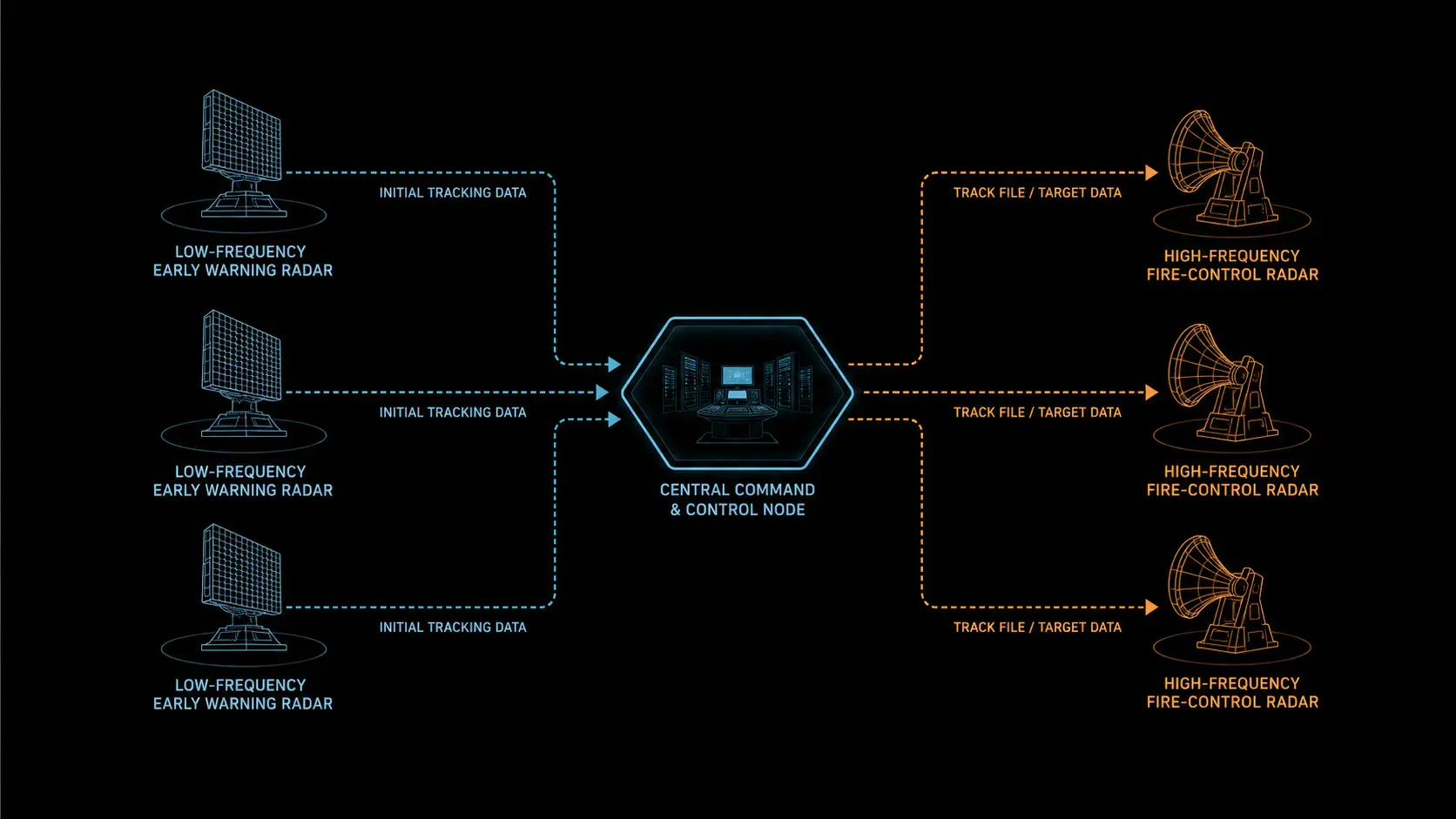
The architecture relies heavily on sensor fusion. An adversary might employ stealth technology to scatter high-frequency X-band radar waves, rendering the aircraft invisible to targeting radars. However, lower-frequency VHF or UHF early-warning radars can still detect the physical displacement of the stealth jet, even if they lack the precision to shoot it down.
Through tactical data protocols like Link-16 or Link-22, the low-frequency radar passes this crude location data to the central command node. The commander’s software correlates the tracks and instantly cues a high-frequency fire-control radar precisely where to look. Because the targeting radar only turns on at the absolute last second, the enemy pilot receives zero warning that they are being painted.
The command node then executes the fire-control loop. It selects the optimal kinetic effector—either an interceptor missile or a friendly fighter jet—and provides continuous mid-course guidance updates to the weapon while it is in flight.
This creates a multi-tiered engagement zone. If the adversary manages to spoof a long-range interceptor using Electronic Countermeasures (ECM), the IADS seamlessly hands the target off to a short-range, infrared-guided point defense system, trapping the hostile aircraft in overlapping layers of lethality.
REAL WORLD EXAMPLE
During the 1991 Gulf War, the United States military faced the Iraqi Kari system, a massive, French-designed IADS heavily fortified with Soviet weaponry. Instead of fighting the missiles directly, coalition forces systematically dismantled the network’s brain.
By deploying Apache helicopters and stealth bombers to physically destroy the central fiber-optic command nodes, the US shattered the network into isolated, uncoordinated radar sites. This allowed coalition aircraft to exploit the newly created blind spots, paralyzing the Iraqi air force and securing total air supremacy within days.
WHY IT MATTERS NOW
The proliferation of advanced IADS technology fundamentally changes the geopolitical balance of power. Superpowers can no longer assume they possess guaranteed air supremacy over developing nations. Countries like Iran and North Korea are heavily investing in decentralized, deeply buried command networks to project impenetrable “Anti-Access/Area-Denial” (A2/AD) bubbles over their sovereign territory.
This denies Western militaries their primary strategic advantage: precision air support. If an aircraft carrier cannot safely launch fighter jets into a combat zone without them being instantly targeted by a synchronized missile web, the carrier itself becomes a multi-billion dollar liability.
Consequently, the defense industry is experiencing a massive procurement shift toward electronic warfare and stealth penetration. Prime contractors are pivoting away from simply building faster jets. They are currently funneling billions into developing autonomous electronic attack swarms designed specifically to blind and confuse networked radars.
For investors, the most lucrative contracts now lie in the digital architecture rather than the physical missiles. Companies specializing in AI-driven sensor fusion algorithms and secure, quantum-resistant data links are capturing the highest margin defense budgets, dictating the operational survival of entire military forces.
COMMON MISCONCEPTIONS
- “An IADS is just a really big missile.” It is not a weapon; it is the digital nervous system that connects the weapons. The actual missiles and radars are simply physical nodes plugging into the network.
- “Stealth jets are totally invisible to an IADS.” Stealth delays detection, but it does not erase a physical aircraft. A heavily networked IADS uses overlapping sensor angles to eventually triangulate a stealth fighter’s location.
- “Destroying the radar destroys the system.” Modern networks are highly decentralized. If one radar is blown up, the system automatically routes the tracking data through surviving sensors without dropping the target.
WHAT MOST PEOPLE MISS
Military analysts focus heavily on the explosive speed of the interceptor missiles, but they overlook the brutal mathematics of the radar horizon.
Because the Earth is curved, a ground-based radar cannot see low-flying aircraft until they are extremely close. To fix this, an advanced IADS physically elevates its sensors. It networks directly with airborne early warning planes (like the AWACS) flying at 30,000 feet. These flying radar stations look down over the curve of the Earth, spotting low-altitude cruise missiles hundreds of miles away and feeding that data directly to ground-based missile batteries that are completely blind to the threat.
THE ECONOMIC AND STRATEGIC IMPACT
The primary financial beneficiaries are legacy defense conglomerates specializing in systems integration, such as Lockheed Martin, Raytheon, and Thales. These companies do not just sell a single missile; they sell the proprietary software ecosystem that glues the entire national defense grid together, guaranteeing decades of highly lucrative maintenance contracts.
Strategically, exporting an IADS is the ultimate act of geopolitical alignment. When Russia sells the S-400 system to nations like Turkey or India, they are not just exporting hardware. They are embedding Russian engineers, training protocols, and software architecture deep into the buyer’s national security apparatus, structurally pulling those nations out of the Western military orbit.
However, operating these systems requires an immaculate logistical tail. Firing a barrage of networked interceptors can cost hundreds of millions of dollars in a single afternoon. If a nation lacks the domestic industrial base to rapidly manufacture replacement missiles, an adversary can easily bankrupt their defense grid simply by launching swarms of cheap, decoy drones to exhaust the expensive interceptor stockpiles.
THE TRAJECTORY
Next 12–36 Months: The integration of commercial low-Earth orbit (LEO) satellites into tactical fire-control loops. IADS networks will begin pulling raw tracking data directly from private space constellations, vastly expanding their sensor footprint without requiring new ground radars.
Next Five Years: The deployment of cognitive electronic warfare. Artificial intelligence will manage the network’s radar frequencies dynamically. Instead of a human operator trying to dodge enemy jamming, the AI will rewrite its own radar waveforms in milliseconds, making the network mathematically impossible to jam using traditional methods.
Next Ten Years: The transition to directed energy effectors. As the cost of shooting down drone swarms with traditional missiles becomes economically fatal, IADS networks will integrate gigawatt-class solid-state lasers and high-powered microwave arrays. These systems will intercept incoming threats at the speed of light for pennies per shot.
What Could Go Wrong: A catastrophic network decapitation via cyberattack. Because an IADS is entirely reliant on software to function, a highly sophisticated zero-day virus could theoretically sever the links between the radars and the command center. The physical missiles would remain fully loaded, but the defenders would be completely blind to incoming bombers.
Most Likely Outcome: The sky will become a computationally dense, impassable environment. The sheer mathematical advantage of networking hundreds of overlapping sensors guarantees that airspace dominance will no longer be determined by who has the fastest jet, but by who controls the fastest data processing loop.
KEY TERMS
- Integrated Air Defense System (IADS): A computerized network that links multiple radars, missiles, and command centers together to defend airspace as a unified organism.
- Sensor Fusion: The software process of compiling raw data from multiple different radars to create one perfectly accurate track of a target.
- Tactical Data Link: A highly secure, jam-resistant military communication standard used to transmit radar pictures instantly between forces.
- Electronic Countermeasures (ECM): The art of broadcasting powerful radio waves to blind, confuse, or deceive an enemy’s radar system.
- Anti-Access/Area-Denial (A2/AD): A military strategy that uses heavily networked missile zones to prevent an enemy force from safely entering a specific region.
- Fire-Control Radar: A highly focused, narrow-beam radar used to precisely guide an interceptor missile directly into a moving target.
BEGINNER FAQ
What is an Integrated Air Defense System? It is a massive digital network that connects a country’s individual radars, missile launchers, and fighter jets together so they can fight as one coordinated team.
Why is it better than just having regular missiles? If a single missile site acts alone, it has blind spots and can be easily jammed. A networked system covers those blind spots by sharing data across hundreds of different sensors instantly.
Can it shoot down stealth fighters? Stealth is not an invisibility cloak; it just shrinks the distance at which a radar can lock on. An advanced IADS networks low-frequency radars with high-frequency radars to detect and eventually corner stealth aircraft.
Who makes these decisions, a computer or a human? The computers track the targets and recommend the best weapon to use, but a human commander sitting in a secure bunker must give the final authorization to actually fire the missile.
What happens if you blow up the main radar? Nothing stops. A true IADS is decentralized. If you destroy one radar, the network instantly pulls data from a different radar fifty miles away to keep tracking the target.
How do the different parts talk to each other?They use specialized, highly encrypted military WiFi networks, such as Link-16, combined with buried fiber-optic cables that are very difficult for enemies to hack or jam.
Is it purely defensive? Mostly, yes. But by projecting a massive shield over hundreds of miles, it allows a military to confidently launch its own offensive strikes from safely behind the protective wall.
Do these systems ever make mistakes? Yes. In the chaos of war, if the network misidentifies a target, human operators can mistakenly shoot down civilian airliners or friendly fighter jets, which has happened in several recent conflicts.
SOURCES
- Department of Defense (DoD) — Joint Publication 3-01: Countering Air and Missile Threats
- Center for Strategic and Budgetary Assessments (CSBA) — The Air and Missile War in the Middle East and A2/AD Environments
- Royal United Services Institute (RUSI) — Russian and Chinese Air Defense Network Architectures
- Institute of Electrical and Electronics Engineers (IEEE) — Sensor Fusion and Tactical Data Link Protocols in Defense Networks