Advertisement
)

AT A GLANCE
- Concept: Polymetallic Nodules: Rock-like deposits scattered across the seafloor containing high concentrations of battery metals like cobalt and nickel.
- Concept: Clarion-Clipperton Zone: A massive fracture region in the Pacific Ocean holding the highest known density of harvestable minerals.
- Concept: Hydraulic Riser: A vertical pipe system used to pump a slurry of crushed rocks and seawater miles upward to a surface ship.
- Concept: International Seabed Authority (ISA): The United Nations body responsible for regulating and leasing the ocean floor in international waters.
IN SIMPLE WORDS
Electric vehicles and massive power grids require millions of tons of specific metals like cobalt and nickel. Mining these metals on land is politically difficult, environmentally destructive, and controlled by only a few nations.
However, the bottom of the Pacific Ocean is literally paved with these exact metals. Over millions of years, minerals dissolved in the seawater slowly bonded together to form small, dark rocks called polymetallic nodules. These nodules sit completely exposed in the soft mud, waiting to be picked up.
Instead of blasting massive open-pit mines into mountains, engineering companies are building giant robotic vacuums. These machines drive across the dark ocean floor, harvest the nodules, and pump them miles up to a waiting ship. It represents a massive new frontier for securing the raw materials required for the global energy transition.
HOW IT WORKS
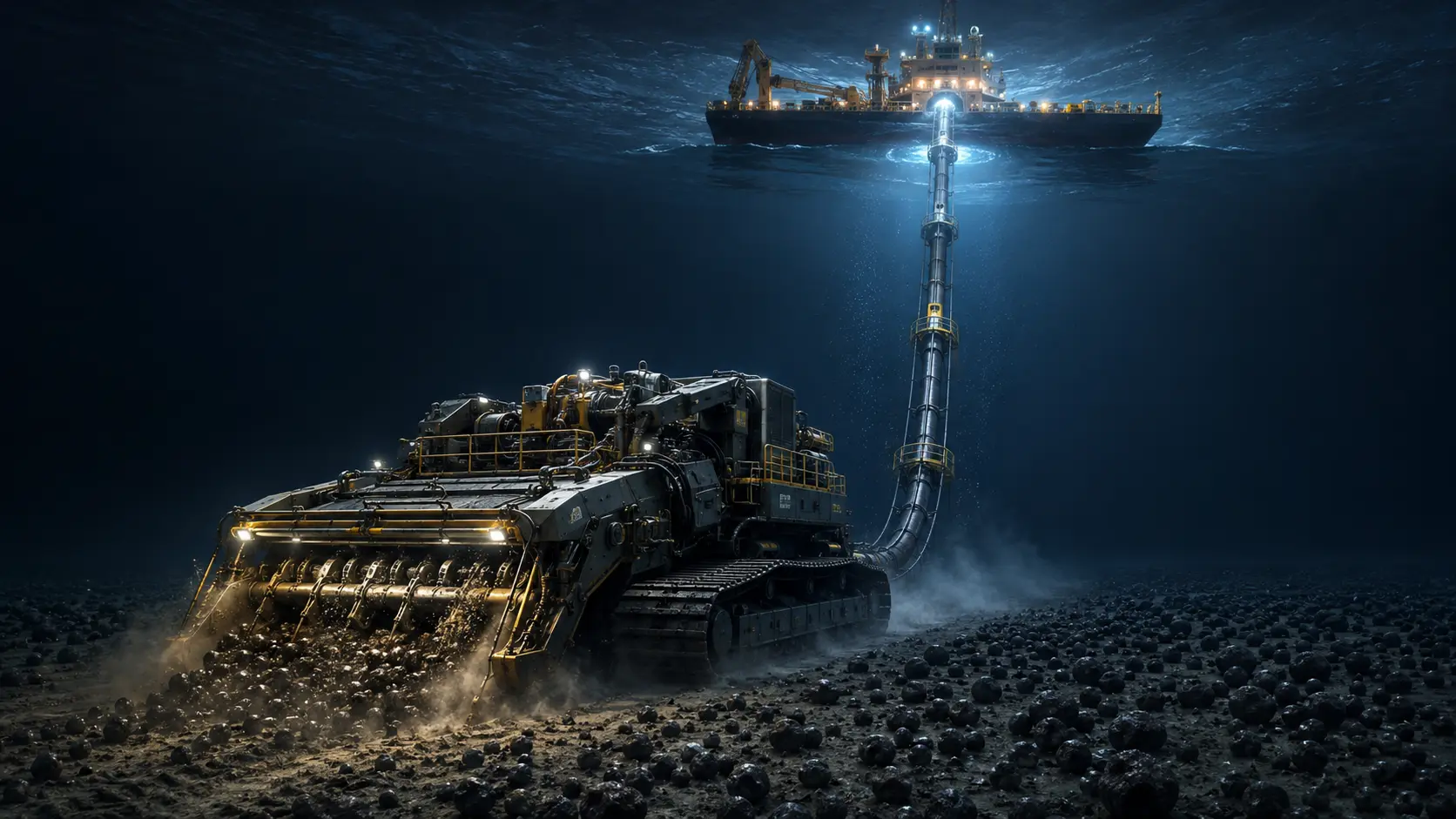
Deep-sea mining relies on advanced subsea robotics operating in extreme conditions. At 4,000 meters below the surface, the ocean exerts crushing hydrostatic pressure in complete darkness. The extraction architecture involves three primary components: the collector vehicle, the hydraulic riser system, and the surface production vessel.
The process begins with a benthic collector vehicle. This massive, tank-like robot lowers to the abyssal plain and drives across the soft sediment. Rather than digging or drilling into the crust, the collector uses directed water jets to lift the polymetallic nodules gently out of the mud.
Once collected, the vehicle crushes the nodules into smaller pieces and feeds them into the base of the hydraulic riser. This riser is a continuous steel pipe stretching several miles vertically to the surface. Massive subsea pumps force seawater upward at high velocity, carrying the crushed mineral slurry directly to the production ship.
Aboard the surface vessel, engineers mechanically separate the solid nodules from the seawater. The rocks are stored in the cargo hold, while the wastewater must be returned to the ocean. The environmental safety of this entire operation depends on how that wastewater is handled.
If the ship dumps the sediment-heavy water directly into the upper ocean layers, it creates a massive particulate plume. This cloudy water can block sunlight, suffocating microscopic plankton and disrupting the marine food chain. To prevent this, strict engineering designs require pumping the filtered wastewater all the way back down to the abyssal depths before releasing it.
REAL WORLD EXAMPLE
The Metals Company (TMC) is one of the most aggressive commercial entities in the deep-sea mining sector. They hold massive exploration rights in the Clarion-Clipperton Zone (CCZ), a stretch of the Pacific Ocean located between Hawaii and Mexico.
In late 2022, TMC successfully deployed a pilot collector vehicle and a 4.3-kilometer riser system. They successfully pumped thousands of tons of polymetallic nodules to their surface ship, the Hidden Gem. This pilot test proved that the heavy engineering physics of abyssal mineral extraction actually work efficiently in real-world oceanic conditions.
WHY IT MATTERS NOW
The global shift away from fossil fuels is creating a severe metallurgical deficit. Building lithium-ion batteries requires cobalt, nickel, and manganese. Current terrestrial mines cannot produce enough of these metals to meet the projected demand for electric vehicles over the next decade.
Furthermore, terrestrial mining is geopolitically concentrated. A few nations dominate the global supply of raw battery materials, giving them immense political leverage. Deep-sea mining offers a massive, unowned resource base sitting in international waters.
The Clarion-Clipperton Zone alone contains more unmined cobalt, manganese, and nickel than all known land-based reserves combined. Accessing this zone would instantly break terrestrial supply monopolies, shifting the balance of resource power to whichever nations master deep-water robotic engineering.
However, the international legal framework is currently in chaos. The International Seabed Authority (ISA) is under immense pressure to finalize the official rulebook for commercial extraction. If they fail to agree on strict environmental regulations, countries may simply begin mining unilaterally, triggering a lawless gold rush on the ocean floor.
COMMON MISCONCEPTIONS
- “Deep-sea mining involves blowing up coral reefs.” The targeted abyssal plains are vast, muddy deserts located 4,000 meters deep, entirely separate from shallow-water coastal coral reef ecosystems.
- “Companies will claim parts of the ocean for themselves.” Under international law, the deep seabed is the “common heritage of mankind.” Companies must receive temporary leases from the ISA and pay royalties that benefit all nations.
- “The rocks are deeply buried.” Polymetallic nodules sit completely unattached on top of the mud. Harvesting them is more like vacuuming a carpet than digging a mine shaft.
WHAT MOST PEOPLE MISS
Environmental activists focus heavily on the sediment plumes, but they frequently overlook the severe acoustic impact.
The abyssal plain is one of the quietest places on Earth. Marine mammals, particularly deep-diving whales, rely entirely on sound to navigate and communicate over hundreds of miles. The continuous, grinding mechanical noise of tracked collector vehicles and massive hydraulic pumps will introduce extreme acoustic pollution into this silent ecosystem. The long-term impact of this industrial noise on whale migration patterns is largely unknown.
THE ECONOMIC AND STRATEGIC IMPACT
The primary financial beneficiaries are specialized offshore engineering firms and battery manufacturers. Companies that previously built deep-water drilling rigs for the oil and gas industry are rapidly pivoting to build and operate nodule collectors.
Strategically, island nations in the Pacific hold immense new power. Under ISA rules, a private mining company must be sponsored by a sovereign state. Small island nations like Nauru and Tonga are sponsoring massive Western mining conglomerates, turning their geographic proximity to the CCZ into highly lucrative diplomatic leverage.
The losers are terrestrial mining giants and nations heavily reliant on exporting raw minerals. If millions of tons of cheap, high-grade ocean metals flood the market, the price of terrestrial cobalt and nickel will drop. This will severely damage the economies of traditional mining nations in Africa and South America.
THE TRAJECTORY
Next 12–36 Months: The International Seabed Authority will be forced to approve or deny the first official commercial mining licenses. We will likely see a highly restricted, heavily monitored initial deployment of commercial collector vehicles in the CCZ by state-sponsored consortiums.
Next Five Years: The rise of zero-plume collector technology. Environmental lawsuits will force engineering companies to develop closed-loop harvesting robots. These advanced vehicles will filter and retain all sediment internally, ensuring zero cloudy water escapes into the surrounding ocean currents.
Next Ten Years: The expansion from nodules to crusts. Once nodule harvesting is perfected, companies will target cobalt-rich crusts located on underwater mountains (seamounts). This will require completely different, highly destructive robotic grinding machines, triggering a much fiercer environmental battle.
What Could Go Wrong: A massive riser pipe failure. If a rigid steel pipe carrying thousands of tons of crushed rocks snaps during a violent surface storm, it will collapse to the seafloor. This would instantly release a massive, uncontrolled toxic slurry plume across hundreds of miles of pristine ocean water.
Most Likely Outcome: Deep-sea mineral extraction will inevitably become a major pillar of the global commodity market. The economic demand for battery metals is too high to ignore the ocean floor. However, production volumes will be strictly artificially capped by the ISA to prevent a total collapse of terrestrial mineral prices.
KEY TERMS
- Polymetallic Nodules: Small, rock-like deposits on the ocean floor that contain high concentrations of valuable metals like manganese, nickel, copper, and cobalt.
- Clarion-Clipperton Zone (CCZ): A massive fracture region in the Pacific Ocean that holds the highest known density of polymetallic nodules.
- Benthic Zone: The ecological region at the very bottom of the sea, including the sediment surface and sub-surface layers.
- Hydraulic Riser: A massive vertical pipe system used to pump a slurry of water and crushed rocks from the seafloor up to a surface ship.
- International Seabed Authority (ISA): The United Nations body responsible for organizing and controlling all mineral-related activities in the international seabed area.
- Sediment Plume: A cloud of suspended dirt, mud, and water created when heavy machinery disturbs the ocean floor.
BEGINNER FAQ
What is deep-sea mining? It is the process of retrieving mineral deposits from the deep ocean floor, usually at depths below 200 meters, to harvest metals needed for modern electronics.
Why do we need these metals? Metals like cobalt and nickel are the critical ingredients for making the lithium-ion batteries that power electric cars and store renewable energy on the power grid.
How do they get the rocks up to the surface? A giant robotic vehicle drives along the ocean floor, collects the rocks, and feeds them into a massive pipe. Giant pumps then suck the rocks miles up to a ship on the surface.
Is this legal? Yes, but it is strictly regulated. The ocean floor outside of national borders is governed by the International Seabed Authority, which must grant permission before any commercial mining can begin.
Will this destroy the ocean? It will definitely alter the seafloor where the machines drive. The biggest concern is that the dirt kicked up by the machines will float away and harm delicate marine life in other areas.
Who owns the metals at the bottom of the ocean? By international law, they belong to all of humanity. Mining companies must pay a portion of their profits back to an international fund designed to benefit developing nations.
Are they mining anywhere besides the Pacific Ocean? The Pacific CCZ is the primary target right now, but other areas like the Indian Ocean and specific underwater mountain ranges are also being explored for different types of mineral deposits.
When will large-scale mining actually start? Pilot tests have already been completed successfully. Full-scale commercial operations are waiting for the final legal rules to be approved, which is expected to happen before the end of the decade.
SOURCES
- International Seabed Authority (ISA) — Regulations on Exploitation of Mineral Resources in the Area
- Massachusetts Institute of Technology (MIT) — Fluid Dynamics and Plume Modeling in Deep-Sea Nodule Mining
- The Royal Society — The Environmental Impact of Deep-Sea Mining and Benthic Ecosystems
- International Energy Agency (IEA) — The Role of Critical Minerals in Clean Energy Transitions