Advertisement
)

At a Glance
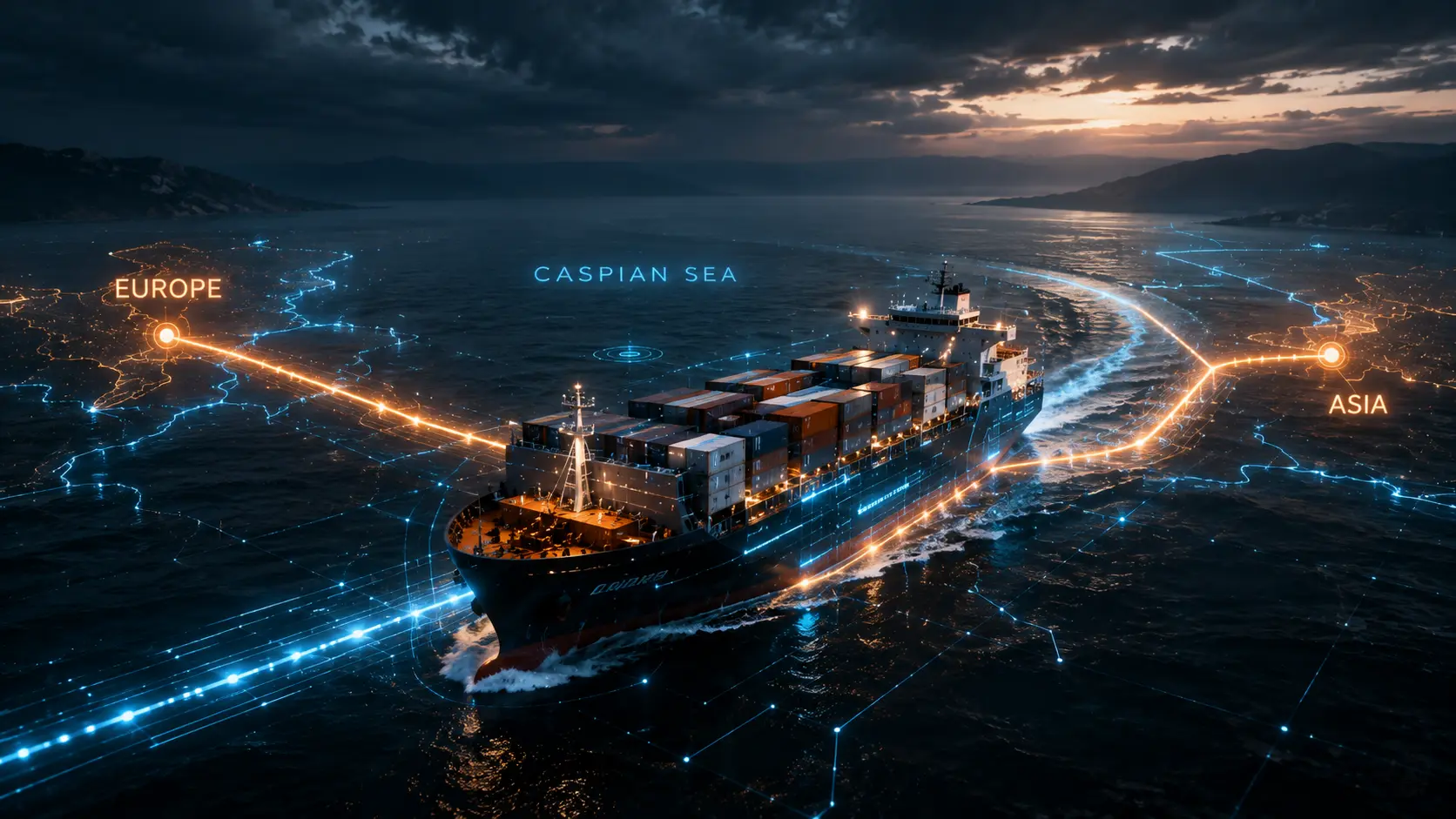
- Concept: A trans-continental supply chain routing freight from China, through Kazakhstan, across the Caspian Sea by ship, into Azerbaijan and Georgia, and finally into Turkey and the European Union.
- Why it matters: The global economy was built on two primary East-West arteries: the Northern Corridor (rail through Russia) and the Southern Maritime Route (ships through the Suez Canal). With Russia heavily sanctioned and the Red Sea plagued by armed conflict, the Middle Corridor is the only viable, large-scale overland alternative.
- Who uses it: Chinese exporters, European manufacturers, Central Asian energy producers, and global logistics giants actively restructuring their transport contracts.
- Biggest takeaway: The Middle Corridor is no longer an emergency backup plan; it is a primary, institutionalized trade route. In 2025, it handled a record 4 million tonnes of freight, with end-to-end transit times compressed to just 13–17 days.
In Simple Words
If a factory in China needs to send a massive container of electronics to a store in Germany, it historically had two easy choices.
Choice A: Put it on a train straight through Russia. It is fast, but because of the war in Ukraine and strict international sanctions, many Western companies legally cannot—or morally will not—use this route.
Choice B: Put it on a massive cargo ship and sail it through the Suez Canal. This is cheap, but Houthi rebel attacks in the Red Sea have turned this route into a warzone, forcing ships to take a massive, expensive detour around the entire continent of Africa.
The Middle Corridor is Choice C.
It is a route that sneaks between the danger zones. The container is put on a train in China and travels west into Kazakhstan. Because you cannot build a train track across water, the train stops at the Caspian Sea. The container is lifted off the train, put onto a ferry, and sailed across the sea to Azerbaijan. It is put back on a train, rolls through Georgia, and arrives in Europe. It is a highly complex logistical relay race, but it guarantees the cargo avoids both Russian borders and Middle Eastern missiles.
Why This Matters
Supply chain resilience is now a tier-one national security mandate for both the European Union and China.
Before 2022, the Middle Corridor (officially known as the Trans-Caspian International Transport Route, or TITR) was widely considered an expensive, bureaucratic nightmare. It required crossing multiple sovereign borders, dealing with corrupt customs agencies, and waiting days for ferries.
Geopolitical shocks forced the route to mature overnight. Today, the TITR is backed by billions of dollars in multilateral financing from the World Bank and the European Bank for Reconstruction and Development (EBRD). Transit volumes exploded by 38% in 2025 alone, surpassing the 4-million-tonne threshold. For logistics directors at multinational corporations, integrating the Middle Corridor into their carrier panels is no longer optional—it is the baseline requirement for maintaining operations when global maritime chokepoints freeze.
The Big Picture
The geography of the Middle Corridor inherently makes it a geopolitical tool. It elevates the South Caucasus (Azerbaijan, Georgia) and Central Asia (Kazakhstan, Uzbekistan) from isolated, post-Soviet states into indispensable nodes of the global economy.
This alignment aligns perfectly with China’s Belt and Road Initiative (BRI) while simultaneously serving the European Union’s “Global Gateway” strategy, creating a rare convergence where both superpowers are heavily incentivized to fund the exact same infrastructure.
HOW THE MIDDLE CORRIDOR WORKS
Moving steel containers across mountains, deserts, and inland seas requires mastering physical friction. Here is the first-principles breakdown of the Middle Corridor.
1. The Fundamental Problem: Geographical Blockades
Getting cargo from the manufacturing hubs of East Asia to the consumer markets of Western Europe requires traversing the largest landmass on Earth. If the fastest overland route (Russia) and the fastest maritime route (Suez) are blocked by geopolitical violence, the cargo must thread the needle through the fragmented topography of Central Asia.
2. The Insufficiency of Pure Rail
Unlike the Northern Corridor, which is a continuous ribbon of steel from China to Europe, the Middle Corridor is bisected by the Caspian Sea and the Black Sea. You cannot drive a train across an ocean. Therefore, the route cannot rely on a single mode of transport; it must be multimodal.
3. The Core Mechanism: Multimodal Transfer Operations
The TITR operates as an orchestrated relay. A train departs Chongqing, China, and crosses the border into Kazakhstan at Khorgos or Dostyk. It travels by rail to the Caspian coast—specifically to the ports of Aktau or Kuryk. Here, massive Roll-on/Roll-off (Ro-Ro) ferries or specialized container ships receive the cargo. The ships sail across the Caspian Sea to the Port of Baku in Azerbaijan. The cargo is unloaded back onto rail cars, travels through the Caucasus mountains via Georgia, and enters Turkey (via the Baku-Tbilisi-Kars railway) or crosses the Black Sea directly into Romania or Bulgaria.
4. Technical Depth: Gauge Breaks and Capacity Constraints
The physical friction of this route is the “gauge break.” China and Europe use standard gauge railway tracks (1,435 mm). However, the former Soviet states (Kazakhstan, Azerbaijan, Georgia) use broad gauge (1,520 mm). Every time a train crosses these borders, the massive steel containers must be physically lifted by giant gantry cranes off the Chinese train and placed onto a Kazakh train. This process repeats multiple times. Furthermore, the route’s total volume is strictly capped by the number of ferries operating on the Caspian Sea, which acts as the ultimate physical bottleneck.
5. Real-World Consequences: Electronic Customs Harmonization
Physical cranes are useless if the paperwork is slow. Historically, a train would sit at the Kazakh-Azerbaijani border for days waiting for customs agents to stamp paper documents. To compress the transit time from 30+ days down to 13–17 days, the participating nations instituted single-window logistics. By digitizing customs declarations and creating a unified transit tariff, a container clears border checkpoints in hours rather than days, drastically increasing the velocity of the entire network.
Real-World Applications
The corridor is reshaping the operational strategies of major global industries.
Automotive and High-Tech Manufacturing: European automakers (like BMW, Volkswagen, and Volvo) rely on “Just-in-Time” manufacturing. They cannot afford to have critical components trapped on a ship rerouted around the Cape of Good Hope (which adds 14 to 20 days to the journey). They are actively shifting high-value, time-sensitive components (like microchips and EV battery cells) to the Middle Corridor to guarantee predictable 15-day delivery windows.
Central Asian Commodity Exports: The Middle Corridor is not just a transit pipe for China; it is an export artery for Kazakhstan. As Europe desperately seeks to replace Russian oil, gas, and uranium, Kazakhstan is utilizing the Caspian ports of Aktau and Kuryk to export its vast natural resources westward. The corridor allows Central Asia to monetize its raw materials without relying on Russian pipelines or rail networks.
Port Infrastructure Real Estate: The surge in volume has triggered a massive infrastructure boom. Dredging works and expansions at Kazakhstan’s Kuryk port, backed by entities like the Abu Dhabi Ports Group, aim to construct multi-functional terminals capable of handling millions of tons. Concurrently, the Port of Baku is entering a second development phase to raise throughput capacity to 25 million tonnes.
Economic & Strategic Impact
The financial capitalization of the Middle Corridor proves that supply chain resilience is now priced higher than raw efficiency.
On a pure cost-per-container basis, the Middle Corridor is structurally more expensive than sending a ship through a peaceful Suez Canal. Lifting a container on and off a train three different times costs money. However, global markets have realized that “cheap” maritime shipping is an illusion if the ship gets hit by an anti-ship ballistic missile or delayed by a month.
By 2026, the World Bank and the Asian Infrastructure Investment Bank (AIIB) had mobilized nearly USD 1.4 billion to reform the Kazakh national railway operator. Strategically, this influx of Western and Asian capital binds the nations of the Middle Corridor together. By linking their economic survival to the unified transit route, it naturally de-escalates historical regional conflicts in the Caucasus, as an open trade route is vastly more profitable for Azerbaijan and Georgia than a closed border.
Advantages
- Geopolitical Immunity: Completely bypasses Russian territory and the volatility of the Middle East, neutralizing the risk of sanctions compliance and maritime terrorism.
- Speed Advantage over Ocean: At 13 to 17 days end-to-end, it is significantly faster than ocean freight (which typically takes 35 to 45 days, or longer if routed around Africa).
- Regional Economic Integration: Transforms landlocked Central Asian nations into critical logistics hubs, unlocking new export markets for their domestic industries.
Limitations
- The Caspian Bottleneck: A rail network can run hundreds of trains a day, but the Middle Corridor is limited by the number of Ro-Ro ferries and container ships actively sailing the Caspian Sea. Building new ships takes years.
- Multimodal Friction: Every time cargo is lifted from a train to a ship and back to a train, it increases handling costs, introduces the risk of cargo damage, and adds hours of delay.
- Infrastructure Deficits: To reach its maximum theoretical capacity, the EBRD estimates the region needs roughly EUR 18.5 billion in physical infrastructure upgrades, including massive railway double-tracking and port expansions.
Common Misconceptions
Misconception: The Middle Corridor can completely replace the Suez Canal.
Reality: The sheer mathematics of volume make this impossible. A single ultra-large container vessel (ULCV) carries 24,000 TEU. A single freight train carries roughly 100 TEU. You would need 240 trains to equal one ship. The Middle Corridor handles millions of tonnes, but global maritime shipping handles billions. The corridor is a pressure-relief valve for high-value goods, not a wholesale replacement for ocean freight.
Misconception: It is solely a Chinese “Belt and Road” project.
Reality: While China heavily utilizes and supports the route, the European Union is equally invested. The EU’s “Global Gateway” initiative actively funds the corridor’s infrastructure to ensure Europe has secure access to Central Asian critical minerals and secure supply lines to Asia.
Misconception: Trains run from China all the way to Germany without stopping.
Reality: Because of the gauge breaks (standard to broad to standard) and the Caspian Sea crossing, the containers travel the distance, but the physical locomotive engines and railcars are swapped out multiple times along the journey.
What Most People Miss
The strategic importance of the Zangezur Corridor debate.
Currently, trains crossing the Caspian Sea to Baku (Azerbaijan) must route north through Georgia to reach Turkey. However, following the 2020 and 2023 conflicts in Nagorno-Karabakh, Azerbaijan has aggressively pushed for the opening of the “Zangezur Corridor”—a direct land link through southern Armenia straight into Turkey.
If this highly contested 40-kilometer strip of land is opened to rail traffic, it would shave days off the Middle Corridor transit time by entirely bypassing the mountainous detour through Georgia. The geopolitical wrangling over this tiny strip of rail line is the most closely watched flashpoint for the future velocity of trans-Eurasian trade.
Comparison Table
| Feature | Northern Corridor (via Russia) | Middle Corridor (TITR) | Southern Maritime (via Suez) |
|---|---|---|---|
| Transit Mode | Pure Rail (Direct) | Multimodal (Rail + Sea + Rail) | Pure Ocean |
| Average Transit Time | ~12 to 15 Days | ~13 to 17 Days | ~35 to 45 Days |
| Geopolitical Risk | Extreme (Sanctions / War) | Low to Moderate | High (Houthi Attacks / Piracy) |
| Logistical Complexity | Low (Single landmass) | Extreme (Gauge breaks, ferries) | Low (Single ship) |
| Primary Advantage | Raw overland speed | Geopolitical neutrality | Unmatched volume capacity |
Case Study
Situation: In early 2024 and continuing into 2025, continuous attacks by Houthi militants in the Red Sea forced the world’s largest ocean carriers (Maersk, MSC, Hapag-Lloyd) to abandon the Suez Canal. They rerouted ships around the Cape of Good Hope, adding weeks of delay and massively spiking freight rates.
Challenge: European manufacturers of high-value electronics and automotive parts faced critical supply shortages. They could not use the Russian rail network due to sanctions, and the ocean route was now too slow to sustain their “Just-in-Time” manufacturing assembly lines.
Solution (The Multimodal Pivot): Logistics forwarders aggressively executed a pivot to the Trans-Caspian International Transport Route. Chinese exporters in inland hubs like Chongqing and Yiwu accelerated their use of the railway into Kazakhstan. The cargo was ferried across the Caspian to Baku, and railed straight into the heart of Europe.
Outcome: The volume of the Middle Corridor skyrocketed, breaking the 4-million-tonne barrier in 2025. The crisis permanently altered corporate behavior. For major European retailers and manufacturers, the Middle Corridor graduated from an experimental “evaluation list” to a permanent fixture in their baseline transport contracts.
Lessons Learned: Global supply chains will inevitably route around geopolitical damage. While multimodal transport inherently carries more friction and higher base costs than pure ocean freight, the guarantee of a secure, 15-day delivery window is mathematically more valuable to a manufacturer than risking a 50-day ocean detour.
Future Outlook
Next 12–24 Months
The corridor will experience intense optimization. With the massive surge in volume exposing the weak links in the chain, Kazakhstan and Azerbaijan will heavily deploy the World Bank and AIIB financing to upgrade port machinery (such as wind-resistant ship-to-shore cranes at Aktau). The introduction of new container vessels currently being built at the Baku Shipyard (expected delivery in 2027) will begin to relieve the strict ferry capacity bottleneck on the Caspian Sea.
Next 3–5 Years
The completion of major regional feeder lines. The construction of the China-Kyrgyzstan-Uzbekistan railway, projected for completion by 2026/2027, will provide an even more direct southern link into the corridor, further compressing transit times from Chinese manufacturing hubs. By 2029, the TITR member states aim to quadruple their containerized volume to 300,000 TEU annually.
Next 10 Years
Total digital harmonization. The Middle Corridor will become a proving ground for blockchain-based logistics. Smart contracts and electronic Bills of Lading (eBL) will completely eradicate physical paperwork at the borders. A container leaving China will trigger automated customs pre-clearance in Georgia and Turkey instantly, allowing the cargo to flow across five sovereign nations as smoothly as a truck driving across the United States.
Most Likely Scenario
The Middle Corridor will never replace the sheer tonnage of the global maritime fleet. However, it will establish itself as the premier, indispensable “express lane” of the Eurasian landmass. As global geopolitical fragmentation deepens and trade routes become increasingly weaponized, the TITR will serve as the neutral, multi-national backbone of the Eurasian economy, permanently altering the geopolitical gravity of Central Asia.
Key Takeaways
- The Middle Corridor (TITR) routes freight from China to Europe through Kazakhstan, the Caspian Sea, Azerbaijan, Georgia, and Turkey.
- It is structurally multimodal, requiring cargo to be loaded onto trains, transferred to ships to cross the Caspian Sea, and then loaded back onto trains.
- By bypassing both the sanctioned Russian rail network and the dangerous Red Sea, it has become the most secure, high-velocity overland trade route in the world.
- End-to-end transit times have dropped to 13–17 days, directly competing with the speed of the Russian Northern Corridor.
- In 2025, freight volumes hit a record 4 million tonnes, driven by European manufacturers institutionalizing the route into their permanent supply chain contracts.
- The ultimate capacity of the route is constrained by the “gauge breaks” at borders and the limited number of Ro-Ro ferries operating on the Caspian Sea.
Glossary
Belt and Road Initiative (BRI): China’s massive global infrastructure development strategy aimed at investing in nearly 150 countries to enhance global trade routing toward Beijing.
Gauge Break: The physical point where a railway track of one width (e.g., standard gauge) meets a track of a different width (e.g., Russian broad gauge), requiring cargo to be lifted and transferred to different trains.
Multimodal Transport: Moving cargo from origin to destination using at least two different methods of transport (e.g., train, ship, and truck) under a single contract.
Ro-Ro (Roll-on/Roll-off): Specialized ships designed to carry wheeled cargo, such as trains or trucks, that are driven on and off the ship on their own wheels.
TEU (Twenty-foot Equivalent Unit): The standard unit of measurement in global shipping, representing the volume of a standard 20-foot-long intermodal shipping container.
Trans-Caspian International Transport Route (TITR): The official, diplomatic name for the Middle Corridor infrastructure and logistics network.
Frequently Asked Questions
Why not just fly the cargo on an airplane?
Air freight is incredibly fast but astronomically expensive. It is reserved for ultra-high-value, low-weight goods (like fresh pharmaceuticals or luxury fashion). For heavy electronics, automotive parts, or bulk commodities, air freight would bankrupt the manufacturer. The Middle Corridor offers a middle ground: faster than a ship, but vastly cheaper than a plane.
Who owns the Middle Corridor?
No single country owns it. It is a consortium and a cooperative agreement. The railways and ports are owned by the respective sovereign nations (Kazakhstan, Azerbaijan, Georgia, Turkey), but they operate under the TITR International Association to harmonize their tariffs and schedules.
Is it safe from the war in Ukraine?
Yes. The physical route runs hundreds of miles south of the Ukrainian border and the Russian landmass, crossing the Caspian and Black Seas (or moving overland into Turkey), keeping the cargo entirely out of the active conflict zone.
Why does the gauge break exist?
It is a historical legacy of the Russian Empire and the Soviet Union, which built their railways wider (1,520 mm) than the European and Chinese standard (1,435 mm), partially for military defense reasons to prevent foreign trains from easily invading their territory.
Does the U.S. support the Middle Corridor?
Yes. While the U.S. is not geographically involved, Washington heavily supports the corridor diplomatically and financially because it provides Central Asian nations with an economic lifeline that is independent of both Russian and Chinese control, fostering regional sovereignty.
Sources
- Alliance Logistics: Middle Corridor Hits 4 Million Tonne Record in 2025 & Growth Is Accelerating (May 2026)
- The Astana Times: Trans-Caspian Transport Route Cargo Volumes Increase Fivefold in Seven Years (March 2026)
- Oxford Business Group: The Trans-Caspian International Transport Route is emerging as an alternative to global trade corridor disruptions (May 2026)
- European Commission: Trans-Caspian Transport Corridor and Connectivity Investors Forum Updates (2025/2026)