Advertisement
)

At a Glance
- Concept: Replacing mechanical and optical gyroscopes with “cold atom interferometry” and quantum optical atomic clocks to create an un-jammable, drift-free compass.
- Why it matters: Modern adversaries routinely jam and spoof GPS signals, blinding ships, drones, and missiles. Furthermore, GPS does not work underwater or underground. Quantum navigation provides absolute positioning independently, neutralizing the primary electronic warfare weapon of the 21st century.
- Who uses it: The U.S. Department of Defense (DARPA), the UK Royal Navy, and highly specialized quantum hardware firms like Infleqtion, Q-CTRL, and Aquark Technologies.
- Biggest takeaway: Classical navigation systems suffer from “drift”—microscopic manufacturing errors that cause a submarine to lose its exact position over time. Quantum systems use fundamental atoms, which are perfectly identical across the universe. Because the “ruler” is perfect, the navigation never drifts.
In Simple Words
If you want to walk through a dark forest without a map, you have two choices.
Choice A is to look up at the stars and figure out where you are. This is how GPS works. Your phone looks up at satellites in space. But in modern warfare, the enemy can easily block your view of the sky (jamming) or put up fake stars to trick you into walking off a cliff (spoofing).
Choice B is to close your eyes, take exactly 100 steps north, turn 90 degrees right, and take 50 steps. If you keep perfect track of your speed and direction, you always know exactly where you are without looking at the sky. This is called “dead reckoning”.
The military uses dead reckoning for submarines and stealth bombers. The problem is that the tools they use to count those steps (classical gyroscopes) have tiny mechanical flaws. Over a few days, those tiny flaws add up, and the submarine thinks it is a mile away from its actual location.
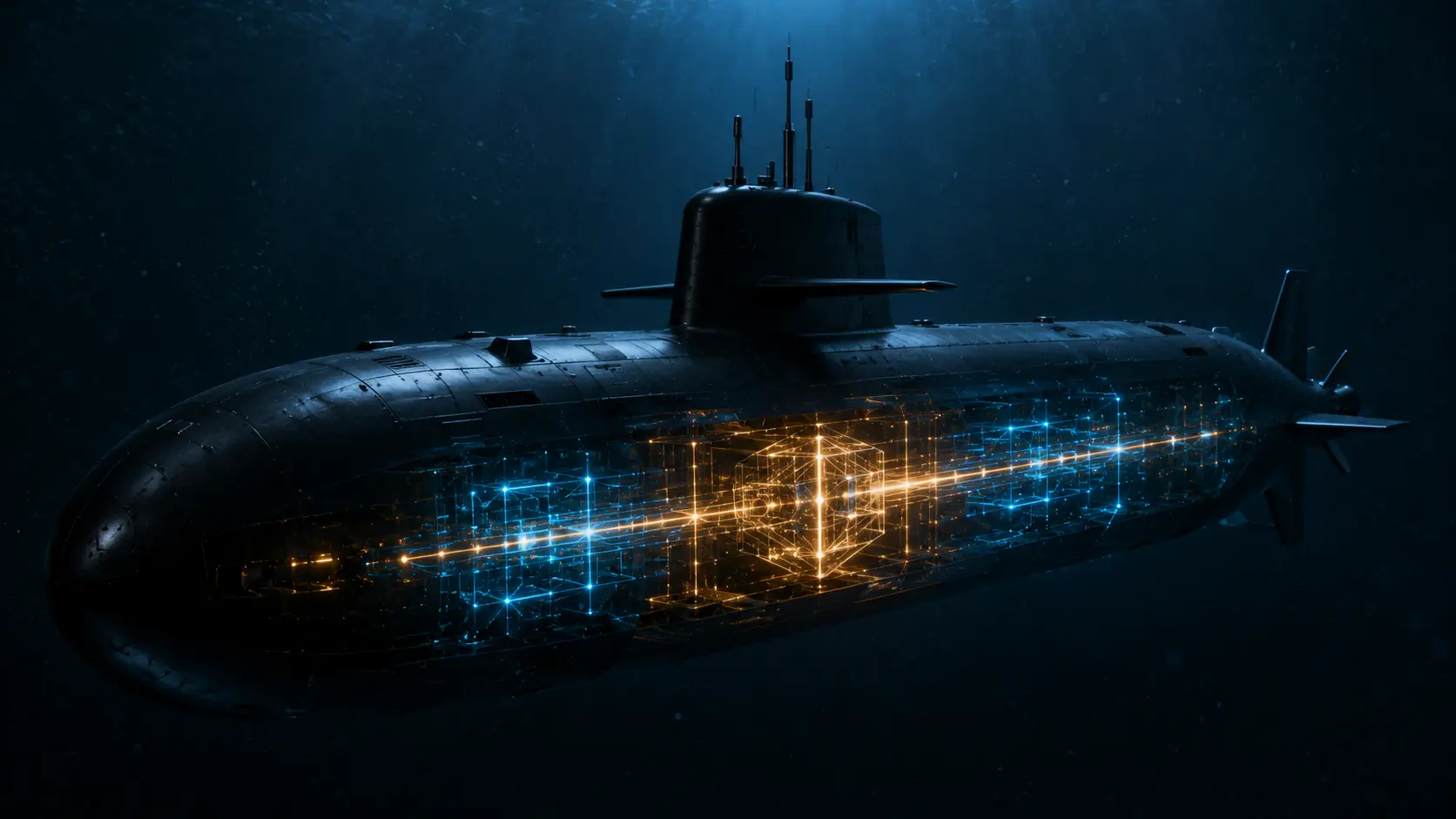
Quantum Inertial Navigation fixes Choice B. Instead of using spinning metal or glass tubes to measure movement, it uses ultra-cold atoms trapped by lasers. Because atoms are flawless and obey the strict laws of quantum physics, the sensor measures the submarine’s movement with absolute mathematical perfection. The submarine never loses count of its steps, meaning it never has to surface to look at the stars again.
Why This Matters
The global economy and the modern military are suffering from a fatal over-reliance on the Global Positioning System (GPS).
In contested theaters like the South China Sea or Eastern Europe, GPS signals are routinely jammed by sophisticated electronic warfare units. According to UK economic estimates, a single day of total satellite service denial would cost the British economy over £1 billion. For the military, a jammed GPS signal means multi-million-dollar precision missiles miss their targets, and autonomous drones fall out of the sky.
If a military cannot navigate, it cannot fight. Quantum Inertial Navigation Systems (Q-INS) represent the ultimate countermeasure to Anti-Access/Area Denial (A2/AD) warfare. By severing the invisible tether to space satellites, quantum sensors guarantee “assured PNT” (Positioning, Navigation, and Timing). The nation that masters this technology first will secure total operational supremacy in the electromagnetically contested battlefields of the 2030s.
The Big Picture
The leap to quantum navigation marks a shift from relative measurement to absolute measurement.
A traditional Fiber Optic Gyroscope (FOG) measures how much a vehicle has rotated relative to its starting point. But traditional sensors are susceptible to temperature changes, vibrations, and manufacturing tolerances.
A quantum sensor does not rely on a manufactured component; it relies on the fundamental constants of the universe. An atom of Rubidium-87 in an American submarine behaves identically to an atom of Rubidium-87 in a British submarine. By building sensors around the immutable laws of quantum mechanics, physicists have effectively created an “optical ruler” that can never bend, warp, or degrade.
HOW QUANTUM NAVIGATION WORKS
Extracting navigational data from quantum mechanics requires manipulating matter at temperatures colder than deep space. Here is the first-principles breakdown of the architecture.
1. The Fundamental Problem: Dead Reckoning Drift
Submarines and stealth aircraft cannot use GPS because radio signals do not penetrate deep water, and transmitting a signal gives away the vehicle’s position to enemy radar. They must use Inertial Navigation Systems (INS) to calculate their position based on acceleration and rotation. However, because the mathematical calculation relies on integrating acceleration over time, even a microscopic sensor error compounds exponentially. This is known as “drift.”
2. The Insufficiency of Classical Sensors
Modern military INS rely on Micro-Electromechanical Systems (MEMS) or Ring Laser Gyroscopes. These are physical devices. No matter how perfectly they are machined, temperature fluctuations and material fatigue introduce noise. Over weeks of submerged operation, this noise causes the submarine’s calculated position to drift by kilometers, forcing the sub to surface and risk detection just to get a corrective GPS fix.
3. The Core Mechanism: Cold Atom Interferometry
To eliminate physical imperfections, scientists discard mechanical parts and use a cloud of atoms (usually rubidium) suspended in a vacuum chamber. Lasers are fired at the cloud from six different directions. The photons from the lasers strike the atoms, sapping their kinetic energy and cooling them to a fraction of a degree above absolute zero (microkelvins).
4. Technical Depth: Wave-Particle Duality and Phase Shifts
At this extreme temperature, the atoms stop behaving like solid particles and begin exhibiting wave-like properties (quantum superposition). A sequence of laser pulses splits the atomic wave into two separate paths, allows them to travel, and then recombines them. If the submarine accelerates or rotates while the atom is split, the paths shift slightly relative to each other. When recombined, they create an “interference pattern”. By measuring this pattern, the onboard computer can calculate the exact inertial force that caused the shift with a sensitivity up to 1,000 times greater than classical sensors.
5. Real-World Consequences: Quantum Gravimetry
Because the sensor is so incredibly sensitive, it can do more than just measure movement; it can measure the microscopic variations in Earth’s gravity. The planet’s gravitational field is not uniform; an underwater mountain pulls slightly harder than a deep trench. A Quantum Gravimeter can read these tiny gravitational signatures and compare them to an onboard map. This provides the submarine with an absolute “position fix” completely independent of satellites, entirely eradicating the drift problem.
Real-World Applications
Quantum navigation is moving rapidly from laboratory physics experiments to active military deployments.
Extra-Large Uncrewed Underwater Vehicles (XLUUVs): In late 2025, the UK Royal Navy deployed the XV Excalibur, an autonomous submarine, equipped with Infleqtion’s “Tiqker” quantum optical atomic clock. Autonomous subs cannot surface for GPS without abandoning their covert mission profiles. The quantum clock provided a flawless, onboard “time heartbeat” that smoothed out navigation noise, allowing the drone sub to operate independently for prolonged durations without human intervention.
Arctic Navigation Trials: Navigating near the Earth’s poles is notoriously difficult for classical compasses and GPS. In December 2025, Imperial College London integrated a quantum inertial sensor into a rapid-prototyping NavyPOD and deployed it aboard the MV Anvil Point in the Arctic. The trial successfully proved that delicate quantum sensors—previously confined to static, vibration-free laboratory tables—could withstand the violent pitching, rolling, and extreme temperatures of a naval warship at sea.
GPS-Denied Drone Swarms: DARPA’s Robust Quantum Sensing (RoQS) program is actively funding the miniaturization of these sensors. As drones become the primary weapon of modern warfare, adversaries use electronic warfare to jam their GPS, causing them to crash. By equipping high-value autonomous drones with chip-scale atomic clocks and miniature quantum accelerometers, the drones can navigate deep into hostile, jammed territory, identify targets, and return home with pinpoint accuracy.
Economic & Strategic Impact
The £1 billion-a-day threat of GPS denial is restructuring the defense contracting hierarchy.
Historically, aerospace primes like Lockheed Martin and Boeing dominated the navigation market. However, quantum physics requires an entirely different engineering skill set. This has elevated specialized quantum technology firms—such as Q-CTRL, Infleqtion, Aquark Technologies, and AOSense—into tier-one defense contractors.
In 2025, Lockheed Martin was forced to team up with Q-CTRL and AOSense specifically to accelerate the transition of quantum INS into their tactical platforms, acknowledging that legacy aerospace companies cannot build these atomic architectures alone. For defense investors, the capital flow is clear: the hardware budgets previously allocated to building multi-billion-dollar GPS satellite replacements are being re-routed into terrestrial, SWaP-optimized quantum hardware startups.
Advantages
- Absolute Accuracy: Zero mechanical drift. The sensors provide pinpoint positional accuracy over weeks or months of operation.
- Total Passive Operation: Unlike radar or sonar, quantum inertial sensors do not emit any signals into the environment. A submarine remains totally silent and invisible to enemy detection while navigating.
- Unjammable: Because the system measures internal atomic physics and does not rely on external radio waves, it is physically impossible to jam or spoof using electronic warfare.
- Gravimetric Map-Matching: The ability to read the Earth’s gravitational field allows for terrain-referenced navigation in the deep ocean, creating a fail-safe position fix.
Limitations
- SWaP Constraints (Size, Weight, and Power): Generating ultra-cold atoms requires vacuum chambers, magnetic shielding, and multiple high-powered lasers. While shrinking, many field prototypes are still the size of a large trunk, making them impossible to fit inside a standard smartphone or a small drone.
- Environmental Fragility: Maintaining quantum superposition on a warship smashing through ocean waves is incredibly difficult. Extreme shocks or vibrations can disrupt the laser cooling process, instantly crashing the sensor.
- Astronomical Cost: The manufacturing of micro-fabricated vacuum cells and photonic integrated circuits remains a bespoke, low-yield process, keeping the unit cost of quantum navigation suites in the millions of dollars.
Common Misconceptions
Misconception: Quantum navigation connects to a “quantum satellite” network.
Reality: It connects to absolutely nothing. The entire point of the technology is that it is 100% self-contained inside the vehicle. It does not send or receive any signals from space or the ground.
Misconception: It relies on quantum computers.
Reality: Quantum sensing and quantum computing are different branches of physics. Quantum computing uses qubits to process complex math. Quantum sensing (navigation) uses the physical properties of atoms to act as hyper-sensitive measuring tape. They do not require a quantum computer to function.
Misconception: It will replace GPS in your car.
Reality: GPS is cheap, fits on a $2 microchip, and works perfectly well for civilians. Quantum navigation is hyper-expensive, complex, and large. It is strictly reserved for high-stakes military, aerospace, and deep-sea commercial operations where GPS is unavailable or compromised.
What Most People Miss
The strategic difference between Laser Cooling and Supermolasses.
To make a cold atom sensor work, you must trap the atoms. Traditionally, this required wrapping the vacuum chamber in massive, heavy electromagnetic coils to create a magnetic field (a magneto-optical trap).
Companies like UK-based Aquark Technologies have recently successfully tested a proprietary method called “supermolasses” at sea. This laser-cooling technique creates the necessary cold atoms without an applied magnetic field. Eliminating the heavy magnets drastically reduces the size, weight, and power consumption of the sensor. This specific breakthrough in atomic physics is the critical catalyst that will finally allow quantum sensors to shrink from the size of a refrigerator down to the size of a coffee cup.
Comparison Table
| Feature | Global Positioning System (GPS) | Classical Inertial Navigation (MEMS/FOG) | Quantum Inertial Navigation (Q-INS) |
| Primary Mechanism | External satellite radio signals | Internal mechanical / optical measurement | Internal atomic wave-particle measurement |
| Vulnerability | Extremely High (Easily Jammed/Spoofed) | Low (Self-contained) | Zero (Physically un-jammable) |
| Drift Rate | None (Absolute position) | High (Drifts kilometers per hour) | Near Zero (Drifts meters per day) |
| Underwater/Underground Use | Fails completely | Yes | Yes |
| Size and Cost | Microscopic / Cents | Small / Moderate | Large / Millions of Dollars |
Case Study
Situation: The Royal Navy recognized that its fleet of nuclear submarines and extra-large uncrewed underwater vehicles (XLUUVs) were strategically vulnerable. To maintain absolute stealth, a submarine must stay submerged. However, legacy onboard clocks and classical gyroscopes slowly lose their accuracy. Eventually, the submarine must surface an antenna to catch a GPS signal to recalibrate, exposing it to enemy anti-submarine warfare (ASW) networks.
Challenge: The Ministry of Defence required an onboard timing and navigation system that provided laboratory-grade stability but could survive the relentless vibration, pressure, and temperature swings of a combat submarine operating in the North Atlantic.
Solution (The Excalibur Deployment): In late 2025, the Royal Navy partnered with Infleqtion to install the “Tiqker” quantum optical atomic clock onboard the XV Excalibur—an autonomous XLUUV testbed manufactured by MSubs. Concurrently, they deployed Imperial College London’s cold-atom quantum sensor into the Arctic aboard the MV Anvil Point.
Outcome: The trials were a resounding success. By placing the Tiqker optical clock directly into the autonomous submarine, the vessel maintained a perfect internal “time heartbeat” throughout multiple dives. This steady heartbeat smoothed out the noise that causes classical navigation systems to drift, while the Imperial sensor proved that quantum acceleration tracking could survive the harsh Arctic sea conditions.
Lessons Learned: The Excalibur and Anvil Point trials proved that quantum technology is mission-ready. By eliminating the necessity for external GPS calibration, the Royal Navy effectively severed the final tether forcing autonomous submarines to the surface, ushering in an era of limitless, un-detectable underwater combat operations.
Future Outlook
Next 12–24 Months
The immediate priority for the Department of Defense and defense primes is Sensor Fusion. Because quantum sensors are currently slow (taking a second or more to cool and drop the atoms), they cannot provide the high-frequency updates needed to steer a fast-moving missile. In the short term, military platforms will deploy “Hybrid Stacks.” A traditional, fast MEMS gyroscope will steer the vehicle second-by-second, while the highly accurate Quantum sensor will continuously calibrate and correct the MEMS sensor in the background, offering the best of both worlds.
Next 3–5 Years
The commercialization of Chip-Scale Atomic Clocks (CSACs) and photonic integrated circuits. As DARPA programs yield results, the massive optical tables required for laser cooling will be etched directly into silicon wafers. This SWaP reduction will allow quantum navigation suites to be installed in commercial autonomous cargo ships, long-haul aviation, and critical civilian infrastructure that requires absolute timing precision to prevent spoofing attacks from disrupting financial markets or power grids.
Next 10 Years
The maturation of Quantum Gravimetric Map-Matching. Submarines and stealth aircraft will carry detailed, high-resolution gravity maps of the Earth in their hard drives. By continuously comparing the live gravitational readings from their quantum gravimeters against the stored maps, vehicles will achieve absolute terrain-referenced positioning in the deep ocean or in the stratosphere, achieving GPS-level accuracy entirely in the dark.
Most Likely Scenario
Quantum Inertial Navigation will permanently retire the concept of the “GPS-denied environment.” While GPS will remain the cheap, ubiquitous standard for civilian life, every tier-one military asset built after 2030 will feature quantum-assured PNT as baseline hardware. The ability to navigate with atomic perfection without emitting a single radio wave will fundamentally shift modern warfare back to a game of absolute stealth.
Key Takeaways
- Quantum Inertial Navigation utilizes ultra-cold atoms and lasers to measure acceleration and rotation with extreme, mathematically perfect accuracy.
- Unlike GPS, which relies on vulnerable satellite signals, quantum navigation is 100% self-contained, completely passive, and impossible to jam or spoof.
- Classical dead reckoning systems (gyroscopes) suffer from “drift” over time due to microscopic mechanical flaws. Quantum sensors use perfectly identical atoms, virtually eliminating navigation drift.
- The UK Royal Navy and DARPA are actively trialing quantum optical clocks and cold-atom sensors on autonomous submarines and warships to extend their covert operational ranges.
- Quantum gravimeters can measure minute changes in the Earth’s gravitational pull, allowing vehicles to match their readings to a gravity map for an absolute position fix underwater.
- The primary barrier to widespread adoption is SWaP (Size, Weight, and Power). Engineers are actively working to shrink the bulky vacuum chambers and lasers down to chip-scale integrated circuits.
Glossary
Assured PNT: Positioning, Navigation, and Timing. A military standard ensuring that a vehicle always knows where it is and what time it is, even in environments where GPS is blocked or jammed.
Atom Interferometry: A quantum sensing technique that exploits the wave-like nature of atoms cooled to near absolute zero. By splitting and recombining the atomic wave using lasers, physicists can measure interference patterns to determine acceleration and gravity with extreme precision.
Cold Atom Sensor: A device that uses lasers to trap and cool a cloud of atoms (like rubidium) to microkelvins (a fraction above absolute zero), suppressing their erratic thermal motion so their quantum properties can be measured.
Dead Reckoning: The process of calculating one’s current position by using a previously determined position and advancing that position based upon known or estimated speeds over elapsed time and course.
Drift: The gradual loss of accuracy in classical inertial navigation systems. Tiny measurement errors in the gyroscopes compound over time, causing the calculated position to wander away from the actual position.
SWaP: Size, Weight, and Power. The three critical constraints for integrating new technology into mobile military platforms.
Frequently Asked Questions
Why can’t submarines just use GPS?
Radio waves from GPS satellites bounce off water; they do not penetrate the ocean. To get a GPS signal, a submarine must rise to periscope depth and stick an antenna out of the water. Doing so makes the submarine visible to enemy radar and anti-submarine warfare (ASW) patrols.
What happens if the lasers inside the quantum sensor break?
If the quantum sensor fails, the vehicle relies on its classical backup systems (standard gyroscopes). This is why current deployments use “Sensor Fusion”—pairing the experimental quantum tech with proven, classical inertial systems to ensure safety.
How does cooling atoms make them easier to measure?
At room temperature, atoms zip around chaotically at hundreds of miles per hour, making them impossible to measure accurately. When lasers cool them to near absolute zero, they slow down to a crawl. In this state, they stop acting like bouncing billiard balls and start acting like smooth, predictable waves, which can be measured with microscopic precision.
Is this technology radioactive or dangerous to the crew?
No. Quantum sensors use harmless isotopes of elements like Rubidium or Strontium. There is no nuclear fission, radiation, or explosive risk involved. It is an optical and physical measurement tool, not a reactor.
Why is it so expensive?
Building a device that maintains an ultra-high vacuum, generates precise magnetic fields, and fires perfectly tuned lasers—all while surviving the violent shaking of a warship—is incredibly difficult. Mass production of these delicate components is still in its infancy.
Sources
- Imperial College London: Quantum sensor for a future navigation system tested aboard Royal Navy ship (May 2023) / Arctic Trials (Dec 2025)
- Royal Navy Newsroom: Quantum technology trialled on Royal Navy uncrewed submarine XV Excalibur (Oct 2025)
- Fortune Business Insights: Quantum Navigation Systems Market Size, Share [2026-2034] (July 2026)
- Defense Advanced Research Projects Agency (DARPA): Adaptable Navigation Systems (ANS) and Micro-PNT Program Overviews
- BQP: Quantum Algorithms Transform Navigation Accuracy and Resilience (2026)