Advertisement
)

At a Glance
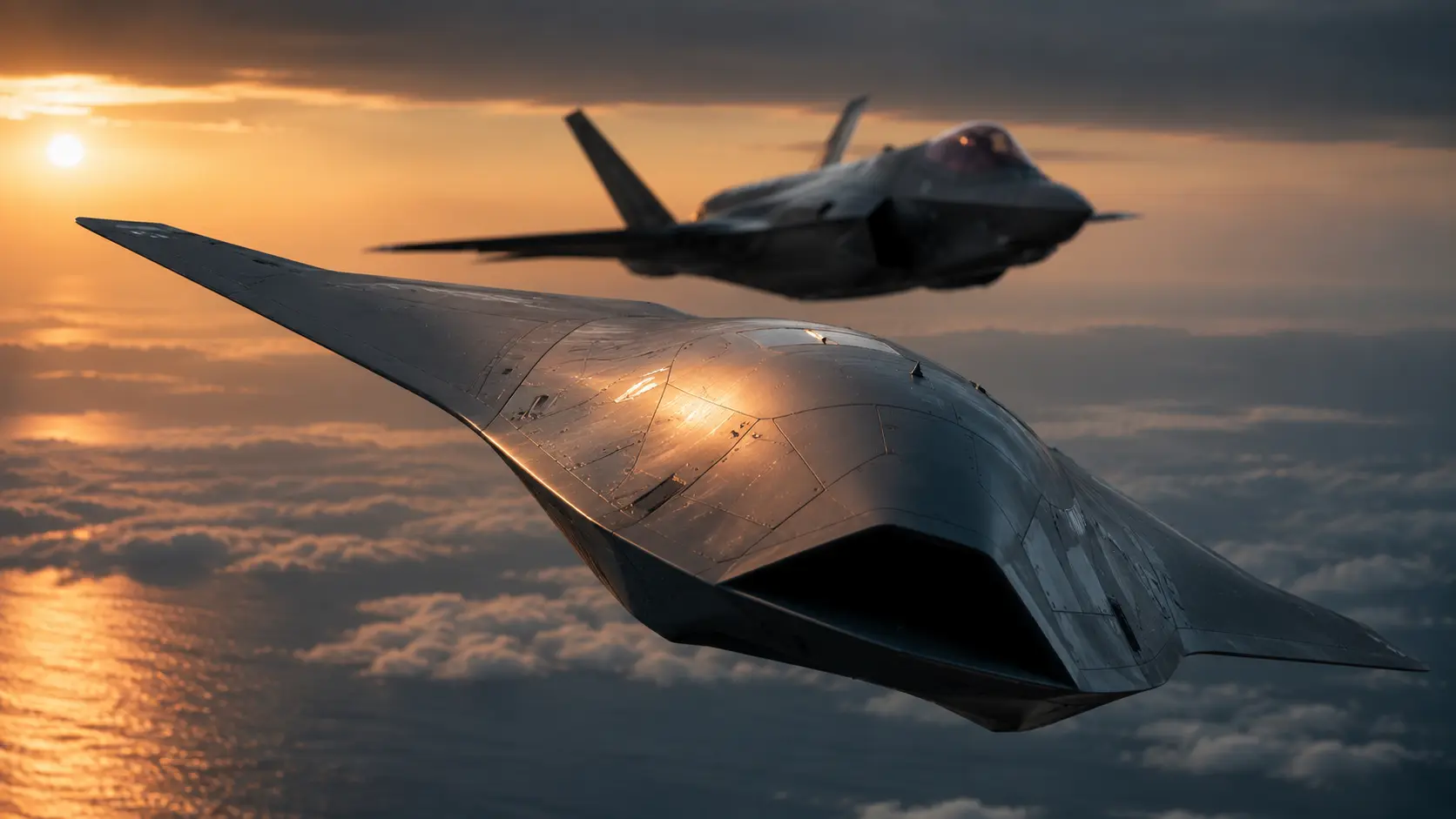
- Concept: Removing the human pilot from a fighter jet to slash costs, eliminate physiological G-force limits, and create a scalable fleet of robotic “Loyal Wingmen.”
- Why it matters: A modern F-35 costs roughly USD 100 million, and a human pilot takes years and millions of dollars to train. U.S. and allied air forces cannot afford to lose them in high-end conflicts. CCAs provide “affordable mass”—swarms of lethal, USD 25 million drones that commanders are willing to sacrifice to complete a mission.
- Who uses it: The United States Air Force (via the Increment 1 program featuring Anduril and General Atomics), the U.S. Navy, and allied nations developing parallel Manned-Unmanned Teaming (MUM-T) doctrines.
- Biggest takeaway: The true innovation of the CCA program is software decoupling. The military is buying the physical jets from hardware companies, but acquiring the AI “brains” separately through an open-source architecture, ensuring the drones get constantly upgraded like smartphones.
In Simple Words
Imagine a human police officer entering a highly dangerous, dark building. Instead of going in alone, the officer sends in three robotic dogs.
The first robot dog runs ahead to map out the rooms and look for threats. The second robot carries heavy armor and weapons to protect the officer. The third robot makes a loud noise in the opposite direction to distract the criminals. The human officer stays safely behind cover, looking at a screen, telling the robots what to do.
Collaborative Combat Aircraft (CCAs) are the fighter jet equivalent of those robot dogs.
A human pilot flying an F-35 stealth fighter will enter a warzone accompanied by three to five robotic jets. These drones do not have cockpits or life-support systems. Because they do not have a human inside, they are vastly cheaper to build and can pull violent, extreme maneuvers that would crush a human spine. The human pilot acts like a quarterback, directing the drones to fly ahead, jam enemy radar, or fire missiles, overwhelming the enemy without ever putting the human in the direct line of fire.
Why This Matters
Air superiority is no longer a game of individual stealth; it is a game of mass and cost-exchange ratios.
For decades, the West dominated the skies by building the most exquisite, technologically advanced fighter jets on Earth. However, adversaries like China and Russia have developed massive, dense networks of surface-to-air missiles (SAMs). If a conflict erupts over Taiwan or Eastern Europe, penetrating these defenses will result in inevitable aircraft losses. Losing a USD 100 million stealth fighter and its highly trained pilot is a strategic catastrophe; doing so repeatedly rapidly depletes a nation’s military capacity.
The CCA program solves the math problem of modern warfare. By supplementing the crewed fleet with 1,000 highly capable, unmanned jets costing roughly USD 25 million each, the Air Force generates “affordable mass.” This allows commanders to deliberately fly CCAs into the teeth of an enemy air defense system to bait the enemy into firing their multi-million-dollar missiles at cheap, disposable drones. This exhausts the enemy’s magazines, opening a safe corridor for the human pilots to execute the primary strike.
The Big Picture
The evolution of CCAs marks the transition to Manned-Unmanned Teaming (MUM-T).
Historically, military drones (like the MQ-9 Reaper) were completely isolated from the fighter jets. A Reaper was flown via satellite by a pilot sitting in a trailer in Nevada, completely disconnected from the F-16 pilot flying in the actual airspace.
MUM-T fundamentally alters this architecture. The CCA drones communicate directly and securely with the crewed fighter jet flying next to them in real-time. The artificial intelligence onboard the CCA processes massive amounts of radar data and presents the human pilot with tactical options. This shifts the human pilot’s role from “stick-and-rudder flying” to “battle management,” drastically expanding the lethal reach of a single human operator across hundreds of miles of airspace.
HOW A COLLABORATIVE COMBAT AIRCRAFT WORKS
Creating an autonomous, supersonic wingman requires stripping away human life-support systems and replacing them with modular, software-defined architectures. Here is the first-principles breakdown.
1. The Fundamental Problem: The Human Limit
The most expensive and limiting component of a fighter jet is the human pilot. To keep a human alive, a jet requires heavy oxygen systems, ejection seats, pressurized cockpits, and armored glass. Furthermore, the airframe must be structurally limited to maneuvers under 9 Gs to prevent the pilot from blacking out or dying. This adds weight, complexity, and astronomical cost to every airframe.
2. The Insufficiency of Remote Control
Legacy drones were remote-controlled via satellite links. In a high-end peer conflict, adversaries will heavily jam satellite communications and GPS. If a drone relies entirely on a joystick command from 5,000 miles away, it will simply fall out of the sky the moment the radio link is severed by electronic warfare.
3. The Core Mechanism: Edge Autonomy
CCAs remove both the human and the reliance on continuous remote control. The aircraft is equipped with advanced neural networks and onboard processing compute. It operates on “edge autonomy.” The human pilot gives the CCA a broad commander’s intent (e.g., “Patrol that sector and suppress any radar signatures”). The CCA flies itself, calculates its own aerodynamics, avoids collisions, and executes the complex mission without needing a continuous, unbroken data link back to base.
4. Technical Depth: Autonomy Government Reference Architecture (A-GRA)
The technological masterpiece of the CCA program is the software architecture. The Air Force enforces the Autonomy Government Reference Architecture (A-GRA). This means the physical jet (built by General Atomics or Anduril) must feature a standardized “plug-and-play” digital interface. The “brain” of the drone—the mission autonomy software developed by companies like Shield AI—can be uploaded into any CCA, regardless of who manufactured the hardware. This prevents hardware monopolies and ensures the AI can be rapidly updated with new combat algorithms overnight.
5. Real-World Consequences: Modular Payload Bays
Because the drone is freed from human constraints and features an open software architecture, it acts as a modular truck. Depending on the mission of the day, ground crews can snap different payloads into the CCA. On Monday, it can carry a Ghost Mantis Electronic Warfare (EW) pod to blind enemy radar. On Tuesday, that pod is swapped out for two AIM-120 AMRAAM air-to-air missiles. This modularity allows the human fighter pilot to assemble a custom, highly specialized fleet of robotic wingmen tailored exactly to the target they are hunting.
Real-World Applications
The deployment of CCAs is aggressively shifting from prototype testing to operational fleet integration.
The Missile Truck (Magazine Capacity): Fifth-generation stealth fighters like the F-35 and F-22 carry all their weapons in internal bays to remain invisible to radar. This severely limits the number of missiles they can carry (often just four to six). By bringing three CCAs along, the F-35 pilot effectively quadruples their missile magazine. The F-35 uses its superior stealth sensors to quietly find the target, and then silently commands a CCA flying 50 miles ahead to fire its missiles, keeping the human pilot perfectly hidden.
Electronic Warfare and Decoys: A human F-35 pilot can direct a CCA equipped with advanced RF payloads to fly directly at an enemy Surface-to-Air Missile (SAM) site. The CCA uses electronic deception to mimic the radar signature of a massive B-52 bomber or an F-35. When the enemy radar turns on to track the fake target, it exposes its location, allowing the real F-35 to launch an anti-radiation missile and destroy the SAM site without risk.
Distributed ISR (Intelligence, Surveillance, and Reconnaissance): CCAs equipped with infrared sensors and AESA radars can spread out across hundreds of miles of ocean. They share this data seamlessly across a mesh network. If one CCA is shot down by the enemy, the mesh network instantly heals itself, allowing the human commander to maintain total situational awareness of the battlespace despite taking losses.
Economic & Strategic Impact
The CCA program represents the most radical restructuring of defense procurement since the invention of stealth technology.
For the last three decades, defense prime contractors (Lockheed Martin, Boeing, Northrop Grumman) dominated the skies by building massive, exquisite, trillion-dollar franchise programs. The CCA Increment 1 awards shattered this paradigm. By awarding the primary production contracts to Anduril Industries (a Silicon Valley-backed defense tech disruptor) alongside established drone maker General Atomics, the Pentagon deliberately broke the oligopoly of legacy aerospace primes.
The financial pivot is staggering. The Air Force demands CCAs cost a fraction of a crewed fighter. This forces contractors to abandon bespoke, hand-crafted aerospace manufacturing in favor of rapid, automotive-style mass production techniques. The business model shifts from selling a few highly expensive jets to selling thousands of cheap, attritable airframes, with the highest profit margins migrating to the software companies supplying the constantly evolving mission autonomy algorithms.
Advantages
- Cost-Exchange Asymmetry: Forcing adversaries to shoot down a USD 25 million drone using a USD 5 million interceptor missile mathematically bankrupts the enemy’s air defense network over a prolonged campaign.
- No Pilot Risk: Entire squadrons can be sent on high-risk “one-way” suppression missions without the political or moral calculation of capturing or killing human pilots.
- Aerodynamic Superiority: Without human physiological constraints, future CCA variants can execute high-G maneuvers that would easily evade incoming missiles.
- Rapid Development Cycle: Decoupling the software from the hardware allows the AI logic to be updated continuously in months, compared to the decade-long upgrade cycles of legacy fighter jets.
Limitations
- The Trust Gap: Human pilots must inherently trust that an autonomous, heavily armed robot flying off their wing will execute commands flawlessly and not accidentally cause a fratricide (friendly fire) incident. Cultivating this psychological trust is a massive training hurdle.
- Electromagnetic Contestation: While CCAs have edge autonomy, they must still communicate with the “quarterback” pilot. If peer adversaries successfully jam all intra-flight data links, the CCAs lose their synchronized lethality and revert to pre-programmed, predictable baseline behaviors.
- Supply Chain Scaling: While designed to be cheap, producing 1,000 jet-powered drones requires a massive surge in turbojet engine manufacturing and rare-earth mineral acquisition, which the current defense industrial base struggles to support.
Common Misconceptions
Misconception: “Attritable” means the drones are cheap, throwaway garbage.
Reality: A USD 25 million jet is not garbage. They feature highly advanced sensors, composite materials, and lethal payloads. “Attritable” simply means the cost is low enough that a general is willing to risk losing it in a high-stakes battle to achieve a strategic objective—a risk they would never take with a USD 100 million manned platform.
Misconception: The AI makes the decision to kill humans independently.
Reality: U.S. Department of Defense directive 3000.09 mandates strict human oversight for lethal action. While the CCA flies itself and identifies targets, the final command to launch a weapon and take a life must be explicitly authorized by the human pilot acting as the battle manager.
Misconception: CCAs will eventually replace human fighter pilots completely.
Reality: The current and foreseeable doctrine is entirely based on Manned-Unmanned Teaming. The human brain’s ability to intuitively adapt to unpredictable, chaotic battlefield situations remains superior to AI. The robots provide the muscle and the risk-absorption; the human provides the tactical ingenuity.
What Most People Miss
The disruptive impact of the Six-Month Software Sprints.
In legacy military procurement, software was tied directly to the hardware. If you bought an F-35, you were locked into Lockheed Martin’s software update schedule for 40 years.
With CCAs, the Air Force structured the autonomy software contracts as continuous, six-month competitive sprints. Companies like Anduril, Shield AI, and Collins Aerospace must continuously fight for the contract. If Shield AI’s combat algorithm performs better in simulated dogfights this year, they win the license. If Anduril develops a better algorithm next year, the Air Force simply uninstalls Shield AI’s code and uploads Anduril’s into the fleet. This introduces brutal, commercial-tech-sector iteration speed directly into the heart of the military-industrial complex.
Comparison Table
| Feature | Legacy Crewed Fighter (e.g., F-35A) | Collaborative Combat Aircraft (CCA) | Legacy MQ-9 Reaper Drone |
| Primary Operator | Human pilot onboard | Semi-autonomous (Human quarterback) | Human pilot via remote satellite |
| Unit Cost | ~$80M to $100M+ | ~$20M to $27.5M | ~$30M |
| Risk Tolerance | Extremely Low (Invaluable asset) | Attritable (Willing to take losses) | Moderate (Too slow for contested airspace) |
| Speed & Maneuverability | Supersonic / Limited by Human G-Tolerance | High-subsonic to Supersonic / No human limit | Slow / Non-maneuverable |
| Software Architecture | Proprietary & Hardware-locked | Open (A-GRA) / Hardware-agnostic | Proprietary |
Case Study
Situation: The U.S. Air Force realized that the sheer number of aircraft required to deter a peer adversary in the Indo-Pacific vastly exceeded their budget and their pilot training pipeline. They required a massive influx of combat airframes, but could not wait the standard 15 to 20 years it takes to develop a new traditional fighter jet.
Challenge: How to rapidly design, test, and manufacture a completely new class of autonomous fighter jets, while ensuring the defense industrial base could actually produce them at high volume without driving the price above the “attritable” threshold.
Solution (The Increment 1 Awards): The Air Force broke from tradition. Instead of selecting a single prime contractor to spend a decade building a perfect jet, they launched the CCA program with aggressive, rapid prototyping phases. In June 2026, they officially awarded production contracts for Increment 1 to General Atomics (with their FQ-42 “Dark Merlin”) and Anduril Industries (with their FQ-44).
Outcome: By selecting two different vendors, the Air Force ensured a constant state of hardware competition. Because both the Dark Merlin and the FQ-44 operate on the same Autonomy Government Reference Architecture (A-GRA), the Air Force can field a blended fleet. The rapid timeline—moving from concept to production contracts in just a few years—proved that the Pentagon could successfully leverage Silicon Valley development speeds (Anduril) alongside established drone expertise (General Atomics) to field over 150 combat-ready CCAs by 2030.
Lessons Learned: The Increment 1 milestone proved that “software-defined, hardware-enabled” is the new reality of defense procurement. By enforcing open architectures and separating the hardware competition from the software competition, the military effectively insulated itself against vendor lock-in and achieved the affordable mass necessary to dominate contested airspace.
Future Outlook
Next 12–24 Months
The focus will be entirely on live-fire testing and human-machine trust building. As the FQ-42 Dark Merlin and FQ-44 proceed through flight testing, the Air Force will integrate live kinetic weapon launches (firing real AMRAAMs from the drones) and conduct massive Red Flag exercises where human F-35 pilots practice commanding multiple drone wingmen in highly congested, simulated electronic warfare environments.
Next 3–5 Years
The launch of CCA Increment 2. While Increment 1 prioritized speed to field a capable, semi-autonomous wingman, Increment 2 will focus heavily on driving down costs even further and integrating entirely new vendors into the ecosystem. Expect international expansion as well; allied nations (like the UK, Australia, and Japan through the GCAP and AUKUS programs) will finalize their own domestic Loyal Wingman variants, leading to joint NATO exercises where a U.S. pilot commands a blended swarm of American, British, and Australian CCAs.
Next 10 Years
The maturation of Swarm Autonomy. Currently, CCAs operate primarily under the direct, explicit command of a “quarterback” aircraft. By the mid-2030s, the AI will mature from strict MUM-T to true Swarm Intelligence. A human commander will issue a high-level intent (“Destroy the airfield”), and a fleet of 50 CCAs will autonomously divide the labor—some jamming, some acting as decoys, some striking—communicating entirely machine-to-machine to execute complex, multi-axis attacks faster than any human could orchestrate.
Most Likely Scenario
Collaborative Combat Aircraft are not a temporary experiment; they are the permanent, structural backbone of 21st-century airpower. The crewed fighter jet will transition away from being the primary dogfighter and instead become an airborne command-and-control server, managing the lethal geometry of the battlefield while staying safely out of range of enemy missiles. The nation that scales its CCA manufacturing and autonomy software fastest will establish unquestionable air supremacy for the next fifty years.
Key Takeaways
- Collaborative Combat Aircraft (CCAs) are autonomous, jet-powered drones that fly alongside human fighter pilots, providing “affordable mass” to the military.
- By removing the human pilot, CCAs cost a fraction of a crewed fighter (roughly USD 25 million) and can execute maneuvers free from human physiological G-force limits.
- The Air Force selected General Atomics (FQ-42 Dark Merlin) and Anduril Industries (FQ-44) to produce the first operational fleet of 150 Increment 1 CCAs by the end of the decade.
- Through Manned-Unmanned Teaming (MUM-T), human pilots act as battle managers, directing CCAs to fly ahead as electronic jammers, decoys, or missile-firing trucks.
- The CCA program enforces open software architectures (A-GRA), meaning the AI autonomy algorithms are developed separately from the hardware and can be continuously upgraded.
- Because they are “attritable,” commanders are willing to sacrifice CCAs in high-threat environments to exhaust enemy air defenses and protect invaluable human pilots.
Glossary
A-GRA (Autonomy Government Reference Architecture): The standardized software framework mandated by the U.S. government that ensures AI and mission autonomy programs can plug into any drone hardware, preventing vendor lock-in.
Attritable: A military term for an asset that is highly capable but inexpensive enough that commanders are willing to risk its loss in combat to achieve a strategic objective.
CCA (Collaborative Combat Aircraft): The specific U.S. Air Force program and designation for next-generation, AI-driven, semi-autonomous robotic wingmen.
Loyal Wingman: The colloquial industry term for unmanned aircraft designed to operate cooperatively with manned combat aircraft.
MUM-T (Manned-Unmanned Teaming): The operational architecture and doctrine of synchronizing human operators with autonomous robotic systems to enhance situational awareness and lethality.
NGAD (Next Generation Air Dominance): The broader U.S. Air Force initiative to replace the F-22 Raptor, which includes a highly advanced 6th-generation crewed fighter platform alongside fleets of CCAs.
Frequently Asked Questions
Who controls the CCA in combat?
The CCA flies itself using onboard AI, but it acts under the supervision of a human pilot in a nearby fighter jet (like an F-35 or F-22) or a battle manager in an airborne command plane. The human provides the broad instructions, and the AI executes the flight path and sensor management.
Can the AI decide to fire a weapon on its own?
No. U.S. military doctrine strictly requires a “human in the loop” for lethal action. The CCA can track a target and request permission to fire, but the human commander must explicitly pull the trigger or authorize the launch.
Why are they called “attritable” instead of “expendable”?
“Expendable” means it is designed to be destroyed after one use (like a cruise missile). “Attritable” means it is designed to be reusable and fly dozens of missions, but it is cheap enough that losing it to enemy fire is an acceptable cost of doing business.
Why not just build more F-35s?
Two reasons: Cost and Pilot Safety. F-35s cost roughly USD 100 million each and cost tens of thousands of dollars per hour to fly. Furthermore, you cannot mass-produce human pilots. CCAs cost roughly a quarter of the price and put zero human lives at risk.
What happens if the enemy jams the radio link between the human and the drone?
This is why CCAs possess “edge autonomy.” If the communication link is jammed, the CCA does not crash or turn off. Its onboard AI relies on pre-programmed instructions and localized sensor data to either complete a safe baseline mission (like patrolling an area) or autonomously return to base.
Sources
- Air & Space Forces Magazine: Air Force Selects Both General Atomics and Anduril for CCA Production (June 17, 2026)
- DefenseScoop: Air Force picks Anduril, General Atomics to build first operational CCA drones (June 17, 2026)
- Mitchell Institute for Aerospace Studies: The Need for Collaborative Combat Aircraft for Disruptive Air Warfare
- General Atomics Aeronautical Systems: YFQ-42A “Dark Merlin” Flight Testing Updates (2025/2026)
- U.S. Department of the Air Force: Air Force advances future of air superiority with CCA contracts (June 2026)