Advertisement
)


What are Silicon Anode Batteries?
Silicon Anode Batteries are advanced lithium-ion energy storage systems that replace traditional graphite anodes with silicon-based materials. Because silicon can bond with ten times more lithium ions than graphite, these batteries deliver drastically higher energy density and faster charging speeds, fundamentally enabling longer ranges for electric vehicles and extended battery life for consumer electronics.
At a Glance
- Concept: Utilizing silicon—one of the most abundant elements on Earth—as the primary host for lithium ions at the negative terminal (anode) of a battery, drastically increasing energy density.
- Why it matters: Conventional EV batteries have hit a chemical ceiling. To give an electric car a 1,000-mile range using graphite, the battery pack would be too heavy for the car to drive efficiently. Silicon holds vastly more energy by weight and volume, breaking this physical bottleneck.
- Who uses it: Global cell manufacturers like Panasonic, premium automakers (Mercedes-Benz, Porsche), aerospace contractors, and elite consumer electronics brands, fueled by material science pioneers like Sila Nanotechnologies and Group14.
- Biggest takeaway: The challenge with silicon has never been its capacity; it was its volatility. Pure silicon expands by over 300 percent when charged, shattering the battery. The modern breakthrough lies in creating microscopic, rigid carbon cages to hold the silicon, absorbing the swelling and unlocking automotive-grade cycle life.
In Simple Words
Imagine a parking garage (the battery’s anode) where the parking spaces are reserved for cars (lithium ions).
For the last 30 years, our battery “parking garages” have been built using graphite. In a graphite garage, it takes a massive amount of concrete just to hold a single car. The garage fills up quickly. If you want to store more cars, you have to build a much larger, heavier garage.
Silicon Anode Batteries tear down the graphite garage and build one out of silicon.
Silicon is chemically remarkable. A silicon garage can hold ten times as many cars in the exact same physical footprint. This allows electric vehicles to pack enormous amounts of energy into a very small, lightweight space. The catch? When silicon absorbs that many lithium ions, it physically swells up like a balloon, cracking the foundation of the garage. For the last decade, scientists have been designing microscopic scaffolding to contain that swelling. Today, those structural designs have finally been perfected, and automotive-scale silicon batteries are rolling off assembly lines.
Why This Matters
The commercialization of silicon anodes is the most significant leap in battery chemistry since the debut of the commercial lithium-ion cell in 1991.
To accelerate mass consumer adoption of electric vehicles, the automotive industry must solve two psychological barriers: range anxiety and charge time. Standard graphite anodes physically bottleneck the speed at which lithium ions can be absorbed during charging (a phenomenon known as lithium plating). Silicon anodes not only store significantly more energy, enabling massive ranges, but they also absorb lithium dramatically faster, paving the way for 5-to-10-minute ultra-fast charging architectures.
Strategically, the shift to silicon rewrites the global supply chain. The legacy graphite anode market is overwhelmingly dominated by China. Silicon is globally abundant. By synthesizing silicon-carbon composite materials domestically—such as Sila Nanotechnologies’ massive Moses Lake facility in Washington State—the United States and its allies are successfully securing a domestic, high-performance supply chain independent of foreign geopolitical chokepoints.
The Transition to Silicon-Carbon Composite Anodes
The battery industry is executing a phased transition, not an overnight replacement.
We are currently in the “Silicon-Doped” and “Silicon-Composite” eras. For years, cell manufacturers sprinkled a tiny amount of silicon oxide (roughly 3 to 5 percent) into their graphite anodes to achieve minor energy boosts. However, pushing the silicon content higher reliably destroyed the battery after a few dozen charges.
As of 2026, the technology has advanced to true silicon-carbon composites. These next-generation powders replace a substantial portion (or entirely replace) the graphite. By achieving stable, high-silicon anodes, battery manufacturers are pushing volumetric energy densities past 800 Wh/L, with aggressive 2030 targets set by companies like Panasonic to reach 1,000 Wh/L. This milestone effectively decouples the physical size of an electric vehicle from its maximum driving range.
How Silicon Anode Batteries Work
Harnessing the immense capacity of silicon requires managing catastrophic mechanical stress at the atomic level. Here is the first-principles breakdown.
1. The Fundamental Problem: Intercalation Limits
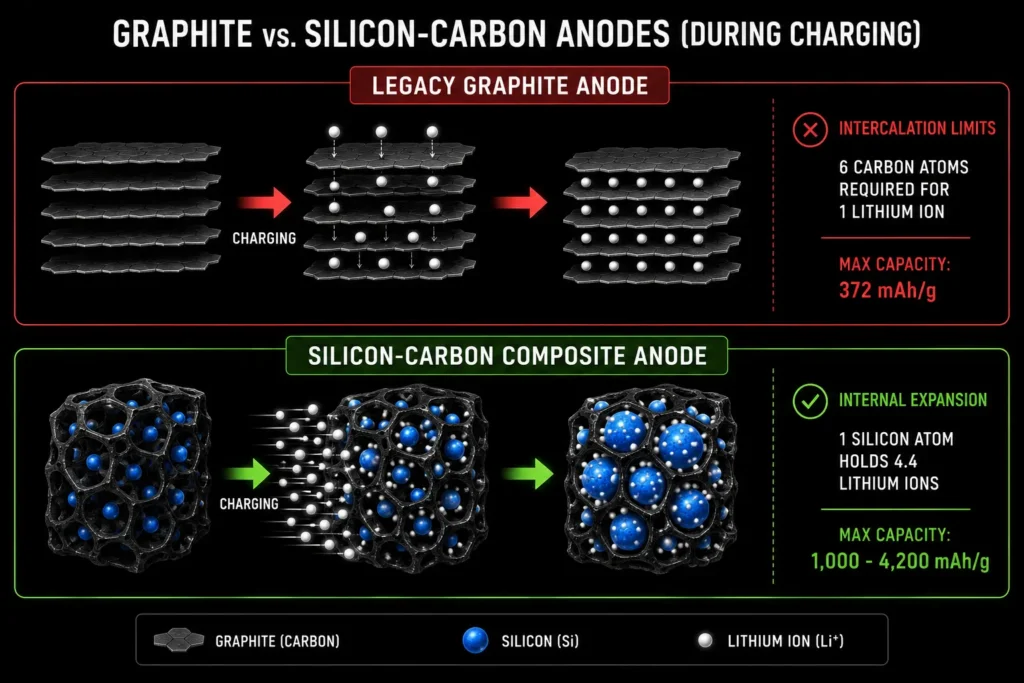
In a traditional battery, lithium ions are stored in a graphite anode through “intercalation”—they slip between the layered sheets of carbon. It requires exactly six carbon atoms to host just one lithium ion ($LiC_6$). This specific chemical ratio places a strict, unbreakable limit on graphite’s theoretical specific capacity: ~372 milliampere-hours per gram (mAh/g).
2. The Insufficiency of Pure Silicon
Silicon is radically different. Instead of slipping between layers, lithium ions chemically alloy with silicon atoms. A single silicon atom can bond with up to 4.4 lithium ions ($Li_{4.4}Si$), unlocking an extraordinary theoretical capacity of ~4,200 mAh/g. However, absorbing that much lithium causes the silicon structure to physically expand in volume by over 300 percent.
3. The Core Mechanism: Mechanical Pulverization and SEI Failure
When a pure silicon battery charges, the silicon swells by 300 percent. When it discharges, it shrinks back down. This violent, repeated mechanical stress causes the silicon particles to crack and pulverize. Worse, every battery forms a protective film called the Solid Electrolyte Interphase (SEI) layer. When the silicon expands and cracks, the SEI layer tears. The battery liquid (electrolyte) rushes in to form a new SEI layer, consuming the liquid over time until the battery completely dries out and dies.
4. Technical Depth: Nanostructured Composites
To solve this, material scientists developed nanostructured silicon-carbon composites. Instead of using solid chunks of silicon, engineers create a highly porous, microscopic carbon “scaffold.” They deposit nano-sized silicon particles deep inside the empty pores of this scaffold.
5. Real-World Consequences: Internal Expansion
When the lithium ions enter the composite anode during charging, the silicon nano-particles still swell by 300 percent. However, because they are sitting inside a rigid, empty carbon pore, they expand internally to fill the empty space. The outer carbon shell remains perfectly stable, meaning the macroscopic battery electrode does not swell. Because the exterior remains intact, the SEI layer never tears. The battery achieves the massive energy density of silicon while maintaining the 1,000+ cycle lifespan required for a commercial electric vehicle.
Real-World Applications
The technology has officially exited the laboratory and is securing massive commercial automotive offtake agreements.
Premium Electric Vehicles: In December 2023, Panasonic Energy (a primary battery supplier for Tesla and others) signed a landmark commercial agreement to purchase Sila’s nano-composite silicon anode material, Titan Silicon. By integrating this high-performance powder into their cylindrical cells, cell makers can instantly boost the range of a vehicle by 20 percent, with development runways targeting a 40 percent boost. Mercedes-Benz has explicitly committed to utilizing silicon anode technology for upcoming variants of its electric G-Class.
Electric Vertical Takeoff and Landing (eVTOL) Aircraft: Aviation requires the absolute highest specific energy (Wh/kg) possible; airplanes cannot afford heavy batteries. Companies like Amprius Technologies utilize 100 percent silicon nanowire anodes to achieve staggering densities of 450 to 500 Wh/kg. While these pure silicon cells historically lacked the thousands of cycles needed for a car, their unmatched power-to-weight ratio is currently powering high-altitude pseudo-satellites, military drones, and the first generation of commercial flying taxis.
Consumer Wearables: Because consumer electronics require much smaller batteries and generally have a shorter hardware lifespan than a car, they serve as the perfect testing ground. Sila’s Titan Silicon initially debuted commercially in 2021 inside the WHOOP 4.0 fitness tracker. The 17 percent increase in energy density allowed the device to drastically shrink its physical footprint while adding more biometric sensors and maintaining a multi-day battery life.
Economic & Strategic Impact
Silicon anodes are decoupling Western battery manufacturing from Chinese raw material dominance.
Graphite is considered a critical mineral. China controls approximately 70 percent of global natural graphite mining and nearly 100 percent of the complex purification and graphitization processes required to turn it into battery-grade anode material. When China implemented strict export controls on highly sensitive graphite products in late 2023, the vulnerability of the Western EV supply chain was glaringly exposed.
Silicon offers a geopolitical escape route. It is the second most abundant element in the Earth’s crust. By synthesizing silicon anode powders natively, Western nations eliminate their reliance on imported graphite. Facilities like Sila’s Moses Lake plant in Washington State—which opened in late 2025 and utilizes clean hydropower to drive its processes—ensure that next-generation battery components are produced domestically, satisfying the strict local-sourcing requirements of the U.S. Inflation Reduction Act (IRA).
Advantages of Silicon Anode Batteries
- Extreme Energy Density: Achieves up to a 10x increase in theoretical anode capacity compared to graphite, directly translating to 20 to 40 percent increases in total battery pack energy density.
- Ultra-Fast Charging: Silicon fundamentally resists “lithium plating”—a dangerous phenomenon where lithium ions pile up on the surface of graphite during fast charging. Silicon’s high absorption rate allows automakers to target 5-to-10-minute charge times without degrading the battery.
- Lighter Vehicle Weight: By storing more energy in fewer cells, automakers can slash hundreds of pounds from the vehicle’s curb weight. Lighter cars require less energy to move, creating a compounding loop of aerodynamic and kinetic efficiency.
- Domestic Supply Chain: Silicon precursors are globally abundant and environmentally benign, allowing synthetic production to occur onshore, drastically reducing the CO2 footprint compared to mining and refining natural graphite.
Limitations
- Manufacturing Cost: Synthesizing complex nano-composite silicon-carbon scaffolds requires highly specialized chemical vapor deposition (CVD) equipment. This drives the cost of silicon powder significantly higher per kilogram than heavily commoditized synthetic graphite.
- Cycle Life Constraints: While nano-composites solve the severe pulverization issue, maintaining an impenetrable SEI layer over 1,500 to 2,000 aggressive fast-charge cycles remains the primary engineering hurdle for 100 percent pure silicon applications.
- Electrolyte Compatibility: Standard lithium-ion liquid electrolytes degrade quickly when interacting with exposed silicon. The industry requires customized, heavily engineered electrolyte additives (like fluoroethylene carbonate) to maintain a stable chemical interface throughout the battery’s life.
Common Misconceptions
Misconception: Silicon batteries are a brand-new battery chemistry.
Reality: They are still standard Lithium-Ion batteries. The only thing that changes is the material used for the negative terminal (the anode). The positive terminal (the cathode, such as NMC or LFP) and the lithium ions flowing between them remain largely the same.
Misconception: A battery with 10x the anode capacity means 10x the driving range.
Reality: The anode is only half of the battery. If you increase the anode’s capacity by 10x, you are still bottlenecked by how much energy the cathode can hold. Realistically, an optimized silicon anode translates to a 20 to 40 percent increase in the overall energy density of the entire battery cell.
Misconception: Solid-state batteries will make silicon anodes obsolete.
Reality: Solid-state technology and silicon anodes are actually highly complementary. Many of the most advanced solid-state battery designs rely heavily on high-content silicon anodes to achieve their extreme energy density targets without using highly volatile pure lithium metal.
What Most People Miss
The role of Drop-In Compatibility.
One of the greatest challenges in battery innovation is that completely new chemistries (like sodium-ion or solid-state) often require automakers to build brand-new, multi-billion-dollar gigafactories. The tooling is entirely different.
Advanced silicon-carbon composites are engineered explicitly as “drop-in” replacements. The black powder arrives at existing Gigafactories and runs through the exact same commercial mixing, coating, and rolling machines that are currently used for graphite. By ensuring that battery makers do not have to scrap billions of dollars of legacy manufacturing equipment, companies like Sila and Group14 have drastically accelerated the timeline for commercial adoption, skipping the traditional decade-long retooling phase.
Comparison Table
| Feature | Conventional Graphite Anode | Silicon-Carbon Composite (Nano-scaffold) | Pure Silicon Nanowire |
| Specific Capacity | ~ 372 mAh/g | ~ 1,000 – 2,500 mAh/g | ~ 3,500+ mAh/g |
| Volume Expansion | ~ 10% | Managed Internally (Stable exterior) | Extreme (> 300%) |
| Cycle Life | Excellent (2,000+ cycles) | Very Good (Automotive grade) | Moderate (Aerospace/Drones) |
| Charging Speed | Moderate (Lithium plating risk) | Very Fast | Ultra-Fast |
| Manufacturing Scale | Massive (Commoditized) | Scaling rapidly (2025/2026 rollout) | Niche/Boutique |
| Cost | Low | Moderate to High | Very High |
Case Study
Situation: In the early 2020s, global automakers realized that relying exclusively on incremental improvements to graphite anodes would never yield the energy density required to mass-produce affordable, 500-to-1,000-mile range electric vehicles. Panasonic, a primary supplier for major automakers, set an aggressive goal to deliver 1,000 Wh/L volumetric energy density by 2030.
Challenge: Achieving this goal using graphite was chemically impossible. Panasonic needed a mature silicon solution that solved the 300 percent swelling problem, could drop directly into their existing cylindrical cell manufacturing lines, and was produced in massive quantities outside of China.
Solution (The Sila Moses Lake Partnership): Panasonic Energy formally partnered with Sila Nanotechnologies. Sila had already proven their Titan Silicon nano-composite in consumer wearables. To meet Panasonic’s massive automotive demand, Sila aggressively completed construction on the world’s first automotive-scale silicon anode plant in Moses Lake, Washington, officially opening operations in late September 2025.
Outcome: The Moses Lake facility is powered entirely by clean Columbia River hydropower and features an initial capacity capable of supporting 2 to 5 GWh, with architectural designs to scale up to 250 GWh within five years. Panasonic secured long-term off-take, guaranteeing that their next-generation cells will utilize U.S.-manufactured silicon.
Lessons Learned: The Panasonic-Sila partnership proved that commercializing breakthrough material science requires scaling manufacturing simultaneously with cell chemistry. By building an automotive-grade domestic factory, Sila solved both the chemical swelling problem and the geopolitical supply chain vulnerability, successfully pushing silicon anodes from a laboratory novelty into the bedrock of the 2026 automotive supply chain.
Future Outlook
Next 12–24 Months
The era of the “Silicon-Dominant” EV. Through the remainder of 2026 and 2027, high-performance vehicles (such as the electric Mercedes G-Class and upcoming Porsche variants) will officially debut with battery packs utilizing heavy silicon-composite anodes. Consumers will experience a noticeable leap in charging speed, routinely seeing 10-to-80 percent charge times drop toward the 10-minute threshold at high-power DC fast chargers. Simultaneously, competitors like Group14 will bring their massive commercial factories online, driving down the unit economics of the silicon-carbon powders.
Next 3–5 Years
The advancement of Electrolyte Engineering. As mechanical swelling is successfully mitigated by carbon scaffolds, the industry’s focus will shift aggressively to the liquid electrolyte. Research into High-Concentration Electrolytes (HCEs) and fluorinated solvents will yield commercial liquids that actively repair the Solid Electrolyte Interphase (SEI) layer in real-time. This chemical stabilization will allow cell makers to push the silicon content even higher, moving from 20 percent composite blends toward 50 percent or greater, unlocking the 800+ mile passenger vehicle.
Next 10 Years
The convergence of Silicon and Solid-State. By the mid-2030s, the liquid electrolyte will be phased out for high-end applications. Solid-state batteries utilizing highly compressed solid polymer or ceramic electrolytes will be paired with pure silicon anodes. Because the solid electrolyte acts as a physical barrier that forcibly suppresses silicon’s volume expansion, the need for complex carbon scaffolding will diminish. This union will theoretically yield the absolute chemical limit of the lithium-ion architecture, providing lifetime-lasting, ultra-dense energy storage that permanently renders the internal combustion engine obsolete.
Most Likely Scenario
Graphite will remain the dominant, cheap anode for entry-level, low-range commuter EVs and grid-storage batteries for the next decade. However, silicon-composite anodes will completely capture the premium automotive, heavy trucking, and aerospace markets. The companies that successfully master the continuous, low-cost chemical vapor deposition of nano-silicon will displace the legacy Chinese graphite giants, emerging as the most valuable materials companies of the 21st century.
Key Takeaways
- Silicon Anode Batteries replace traditional graphite with nano-engineered silicon, increasing the theoretical storage capacity of the anode by up to 10x and unlocking significantly higher overall battery energy density.
- Pure silicon physically expands by over 300 percent when charging with lithium ions, causing it to crack and rapidly destroy the battery’s cycle life.
- Modern commercial breakthroughs rely on silicon-carbon composites. Microscopic carbon scaffolds encapsulate the silicon, allowing it to expand internally without swelling or damaging the actual battery cell.
- These advanced silicon powders are “drop-in” compatible, meaning they can be seamlessly manufactured using the exact same multi-billion-dollar Gigafactory equipment currently used for graphite.
- In late 2025, Sila opened a massive automotive-scale silicon plant in Moses Lake, Washington, securing a commercial rollout with Panasonic to power next-generation EVs.
- Silicon anodes drastically reduce Western reliance on Chinese-controlled graphite supply chains, establishing a domestic, U.S.-based material source for critical energy infrastructure.
Glossary
Anode: The negative terminal of a battery where lithium ions are stored while the battery is charged.
Chemical Vapor Deposition (CVD): A high-tech manufacturing process used to synthesize nano-composite silicon powders by depositing vaporized materials onto a solid scaffold.
Intercalation: The process in a traditional battery where lithium ions physically slip into the spaces between the layered carbon atoms of a graphite anode.
Lithium Plating: A dangerous condition where lithium ions fail to absorb into the anode during fast charging, instead piling up as metallic lithium on the surface, which can cause short circuits and fires.
Solid Electrolyte Interphase (SEI): A protective chemical layer that forms on the anode when it first interacts with the liquid electrolyte. Maintaining a stable SEI is critical to a battery’s lifespan.
Specific Capacity (mAh/g): A metric describing how much electrical charge a specific material can hold per gram of weight. Graphite peaks at ~372 mAh/g, while pure silicon can theoretically reach ~4,200 mAh/g.
Frequently Asked Questions
Will silicon batteries catch fire easily?
No. Silicon anodes actually improve charging safety. Because silicon absorbs lithium ions much faster and more eagerly than graphite, it drastically reduces the risk of lithium plating—a primary cause of battery short circuits and thermal runaway during ultra-fast charging.
How soon can I buy a car with a silicon battery?
You already can, though in minor percentages. Many modern EVs use a tiny “doping” of silicon (around 3 to 5 percent). However, vehicles with high-performance silicon-dominant anodes are actively rolling out in 2026 and 2027, starting with premium models like the electric Mercedes G-Class and high-end Porsche trims.
Do silicon batteries cost more than regular EV batteries?
Currently, yes. The advanced nano-engineering required to create the silicon-carbon composite powder is more expensive than processing natural graphite. However, because silicon holds so much more energy, automakers require fewer total cells to achieve the same range, partially offsetting the higher material cost at the pack level.
Why does silicon swell when charging?
When lithium ions enter a graphite anode, they gently slip between existing layers. When they enter silicon, they chemically bond and physically force the silicon atoms apart, completely restructuring the material and causing it to balloon in size by over 300 percent.
Are silicon anodes used in solid-state batteries?
Yes. While many companies are trying to use pure lithium metal anodes in solid-state batteries, pure lithium is highly volatile. High-content silicon anodes are viewed as the most viable, stable alternative to pair with solid electrolytes to achieve massive energy density safely.
Sources
- Sila Nanotechnologies: Panasonic and Sila Sign Agreement for Titan Silicon to deliver enhanced battery performance for EVs
- Sila Nanotechnologies: Sila Opens Nation’s First Automotive-Scale Silicon Anode Plant in Moses Lake
- MDPI: Various Technologies to Mitigate Volume Expansion of Silicon Anode Materials in Lithium-Ion Batteries (2025)
- MDPI: Recent Advances in Electrolyte Engineering for Silicon Anodes (2025)
- Technavio: Lithium Silicon Battery Market Growth Analysis 2026-2030