Advertisement
)

Every traditional solar panel in the world is currently crashing into an invisible, mathematical wall. The silicon technology that powers the global transition away from fossil fuels is fundamentally capped by the laws of physics. Because of how silicon absorbs light, a standard solar panel can never convert more than 33 percent of the sun’s energy into electricity. In reality, commercial panels plateau at roughly 22 to 24 percent. Adding more silicon won’t fix it; the material is entirely exhausted. To keep driving down the cost of global electricity, scientists realized they had to completely change the chemical recipe of the panel itself.
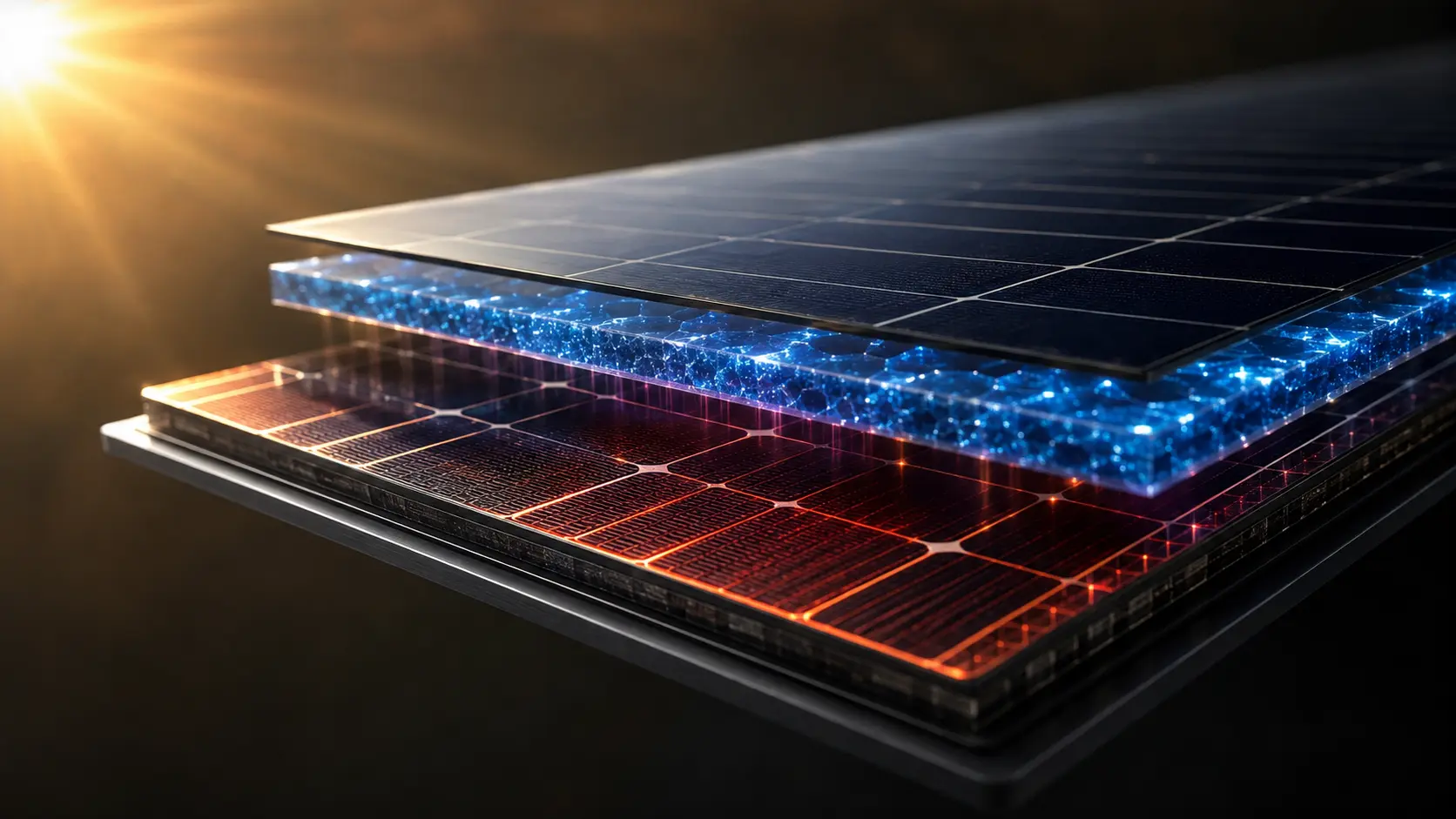
Why should you care right now? Because the breakthrough has arrived, and it is actively reshaping global clean energy economics. By painting traditional silicon with a microscopic layer of a highly reactive crystal called perovskite, engineers have created a “tandem” solar cell. The crystal harvests the high-energy light that silicon wastes as heat, pushing cell efficiency well past the 33 percent limit in the laboratory. For utility executives and clean-tech investors, this is the holy grail: a technology that generates drastically more power from the exact same physical footprint, promising to permanently tilt the grid toward renewables.
What is Perovskite-Silicon Tandem Solar?
Perovskite-silicon tandem solar is an advanced photovoltaic architecture that stacks a thin layer of perovskite crystal on top of a traditional silicon solar cell. The perovskite layer absorbs high-energy visible light, while the underlying silicon absorbs lower-energy infrared light, significantly increasing the total electrical power generated by the panel.
At a Glance
- Concept: Layering a synthetic crystal over traditional silicon to capture distinct parts of the solar spectrum, effectively creating a “double-decker” solar panel.
- Why it matters: Generating 30 percent more power from the same sized panel slashes the “Balance of System” costs (land, wiring, labor, permitting) for utility-scale solar farms, radically accelerating the ROI of clean energy deployments.
- Who uses it: Elite solar manufacturers (LONGi, Hanwha Qcells), specialized European pioneers (Oxford PV), and next-generation utility developers.
- Biggest takeaway: The physics are proven, but the materials science is fragile. Perovskites are incredibly sensitive to moisture. The commercial race is no longer about proving the efficiency limit; it is about engineering a glass and polymer encapsulation barrier that can keep the crystal dry and stable for 25 years.
In Simple Words
Imagine trying to catch falling rain using a bucket covered in a specialized net.
In a traditional solar panel, the silicon is the net. But the holes in the silicon net are a specific size. If the “raindrops” (sunlight particles, or photons) are too small, they slip right through the holes and are lost. If the raindrops are too big, they crash into the net, but the extra energy is just wasted as heat, not electricity. Because of this, traditional silicon nets max out at catching about 33 percent of the sun’s energy.
A Perovskite-Silicon Tandem Cell stacks a second, different net on top.
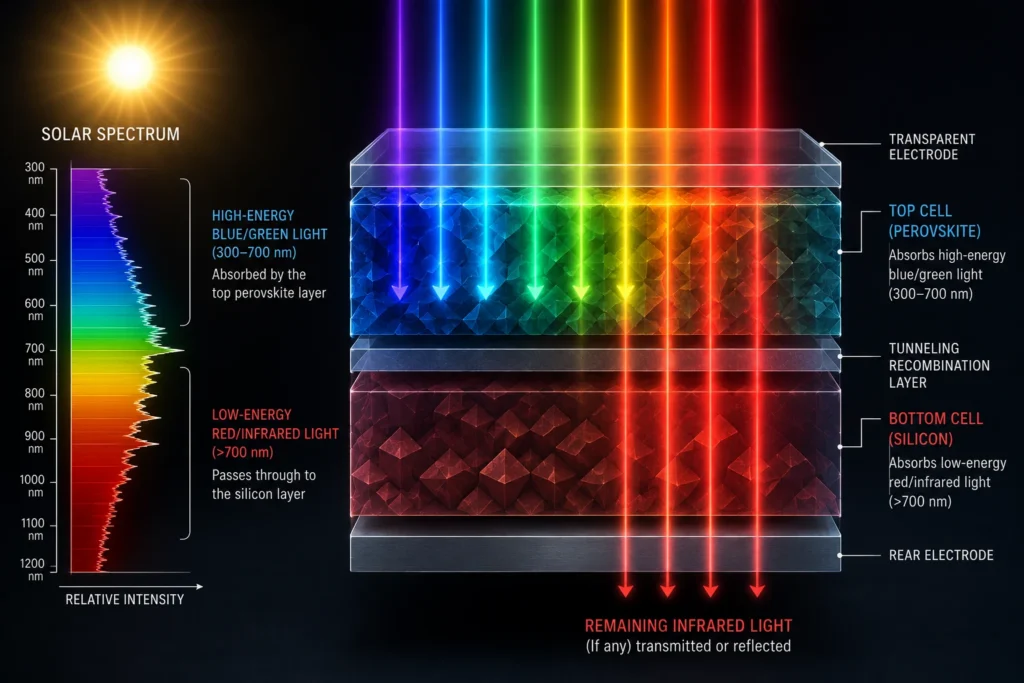
The top net is made of a crystal called perovskite. The holes in the perovskite net are the perfect size to catch the massive, high-energy “raindrops” (blue and green light) and turn them into pure electricity. The smaller, low-energy drops (red and infrared light) fall right through the top net and are caught perfectly by the silicon net waiting on the bottom. By working together in “tandem,” the two nets catch almost the entire spectrum of sunlight, producing far more electricity than either net could alone.
Why This Matters
For the last decade, solar energy became the cheapest electricity in history purely through economies of scale—building massive factories in China to pump out silicon cheaply. That economic lever is largely tapped out.
To continue driving down the Levelized Cost of Energy (LCOE), the panels themselves must generate more power. If a utility-scale solar farm requires 1,000 acres of land to generate 100 megawatts using standard silicon, a tandem perovskite farm could generate 130 megawatts on that exact same 1,000 acres. For developers, this means the massive, fixed costs of the project—buying the land, paying the construction crew, building the steel tracking mounts, and securing the grid interconnection—are suddenly amortized over 30 percent more revenue-generating electricity. This density multiplier changes the foundational math of global energy finance.
The Commercial Race for Perovskite Solar Cells
The solar industry operates on microscopic margins. Introducing a completely new chemical compound onto a manufacturing line designed strictly for silicon is a massive capital risk.
Yet, the transition is inevitable. The global push for tandem solar is sparking a technological arms race between European R&D hubs (who hold vast intellectual property in perovskite synthesis) and massive Asian manufacturing conglomerates (who control the silicon base layer). Companies like Oxford PV in the UK and Hanwha Qcells in South Korea are aggressively pivoting from pilot lines to commercial rollouts. The entity that successfully bridges the gap between laboratory perfection and high-volume, defect-free manufacturing will secure a de facto monopoly on the next generation of global energy infrastructure.
How Perovskite-Silicon Tandem Solar Works
Extracting maximum electricity from a photon requires manipulating the microscopic energy barriers of semiconductors. Here is the first-principles breakdown.
1. The Fundamental Problem: The Shockley-Queisser Limit
Every semiconductor has a “bandgap”—the minimum amount of energy required to knock an electron loose and create an electrical current. Silicon has a bandgap of roughly 1.1 electron volts (eV). If a sunlight photon hits the silicon with less than 1.1 eV, it passes right through (lost energy). If a high-energy blue photon hits the silicon with 2.5 eV, the silicon captures the required 1.1 eV, but the remaining 1.4 eV is instantly wasted as heat (thermalization). This dual loss creates the mathematical Shockley-Queisser limit of ~33.7%.
2. The Insufficiency of Single-Junction Silicon
For seventy years, the solar industry relied on “single-junction” cells—meaning the entire panel used only one material (silicon) with one bandgap. No matter how perfectly the silicon is polished or wired, it is physically blind to massive portions of the solar spectrum.
3. The Core Mechanism: The Tandem Stack
The solution is a “tandem” (multi-junction) architecture. Engineers synthesize a perovskite crystal—often a compound of lead, iodine, and organic molecules—and spin-coat or vapor-deposit it as a microscopic film directly on top of the silicon.
4. Technical Depth: Tunable Bandgaps and Recombination
The genius of perovskite is its tunability. Chemists can alter its recipe to perfectly set its bandgap to ~1.7 eV.
When sunlight hits the panel:
- The top perovskite layer absorbs the high-energy visible light (blue/green) at a highly efficient voltage, converting it to electricity without wasting it as heat.
- The perovskite is transparent to low-energy infrared light, letting it pass through to the bottom silicon layer, which efficiently catches the remaining 1.1 eV photons.Where the two layers meet, engineers construct a microscopic “recombination junction”—a tunnel of transparent conductive oxide (like Indium Tin Oxide) that allows the electrical current from the top and bottom layers to merge and flow out of the panel.
5. Real-World Consequences: Shattering the Limit
By ensuring that high-energy photons are caught by high-bandgap materials, and low-energy photons are caught by low-bandgap materials, thermalization loss is drastically minimized. This raises the theoretical efficiency limit of the tandem panel to roughly 43%. In practical laboratory settings, these tandem cells have already achieved certified efficiencies over 34%, completely obliterating the physical capabilities of standalone silicon.
Commercial Applications of Tandem Solar Panels
The transition from the laboratory bench to the commercial roof is actively underway across global manufacturing hubs.
Utility-Scale Solar Farms: The primary target market for tandem cells. Land acquisition and grid interconnection are the most expensive bottlenecks for new solar deployments. By deploying tandem panels with 30% higher power output, utility developers can generate significantly more megawatt-hours on smaller plots of land. This makes previously uneconomical parcels—such as smaller brownfield sites near urban centers—highly profitable for solar development.
Space and Aerospace Power: Satellites and high-altitude drones require the absolute maximum amount of power from the lowest possible weight. Because the perovskite layer is microscopic (often just a few hundred nanometers thick) and highly efficient, tandem solar cells provide an unmatched power-to-weight ratio, making them a critical hardware component for the next generation of orbital satellites and stratospheric telecommunications drones.
Building-Integrated Photovoltaics (BIPV): Because perovskites can be manufactured as semi-transparent, thin-film coatings, architects are exploring advanced tandem architectures. Future commercial skyscraper windows could be coated in a tuned perovskite layer that generates electricity from blue light while allowing standard visible light to pass through to the occupants, effectively turning the entire facade of a building into a localized power plant.
Economic & Strategic Impact
The integration of perovskites introduces a critical vulnerability into the global supply chain: The Encapsulation Monopoly.
Traditional silicon is essentially baked sand. It is incredibly stable and easily lasts 25 to 30 years outdoors. Perovskite, however, is a highly sensitive crystal. If exposed to even trace amounts of ambient moisture or oxygen, the crystal lattice physically collapses within hours, rendering the solar cell dead.
Therefore, the most valuable intellectual property in the tandem solar market is not the crystal itself—it is the packaging. The economic winners of the tandem revolution will be the advanced materials companies that synthesize hyper-dense atomic layer deposition (ALD) barriers, specialized polymers, and edge-sealants capable of hermetically sealing the perovskite layer from the atmosphere for a quarter of a century. Whoever controls this chemical supply chain will dictate the scaling speed of the entire global tandem solar market.
Advantages
- Shatters Efficiency Limits: Pushes commercial solar panels beyond the 33% silicon ceiling, generating vastly more electricity per square meter.
- Leverages Existing Supply Chains: Because it uses standard silicon as the base layer, manufacturers do not have to rebuild their billion-dollar silicon fabrication plants. They simply add a perovskite coating step to the end of the existing assembly line.
- Superior Low-Light Performance: Perovskites are incredibly efficient at absorbing diffuse and low-angle light, meaning tandem panels generate electricity earlier in the morning and later into the evening than traditional silicon panels.
Limitations
- Moisture Sensitivity and Degradation: The Achilles’ heel of the technology. Perfecting the transparent moisture barriers required to protect the perovskite from degrading over a 25-year commercial lifespan remains heavily unproven in real-world, outdoor grid deployments.
- Lead Toxicity Concerns: The highest-performing perovskite crystals rely on a lead-halide structure ($MAPbI_3$). While the total amount of lead per panel is tiny, environmental regulations in regions like the European Union mandate strict recycling protocols to prevent toxic leaching if a panel shatters during a storm.
- Manufacturing Uniformity: Scaling the spin-coating or vapor-deposition of the perovskite liquid onto massive, commercial-sized silicon wafers without creating microscopic pinholes or uneven crystallization is a severe quality-control challenge.
Common Misconceptions
Misconception: Perovskites will completely replace silicon.
Reality: Perovskites are highly complementary to silicon. While standalone “thin-film” perovskite panels exist, the commercial holy grail is the “tandem” cell, which permanently marries the two materials to leverage silicon’s durability and market dominance.
Misconception: Breaking the 33% limit means panels will be 100% efficient.
Reality: The tandem architecture simply moves the mathematical goalposts. A two-layer perovskite-silicon cell has a theoretical thermodynamic limit of around 43%. Reaching 100% efficiency is mathematically impossible due to the laws of thermodynamics (entropy and thermal emission).
Misconception: A 30% efficient panel produces 30% more total power.
Reality: Efficiency refers to the percentage of sunlight converted to electricity. If you upgrade a 20% efficient panel to a 30% efficient panel, you have actually increased the total power output of that panel by 50% relative to its previous baseline.
What Most People Miss
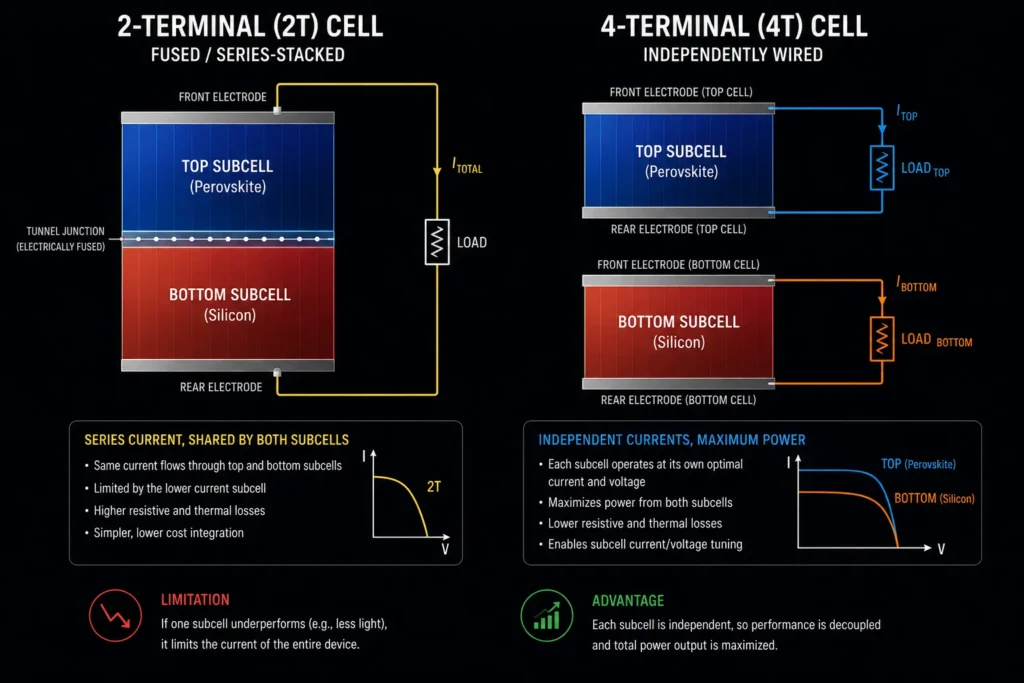
The strategic difference between 2-Terminal (2T) and 4-Terminal (4T) architectures.
When scaling tandem panels, manufacturers must choose how to wire the two distinct layers together.
What most industry observers miss is the engineering trade-off.
- A 2-Terminal (2T) cell physically fuses the perovskite and silicon together with a microscopic tunnel junction, requiring only two wires to pull the power out. It is cheaper to manufacture but mathematically fragile—if the top layer degrades slightly, it acts as an electrical bottleneck, crippling the output of the entire panel.
- A 4-Terminal (4T) cell separates the layers. The perovskite and silicon operate independently, each with their own set of wires. It requires much more complex wiring and inverters, but it is vastly more resilient. If the top perovskite layer degrades, the bottom silicon layer continues to pump out maximum electricity completely unaffected.
Comparison Table
| Feature | Standard Silicon Solar Cell | Perovskite-Silicon Tandem Cell |
| Material Bandgap | Fixed (~1.1 eV) | Dual / Tunable (~1.7 eV & 1.1 eV) |
| Theoretical Efficiency Limit | ~33.7% (Shockley-Queisser) | ~43% |
| Light Absorption Profile | Broad, struggles with high-energy blue light | Optimized for both high-energy and low-energy spectrums |
| Degradation Resistance | Excellent (25+ year proven lifespan) | Poor (Highly susceptible to moisture & oxygen) |
| Manufacturing Cost | Low (Massive economies of scale) | Moderate to High (Requires precise deposition/encapsulation) |
Case Study
Situation: Despite dominating global silicon solar manufacturing, major clean energy players realized that the relentless drive to lower the cost of solar energy was stagnating. Standard monocrystalline silicon cells were physically approaching their theoretical ceiling, making further R&D investments highly inefficient.
Challenge: How to rapidly commercialize a next-generation cell architecture that generates significantly more power without rendering billions of dollars of existing silicon manufacturing infrastructure obsolete.
Solution (The LONGi World Record): In late 2023 and into the mid-2020s, LONGi Green Energy Technology—one of the world’s largest solar manufacturers—pivoted massive R&D resources toward perovskite-silicon tandem cells. Rather than building new factories for standalone perovskite, they utilized their world-class silicon heterojunction (HJT) wafers as the bottom base layer, and expertly deposited an optimized perovskite top layer.
Outcome: LONGi repeatedly shattered world records, achieving certified Power Conversion Efficiencies of 33.9%, and soon pushing past 34.6% in laboratory settings. They proved unequivocally that tandem architectures could break the Shockley-Queisser limit using commercially viable silicon bases.
Lessons Learned: The achievement signaled the end of the pure-silicon era. It proved that the future of solar dominance requires chemical hybridization. However, it also confirmed that the ultimate winner of the tandem race will not be the company with the highest lab efficiency, but the company that can mass-produce the hyper-complex moisture barriers required to protect that efficiency for 25 years on a commercial roof.
Future Outlook
Next 12–24 Months
The era of Pilot Line Commercialization. Throughout 2026 and 2027, elite manufacturers like Oxford PV, Hanwha Qcells, and LONGi will transition from producing small laboratory wafers to standard, full-sized commercial panels. These early commercial tandem modules will likely target high-margin, space-constrained markets (such as commercial rooftops and aerospace applications) where maximizing power output per square meter completely justifies the premium initial cost of the module.
Next 3–5 Years
The optimization of Lead-Free and Encapsulation Technologies. As tandem panels scale toward utility-level deployment, regulatory pushback regarding the toxicity of lead-based perovskites will intensify in Europe and North America. Massive R&D capital will flow into discovering “lead-free” tin-based or bismuth-based perovskite structures. Concurrently, the deployment of advanced Atomic Layer Deposition (ALD) will perfect the invisible, impenetrable moisture barriers required to guarantee a 25-year power warranty.
Next 10 Years
The transition to All-Perovskite Tandems. By the 2030s, as the chemistry fully matures, the industry will eventually phase out the heavy, rigid silicon base layer entirely. Engineers will stack a high-bandgap perovskite on top of a low-bandgap perovskite. These “All-Perovskite Tandems” will be incredibly lightweight, flexible, and printable like newspaper on massive roll-to-roll manufacturing lines. This will completely sever the solar supply chain from traditional, energy-intensive silicon smelting, ushering in the era of ubiquitous, hyper-cheap, printed solar energy.
Most Likely Scenario
Silicon will remain the bedrock of the global grid for the next decade, but the perovskite tandem upgrade is mathematically inevitable. By 2030, a tandem module will become the premium standard for all new utility-scale deployments, effectively increasing the power output of the global solar footprint by 30 percent overnight and permanently lowering the floor for the Levelized Cost of Energy.
Key Takeaways
- Traditional silicon solar panels cannot convert more than ~33% of sunlight into electricity due to a physical limitation known as the Shockley-Queisser limit.
- Perovskite-silicon tandem solar cells shatter this limit by stacking a high-energy perovskite crystal on top of a low-energy silicon base, catching distinct spectrums of light.
- By combining the two materials, theoretical panel efficiency leaps to 43%, and laboratory test cells have already breached 34%.
- Generating 30% more power from the exact same footprint drastically lowers land, labor, and installation costs for massive utility-scale solar farms.
- The primary commercial bottleneck is durability. Perovskite crystals rapidly dissolve when exposed to ambient moisture, requiring immensely complex, long-lasting chemical encapsulation to survive a 25-year warranty.
- Rather than replacing silicon, the tandem approach brilliantly leverages billions of dollars in existing silicon manufacturing infrastructure, ensuring rapid global adoption once the moisture barriers are perfected.
Glossary
Atomic Layer Deposition (ALD): A highly precise manufacturing technique used to lay down a protective coating exactly one atom thick. Crucial for hermetically sealing perovskite from moisture.
Bandgap: The specific amount of energy required to knock an electron loose in a semiconductor to create electricity. Perovskites can be “tuned” to have high bandgaps, while silicon has a fixed, lower bandgap.
Levelized Cost of Energy (LCOE): The primary metric used by utilities to compare energy sources. It calculates the total cost to build and operate a power plant over its lifetime divided by the total energy it produces.
Perovskite: A specific type of crystal structure (often synthetic) that is exceptionally efficient at absorbing light and conducting an electrical charge.
Shockley-Queisser Limit: A fundamental physics theorem stating that a single-junction solar cell (like traditional silicon) can theoretically convert a maximum of roughly 33.7% of solar energy into electricity.
Tandem Solar Cell (Multi-Junction): A solar panel architecture that stacks two or more distinct semiconductor materials on top of each other, allowing the panel to harvest multiple, distinct spectrums of sunlight.
Frequently Asked Questions
Why does silicon max out at 33% efficiency?
Light comes in different energy levels (colors). Silicon’s “bandgap” is optimized for low-energy red and infrared light. When a high-energy blue photon hits silicon, the extra energy cannot be converted into electricity and is violently wasted as heat.
Is the perovskite toxic?
The most efficient perovskites currently use a lead-halide chemical structure. While the total amount of lead in a panel is microscopic, it poses a long-term environmental hazard if the panel breaks and the lead leaches into the soil, driving intense research into lead-free alternatives.
Will I be able to buy these panels for my house soon?
Yes, but they will initially carry a premium price tag. The first commercial tandem panels will likely be deployed on commercial rooftops where space is highly constrained and maximizing output per square foot justifies the higher cost.
How is the perovskite attached to the silicon?
It is applied as a microscopic thin film. Manufacturers use techniques like spin-coating (dropping a liquid solution onto the silicon and spinning it extremely fast) or vapor deposition (spraying the chemicals as a gas in a vacuum chamber) to create a perfectly flat, nanometer-thick crystal layer.
If the perovskite degrades, does the whole panel die?
It depends on the wiring. In a “2-Terminal” configuration, the two layers are fused in a single circuit; if the top dies, the whole panel suffers heavily. In a “4-Terminal” configuration, they are wired separately, meaning the bottom silicon layer will keep working perfectly even if the perovskite fails.
Sources
[1] Nature Energy: Perovskite-silicon tandem solar cells: Progress and Commercialization (2025/2026 Analysis)
[2] National Renewable Energy Laboratory (NREL): Best Research-Cell Efficiency Chart
[3] Oxford PV: Commercializing Perovskite Photovoltaics and Encapsulation Lifespans (2026 Briefs)
[4] LONGi Green Energy Technology: Breaking the Silicon Limit with Silicon-Perovskite Tandems
[5] Helmholtz-Zentrum Berlin (HZB): Material Science and Recombination Junctions in Tandem Solar Cells