Advertisement
)

In modern warfare, the math of armored combat is fundamentally broken. A 70-ton main battle tank like the M1 Abrams or Leopard 2 costs roughly $10 million to build and field. Yet, on the battlefields of Eastern Europe and the Middle East, these steel behemoths are routinely reduced to burning scrap metal by $500 commercial drones strapped with explosives, or shoulder-fired rockets that cost less than a used car. The sheer density of Anti-Tank Guided Missiles (ATGMs) has made traditional, thick steel armor mathematically obsolete. You cannot simply bolt more heavy metal onto a tank to stop modern warheads without making the vehicle too heavy to cross a bridge or navigate urban mud.
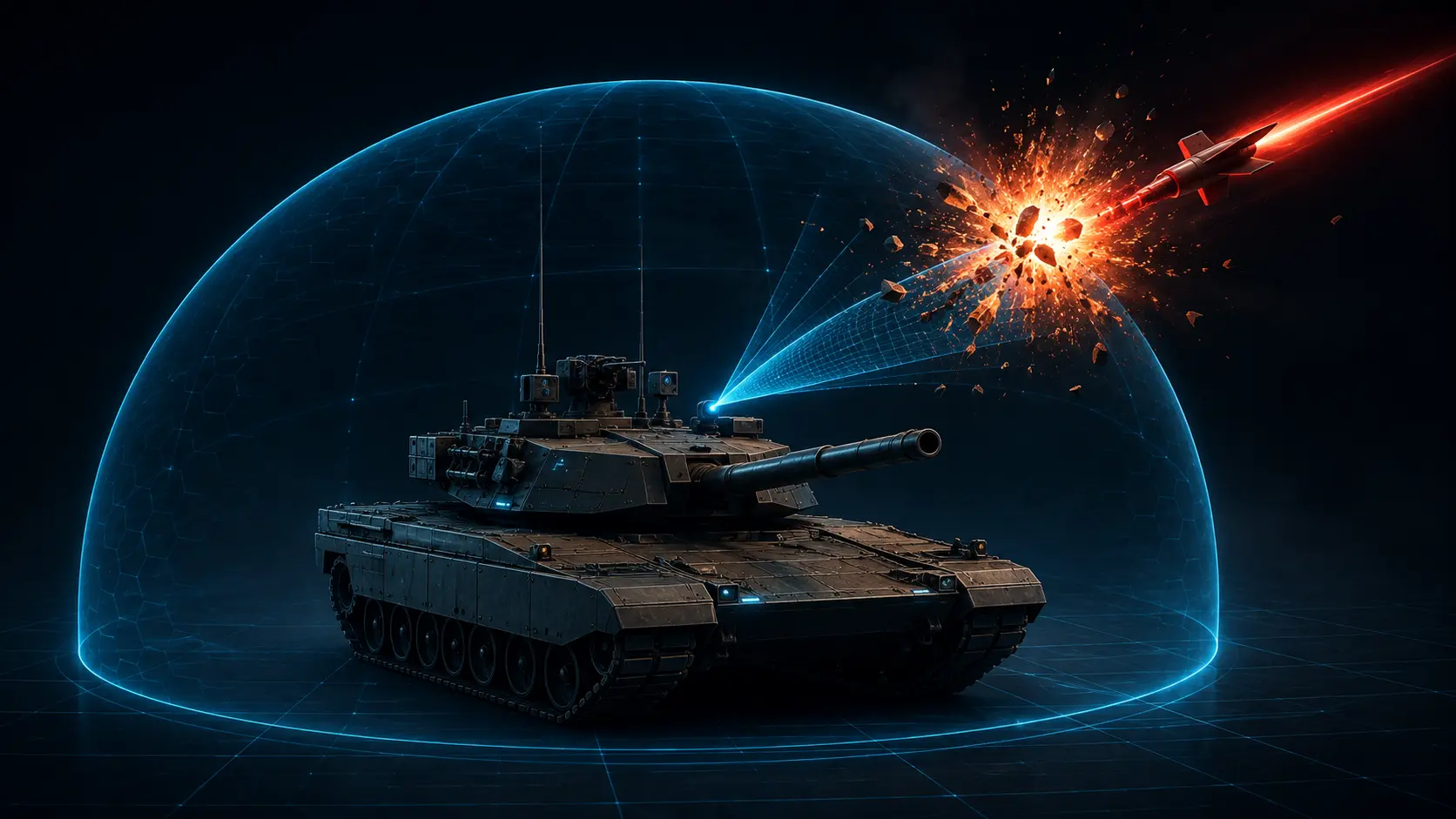
To survive this catastrophic economic and tactical asymmetry, militaries are turning tanks into autonomous missile-defense fortresses. By strapping miniaturized, military-grade radar arrays and automated, shotgun-like explosive interceptors to the turret, tanks can now actively swat incoming projectiles out of the sky before they ever touch the hull. Why should you care right now? Because mastering this automated “force field”—known as an Active Protection System (APS)—is the only way the tank survives the 21st century.
What are Active Protection Systems (APS)?
Active Protection Systems (APS) are automated, vehicle-mounted defense networks designed to detect, track, and intercept incoming anti-armor threats. Utilizing advanced radar arrays, the system continuously scans the perimeter and automatically fires explosive counter-munitions to physically destroy or deflect incoming missiles and drones milliseconds before they strike the vehicle.
At a Glance
- Concept: Shifting vehicle survivability from passive weight (heavy steel armor) to active intelligence (radar and automated interception).
- Why it matters: It restores the maneuverability and survivability of heavy armor on a modern battlefield saturated with cheap, highly lethal anti-tank weapons.
- Who uses it: Elite armored divisions globally. The Israeli Defense Forces (IDF) pioneered combat usage with the Trophy system on Merkava tanks; the US Army has aggressively integrated APS onto the M1A2 Abrams and Bradley Fighting Vehicles.
- Biggest takeaway: An APS reacts faster than humanly possible. From the moment the radar detects an incoming RPG to the moment the interceptor detonates, the entire sequence executes autonomously in a fraction of a second, completely bypassing the vehicle crew.
In Simple Words
For a hundred years, tank defense was simple: make the metal so thick that the enemy’s bullet cannot punch through it.
But weapons got better. Today’s anti-tank missiles shoot a jet of molten copper that slices through three feet of solid steel like butter. Tanks cannot physically carry enough steel to stop them.
An Active Protection System (APS) changes the game. It acts like a localized, miniature Iron Dome system strapped directly to the tank.
Small, flat radar panels are mounted on the corners of the tank, creating an invisible, 360-degree bubble. If an enemy soldier fires a rocket at the tank, the radar instantly detects it, calculates its speed, and predicts exactly where it will hit. A computer then aims a small launcher on the roof and fires a tight blast of explosive shrapnel directly at the incoming rocket. The rocket is blown to pieces in mid-air, a few yards away from the tank, leaving the crew inside completely unharmed.
Why This Matters
The integration of APS completely alters the economics of force projection.
Without APS, an armored column advancing into an urban environment is incredibly vulnerable. Every window and rooftop is a potential launch site for a lethal ATGM. This vulnerability forces military commanders to advance at a crawl, heavily relying on artillery to flatten cities before tanks can move in.
With APS, the tactical tempo accelerates. For defense contractors and military procurement officers, APS is no longer an optional upgrade; it is a mandatory baseline requirement for any future combat vehicle. This has triggered a massive, multi-billion-dollar retrofit industry, as NATO nations rush to bolt APS hardware onto legacy fleets of Strykers, Bradleys, and Abrams tanks to ensure they remain combat-relevant against the proliferation of cheap, lethal drones.
Soft-Kill vs. Hard-Kill Active Protection Systems
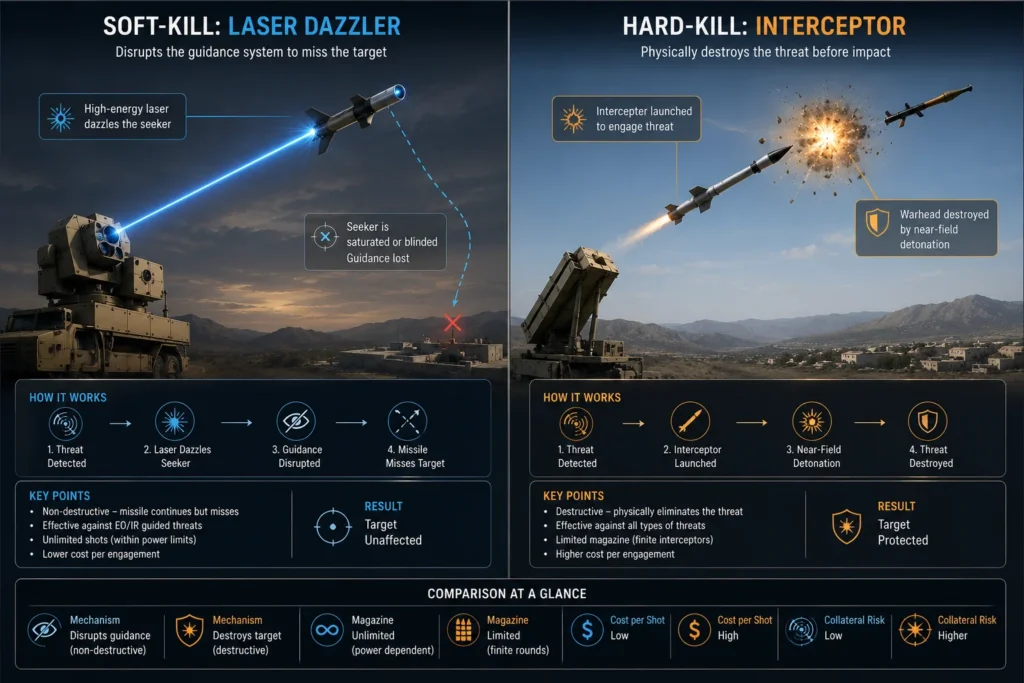
APS is broadly categorized into two distinct philosophies: Soft-Kill and Hard-Kill.
- Soft-Kill systems do not shoot bullets. They use lasers, infrared dazzlers, or localized smoke screens to “blind” the incoming missile. If an enemy fires a laser-guided missile, a soft-kill system shines an overpowering laser back at it, confusing the missile’s computer and causing it to crash into the dirt.
- Hard-Kill systems (the focus of this analysis) rely on brute physical force. They launch an explosive projectile to physically smash the incoming threat.
The industry standard is moving toward integrated suites that combine both. However, because modern top-attack drones (like FPVs) often lack complex laser guidance to blind, militaries are heavily prioritizing Hard-Kill kinetic interceptors to ensure physical destruction of the threat regardless of its guidance mechanism.
How Hard-Kill APS Intercepts Missiles
Stopping a missile traveling at hundreds of meters per second when it is fired from only a block away requires edge-computing and extreme mechanical violence. Here is the first-principles breakdown.
1. The Fundamental Problem: Shaped Charges
Modern anti-tank weapons (like the Javelin or RPG-7) rely on High-Explosive Anti-Tank (HEAT) warheads. When the nose of the missile touches the tank, a cone of explosives detonates, turning a copper liner into a hyper-velocity jet of superplastic metal that burns straight through the armor. To stop it, you must prevent the nose of the missile from physically touching the tank’s surface.
2. The Insufficiency of Reactive Armor
Historically, militaries used Explosive Reactive Armor (ERA)—blocks of explosives bolted to the outside of the tank that blow outward when hit, disrupting the copper jet. However, modern “tandem-charge” missiles have two warheads: the first blows up the ERA, and the second punches through the bare steel underneath. ERA is no longer sufficient on its own.
3. The Core Mechanism: AESA Radar Tracking
The APS cycle begins with Active Electronically Scanned Array (AESA) radar panels mounted around the turret. Unlike a spinning airport radar, AESA panels are flat and stationary, steering their radar beams digitally at the speed of light. They provide a continuous, 360-degree, three-dimensional tracking dome. The moment a projectile enters the dome, the radar calculates its velocity, trajectory, and estimated time of impact.
4. Technical Depth: Hard-Kill Interception
If the computer determines the projectile will hit the vehicle, it activates the countermeasure. In systems like Rafael’s Trophy, a swiveling launcher instantly rotates to face the threat and fires a matrix of Multiple Explosively Formed Penetrators (MEFPs)—essentially a highly focused, dense cloud of metal slugs. In systems like Elbit’s Iron Fist, a small explosive rocket is launched that detonates directly next to the incoming missile.
5. Real-World Consequences: The Defeat Zone
The explosion must happen in the “Defeat Zone”—usually 5 to 30 meters away from the vehicle. The goal is to detonate the enemy warhead prematurely in mid-air or sheer off the nose cone so the shaped-charge copper jet cannot form properly. The mangled, defused remnants of the rocket then bounce harmlessly off the tank’s base steel armor.
Operational Deployments: Trophy APS and Drone Defense
APS has rapidly evolved from prototype testing to standard operational doctrine.
The Israel Defense Forces (IDF) in Urban Combat: The Trophy APS gained its primary combat validation mounted on Israeli Merkava Mk IV tanks. In dense urban environments like Gaza, tanks are frequently ambushed from narrow alleys and rooftops at extremely close range. Trophy successfully intercepted hundreds of RPGs and advanced Kornet anti-tank missiles, fundamentally preserving armored maneuverability in a battlespace that would have otherwise decimated unprotected vehicles.
US Army Stryker and Abrams Upgrades: Realizing their legacy fleets were vulnerable, the US military executed massive upgrade programs. The M1A2 SEPv3 Abrams tanks deployed to Europe are heavily equipped with Trophy systems to counter advanced Russian ATGMs. Meanwhile, lighter vehicles like the Bradley and Stryker—which lack the heavy steel to absorb a hit—are integrating lighter APS solutions like Iron Fist, completely altering the survivability profile of mechanized infantry.
Adapting to the FPV Drone Threat: The war in Ukraine introduced a devastating new variable: First-Person View (FPV) kamikaze drones dropping vertically onto the thin top armor of tanks. Early APS radars were angled to look outward, not straight up. Consequently, defense contractors have spent the mid-2020s aggressively updating APS radar firmware and adjusting launcher elevation angles to create a “top-attack hemisphere,” attempting to swat drones diving directly out of the sky.
Economic & Strategic Impact
The proliferation of APS effectively acts as a global reset button on anti-tank weaponry.
For decades, infantry possessed a massive, cheap advantage over heavy armor. A single soldier with a $80,000 Javelin missile could reliably destroy a $10 million tank. APS reverses this asymmetry. If a tank is equipped with an effective APS, traditional shoulder-fired rockets become nearly useless.
This forces adversaries to spend billions developing countermeasures. Armies are now investing in “volley-fire” tactics (firing three or four missiles simultaneously to overwhelm the APS computer) or developing hyper-velocity missiles designed to outrun the APS reaction time. The geopolitical outcome is a renewed, high-tech arms race where the software algorithms running the radar are just as critical to national security as the thickness of the armor plating.
Advantages
- Extreme Survivability: Drastically reduces the probability of a catastrophic vehicle kill from shaped-charge warheads, protecting highly trained crews.
- Weight Reduction: Because the vehicle no longer relies purely on passive steel to absorb hits, future tanks can be designed significantly lighter, improving fuel efficiency, bridge-crossing capability, and logistical transport.
- 360-Degree Situational Awareness: The AESA radar does more than shoot down missiles. It calculates the exact GPS coordinate of where the missile was fired from, instantly slewing the tank’s main gun toward the enemy hidden in the tree line, turning defense into immediate offensive retaliation.
Limitations
- Dismounted Infantry Collateral Damage: The most severe tactical drawback. If a tank shoots down a missile, it sprays deadly shrapnel across the immediate area. Infantry soldiers walking next to the tank are at extreme risk of being killed by their own tank’s defense system. Tactics must be rewritten to keep infantry strictly separated from armored vehicles.
- Minimum Defeat Distance: The radar and computer take milliseconds to react. If an enemy hides in a bush and fires an RPG from just 10 meters away, the projectile will hit the tank before the APS has time to calculate the trajectory and fire the interceptor.
- Magazine Depth: A tank only carries a limited number of explosive interceptors (often 3 to 6 per side). If an enemy swarm-attacks the tank with a dozen cheap drones, the APS will simply run out of ammunition, leaving the tank naked.
- The APFSDS Threat: APS is designed to stop slow-moving, explosive rockets. It severely struggles against tank-fired kinetic energy rounds (APFSDS)—massive, solid darts of depleted uranium moving at Mach 5. The sheer kinetic energy of these rounds means even if an APS hits them, it cannot easily deflect their mass.
Common Misconceptions
Misconception: An APS creates an impenetrable force field around the tank.
Reality: It is a mechanical system subject to physical limits. If the incoming missile is too fast, fired from too close, or if the system has simply run out of interceptor charges, the tank will be hit.
Misconception: APS replaces the need for thick steel armor.
Reality: It is an added layer, not a replacement. When an APS destroys a missile 10 meters away, massive chunks of jagged metal still slam into the side of the tank at high velocity. Without strong base armor, that residual shrapnel would still penetrate the hull and kill the crew.
Misconception: Soft-Kill systems are harmless.
Reality: Soft-kill systems that use “dazzlers” emit incredibly powerful, concentrated lasers designed to blind missile optics. If a human soldier happens to look at the tank while the soft-kill laser fires, it can cause instantaneous, permanent blindness.
What Most People Miss
The lethal vulnerability of the Electromagnetic Signature.
To protect the tank, the APS radar must be turned on, constantly emitting radio waves in a 360-degree sphere to search for threats.
What most tactical analysts miss is that in a modern, peer-to-peer war against a sophisticated adversary, emitting radio waves is incredibly dangerous. Advanced enemy Electronic Warfare (EW) and Signals Intelligence (SIGINT) aircraft can instantly detect the radar emissions of an active APS. Long before the tank even sees the enemy, it is glowing like a beacon on an electronic map. By turning the APS on to survive a close-range ambush, the tank commander inadvertently broadcasts their exact GPS location to long-range enemy artillery.
Comparison Table
| Feature | Passive Armor (Steel/Composite) | Reactive Armor (ERA) | Active Protection System (APS) |
| Defense Mechanism | Absorbs the impact physically | Explodes outward upon physical impact | Destroys threat before physical impact |
| Weight Penalty | Extremely High (Tons) | Moderate | Low (Hundreds of kilograms) |
| Protects Against ATGMs | Poor (Often penetrated) | Moderate (Defeated by tandem-charges) | Excellent (Primary use case) |
| Protects Against Kinetic Darts | Excellent (Thick mass stops darts) | Poor | Poor (Cannot deflect Mach 5 mass) |
| Infantry Danger | Zero | High (Explosive blast on hull) | Extreme (Shrapnel cloud out to 30m) |
Case Study
Situation: During urban pacification operations, elite armored divisions found their highly advanced, heavily armored main battle tanks were being systematically disabled by basic, low-tech RPG-29s fired from elevated building windows. Traditional armor could not cover the roof and engine deck without exceeding weight limits.
Challenge: How to guarantee the survivability of a multi-million-dollar vehicle and its four-man crew in an asymmetrical environment where threats could emerge from 360 degrees and multiple elevations, often fired from only 50 meters away.
Solution (The Trophy Integration): The military retrofitted the fleet with the Trophy APS. Four flat-panel AESA radars were bolted to the turret to establish a continuous tracking dome, wired into a central processing unit capable of executing an intercept calculation in less than a millisecond.
Outcome: During subsequent deployments into heavily contested urban sectors, the system proved decisive. When hidden insurgents fired anti-tank missiles, the APS consistently identified the threat, fired the MEFP blast matrix, and shredded the warheads in mid-air. Notably, the system instantly fed the shooter’s exact coordinates to the tank commander’s screen, allowing the main 120mm gun to instantly return fire into the specific window the RPG originated from.
Lessons Learned: The case study proved that APS does more than enhance survivability; it fundamentally accelerates the “kill chain.” However, it also confirmed the severe logistical constraints: tanks operating with active APS had to strictly enforce a 50-meter “keep-out zone” for their own supporting infantry, completely altering how foot soldiers and armor communicate and advance together in tight city streets.
Future Outlook
Next 12–24 Months
The era of Top-Attack Drone Adaptation. The immediate focus of the global defense industry is re-tuning APS software to combat the plague of FPV drones. Because drones fly much slower than missiles and often hover before diving vertically, older APS algorithms sometimes categorize them as “birds” or “ground clutter” and ignore them. By 2026, mandatory software patches will widen radar elevation angles and train AI classifiers specifically to identify and intercept loitering quadcopters.
Next 3–5 Years
The integration of Directed Energy Interceptors. Currently, a tank only carries a handful of explosive interceptors. Once they run out, the tank must retreat to reload. To achieve an “infinite magazine,” defense contractors are aggressively miniaturizing High-Energy Lasers (HEL). By the late 2020s, tanks will begin carrying 50-kilowatt laser dazzlers integrated directly into the APS, capable of silently burning the optical sensors off incoming drones without wasting a physical interceptor charge or endangering nearby infantry with shrapnel.
Next 10 Years
The Sensor-Fused Battlefield. By the mid-2030s, an individual tank’s APS will no longer operate in isolation. The AESA radar on a tank will network seamlessly with nearby infantry augmented-reality goggles and circling aerial drones. If a tank’s APS detects an incoming missile, it will instantly share the tracking data across the entire platoon’s network. An interceptor might be fired not by the targeted tank itself, but by an autonomous robotic wingman driving fifty yards away, creating a unified, overlapping, and impenetrable defensive matrix for the entire armored column.
Most Likely Scenario
Active Protection Systems are now as fundamental to a tank’s design as its tracks or its cannon. As missiles and drones become cheaper and more ubiquitous, operating a vehicle without an APS will be considered combat suicide. While the collateral damage threat to infantry remains a severe tactical friction point, the sheer economic necessity of protecting $10 million assets will ensure APS remains the defining feature of 21st-century armored warfare.
Key Takeaways
- Active Protection Systems (APS) detect, track, and physically shoot down incoming anti-tank missiles and drones before they strike an armored vehicle.
- The system relies on flat-panel AESA radar for 360-degree tracking, executing the detection and firing sequence autonomously in milliseconds.
- “Hard-Kill” systems fire a blast of shrapnel or an explosive projectile to destroy the incoming warhead in a “Defeat Zone” roughly 10 to 30 meters away from the tank.
- While highly effective against chemical energy warheads (ATGMs and RPGs), APS struggles to stop hyper-velocity kinetic energy rounds (tank-fired sabot darts) due to their immense mass and speed.
- The primary tactical drawback is the extreme danger posed to friendly dismounted infantry, who can be killed by the explosive shrapnel generated during an interception.
- To avoid electronic detection by enemy forces, tank commanders must carefully balance when to turn the APS radar on, as the emissions act as a glowing beacon to enemy artillery.
Glossary
Active Electronically Scanned Array (AESA): A highly advanced, flat-panel radar that steers its radio beams digitally rather than physically spinning. It provides near-instantaneous tracking of multiple fast-moving targets.
Anti-Tank Guided Missile (ATGM): A sophisticated, guided missile (like the Javelin or Kornet) specifically designed to penetrate heavy vehicle armor, usually utilizing a shaped-charge warhead.
Defeat Zone: The specific spatial distance from the vehicle (usually 5 to 30 meters) where the APS interceptor is programmed to detonate and destroy the incoming threat.
Explosive Reactive Armor (ERA): Blocks of explosive material attached to a tank’s hull that detonate outward when struck by a weapon, distinct from APS because it requires the weapon to physically touch the tank first.
Minimum Defeat Distance: The physical blind spot of an APS. If a weapon is fired from too close (e.g., 15 meters), the radar and computer simply do not have the milliseconds required to track it and fire the interceptor before impact.
Soft-Kill System: A defensive mechanism that uses electronic jamming, lasers, or smoke to confuse or blind an incoming missile’s guidance system, rather than physically destroying it with explosives.
Frequently Asked Questions
Does APS stop sniper bullets?
No. APS radars are calibrated to ignore small-arms fire (bullets) and shrapnel. If the system tracked and fired at every bullet on a battlefield, it would run out of interceptors in five seconds. It only targets objects moving at the specific speed and trajectory of a rocket or missile.
Can an enemy just fire two rockets at the exact same time?
This is called a “volley-fire” attack and is a recognized vulnerability. While advanced systems like Trophy can track and engage multiple targets simultaneously from different directions, firing two rockets on the exact same trajectory mere milliseconds apart is a tactic specifically designed to overwhelm the radar and deplete the launcher’s magazine.
Why don’t we put APS on regular Humvees and trucks?
Weight, power, and base armor. An APS system requires significant electrical power for the radar and weighs hundreds of kilograms. More importantly, when the interceptor blows up a missile 10 meters away, the residual shrapnel hits the vehicle. A tank’s base armor can shrug off that shrapnel; a lightly armored Humvee would be shredded by it.
Does the tank crew have to press a button to shoot down the missile?
No. Human reaction time is far too slow to intercept a missile traveling at 300 meters per second. The APS operates entirely autonomously. The crew often only realizes they were attacked because they hear the massive explosion outside the tank.
If the tank runs out of interceptors, what happens?
The tank relies on its traditional passive steel armor and Explosive Reactive Armor (ERA). Most modern doctrines require a tank to immediately retreat, pop smoke, and reload its APS magazines if it has exhausted its hard-kill countermeasures.
Sources
[1] Congressional Research Service (CSIS): Active Protection Systems for Combat Vehicles (2025/2026 Analysis)
[2] U.S. Army Acquisition Support Center: M1A2 Abrams Trophy APS Integration and Fielding
[3] Rafael Advanced Defense Systems: Trophy APS Operational Capabilities and Combat Data
[4] Elbit Systems: Iron Fist Light Decoupled (IFLD) for Armored Fighting Vehicles
[5] Modern War Institute: The Future of Armored Survivability and Electronic Signature Management