Advertisement
)
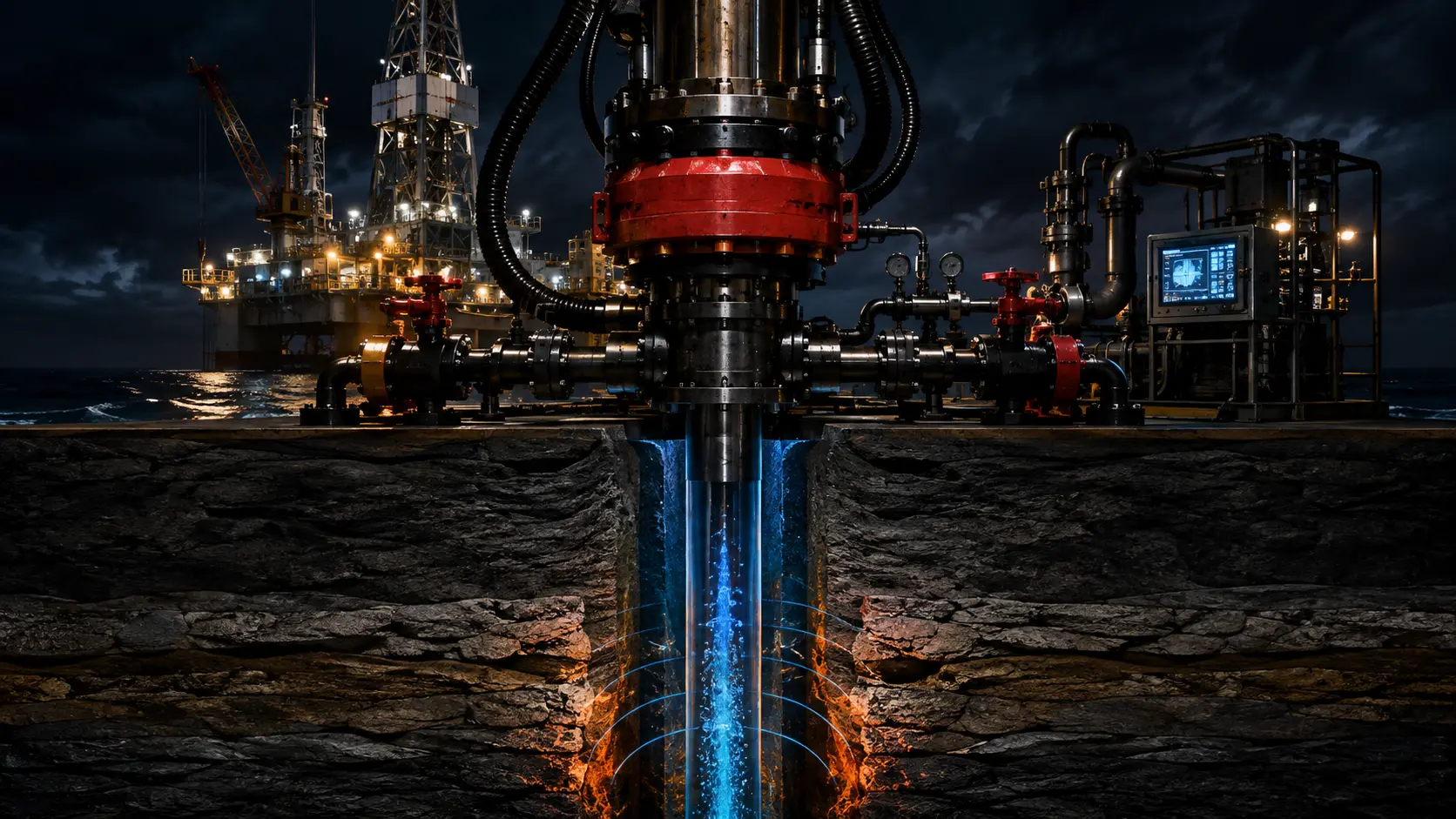

Drilling for oil in ultra-deepwater environments is a terrifying balancing act. Below 10,000 feet of crushing ocean water, drilling crews must punch through another 20,000 feet of seabed rock. At these extreme depths, the earth’s natural pressure is explosive. If the fluid pressure inside the drill pipe is too low, highly pressurized gas from the rock formation will erupt upward, causing a catastrophic blowout. If the pressure is just a fraction too high, the rock shatters, swallowing millions of dollars of specialized drilling fluid and permanently collapsing the wellbore.
For decades, the oil and gas industry managed this razor-thin margin through trial and error, relying on an open-to-the-atmosphere system and the sheer physical weight of “heavy mud” to hold the pressure back. This primitive method is no longer viable for modern offshore exploration. To survive the extreme geology of the 21st century, the industry has transitioned to a radically precise, sealed robotic architecture. Why should you care right now? Because without the automated valves and closed-loop fluid dynamics of Managed Pressure Drilling, extracting energy from the deepwater basins of Brazil, West Africa, and the Gulf of Mexico is mathematically and physically impossible.
What is Managed Pressure Drilling (MPD)?
Managed Pressure Drilling (MPD) is an adaptive drilling process used to precisely control the annular pressure profile throughout a wellbore. Instead of relying solely on the static weight of drilling fluid, MPD utilizes a closed-loop system equipped with automated choke manifolds to apply dynamic backpressure in real-time, mitigating kicks, preventing lost circulation, and ensuring wellbore stability.
At a Glance
- Concept: Sealing the top of an oil well to create a closed loop, allowing computers to instantly adjust the internal fluid pressure using specialized choke valves.
- Why it matters: It solves the “narrow drilling window” problem. By dynamically balancing pressure, it prevents explosive blowouts (kicks) and prevents the well from fracturing, saving lives and millions of dollars in non-productive time (NPT).
- Who uses it: Offshore drilling contractors (Transocean, Valaris), major energy operators (Shell, ExxonMobil, Petrobras), and elite oilfield service providers (SLB, Halliburton, Baker Hughes).
- Biggest takeaway:The global MPD services market reached an estimated USD 4.3 billion in 2025 and is rapidly scaling. It has transitioned from a specialized emergency tool into a mandatory baseline capability for all ultra-deepwater and High-Pressure/High-Temperature (HPHT) operations.
In Simple Words
Imagine inflating a long, thin balloon inside a fragile glass pipe.
In conventional offshore drilling, the “drilling mud” (a heavy liquid pumped down the hole) acts like the air in the balloon. It pushes outward against the rock to keep the explosive oil and gas safely trapped in the earth.
- If you don’t push hard enough, the explosive gas crushes your balloon and shoots up the pipe.
- If you push too hard, the balloon expands too violently and shatters the fragile glass pipe, causing your drilling mud to leak away.
Managed Pressure Drilling (MPD) is a smart lid for the pipe. Instead of leaving the top of the well open and simply guessing the right weight of the mud, MPD seals the top of the well completely. As the mud flows back out of the well, it passes through an automated valve (a choke). By slightly closing the choke valve, the system creates instant “backpressure.” If the computer detects that the rock is about to shatter, it instantly opens the valve a fraction of an inch to relieve the pressure. If it detects a gas bubble trying to escape, it tightens the valve to push back. It continuously balances the balloon perfectly without a human ever having to guess.
Why This Matters
The era of “easy oil” ended a decade ago. To replenish global reserves, operators are targeting mature, depleted deepwater fields and highly complex subsea geology.
In these environments, operators routinely encounter a “narrow pressure window”. The margin of error between a deadly blowout and a catastrophic well collapse is agonizingly small. Using conventional drilling, a simple change in the mud pump’s speed can represent the difference between a profitable success or a costly failure.
For oil and gas investors, MPD is a massive cost-avoidance mechanism. By preventing downhole mud losses and mitigating pressure cycles, MPD drastically reduces Non-Productive Time (NPT). Furthermore, because MPD controls pressure so effectively from the surface, drillers can often skip installing intermediate layers of steel casing deep underground, streamlining the well architecture and saving tens of millions of dollars per well in steel and rig time.
The Global Managed Pressure Drilling Services Market
The integration of MPD is actively restructuring the global offshore drilling fleet.
In the mid-2020s, the global MPD services market was valued at approximately USD 4.3 billion, with projections pushing toward USD 6.08 billion by 2036, compounding at a rate of 3.2% annually.The market is overwhelmingly dominated by the offshore sector, which accounts for 38.2% of total MPD demand, specifically driven by deepwater operations requiring extreme pressure complexity.
Historically, MPD equipment was bolted onto a rig as a temporary afterthought. Today, modern 8th-generation drillships are manufactured “MPD-ready” directly from the shipyard, with high-pressure piping, Rotating Control Devices (RCDs), and automated choke manifolds permanently integrated into the vessel’s central nervous system. This signals a total paradigm shift: closed-loop fluid dynamics is no longer a niche service; it is the default operational standard for the future of maritime energy extraction.
How Managed Pressure Drilling (MPD) Works
Balancing the immense thermodynamic forces of an ultra-deepwater well requires executing complex physics in a highly corrosive environment. Here is the first-principles breakdown.
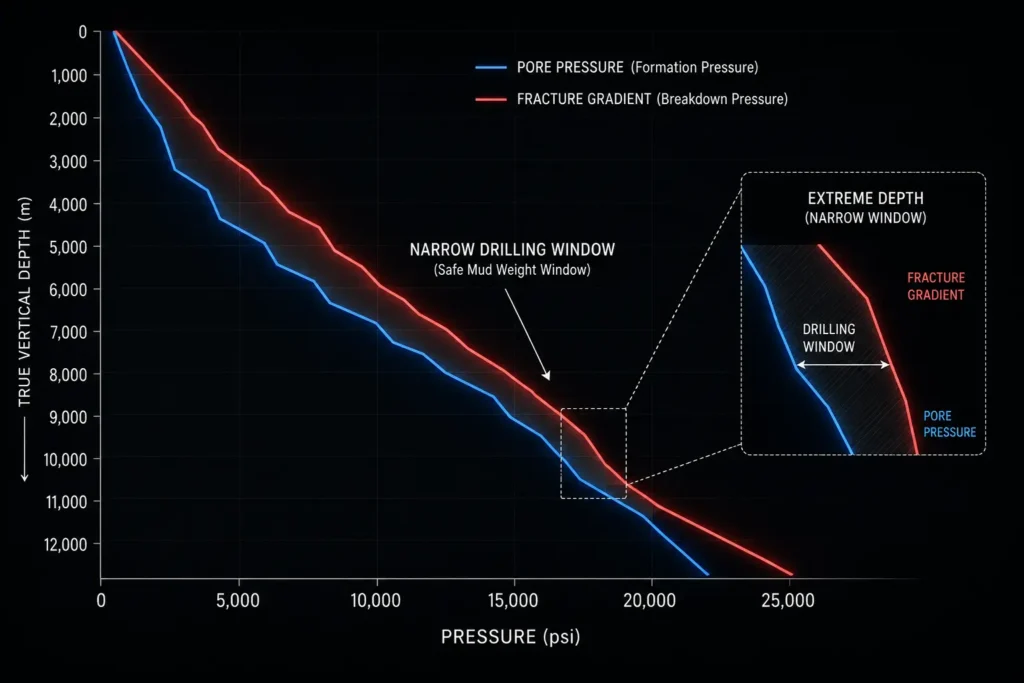
1. The Fundamental Problem: The Narrow Drilling Window
Deep underground, the fluid naturally trapped inside the rock exerts an outward force known as Pore Pressure. Conversely, the physical strength of the rock matrix determines its Fracture Gradient (the pressure required to break the rock). In a stable well, the drilling mud pressure must stay precisely between these two lines. In mature deepwater fields, this “window” shrinks dramatically, leaving almost zero margin for error.
2. The Insufficiency of Conventional Open Systems
Conventional drilling operates as an open system. The drilling mud flows down the drill pipe, up the outside of the pipe (the annulus), and spills openly over a screen into the mud pits. The only way to significantly change the bottom-hole pressure is to halt drilling, mix heavier or lighter chemicals into thousands of barrels of mud, and slowly circulate it down the hole—a process that takes hours.
3. The Core Mechanism: The Rotating Control Device (RCD)
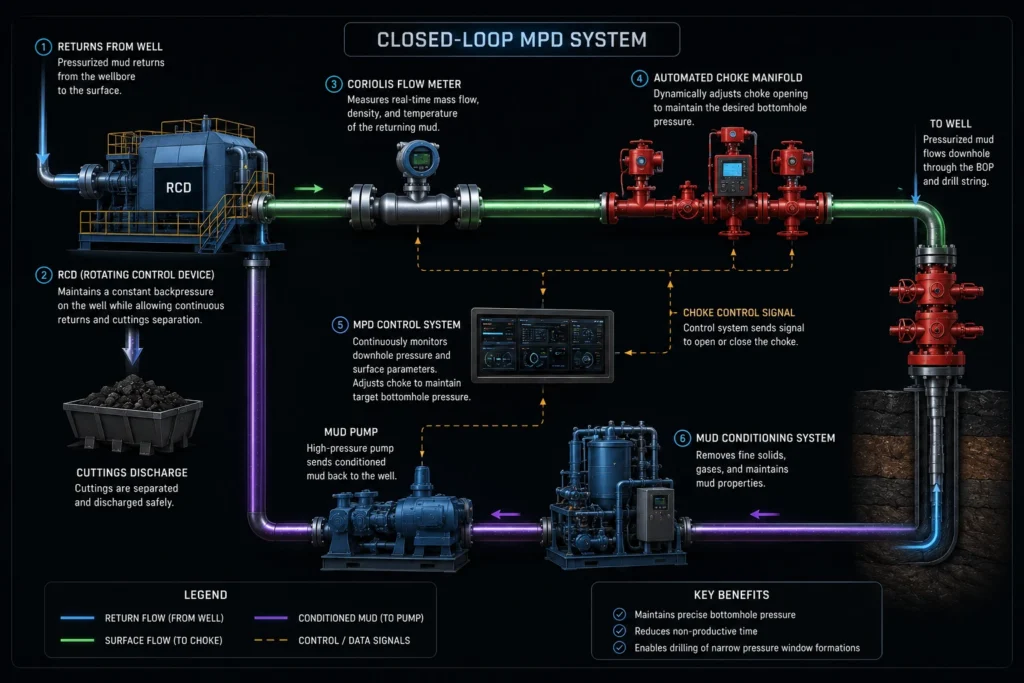
MPD fundamentally changes this by sealing the well. It utilizes a Rotating Control Device (RCD), a massive, heavy-duty rubber bearing that tightly hugs the spinning drill pipe. The RCD completely seals the top of the annulus, transforming the open wellbore into a pressurized, closed-loop hydraulic vessel.
4. Technical Depth: Automated Choke Manifolds and Coriolis Meters
Because the well is sealed, the returning mud is forced through a specialized side pipe. Here, a high-pressure Coriolis meter precisely measures the mud’s density and mass flow rate in real time. The mud then enters the Automated Choke Manifold. This computer-controlled valve dynamically restricts the flow of the mud.
By restricting the flow, the choke applies Surface Backpressure. This relationship is mathematically defined as:
BHP = Phydrostatic + ΔPfriction + Psurface backpressure
Where BHP is the total Bottom Hole Pressure.
5. Real-World Consequences: Constant Bottom Hole Pressure (CBHP)
The most critical capability of MPD is managing the pumps. In a conventional well, when you turn off the mud pumps to add a new section of drill pipe, you lose the friction pressure ($\Delta P_{\text{friction}}$), causing the BHP to plummet and inviting a blowout. In an MPD system, the moment the mud pumps turn off, the automated choke instantly squeezes shut to trap pressure, perfectly replacing the lost friction with $P_{\text{surface backpressure}}$. This achieves Constant Bottom Hole Pressure (CBHP)—the most widely deployed MPD technique, accounting for 34.7% of the global market—ensuring the well remains flawlessly stable even during dynamic operational transitions.
Key MPD Techniques: DGD, PMCD, and Kick Detection
MPD is not a monolith; it encompasses several distinct variants optimized for specific geological nightmare scenarios.
Dual Gradient Drilling (DGD): In ultra-deepwater (exceeding 10,000 feet of water depth), the massive, continuous column of heavy drilling mud running from the rig down to the seabed creates an immense, crushing hydrostatic pressure on the shallow rock below the ocean floor. DGD solves this by using lighter fluid in the ocean riser and heavier fluid in the rock below the seabed, separating the pressure gradients. This prevents the mud from shattering the shallow subsea formations.
Pressurized Mud Cap Drilling (PMCD): Highly fractured carbonate reservoirs (like those in Southeast Asia) are so full of holes that drilling mud instantly drains away into the earth, a phenomenon called total lost circulation. PMCD solves this by pumping a cheap, sacrificial fluid (like seawater) down the drill pipe to clear the rock chips, while pumping a heavy, highly viscous “mud cap” into the top of the annulus to physically block explosive gas from rising to the surface.
Early Kick Detection: Because MPD is a closed loop monitored by a highly sensitive Coriolis meter, it can instantly detect if the volume of fluid coming out of the well is greater than the volume going in. This discrepancy means the earth has “kicked” (injected gas or oil into the wellbore). MPD systems detect kicks within gallons, rather than the dozens of barrels required for conventional open-pit alarm systems to trigger, allowing the automated chokes to instantly suppress the blowout before it escalates.
Economic & Strategic Impact
The financial leverage provided by MPD fundamentally alters the return on investment for offshore leases.
In conventional deepwater drilling, operators must constantly stop drilling to run heavy steel casing down the hole to protect fragile rock sections from being shattered by the heavy mud column. A single deepwater well might require six or seven increasingly narrower strings of steel casing. Each casing string takes days to cement into place, costing millions of dollars in rig time (at $400,000+ per day for a drillship).
Because MPD dynamically manages the pressure, it protects the fragile rock without needing as much steel. MPD frequently allows operators to eliminate one or two entire casing strings from the well design. This saves millions of dollars in raw materials and significantly reduces the total days spent on location, transforming previously uneconomical offshore reservoirs into highly profitable, rapidly executable assets.
Advantages
- Blowout Prevention: Real-time, algorithmic choke control instantly detects and suppresses gas influxes (kicks) before they can escalate into catastrophic, rig-destroying blowouts.
- Reduced Non-Productive Time (NPT): By maintaining constant bottom-hole pressure, MPD drastically reduces the time spent managing lost circulation events, repairing collapsed wellbores, or recovering stuck drill pipes.
- Eliminates Casing Strings: Precise pressure management allows operators to drill deeper sections without needing to stop and line the hole with expensive steel casing.
- Environmental Protection: The closed-loop system inherently contains all hazardous wellbore fluids, drastically reducing the risk of a toxic spill on the rig floor or into the surrounding ocean.
Limitations
- High Upfront Capital and Integration Cost: Deploying a full MPD spread requires massive, heavy equipment (RCDs, choke manifolds, multi-phase separators) and highly specialized technicians, adding significant daily rental costs to the drilling budget.
- Space and Weight Constraints: Upgrading legacy 6th-generation drillships to handle MPD is difficult. The RCD and miles of high-pressure piping require physical space on the rig floor and subsea riser that older vessels simply do not have.
- Elastomer Wear and Tear: The RCD relies on a massive rubber bearing that must perfectly seal against a spinning, vibrating steel drill pipe. The friction causes these elastomer seals to wear out rapidly, requiring the crew to periodically halt drilling to physically replace the massive rubber elements.
Common Misconceptions
Misconception: Managed Pressure Drilling (MPD) is the same thing as Underbalanced Drilling (UBD).
Reality: They are entirely different philosophies. In UBD, the operator intentionally allows the reservoir to flow explosive oil and gas to the surface while drilling to maximize productivity. In MPD, allowing the well to flow is considered a catastrophic failure; the goal is absolute pressure containment and stability, actively suppressing any influx from the formation.
Misconception: MPD is only used for deepwater offshore rigs.
Reality: While born offshore, the onshore segment held a massive 81.84% market share in 2026. Onshore shale operators extensively deploy land-based MPD skids to safely drill ultra-long horizontal laterals through highly depleted, fragile rock formations.
Misconception: The system runs entirely on autopilot.
Reality: While the choke manifold executes automated micro-adjustments, the system requires a highly trained MPD engineer sitting in a specialized control cabin on the rig. The engineer must constantly analyze the thermohydraulic models and update the software’s parameters to account for changing downhole geology.
What Most People Miss
The hidden complexity of Thermal Hydraulic Modeling.
The temperature of drilling mud on the deck of a ship might be 80°F. By the time it travels through the freezing ocean down to the seabed, it drops to 35°F. Once it reaches the crushing depths of the reservoir 20,000 feet underground, it can exceed 300°F.
What most observers miss is that density changes with temperature and pressure. When the mud gets hot, it expands and becomes lighter. When it gets squeezed by pressure, it compresses and becomes heavier. To accurately calculate the Bottom Hole Pressure, the MPD software cannot just use simple math; it must constantly run a massive, real-time thermodynamic simulation that accounts for the exact temperature and compressibility of the fluid at every single foot of depth inside the wellbore.
Comparison Table
| Feature | Conventional Drilling | Underbalanced Drilling (UBD) | Managed Pressure Drilling (MPD) |
| System Architecture | Open to atmosphere | Closed-loop | Closed-loop |
| Primary Pressure Control | Static mud weight | Intentionally light mud | Dynamic choke backpressure + mud weight |
| Influx Management | Highly undesirable (Blowout risk) | Intentionally encouraged (Flowing while drilling) | Rapidly suppressed and contained |
| Response to Pump Shut-off | Severe pressure drop | Continuous flow | Choke automatically traps pressure (CBHP) |
| Target Application | Standard, stable rock formations | Maximizing reservoir production | Navigating narrow pressure windows |
Case Study
Situation: Operating in the Gulf of Mexico’s Mahogany field in 370 feet of water, W&T Offshore needed to drill a highly complex interval. Because the upper reservoir was already heavily depleted from years of production, the formation had an agonizingly narrow pressure window of exactly one pound-per-gallon.
Challenge: If the drilling mud was too heavy, the depleted rock would instantly shatter, causing catastrophic mud loss. If the mud was too light, the lower, fully pressurized zones would kick back into the well, threatening a blowout. Conventional open-system drilling lacked the microscopic precision to thread this geological needle.
Solution (The GeoBalance Integration): The operator deployed Halliburton’s GeoBalance MPD service. They equipped the rig with a high-pressure Coriolis meter and an automated hydraulic choke system. The fluid density was engineered to sit just slightly above the pore pressure, intentionally walking the tightrope.
Outcome: The automated control system perfectly maintained Constant Bottom Hole Pressure (CBHP). When the drillers turned off the pumps to make connections, the surface choke instantly squeezed shut, perfectly trapping the exact pressure required to hold back the gas.
Lessons Learned: The operation was completed safely without a single lost circulation event or kick. By utilizing a closed-loop system, the operator eliminated massive amounts of non-productive time associated with fighting wellbore instability, directly validating the economic necessity of dynamic pressure management in mature offshore basins.
Future Outlook
Next 12–24 Months
The integration of AI-Driven Applied Fluids Optimization. The immediate future of MPD relies on artificial intelligence. Leading service companies are pairing MPD chokes directly with fully automated, skid-mounted Density and Rheology Units (DRUs). Over the next two years, AI algorithms will continuously analyze the physical properties of the mud exiting the well and automatically adjust the rheology (thickness) of the fluid at the mixing hoppers in real-time, removing the final element of human lag from the pressure management cycle.
Next 3–5 Years
The widespread adoption of Subsea MPD Systems. Currently, most MPD choke manifolds and RCDs are physically bolted to the rig deck, hundreds of feet above the ocean. By the late 2020s, manufacturers will commercialize robust subsea MPD systems that integrate the rotating control device and choke valves directly into the Blowout Preventer (BOP) on the ocean floor. This will vastly improve the reaction time to subsea kicks and allow older, weight-constrained drillships to perform complex MPD operations without overloading their surface decks.
Next 10 Years
The Fully Autonomous Drillship. By the mid-2030s, MPD will serve as the foundational nervous system for the fully autonomous drilling platform. The data generated by the closed-loop fluid sensors will be perfectly synchronized with the robotic pipe-handling equipment and the automated top drive. If the MPD system detects a micro-kick, the drillship’s central AI will instantly halt the drill string, close the chokes, balance the well, and circulate the gas out without a human engineer ever touching a dial, fundamentally redefining maritime safety standards.
Most Likely Scenario
As the industry exhaustively explores the remaining ultra-deepwater frontiers of Guyana, Brazil, and Namibia, Managed Pressure Drilling will cease to be a premium service and will become a strict regulatory and insurance mandate. The ability to mathematically guarantee wellbore stability via closed-loop automation ensures that MPD will dominate the hardware capital expenditure of the global offshore drilling fleet for the next decade.
Key Takeaways
- Managed Pressure Drilling (MPD) uses a closed-loop system and automated choke valves to control the pressure inside an oil well in real-time.
- The technology is mandatory for ultra-deepwater drilling because it solves the “narrow pressure window”—the tiny margin between a catastrophic blowout and shattering the rock formation.
- A Rotating Control Device (RCD) seals the top of the well, and a computer-controlled choke valve applies precise “surface backpressure” to balance the well perfectly.
- Constant Bottom Hole Pressure (CBHP) is the most common MPD technique, instantly trapping pressure when the main drilling pumps are turned off so the well remains stable.
- MPD generates massive economic returns by preventing downhole blowouts, reducing non-productive time, and allowing operators to skip installing expensive steel casing strings.
- To accurately calculate downhole pressure, the MPD software must execute complex real-time thermodynamic models that account for extreme deep-ocean temperature and pressure changes.
Glossary
Annulus: The empty space surrounding the drill pipe inside the wellbore, through which the drilling mud flows back up to the surface.
Blowout Preventer (BOP): A massive, specialized mechanical valve structure bolted to the ocean floor, designed to shear the drill pipe and violently seal the well in the event of an uncontrollable catastrophic emergency.
Constant Bottom Hole Pressure (CBHP): A specific MPD technique where the automated choke valve perfectly compensates for the loss of friction when mud pumps are turned off, keeping the total pressure at the bottom of the well perfectly flat.
Fracture Gradient: The maximum amount of pressure the surrounding rock formation can withstand before it physically cracks and breaks apart, causing expensive drilling fluid to leak away.
Non-Productive Time (NPT): Any time the drilling rig is operating but is not actively drilling deeper (e.g., fighting a blowout, fixing equipment, or managing lost fluid), costing operators millions in daily rig rental fees.
Pore Pressure: The natural, inherent outward pressure of the fluids (water, oil, gas) trapped inside the microscopic pores of the deep underground rock formation.
Rotating Control Device (RCD): A heavy-duty, pressurized rubber bearing that hugs the spinning drill pipe, sealing the top of the well and transforming it into a closed-loop hydraulic system.
Frequently Asked Questions
Does MPD replace the Blowout Preventer (BOP)?
No. The BOP is the ultimate, final fail-safe designed to violently crush and seal the pipe to stop a catastrophic explosion. MPD is the active, daily management tool designed to prevent the situation from ever getting bad enough to require the BOP.
Can MPD be used on land?
Yes. While its origins are deeply tied to offshore deepwater complexity, the majority of the global MPD market is actually onshore. Shale drillers heavily utilize MPD to drill ultra-long, horizontal laterals through highly fractured rock without losing massive amounts of drilling fluid.
What happens if the automated choke valve breaks?
MPD manifolds are built with massive redundancy. A standard MPD skid features two or three parallel choke valves. If the primary automated choke fails or becomes plugged with rock debris, the system instantly routes the high-pressure fluid through a backup choke without losing containment of the well.
Why don’t all oil wells use MPD?
Cost and complexity. Adding an MPD spread to a drilling rig is a massive capital expense, requiring specialized hardware and highly paid engineers. For shallow, simple wells with wide, safe pressure margins, traditional open-system drilling remains significantly cheaper and perfectly safe.
How does it detect a blowout so fast?
Because the system is a closed loop, exactly what goes in must come out. The MPD system uses a highly sensitive Coriolis meter to measure the returning fluid. If the rig pumps 100 gallons in, but the meter reads 101 gallons coming out, the system instantly knows the earth has kicked one extra gallon of gas into the wellbore.
Sources
[1] Straits Research: Managed Pressure Drilling Market Size, Share, Growth, Analysis, 2034 (June 2026)
[2] Fact.MR: Managed Pressure Drilling (MPD) Services Market | Global Market Analysis Report 2036 (June 2026)
[3] Fortune Business Insights: Managed Pressure Drilling Market Size, Growth | Report 2034 (July 2026)
[4] Offshore-Mag: Managed pressure drilling helps address narrow pressure window
[5] Drillopedia: Pressure-Managed Drilling Techniques: MPD Variants, UBD, DGD, and their Applications