Advertisement
)

Imagine loading your most valuable corporate trade secrets into an armored car, driving them to a highly secure bank, and then—right before you count the money—dumping the cash out onto the public sidewalk. This is the exact architectural flaw of the modern internet. For decades, cybersecurity has successfully protected data “at rest” on hard drives and data “in transit” through fiber optic cables. But the moment a software application actually needs to use that data, it must be decrypted into plain text inside the computer’s memory. If a hacker, a rogue system administrator, or a compromised cloud provider is watching the server’s memory, your data is completely exposed.
As Fortune 500 companies rush to feed their proprietary financial records, patient data, and unreleased source code into massive Artificial Intelligence models hosted in the public cloud, this vulnerability has escalated into a catastrophic business risk. You cannot ask an AI a question without exposing your prompt to the processor. To solve this, chipmakers have engineered a radical hardware breakthrough. Why should you care right now? Because semiconductor giants have created impenetrable, encrypted vaults directly inside the silicon, guaranteeing that AI can process your data in total secrecy. This technology is finally bridging the gap between absolute data privacy and infinite cloud scale.
What is Confidential Computing?
Confidential Computing is a cloud security technology that encrypts data during processing. By utilizing hardware-based Trusted Execution Environments (TEEs), it isolates data and application code within a highly secure memory enclave directly on the computer chip, preventing unauthorized access or modification by operating systems, hypervisors, or cloud providers.
At a Glance
- Concept: Moving trust away from software companies (like AWS, Azure, or Google Cloud) and placing it entirely into the physical physics of the silicon chip itself.
- Why it matters: It solves the “Data in Use” vulnerability. It allows companies to rent powerful AI supercomputers in the public cloud without ever exposing their proprietary model weights or user prompts to the cloud provider.
- Who uses it: Financial institutions pooling anti-fraud data, healthcare consortiums training cancer-detection AI on private patient records, and military defense contractors.
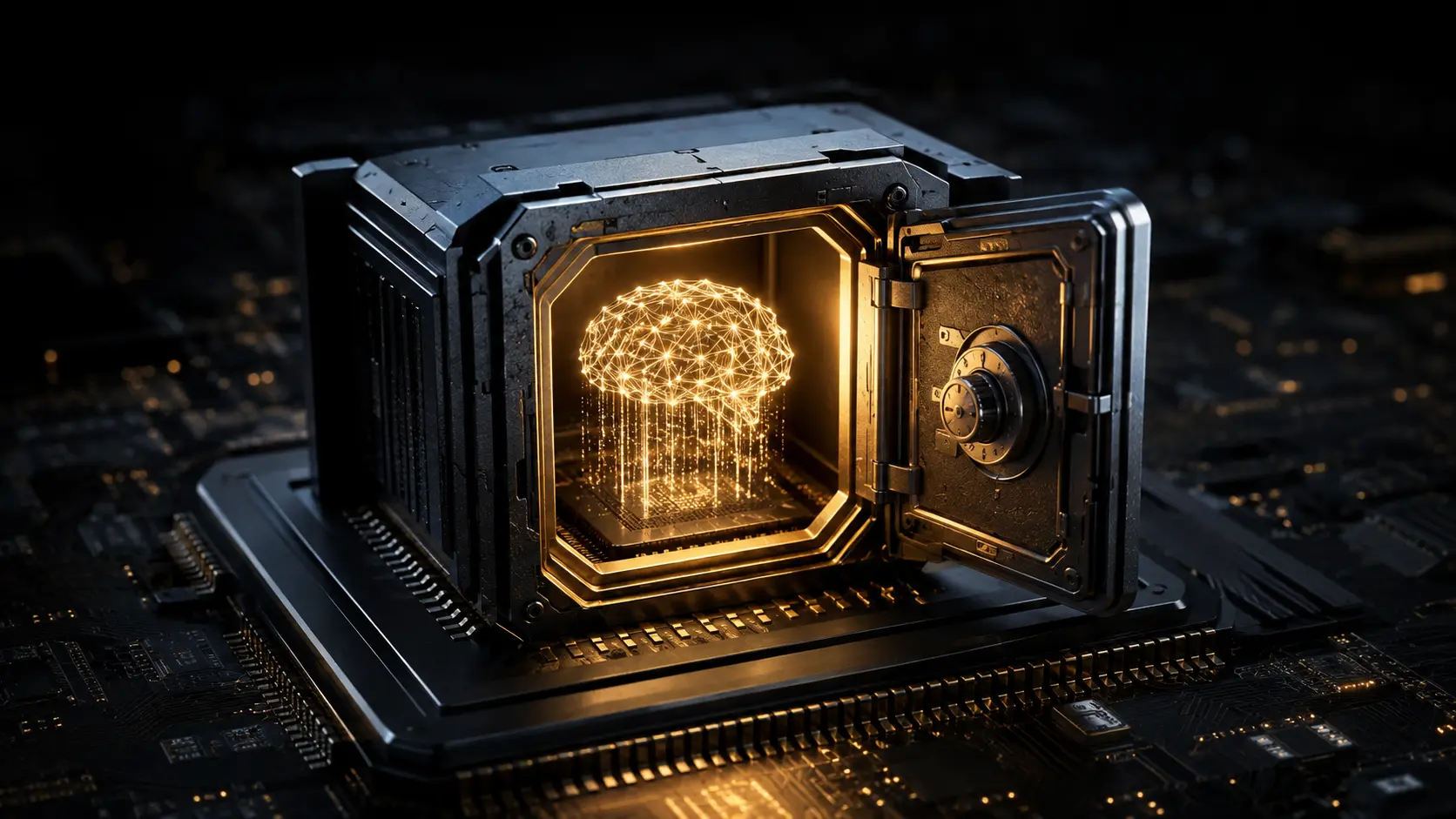
- Biggest takeaway: A TEE acts like a digital black box. Data goes in encrypted, gets decrypted only inside the locked hardware vault, is processed by the AI, and is re-encrypted before it ever leaves the vault.
In Simple Words
Normally, when you run a program on a computer, the “Operating System” (like Windows or Linux) is the absolute boss. It can see and control everything happening in the computer’s memory. If you put a computer in the cloud, the cloud provider controls the operating system. This means if you ask a cloud AI to analyze your secret company financials, the cloud provider theoretically has the power to look at your documents.
Confidential Computing builds a secret, locked room inside the computer chip.
When you send your encrypted financial documents to the cloud, they bypass the operating system entirely and go straight into the locked room. The AI model is also placed inside the locked room. The door locks, the data is decrypted, the AI reads it, does the math, encrypts the answer, and spits it back out. Because the room is built into the physical hardware of the chip, the “boss” (the cloud provider) does not have a key. They can see that the room is using electricity, but they are physically blind to what is happening inside.
Why This Matters
The enterprise adoption of Generative AI is currently paralyzed by Intellectual Property (IP) anxiety. Chief Information Security Officers (CISOs) at major banks and pharmaceutical companies are outright banning employees from using public AI models because they fear their prompts will be leaked, stolen, or ingested into the model’s future training data.
For Cloud Architects and AI Developers, Confidential Computing is the ultimate unblocker. It allows highly regulated industries to utilize the raw compute power of external hyperscalers without violating GDPR, HIPAA, or strict corporate data residency laws. It transitions the cloud from a “trusted” environment (where you hope the provider behaves) to a “trustless” environment (where you possess cryptographic, mathematical proof that the provider cannot access your data).
The Rise of Trusted Execution Environments (TEEs)
The silicon industry has universally adopted this standard, though under different branding.
In the CPU market, Intel utilizes Intel TDX (Trust Domain Extensions) and AMD relies on AMD SEV-SNP (Secure Encrypted Virtualization-Secure Nested Paging).
However, the real revolution occurred when NVIDIA brought Confidential Computing to the GPU. With the Hopper (H100) and subsequent Blackwell architectures, NVIDIA introduced GPU-based Trusted Execution Environments. Because AI requires massive parallel processing, protecting the data strictly on the CPU was insufficient. The data had to be protected while flowing across the PCIe bus and while sitting in the GPU’s High-Bandwidth Memory (HBM). By hardware-locking the GPU, NVIDIA enabled the secure deployment of trillion-parameter models in hostile, multi-tenant cloud environments.
How Confidential Computing Secures Data in Use
Creating a secure vault inside a computer that is being simultaneously shared by dozens of other customers requires master-class cryptography and hardware isolation. Here is the first-principles breakdown.
1. The Fundamental Problem: The Hypervisor
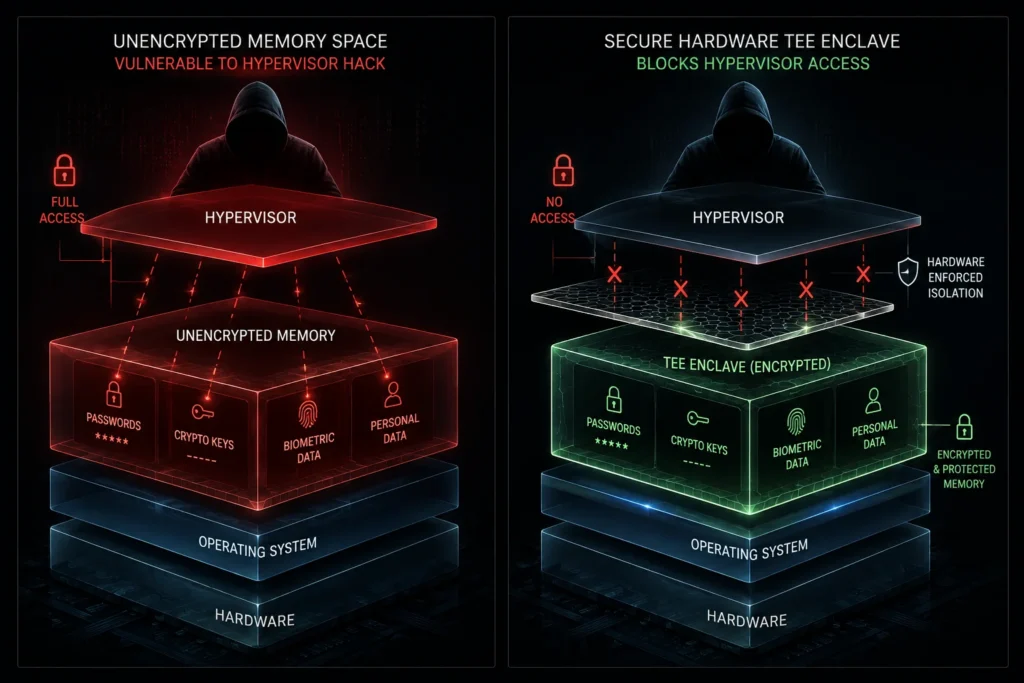
In cloud computing, physical servers are split into multiple Virtual Machines (VMs). A piece of software called the Hypervisor manages these VMs. The hypervisor has root-level access to everything. If a hacker exploits the hypervisor, or if a rogue cloud employee accesses it, they can read the raw memory (RAM) of every single Virtual Machine on that server, stealing keys and plain-text data.
2. The Insufficiency of Software Encryption
You cannot solve this with software alone. If you write a software program to encrypt the memory, the decryption key has to be stored in the memory to be used. The hypervisor can just steal the key. Security must be rooted in hardware.
3. The Core Mechanism: Hardware-Enforced Memory Encryption
In a Trusted Execution Environment (TEE), the encryption engine is physically baked into the memory controller on the silicon die. When the CPU or GPU writes data to the RAM, the hardware automatically encrypts it. When the CPU reads the data back, it decrypts it instantly inside the chip’s core. The encryption keys are generated randomly by the hardware at boot and are completely inaccessible to the hypervisor, the OS, and even the server administrator.
4. Technical Depth: Remote Attestation
How do you know the cloud provider actually put your data in a TEE, and didn’t just route it to a normal, unsecure server? Remote Attestation.
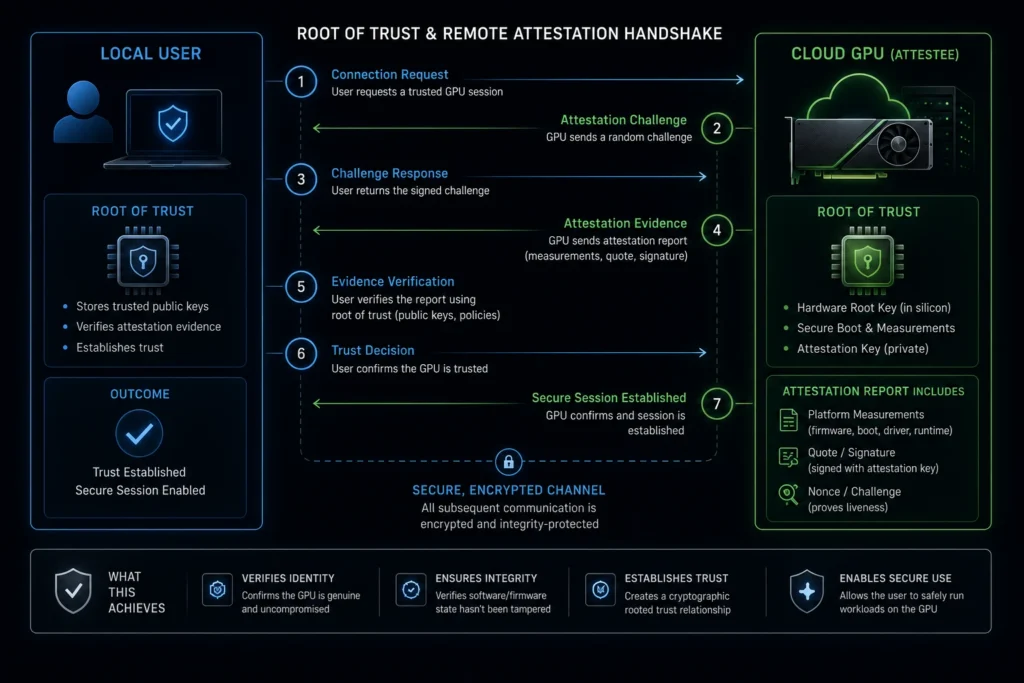
Before you send your data, the hardware chip generates a cryptographic certificate (signed by a master key embedded at the factory by AMD, Intel, or NVIDIA). This certificate provides mathematical proof of the exact microcode running in the enclave. Your local computer verifies this certificate. If it matches, your computer releases the decryption key to the enclave. If the hypervisor has been tampered with, the signature changes, the attestation fails, and your data remains locked.
5. Real-World Consequences: Secure Multi-Party Computation
Because the enclave is completely blind to the outside world, multiple competing companies can safely pool their data. Three rival banks can send their encrypted transaction logs into a single TEE to train a massive, shared AI anti-fraud model. The AI trains on the combined data, but because of the hardware locks, none of the banks can see each other’s proprietary logs.
Enterprise AI Use Cases for Confidential Computing
Confidential Computing is shifting from a niche security feature to a mandatory baseline for enterprise AI deployments.
Protecting Proprietary AI Model Weights: Building a frontier AI model costs hundreds of millions of dollars. If an AI startup deploys their model on a public cloud for customers to use, a hacker could theoretically execute a memory dump and steal the model’s exact neural weights, pirating the entire multi-million-dollar investment in seconds. Deploying the model inside an NVIDIA GPU TEE ensures the weights remain hardware-encrypted while sitting in the VRAM, neutralizing the threat of IP theft.
Healthcare Diagnostics (Federated Pooling): A hospital wants to use an AI to analyze patient MRI scans to detect early-stage tumors. Due to strict HIPAA privacy laws, the hospital cannot legally send unencrypted patient scans to an external AI vendor. By using Confidential Computing, the hospital establishes a secure enclave. The AI vendor sends their algorithm into the vault, the hospital sends the MRI into the vault, the analysis happens in secret, and only the final diagnosis is returned to the doctor. The AI vendor never sees the patient data, and the hospital never sees the underlying AI code.
Blockchain and Web3 Bridges: Cross-chain bridges—the software that moves cryptocurrency between different blockchains—are notoriously vulnerable to hacks because the cryptographic signing keys are often exposed in memory. Web3 infrastructure heavily utilizes TEEs (like Intel SGX) to store these master keys, ensuring that even if the bridge’s external servers are compromised, the attackers cannot extract the keys required to drain the treasury.
Economic & Strategic Impact
The implementation of hardware-based security fundamentally disrupts the Cloud Provider Trust Model.
Historically, Amazon Web Services (AWS), Microsoft Azure, and Google Cloud Platform (GCP) required their customers to trust their security protocols, employee background checks, and software firewalls. This required immense legal and reputational capital.
Confidential Computing shifts the burden of trust away from the cloud provider and directly onto the silicon manufacturer (NVIDIA, AMD, Intel). The hyperscalers are no longer selling “trust”; they are simply selling raw compute power. By neutralizing the cloud provider’s ability to see the data, enterprises are heavily incentivized to adopt multi-cloud strategies, effortlessly moving their highly sensitive AI workloads between AWS, Azure, and Oracle Cloud to chase the cheapest compute prices, knowing their data is secured by the silicon, regardless of whose building the silicon sits in.
Advantages
- Secures Data In Use: Closes the final vulnerability gap in data lifecycle security, ensuring that data is encrypted while resting, moving, and actively computing.
- Cryptographic Attestation: Provides mathematical, verifiable proof to the end-user that the remote server has not been tampered with before releasing sensitive decryption keys.
- Neutralizes Insider Threats: Completely locks out the host operating system and hypervisor, preventing rogue cloud administrators or state-sponsored actors with root access from viewing the data.
Limitations
- Performance Overhead: Constantly encrypting and decrypting data as it moves between the processor core and the memory creates a latency penalty. While manageable for single-node inference, coordinating a TEE across thousands of GPUs connected via InfiniBand for massive AI training significantly degrades throughput.
- Hardware Lock-in: TEE implementations are proprietary. Code optimized for an Intel SGX enclave does not seamlessly port over to an AMD SEV-SNP or NVIDIA Hopper enclave, forcing developers to manage complex, vendor-specific attestation protocols.
- Side-Channel Attacks: While the memory is mathematically encrypted, TEEs have historically been vulnerable to complex physical side-channel attacks (like monitoring the subtle changes in power consumption or electromagnetic radiation to guess the keys), requiring constant firmware patching.
Common Misconceptions
Misconception: Confidential Computing is the same thing as Homomorphic Encryption.
Reality: They are entirely different. Homomorphic Encryption is a purely mathematical concept where the AI performs calculations directly on encrypted data without ever decrypting it, which is incredibly slow and computationally expensive. Confidential Computing is a hardware solution; it decrypts the data normally, but does it inside a physically locked, impenetrable vault on the chip.
Misconception: If a hacker gets root access to the server, they can break the TEE.
Reality: The TEE is designed explicitly to assume the root operating system is already compromised. The hardware encryption engine physically isolates the memory space, returning only unintelligible ciphertext to anyone querying it from outside the enclave, regardless of their administrative privileges.
Misconception: It requires completely rewriting your software from scratch.
Reality: Early implementations (like Intel SGX) did require software rewrites to fit into tiny enclaves. Modern architectures (like AMD SEV-SNP) protect the entire Virtual Machine (Confidential VMs). You can “lift and shift” an entire Linux operating system and AI model into the enclave without altering a single line of code.
What Most People Miss
The critical importance of the Root of Trust Handshake.
When discussing Confidential Computing, most people focus on the encryption. What they miss is that encryption is useless if you hand the keys to the wrong person. The entire system hinges on the “Root of Trust.”
Buried deep inside the silicon of a modern processor is a microscopic, immutable piece of read-only memory injected at the factory. This holds the master certificate. When you connect to the cloud, your computer challenges the server. The silicon chip itself cryptographically signs a report detailing exactly what software is loaded in the enclave. If the cloud provider tries to sneak malicious code into the vault, the signature changes. Your computer checks the signature against NVIDIA or AMD’s public ledger. If it fails, your computer refuses to send the data. This mathematically prevents “Man-in-the-Middle” attacks before the computation even begins.
Comparison Table
| Feature | Data at Rest | Data in Transit | Data in Use (Standard) | Data in Use (Confidential Computing) |
| State of Data | Stored on Hard Drive | Moving over Network | Processing in RAM/CPU | Processing inside Hardware TEE |
| Encryption Status | Encrypted (AES-256) | Encrypted (TLS/SSL) | Plain Text (Unencrypted) | Encrypted by Hardware Memory Controller |
| Primary Vulnerability | Stolen Hard Drive | Network Interception | Hypervisor/Root Access | Sophisticated Side-Channel Attacks |
| Visibility to Host OS | Cannot Read | Cannot Read | Full Visibility | Zero Visibility (Blind) |
Case Study
Situation: A consortium of tier-one global banks wanted to train a massive, multi-billion-parameter Artificial Intelligence model to detect sophisticated, cross-border money laundering networks. To train the model effectively, the AI needed to ingest the raw, highly sensitive transaction logs of millions of customers across all the banks simultaneously.
Challenge: Due to strict national privacy regulations (GDPR) and fierce corporate competition, the banks were legally forbidden from sharing their unencrypted customer transaction data with each other, and they refused to trust a third-party cloud provider to aggregate the plain-text data on their behalf.
Solution (The Confidential Clean Room): The banks deployed a Confidential Computing architecture using AMD SEV-SNP Confidential Virtual Machines hosted in the public cloud. They utilized remote attestation to mathematically verify the integrity of the enclave. Once verified, all the banks securely streamed their encrypted transaction logs directly into the hardware-locked TEE, where the central AI model was waiting.
Outcome: The AI model decrypted the data locally within the isolated silicon vault, trained itself on the combined dataset, updated its neural weights, and permanently deleted the raw data before shutting down.
Lessons Learned: The transaction proved the viability of “trustless collaboration.” No bank ever saw the other banks’ data, and the cloud provider remained entirely blind to the process. By securing the data in use, Confidential Computing allowed the consortium to leverage the power of massive, shared AI infrastructure without sacrificing a single metric of regulatory compliance or corporate privacy.
Future Outlook
Next 12–24 Months
The era of Confidential GPU Standardization. As NVIDIA Blackwell and subsequent architectures deploy heavily across hyperscalers, native GPU TEEs will transition from a premium add-on to an enterprise default. Over the next two years, MLOps orchestration frameworks (like Kubernetes and Ray) will integrate seamless, automated attestation protocols, allowing developers to spin up secure, multi-GPU AI inference clusters with a single line of code, finally unblocking the mass migration of highly sensitive financial and healthcare workloads to the public cloud.
Next 3–5 Years
The rise of Multi-Node Confidential Training. Currently, the performance penalty for encrypting traffic between thousands of GPUs makes massive foundation model training inside TEEs economically painful. By the late 2020s, advances in silicon photonics and in-network encryption offload engines will drastically reduce this latency. This will enable competing AI labs to securely crowdsource computing power, training trillion-parameter models across decentralized, untrusted hardware networks without fear of their proprietary datasets being intercepted.
Next 10 Years
The transition to Quantum-Safe Enclaves. By the mid-2030s, the cryptographic algorithms currently securing the Root of Trust and the remote attestation handshakes will face the existential threat of fault-tolerant quantum computers (Shor’s Algorithm). The industry will execute a massive hardware refresh, issuing new generations of silicon embedded with Post-Quantum Cryptographic (PQC) lattice-based algorithms, ensuring that the hardware vaults remain mathematically impenetrable for the next century of computing.
Most Likely Scenario
Confidential Computing is the foundational security protocol of the AI era. As AI models become deeply integrated into critical national infrastructure, operating without hardware-level memory encryption will be viewed as corporate negligence. The technology will seamlessly fade into the background, becoming an invisible, ubiquitous standard that guarantees data sovereignty in a hyper-connected, cloud-dominated world.
Key Takeaways
- Standard encryption protects data on hard drives and over networks, but traditional architecture forces data to be decrypted into plain text to be processed by the CPU or GPU.
- Confidential Computing uses hardware-isolated vaults (Trusted Execution Environments) built directly into the silicon to keep data encrypted while it is actively being processed.
- The hardware encryption prevents the operating system, the hypervisor, and the cloud provider from accessing the data, neutralizing insider threats and root-level hackers.
- “Remote Attestation” is the critical handshake. It provides cryptographic proof to the user that the remote cloud server is safe and untampered with before sending any sensitive data.
- NVIDIA’s Hopper and Blackwell architectures extend this protection from the CPU to the GPU, allowing massive AI models to process proprietary prompts without risking IP theft.
- The technology enables “Secure Multi-Party Computation,” where rival companies can pool highly sensitive data to train a shared AI model without ever exposing their data to each other.
Glossary
Attestation (Remote Attestation): The cryptographic process where a hardware chip proves to a remote user that it is running the correct, untampered software inside a secure enclave before data is transmitted.
Confidential Virtual Machine (CVM): An entire virtual server that is encapsulated within a Trusted Execution Environment, allowing developers to run standard operating systems securely without modifying their code.
Data in Use: The state of data when it is actively being read, updated, or processed by a computer’s CPU or RAM. This is historically the most vulnerable state in the data lifecycle.
Hypervisor: The foundational software that creates and runs virtual machines (VMs) in a cloud data center. If compromised, standard architecture allows the hypervisor to read the memory of all hosted VMs.
Root of Trust: A highly secure, immutable set of cryptographic keys permanently embedded into the silicon chip at the factory, serving as the absolute foundation for verifying the hardware’s identity.
Trusted Execution Environment (TEE): A physically secure, hardware-isolated area within a main processor that guarantees the code and data loaded inside are protected with respect to confidentiality and integrity.
Sources
[1] Confidential Computing Consortium: A Technical Analysis of Confidential Computing v1.3 (2025/2026 Updates)
[2] NVIDIA Technical Blog: Confidential Computing on NVIDIA Hopper and Blackwell Architectures
[3] IEEE Security & Privacy: Hardware-Assisted Memory Encryption: AMD SEV-SNP and Intel TDX Mechanisms
[4] Cloud Security Alliance (CSA): The Role of Remote Attestation in Zero-Trust Cloud Architectures (2026 Analysis)
[5] Gartner Research: Hype Cycle for Data Security and the Mass Adoption of Trusted Execution Environments