Advertisement
)
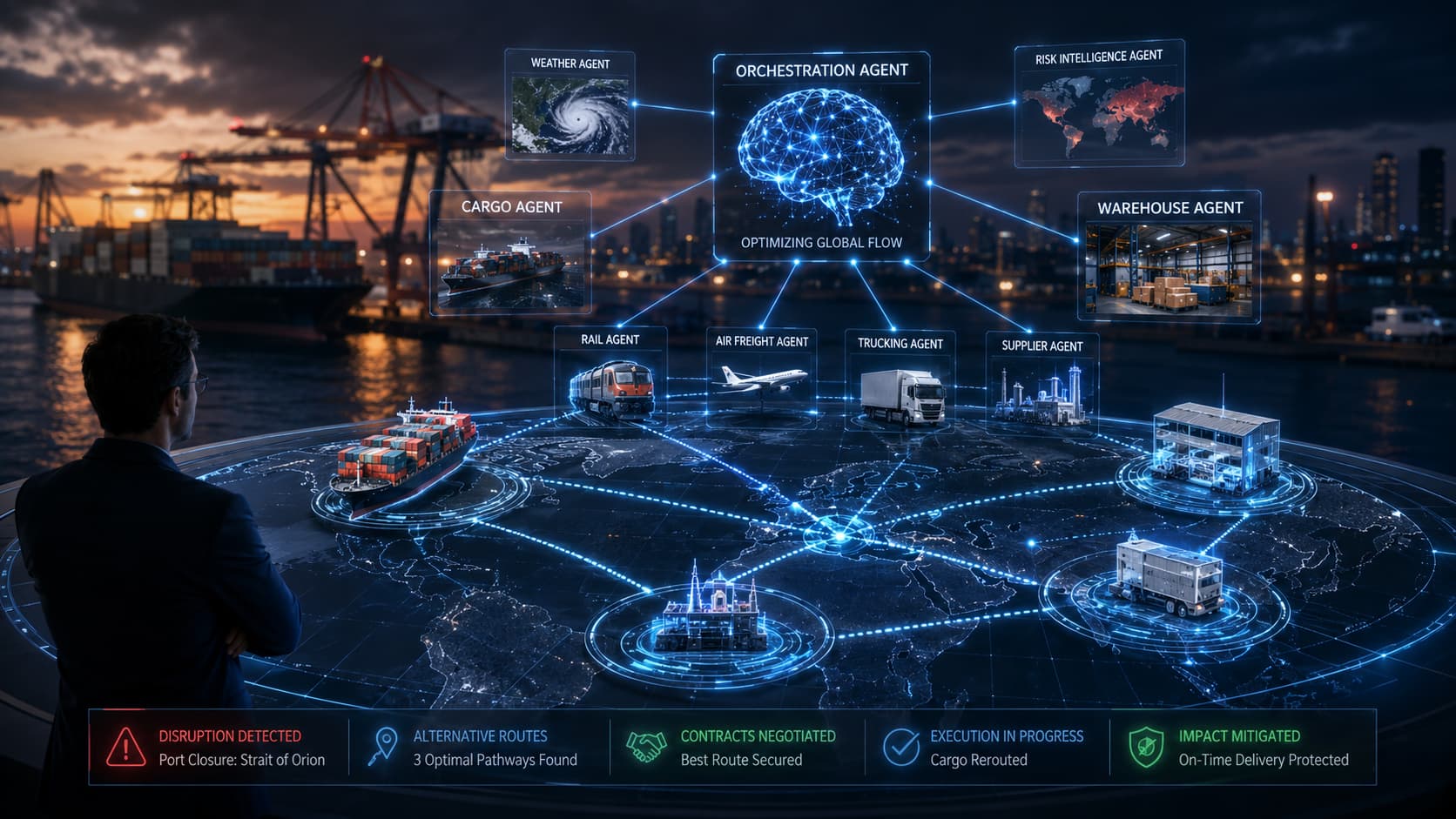

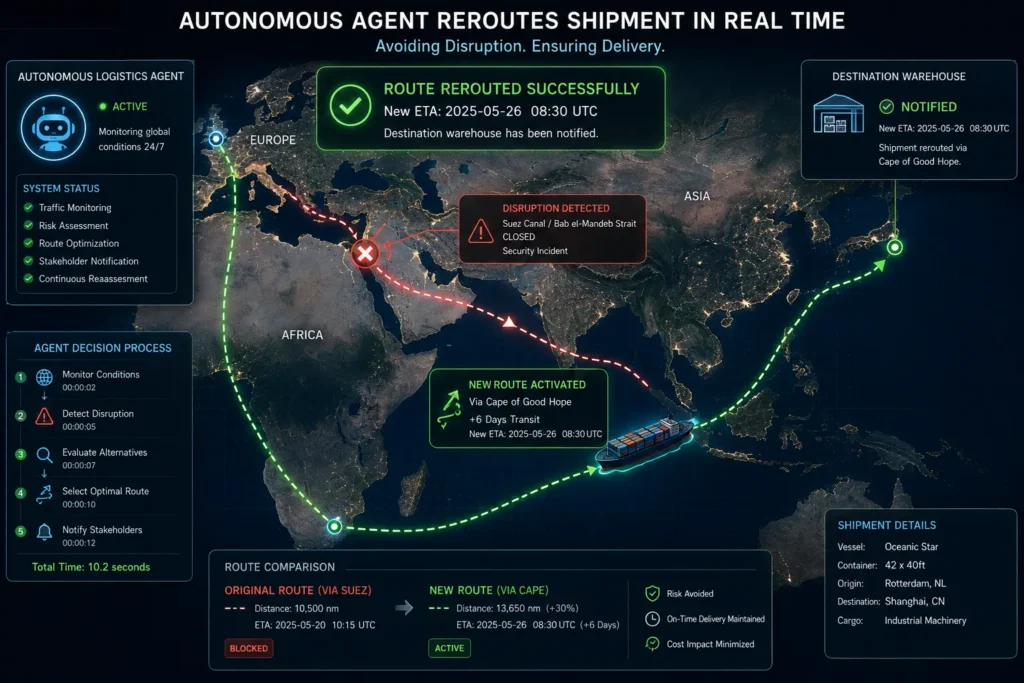
Imagine a massive, ultra-large container vessel carrying $150 million worth of vital semiconductor components toward a major global transit chokepoint. Suddenly, a geopolitical conflict escalates, and the strait is closed to commercial shipping. In a traditional supply chain, this event triggers a cascade of human panic. Analysts scramble to decipher the impact, log into massive ERP dashboards, call freight forwarders, and spend weeks manually renegotiating transit routes, resulting in empty factory floors and massive financial losses.
In an agentic supply chain, nobody panics. Milliseconds after the strait closure is confirmed by global intelligence APIs, a digital AI agent representing the cargo ship automatically communicates with an AI agent representing the destination warehouse. Recognizing the delay, the system instantly broadcasts a request for alternative transport. Within seconds, automated rail and air-freight agents submit pricing bids. The system mathematically selects the optimal detour, digitally signs the contracts, rebalances the warehouse inventory, and notifies the human executives that the crisis has been resolved. Why should you care right now? Because global supply chains have become too complex for humans to manage manually. Handing logistics over to autonomous agentic networks is the only way to insulate the global economy from continuous, devastating geopolitical shocks.
What is Agentic Supply Chain Orchestration?
Agentic Supply Chain Orchestration is an advanced logistics framework that utilizes networks of autonomous artificial intelligence agents. These specialized AI programs continuously monitor global data, autonomously negotiate transit routes, and instantly execute inventory rerouting decisions to optimize enterprise supply chains without requiring human intervention.
At a Glance
- Concept: Deploying a digital workforce of AI agents that represent physical assets (ships, trucks, factories) to autonomously communicate, negotiate, and optimize the flow of global goods.
- Why it matters: It shifts supply chain management from reactive (humans fixing broken supply lines) to predictive and autonomous (AI fixing the supply line before the factory runs out of parts).
- Who uses it: Tier-1 global logistics conglomerates, mega-retailers (Amazon, Walmart), and automotive manufacturers utilizing “Just-in-Time” inventory systems.
- Biggest takeaway: The system does not use one massive AI brain. It uses a Multi-Agent System (MAS) where hundreds of small, specialized AI agents bid against each other to find the most mathematically efficient logistics solution.
In Simple Words
Think of traditional supply chain software like a standard GPS navigation app. If a bridge is out, the app turns red, beeps, and says “Road Closed.” You, the human driver, have to manually pull over, look at the map, calculate how much gas you have, and figure out a new route.
Agentic Orchestration is like a self-driving car that talks to the road.
If the bridge is out, the car’s AI doesn’t just beep at you. It instantly texts the AI of a nearby ferry service to negotiate a ticket price. It calculates that the ferry is cheaper than driving 100 miles out of the way. It buys the ticket using a digital wallet, reroutes the car to the ferry terminal, and then texts your boss to say you will be 15 minutes late. The “agents” (the car and the ferry) handled the entire crisis autonomously while you were sipping your coffee. In global logistics, these agents are doing this simultaneously for tens of thousands of cargo containers, trucks, and warehouses across the planet.
Why This Matters
The fragility of the global supply chain was violently exposed during the rolling crises of the 2020s—from the post-pandemic semiconductor shortage to droughts restricting the Panama Canal, to missile attacks in the Red Sea.
For Supply Chain Directors and Logistics Execs, the mathematical reality is that traditional “Just-in-Time” manufacturing is dead if it relies on human reaction time. Human analysts cannot process the combinatorial explosion of variables required to reroute a 10,000-TEU container ship efficiently. Agentic orchestration is a mandatory upgrade for enterprise survival. It effectively guarantees operational resilience, acting as an algorithmic shock-absorber that isolates massive multinational corporations from the chaos of physical geopolitics.
The Shift to Autonomous Agentic Execution
The integration of artificial intelligence into logistics has occurred in two distinct phases. Phase one was Predictive Analytics: AI told humans what was going to break. Phase two—happening right now—is Agentic Execution: AI actually fixes the break.
This transition relies heavily on the standardization of Enterprise Resource Planning (ERP) APIs. Companies are granting specialized AI agents “write-access” to their core financial and logistical systems (like SAP or Oracle). Instead of just generating a dashboard alert, these agents have the authorized security credentials to physically issue purchase orders, update shipping manifests, and alter manufacturing schedules in real-time, bridging the gap between digital intelligence and physical industrial motion.
How Agentic Supply Chain Orchestration Works
Coordinating millions of moving parts autonomously requires replacing centralized human planning with decentralized, game-theoretic mathematics. Here is the first-principles breakdown of the architecture.
1. The Fundamental Problem: Combinatorial Explosion
When a major port shuts down, a supply chain manager doesn’t just have to find a new port. They have to find a new port, secure available trucks at that new port, ensure the destination warehouse has the staff to unload the trucks at a different time, and recalculate the profit margins. The number of possible logistical combinations explodes into the millions, paralyzing human decision-making.
2. The Insufficiency of Traditional ERPs
Legacy software is deterministic. It relies on hard-coded rules (“If Port A is closed, route to Port B”). But if Port B is also backed up due to a storm, the rigid software breaks. Traditional ERPs lack the dynamic reasoning required to improvise novel solutions.
3. The Core Mechanism: Multi-Agent Systems (MAS)
Agentic orchestration abandons the “central brain” approach. It uses a Multi-Agent System. Every entity in the supply chain gets its own digital proxy (an AI agent). There is a “Cargo Agent,” a “Trucking Agent,” and a “Warehouse Agent.” These agents operate independently, equipped with Large Language Models (LLMs) to reason through unstructured data and strict API constraints to govern their actions.
4. Technical Depth: The Contract Net Protocol (CNP)
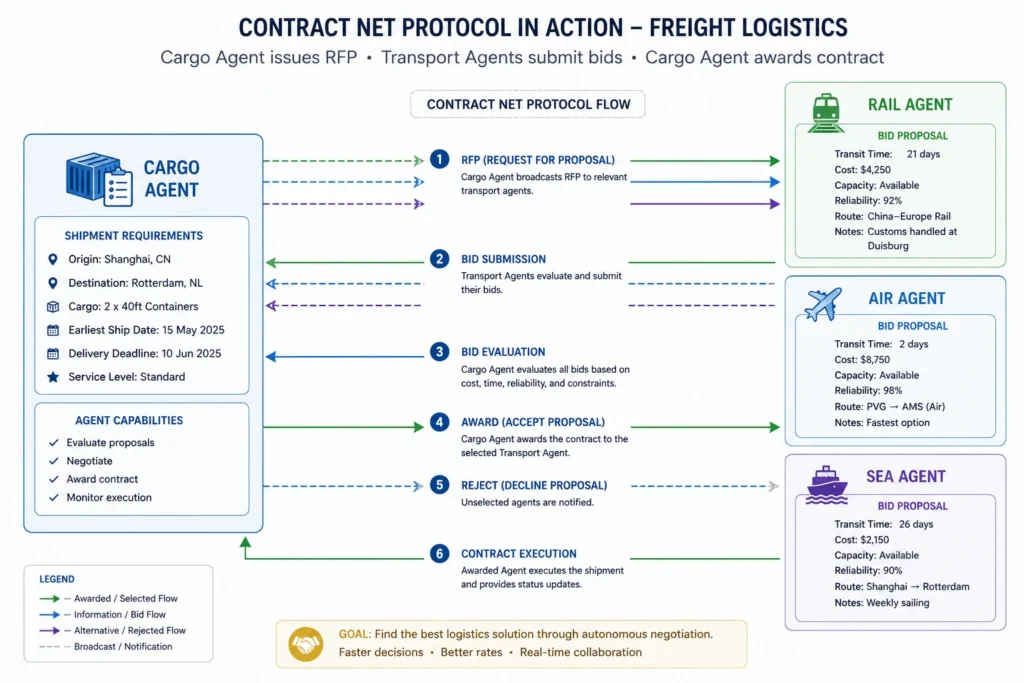
When a disruption occurs, the agents resolve it using decentralized bidding, often based on the Contract Net Protocol (CNP).
If a shipment must be rerouted, the Cargo Agent acts as a “Manager” and issues a Call for Proposals. The available Transit Agents (rail, air, sea) act as “Contractors” and submit bids. The Cargo Agent mathematically evaluates the bids based on a predefined utility function:
(Ui = max(Vj - Cij))
(Where U_i is the utility, V_j is the value of the delivery time, and C_{ij} is the cost of the route). The agent autonomously selects the highest-utility bid and executes the binding contract via API.
5. Real-World Consequences: Dynamic Rebalancing
Once the route is secured, the system automatically cascades the decision. The Warehouse Agent detects the new arrival time and autonomously reallocates dock workers. If the delay threatens a factory stock-out, the Procurement Agent automatically orders a small, expensive batch of raw materials via air-freight to act as a bridge until the delayed maritime cargo arrives, perfectly preserving the manufacturing schedule.
Enterprise Applications of AI Logistics Agents
The deployment of autonomous agents is actively rewriting the operational playbooks of multinational conglomerates.
Predictive Weather Routing: Major maritime logistics companies are integrating weather APIs directly into their agentic networks. If a typhoon forms in the Pacific, an AI agent does not wait for the captain to call headquarters. It analyzes the projected storm path, calculates the fuel cost of outrunning the storm versus the delay cost of anchoring, autonomously submits the optimized coordinate path to the ship’s navigation system, and updates the estimated time of arrival (ETA) for all downstream clients simultaneously.
Micro-Fulfillment Inventory Rebalancing: Mega-retailers operate hundreds of localized micro-fulfillment centers to guarantee same-day delivery. If a sudden, hyper-localized spike in demand occurs (e.g., a viral social media trend causes a specific product to sell out in Chicago), inventory agents detect the anomaly. They autonomously coordinate with trucking agents to move excess stock from Dallas to Chicago overnight, ensuring the specific nodes of the supply chain never run dry.
Automated Vendor Switching: In electronics manufacturing, if a primary supplier in Taiwan suffers a factory fire, traditional procurement teams lose weeks finding a backup. In an agentic system, a Procurement Agent continuously monitors global news feeds. Upon verifying the fire, it instantly accesses a pre-approved list of secondary vendors in Mexico and Vietnam, autonomously requests quotes via API, and issues emergency purchase orders to secure the remaining global supply of the component before human competitors even realize there is a shortage.
Economic & Strategic Impact
The transition to agentic orchestration introduces a critical new enterprise challenge: The API Liability Gap.
While humans make mistakes, corporate liability structures are built to absorb human error. When a human signs a bad contract, the corporation holds the individual accountable. But if an autonomous AI agent operating under the Contract Net Protocol legally signs a binding, $5 million emergency air-freight contract that turns out to be unnecessary, who is legally responsible for the financial loss?
For Corporate Risk Officers, implementing an agentic supply chain requires unprecedented legal and financial guardrails. Companies are being forced to hard-code “token budgets” and strict financial ceilings into their AI agents. The industry is aggressively adopting “Human-on-the-Loop” checkpoints, where the AI does 99% of the math and negotiation, but the final API call that moves massive amounts of corporate capital requires a cryptographic, single-click approval from a human executive.
Advantages
- Sub-Second Crisis Response: Eliminates the days and weeks of human latency required to renegotiate logistics during a geopolitical or environmental shock.
- Decentralized Resilience: Because it uses a Multi-Agent System, the failure of one specific agent (e.g., a trucking provider’s API going down) does not crash the entire system; the cargo agent simply seeks a bid from a different provider.
- Continuous Optimization: Agents do not sleep. They can continuously query spot markets for freight pricing 24/7, constantly refining the cost structure of the supply chain in real-time.
Limitations
- Data Silos and API Fragility: Agents are completely blind if they cannot access data. The system relies entirely on pristine, perfectly maintained APIs across hundreds of different third-party vendors. If a major port updates its database schema and breaks the API, the AI agent is instantly paralyzed.
- The Hallucination Risk: While LLMs are excellent at parsing unstructured data (like reading an email from a supplier about a delay), they can still hallucinate. If an agent misinterprets an email and autonomously cancels a critical shipment, the operational damage is severe.
- Runaway Cost Feedback Loops: If two competing agents get caught in a poorly designed bidding loop during a crisis, they can bid the price of emergency freight up to astronomical, unauthorized levels in milliseconds.
Common Misconceptions
Misconception: The AI physically drives the trucks and steers the ships.
Reality: Agentic orchestration is a digital management layer. The AI agent negotiates the contract, signs the paperwork, and plans the route, but the truck is still largely driven by a human driver or a separate, localized autonomous driving system.
Misconception: Agents talk to each other in English like ChatGPT.
Reality: While LLMs power the logic, efficiency demands that agents do not use conversational language. They communicate using highly structured, machine-readable formats (like JSON) via strict API endpoints, ensuring mathematical precision during negotiations.
Misconception: It requires ripping out legacy ERP systems like SAP.
Reality: Orchestration platforms are designed as “overlay technologies.” They sit on top of legacy databases. The AI agents pull data from the old systems and push commands back into them, acting as the intelligent interface without requiring a multi-year database migration.
What Most People Miss
The geopolitical leverage of Algorithmic Sanctions Evasion & Compliance.
In an era of rapidly expanding international trade sanctions, compliance is an operational nightmare. A shipment might contain components legal in one country but sanctioned in another, requiring humans to manually audit the entire route.
What most people miss is that Agentic Supply Chains treat geopolitical sanctions as just another mathematical obstacle in their routing matrix. The AI agents are continuously grounded in updated international trade law databases. When calculating a route, the agent automatically cross-references the cargo manifest against the specific airspace and maritime jurisdictions it intends to cross. It guarantees absolute, mathematical compliance with international law, preventing corporations from accidentally violating sudden embargoes.
Comparison Table
| Feature | Legacy SCM (Human + ERP) | Agentic Supply Chain Orchestration |
| Response to Disruption | Reactive (Days to Weeks) | Predictive & Autonomous (Milliseconds) |
| Architecture | Centralized Dashboard | Decentralized Multi-Agent System (MAS) |
| Vendor Negotiation | Manual emails and phone calls | Automated Bidding (Contract Net Protocol) |
| Data Utilization | Structured internal data only | Structured + Unstructured external data (News, Weather) |
| Failure Mode | Cascading systemic delays | Localized rerouting and dynamic rebalancing |
Case Study
Situation: In early 2026, a severe, unexpected labor strike paralyzed the major ports on the East Coast of the United States. A leading global consumer electronics manufacturer had fifty shipping containers of critical, high-margin holiday inventory actively crossing the Atlantic Ocean when the strike was announced.
Challenge: Standard operating procedure required human logistics managers to call overwhelmed European freight forwarders to intercept the ships, attempt to secure alternative ports in Canada or the Gulf of Mexico, and manually scramble cross-country rail freight, a process that historically resulted in weeks of stranded inventory.
Solution (The Autonomous Reroute): The manufacturer had recently implemented an Agentic Orchestration Platform overlaying their legacy SAP infrastructure. When the strike hit the global news feeds, the platform’s Intelligence Agent detected the anomaly and flagged the specific incoming maritime assets.
Outcome: Before human executives arrived at the office, the system’s Cargo Agents autonomously intercepted the maritime tracking APIs, engaged in multi-agent bidding with Canadian rail operators, and successfully redirected the vessels to Halifax. Simultaneously, the Warehouse Agents updated the inbound inventory schedules and reallocated domestic trucking assets to intercept the trains at the US border.
Lessons Learned: The crisis validated the extreme ROI of agentic logistics. While competitors had their inventory trapped offshore, the automated network resolved a highly complex, multi-modal logistical knot in under three seconds. It proved that removing the human decision-making bottleneck is the ultimate competitive advantage in volatile global markets.
Future Outlook
Next 12–24 Months
The era of Read-Only to Write-Access Transitions. Most enterprise AI deployments currently operate in “read-only” mode; they can look at supply chain data and advise humans. Over the next two years, the industry will cross the Rubicon into “write-access.” Logistics giants will grant AI agents the cryptographic authority to actually commit capital, sign contracts, and physically alter shipping manifests without human pre-approval for low-level, routine disruptions.
Next 3–5 Years
The scaling of Cross-Corporate Agent Negotiation. Currently, a company’s agents only talk to other agents within that same company. By the end of the decade, standard protocols (like the Model Context Protocol – MCP) will allow an AI agent from Walmart to autonomously negotiate directly with an AI agent from a third-party ocean carrier (like Maersk). This will create an entirely autonomous, machine-to-machine global spot market for freight, where prices fluctuate second-by-second based purely on algorithmic bidding.
Next 10 Years
The Fully Autonomous Physical Supply Web. By the mid-2030s, the digital agentic mesh will fully merge with physical robotics. An AI agent will negotiate the purchase of raw materials, route them via autonomous cargo ships, have them unloaded by autonomous port cranes, and driven to the factory by autonomous electric trucks. The entire supply chain—from raw mineral extraction to final consumer delivery—will operate as a singular, frictionless robotic ecosystem governed entirely by artificial intelligence.
Most Likely Scenario
Agentic orchestration represents the death of manual supply chain management. As geopolitical instability and climate volatility become the baseline normal of the 21st century, the ability to adapt to disruption at the speed of software is non-negotiable. The corporations that master the governance and integration of autonomous AI agents will build unbreakable supply networks, while those relying on human reaction time will simply be priced out of the global market.
Key Takeaways
- Agentic Supply Chain Orchestration replaces human logistics managers with specialized AI agents that autonomously monitor, negotiate, and route global cargo.
- The architecture relies on Multi-Agent Systems (MAS), where different nodes (ships, trucks, factories) have their own AI representatives that bid for services using the Contract Net Protocol.
- By removing the human bottleneck, these systems can instantly reroute multi-million-dollar shipments around port strikes, storms, or war zones in milliseconds.
- The system does not require replacing legacy software like SAP or Oracle; it acts as an intelligent overlay that reads data via APIs and pushes autonomous decisions back into the database.
- A major limitation is the “API Liability Gap”—determining the legal and financial responsibility when an autonomous agent signs a bad, multi-million-dollar contract on behalf of a corporation.
- Agentic networks allow companies to transition from fragile “Just-in-Time” manufacturing to highly resilient, predictive models that guarantee inventory survival during macro-crises.
Glossary
Agentic Orchestration: The enterprise software framework that governs how autonomous AI agents communicate, delegate tasks, and safely execute commands across a corporate network.
Contract Net Protocol (CNP): A decentralized bidding system used in multi-agent networks where a “manager” agent announces a task, and “contractor” agents submit competitive bids to execute it.
Enterprise Resource Planning (ERP): The massive, centralized database systems (like SAP or Oracle) that traditional corporations use to manage their accounting, procurement, and supply chain data.
Human-on-the-Loop: A safety design in autonomous systems where the AI handles the complex planning and math, but a human must manually click a button to authorize high-risk, high-cost final actions.
Multi-Agent System (MAS): An architecture that uses multiple, distinct AI programs interacting with each other to solve problems that are too complex for a single, monolithic AI model.
Write-Access: The critical security permission that allows a software program (or AI agent) to not just look at a database, but to actually alter it, delete files, or sign binding contracts.
Sources
[1] Gartner: Supply Chain 2026: The Rise of Autonomous Agentic Networks (January 2026 Analysis)
[2] Harvard Business Review: How AI Agents Are Rewriting the Rules of Global Logistics (August 2025)
[3] MIT Center for Transportation & Logistics: Multi-Agent Systems and Game Theory in Freight Bidding (2025)
[4] McKinsey & Company: The API Liability Gap: Governing Autonomous AI in the Enterprise (March 2026)
[5] Supply Chain Dive: Moving Beyond ERPs: The Agentic Overlay in Maritime Operations (July 2026)