Advertisement
)

Every time the sun sets and the wind stops blowing, the renewable energy grid races against a ticking clock. Today, that clock is managed by lithium-ion batteries, which successfully bridge the gap between daytime solar generation and evening Netflix consumption. But what happens when the gap isn’t four hours, but four months? In regions like Northern Europe and the American Midwest, solar generation peaks in July but energy demand spikes during the freezing, dark doldrums of January. You cannot build a lithium-ion battery big enough to store summer sunshine for a winter blizzard; the raw materials required would bankrupt the global economy.
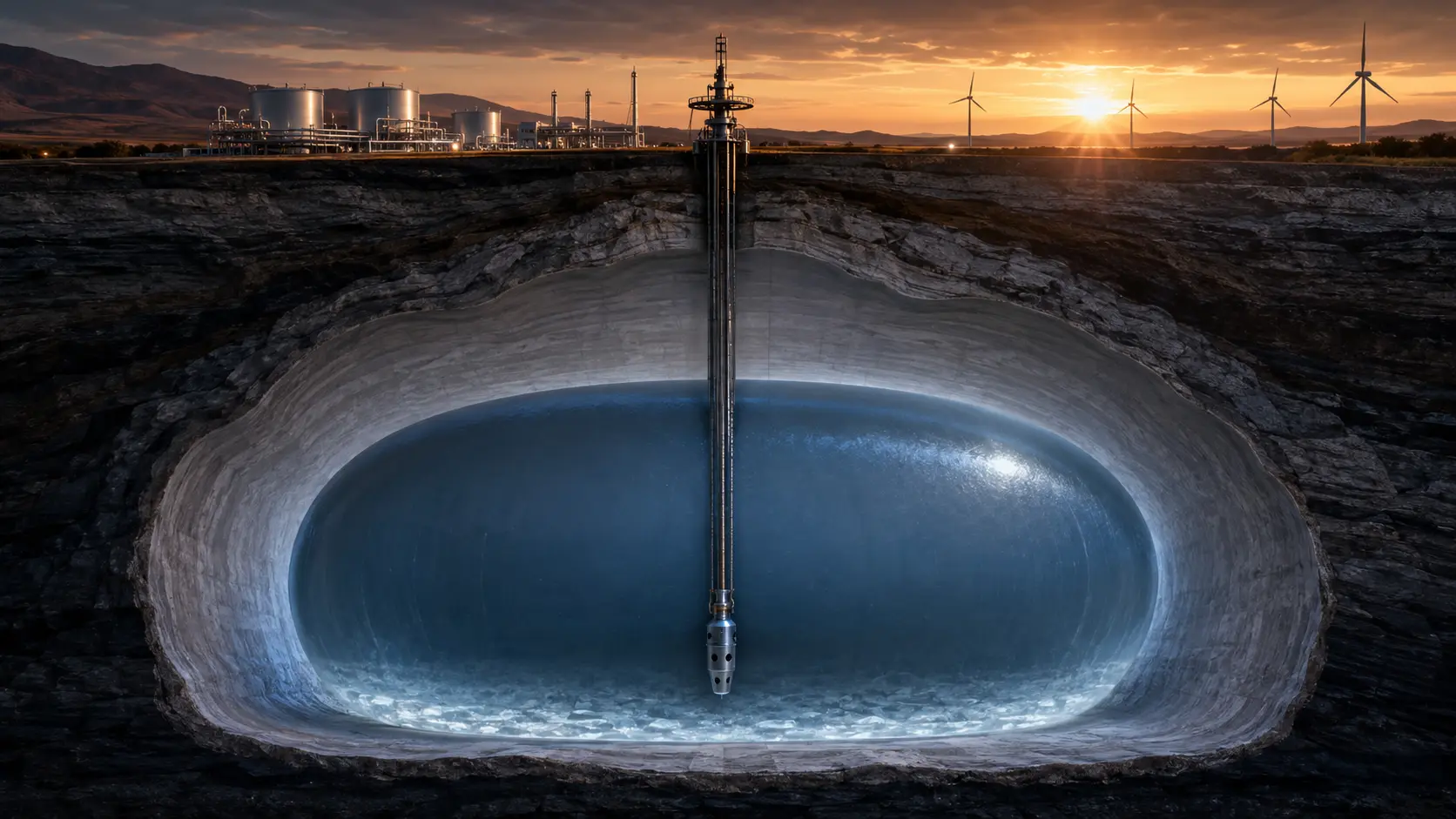
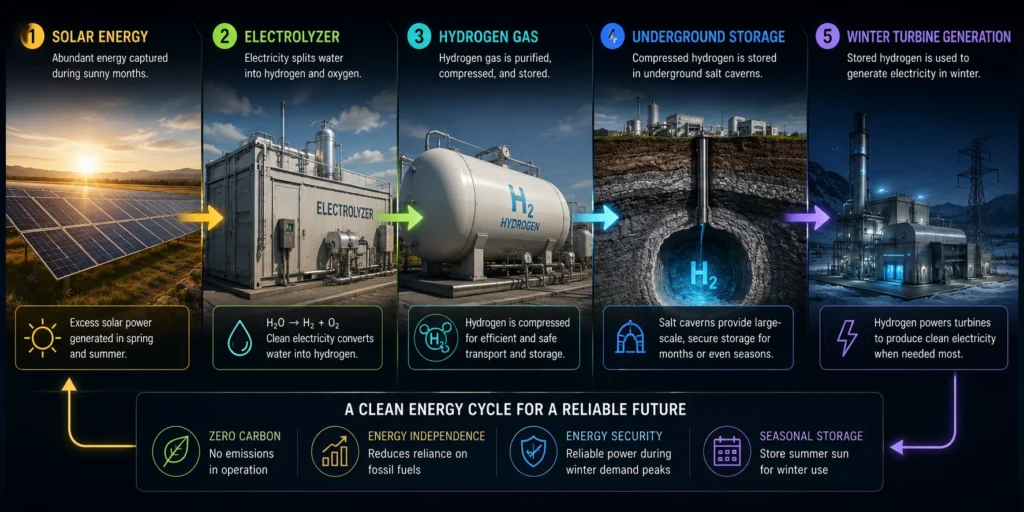
To solve the seasonal mismatch, engineers are abandoning chemical batteries and returning to geology. They are taking excess summer electricity, converting it into explosive hydrogen gas, and pumping it thousands of feet underground into colossal, custom-carved salt caves. Why should you care right now? Because without Long-Duration Energy Storage (LDES), the transition to a 100% renewable power grid is mathematically impossible. Underground Hydrogen Storage (UHS) is rapidly transitioning from a theoretical concept into multi-billion-dollar infrastructure, turning the Earth’s crust into the ultimate strategic energy reserve.
What is Underground Hydrogen Storage (UHS)?
Underground Hydrogen Storage (UHS) is a grid-scale, long-duration energy buffering system. It involves using surplus renewable electricity to produce hydrogen gas, which is then injected into deep, engineered geological formations—primarily solution-mined salt caverns. This allows immense volumes of clean energy to be safely stored for months and withdrawn to generate power when grid demand peaks.
At a Glance
- Concept: Building a subterranean “balloon” out of solid rock salt, filling it with hydrogen gas generated from cheap summer solar power, and emptying it during the winter to keep the lights on.
- Why it matters: It solves the fundamental flaw of renewable energy: seasonality. It provides gigawatt-hours of storage capacity at a fraction of the cost per megawatt-hour of traditional lithium-ion batteries.
- Who uses it: Major utilities, grid operators (like the ACES Delta project in Utah), and massive petrochemical companies looking to secure continuous, zero-carbon hydrogen supplies for manufacturing.
- Biggest takeaway: You cannot put hydrogen in just any cave. Hydrogen is the smallest molecule in the universe and will escape through almost any rock. It requires specific, deep salt domes because rock salt under extreme pressure literally “heals” its own cracks, creating a flawless, gas-tight seal.
In Simple Words
Imagine a farmer who grows massive amounts of tomatoes in July, but no one wants to buy them until December. If he leaves them in a basket, they rot in a week. If he buys a million refrigerators, he will go bankrupt paying for them. The only way to survive is to turn the tomatoes into a highly concentrated paste and store them in a cheap, massive underground cellar.
The power grid faces the exact same problem. Solar panels generate too much power in the summer, and wind turbines generate too much power during storms. If the grid cannot use it instantly, the power is thrown away (curtailed).
Underground Hydrogen Storage is the cellar.
When the grid has too much power, huge machines use that free electricity to split water into hydrogen gas. Engineers drill a hole deep into a natural underground salt deposit and pump fresh water down to melt away the salt, creating a hollow, skyscraper-sized cavern. They pump the hydrogen gas into this cavern. Because salt walls are perfectly airtight, the gas sits there safely for six months. In the dead of winter, when solar panels are covered in snow, they open the valve, pull the hydrogen back up, and run it through a turbine to generate clean, on-demand electricity for the freezing cities above.
Why This Matters
For Grid Planners and Utility Executives, the “Dunkelflaute” (a German term for a period of dark, windless days) is the ultimate existential threat to a decarbonized grid. If a high-pressure weather system stalls over a continent in January, blocking the wind and causing freezing temperatures, a purely renewable grid will collapse within 48 hours.
UHS is the ultimate insurance policy against the Dunkelflaute. A single, standard-sized salt cavern can store roughly 150 gigawatt-hours (GWh) of usable energy. To put that in perspective, the largest lithium-ion battery facility on Earth currently holds about 3 GWh. One hole in the ground holds fifty times more energy than a billion-dollar battery park. Securing the geological rights to these salt domes is currently sparking a massive land-grab among global energy conglomerates.
The Geography of Salt Cavern Energy Storage
The commercial viability of hydrogen relies heavily on spatial geography.
You cannot build a salt cavern just anywhere; you must win the geological lottery. The world’s premier locations for UHS are located above massive underground halite (salt) deposits, primarily the Gulf Coast of the United States and the Zechstein basin in Northern Europe (stretching across the UK, Netherlands, and Germany).
Because these geological formations rarely overlap perfectly with the cities that need the power, the expansion of UHS is forcing the rapid development of a massive “Hydrogen Backbone”—a network of specialized, retrofitted pipelines designed to transport high-pressure hydrogen from the subterranean caverns directly to coastal industrial clusters and inland power plants.
How Underground Hydrogen Storage Works
Trapping the smallest, most volatile molecule in the universe deep underground requires extreme geochemical and mechanical engineering. Here is the first-principles breakdown of the process.
1. The Fundamental Problem: The Physics of Hydrogen
Hydrogen H2 is incredibly light and energy-dense by weight, but terrible by volume. Storing it above ground in steel tanks requires compressing it to 10,000 psi or chilling it to -253°C to turn it into a liquid. Building thousands of these specialized, highly insulated steel tanks to store seasonal grid energy would cost trillions of dollars. It must be stored underground where the earth itself acts as the tank.
2. The Insufficiency of Porous Rock
Engineers initially looked at depleted oil and gas fields (porous sandstone). However, hydrogen is highly reactive. If you pump it into porous rock, microscopic microbes (methanogens) eat the hydrogen and turn it into methane, or the hydrogen reacts with the minerals and gets permanently lost. Furthermore, hydrogen easily leaks through the tiny, porous caps of standard gas fields.
3. The Core Mechanism: Solution-Mined Salt Caverns
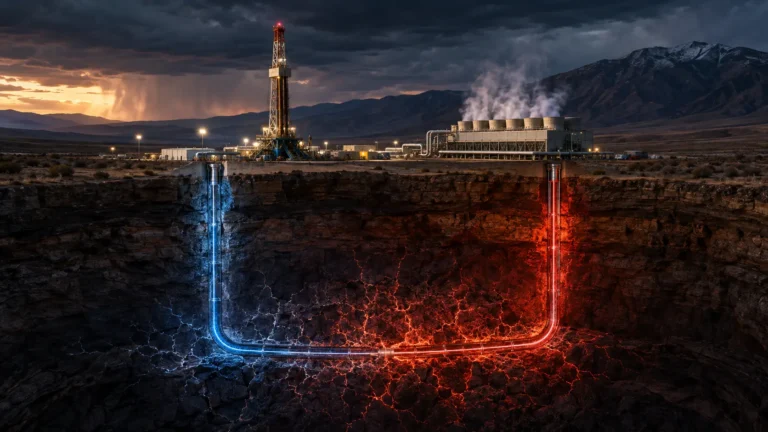
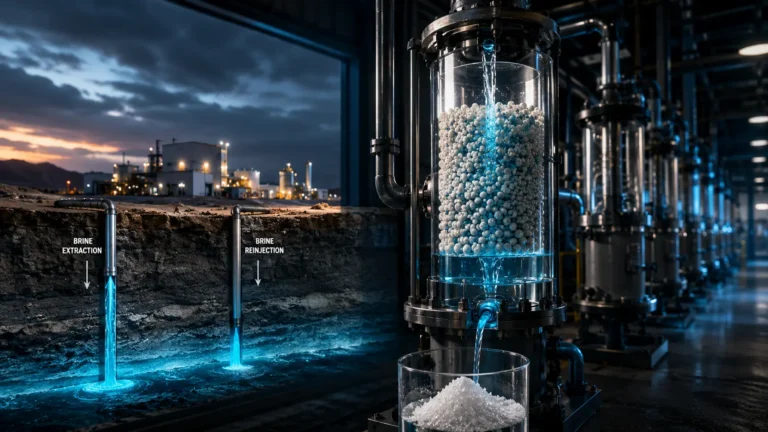
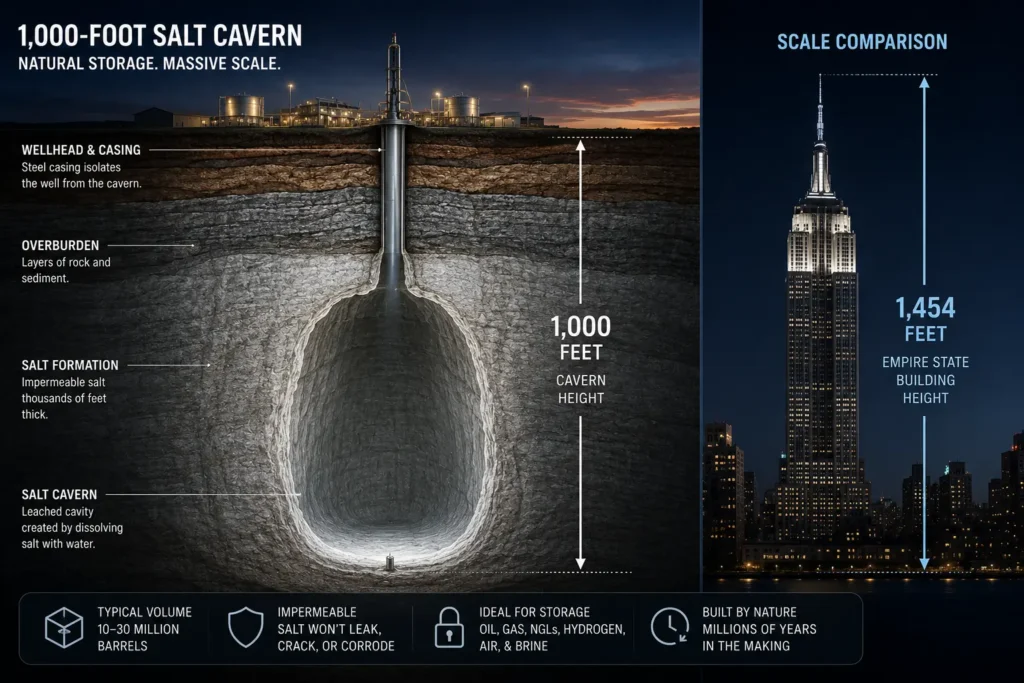
The ultimate container is a Salt Dome. Geologists drill a wellbore thousands of feet down into a solid pillar of halite (rock salt). They pump massive volumes of fresh water down the pipe. The water dissolves the salt, and the resulting brine is pumped back to the surface. Over two years, this controlled “solution mining” melts out a teardrop-shaped cavern that can be 1,000 feet tall and 300 feet wide.
4. Technical Depth: Visco-plasticity and Impermeability
Why salt? Halite has virtually zero porosity and zero permeability. More importantly, under the immense weight of the earth above it (geomechanical pressure), salt behaves like a highly viscous plastic. It slowly flows and deforms rather than shattering. If a micro-fracture ever forms in the cavern wall, the pressure of the surrounding rock physically squeezes the salt back together, instantly healing the crack. It is a flawlessly self-sealing vault.
5. Real-World Consequences: Cushion Gas vs. Working Gas
You cannot simply empty the cavern when you need power. If the gas pressure inside drops too low, the immense weight of the surrounding earth will crush the cavern inward, destroying it.
To prevent cave-ins, operators must maintain a permanent layer of Cushion Gas (roughly 30% of the cavern’s total volume). This gas is trapped capital; it can never be sold. The remaining 70% is the Working Gas—the hydrogen that is aggressively injected in the summer and withdrawn in the winter to generate profit.
Commercial Applications of Hydrogen Storage
The deployment of UHS represents a massive capital shift from traditional fossil-fuel infrastructure to clean-molecule logistics.
Grid-Scale Seasonal Buffering (ACES Delta): The Advanced Clean Energy Storage (ACES Delta) project in Utah is the flagship commercial UHS facility. Supported by a massive $504 million loan guarantee from the U.S. Department of Energy, the facility uses 220 megawatts of electrolyzers to convert surplus renewable energy into up to 100 metric tons of green hydrogen per day. The gas is pumped into two massive salt caverns, providing 300 GWh of dispatchable clean energy to the Intermountain Power Agency, which powers the city of Los Angeles.
Industrial Chemical Buffering: Massive petrochemical and fertilizer plants run 24/7 and cannot tolerate a break in their hydrogen supply. Traditionally, they ran their own fossil-fuel reformers continuously. As they transition to “green” hydrogen generated by unpredictable wind and solar power, they are utilizing UHS salt caverns directly beneath their factories as short-term, massive-volume shock absorbers, ensuring their chemical synthesis loops never starve for feedstock even if the wind stops blowing for a week.
The European Hydrogen Backbone (HyStock): In the Netherlands, Gasunie is developing the HyStock project in the Zuidwending salt caverns. As Northern Europe aggressively builds gigawatts of offshore wind in the North Sea, the power must be captured. HyStock serves as the central geological lung for the European Hydrogen Backbone, breathing in the massive offshore wind surges and distributing steady, baseload hydrogen gas across the continent’s repurposed pipeline network.
Economic & Strategic Impact
The core obstacle to scaling UHS is the metallurgical nightmare of Hydrogen Embrittlement.
For decades, the oil and gas industry stored natural gas (methane) in salt caverns safely. When executives assumed they could simply swap the methane for hydrogen using the same steel pipes and wellbore casings, they encountered catastrophic failures.
Hydrogen is the smallest atom in existence. Under high pressure, hydrogen atoms physically diffuse into the molecular lattice of standard high-strength steel. Once inside, the hydrogen atoms combine, expand, and force the metal apart from the inside out, causing the steel pipe to suddenly become brittle and shatter under load (Hydrogen Embrittlement).
For Supply Chain Executives, this means that retrofitting legacy natural gas infrastructure for hydrogen is almost impossible. UHS facilities require completely new, intensely expensive specialized metallurgy (like specific austenitic stainless steels or advanced polymer liners) for every inch of the wellhead and injection casing, drastically inflating the Capital Expenditure (CapEx) required to break ground.
Advantages
- Unmatched Scale: A single salt cavern can store roughly 150 GWh of energy. Scaling a lithium-ion battery to this size is economically and physically unviable.
- Zero Self-Discharge: If you charge a battery and leave it for six months, it slowly bleeds power. Hydrogen trapped in an impermeable salt cavern suffers zero energy degradation over time.
- Fast Cycling: Unlike porous rock (which requires slow injection to avoid cracking the stone), salt caverns are giant, empty voids. Operators can inject or withdraw massive amounts of hydrogen gas within minutes, allowing the cavern to act as a highly responsive grid battery.
Limitations
- The Round-Trip Efficiency Penalty: The laws of thermodynamics are harsh. Using electricity to make hydrogen, compressing it, storing it, and burning it back into electricity results in a round-trip efficiency of 35% to 45%. You lose over half the energy in the process, requiring massive seasonal price spreads to be profitable.
- Geographical Constraints: You cannot build a salt cavern where there is no salt. Regions built on solid granite or porous limestone (like much of the US East Coast or Japan) cannot utilize UHS, forcing them to rely on massive, expensive pipeline imports from regions that won the geological lottery.
- Trapped Cushion Gas Capital: Buying and pumping millions of tons of expensive green hydrogen into a hole in the ground just to act as “Cushion Gas” (which can never be sold) traps massive amounts of upfront working capital, crushing the immediate ROI of the project.
Common Misconceptions
Misconception: We are storing hydrogen in natural caves.
Reality: Natural caves are unstable and highly porous. UHS uses solid, subterranean pillars of salt. The “cave” does not exist until engineers drill a pipe into the solid salt and actively melt it away with fresh water to create a custom-engineered, perfectly smooth void.
Misconception: The hydrogen will leak out and explode.
Reality: Halite (rock salt) is the ultimate geological seal. It is completely impermeable, and the immense pressure of the earth ensures that the salt essentially acts like a thick, self-healing plastic. If monitored correctly, leakage rates are functionally zero.
Misconception: Batteries will eventually replace the need for this.
Reality: Batteries scale linearly; if you want twice the storage, you must buy twice the lithium, cobalt, and nickel. UHS scales volumetrically; carving a salt cave 20% wider doubles its volume for almost zero extra material cost. Batteries will rule daily storage; geology will rule seasonal storage.
What Most People Miss
The strategic loophole of Alternative Cushion Gases.
The biggest financial hurdle to building a new UHS cavern is the cost of the cushion gas. If a developer has to fill 30% of a massive cavern with incredibly expensive, freshly synthesized green hydrogen just to keep the roof from collapsing, the project economics fail.
What most investors miss is that cutting-edge geologists are experimenting with “Alternative Cushion Gases.” Instead of using hydrogen to hold the cavern open, developers are injecting cheap, dense, inert gases like Nitrogen or captured CO2 into the bottom of the cavern first. Because hydrogen is vastly lighter, it naturally floats on top of the heavier cushion gas with minimal mixing. This allows the operator to maintain geomechanical stability using cheap, heavy waste gas, reserving 100% of the valuable hydrogen purely for profitable working gas extraction.
Comparison Table
| Feature | Lithium-Ion Mega-Pack | Pumped Hydro Storage | Underground Hydrogen Storage (Salt Caverns) |
| Duration of Storage | 2 to 8 Hours (Intraday) | 12 to 24 Hours | Months to Years (Seasonal) |
| Energy Density (Scale) | Moderate (~1-3 GWh per site) | High (~20-40 GWh per site) | Extreme (~150+ GWh per cavern) |
| Round-Trip Efficiency | Highly Efficient (~90%) | Efficient (~80%) | Low (~35% – 45%) |
| Geographic Constraint | None (Place anywhere) | Requires massive mountains/water | Requires deep, thick halite (salt) deposits |
| Self-Discharge | Bleeds power over weeks | Evaporation losses over months | Zero loss (flawless geological seal) |
Case Study
Situation: The state of California aggressively pursued a 100% clean energy grid mandate. However, the state experienced massive solar overproduction during spring days (leading to severe curtailment where power was literally thrown away) and faced existential energy shortages during dark, winter heat-pump demand spikes.
Challenge: California needed Long-Duration Energy Storage (LDES) capable of holding hundreds of gigawatt-hours for six months. The state lacked the geology for massive new pumped hydro, and scaling lithium-ion to that capacity was financially impossible.
Solution (The ACES Delta Hub): A coalition of utilities and infrastructure developers looked one state over to Delta, Utah. The region sits atop a massive, naturally occurring geological salt dome. With heavy backing from the U.S. Department of Energy, the coalition developed the Advanced Clean Energy Storage (ACES Delta) project. They utilized surplus solar power from the Western grid to power 220 MW of alkaline electrolyzers, piped the resulting hydrogen gas into newly solution-mined salt caverns, and contracted to burn the gas in specially designed turbines during winter peaks.
Outcome: The facility became the largest active green hydrogen storage hub on Earth. By utilizing two caverns, it secured the ability to store 300 GWh of dispatchable energy—providing seasonal buffering capacity equivalent to the output of roughly 40,000 shipping containers full of lithium-ion batteries.
Lessons Learned: ACES Delta proved that the physics of the grid require a geographic separation of generation and storage. It validated that moving electrons across state lines to a location with perfect geological storage is vastly cheaper and more scalable than attempting to build massive chemical batteries in locations with hostile geography.
Future Outlook
Next 12–24 Months
The era of Metallurgical Retrofitting and Pilot Proving. As the U.S. Hydrogen Hubs (funded by the Bipartisan Infrastructure Law) break ground, the immediate bottleneck will be the supply chain for hydrogen-rated steel and compression equipment. Over the next two years, the industry will focus heavily on validating high-pressure injection cycles in salt, proving to regulators that the wellbore casings can survive rapid temperature swings (Joule-Thomson effect) and hydrogen embrittlement without catastrophic failure.
Next 3–5 Years
The scaling of Depleted Gas Field Testing. Salt caverns are perfect, but they are rare. By 2030, to achieve true global scale, the industry must figure out how to safely store hydrogen in depleted, porous natural gas fields. Major European operators will run massive field tests, injecting hydrogen into porous sandstone reservoirs to determine exactly how much gas is eaten by underground microbes (methanogens) and how much is permanently lost to the rock. If porous rock storage can be validated, the total addressable market for UHS expands exponentially.
Next 10 Years
The Global Strategic Hydrogen Reserve. By the mid-2030s, the role of UHS will mirror the 20th-century Strategic Petroleum Reserve (SPR). Nations will mandate the maintenance of massive underground hydrogen caverns not just for grid balancing, but for national security. In the event of a catastrophic global supply chain shock or a severe, multi-week extreme weather event, these colossal salt domes will ensure that critical manufacturing, military infrastructure, and civic heating systems have a guaranteed, zero-carbon fuel supply capable of lasting the entire winter.
Most Likely Scenario
Underground Hydrogen Storage is the silent, unglamorous bedrock of the energy transition. While it will never match the raw electrical efficiency of batteries, its unmatched volumetric scale makes it indispensable. As the world officially overbuilds wind and solar capacity, the ability to chemically warehouse the sun’s excess energy in the dark depths of the Earth will become the definitive infrastructure play of the 2030s.
Key Takeaways
- Underground Hydrogen Storage (UHS) converts excess summer renewable energy into hydrogen gas and stores it in massive, subterranean caves to be used during winter energy deficits.
- Salt caverns are the ideal storage medium because rock salt (halite) is completely impermeable and self-healing under extreme pressure, preventing the tiny hydrogen molecules from leaking.
- The caverns are created via “solution mining”—pumping fresh water deep underground to dissolve the salt and pump out the brine, leaving a massive, teardrop-shaped void.
- Operators must leave roughly 30% of the hydrogen inside the cave permanently. This “Cushion Gas” maintains internal pressure and prevents the cavern from collapsing under the weight of the earth.
- Hydrogen cannot be pumped through standard steel natural gas pipes due to “Hydrogen Embrittlement”—the gas seeps into the metal and causes it to shatter, requiring entirely new, specialized infrastructure.
- Converting electricity to hydrogen and back to electricity wastes roughly 60% of the energy, making UHS profitable only when capturing free/negative-priced surplus summer power to sell during extreme winter shortages.
Glossary
Cushion Gas: The base volume of gas that must remain permanently in an underground storage cavern to maintain sufficient pressure to prevent the surrounding rock from collapsing inward.
Dunkelflaute: A period of time (common in winter) characterized by heavily overcast skies and zero wind, rendering solar and wind generation nearly useless.
Hydrogen Embrittlement: A metallurgical phenomenon where tiny hydrogen atoms penetrate the molecular structure of high-strength steel, causing it to lose its ductility and suddenly shatter under stress.
Solution Mining: The process of creating an underground cavern by drilling into a salt deposit, injecting fresh water to dissolve the salt, and extracting the resulting brine to the surface.
Visco-plasticity: The unique physical property of deep rock salt. Under extreme geological pressure, it behaves like a slow-moving, highly viscous plastic, automatically squeezing shut any micro-fractures that form.
Working Gas: The volume of stored hydrogen gas that is actively injected and withdrawn from the cavern for commercial sale and grid generation, representing the profitable capacity of the asset.
Frequently Asked Questions
Is it safe to store explosive hydrogen underground?
Yes, vastly safer than storing it above ground. Underground, there is zero oxygen. Without oxygen, hydrogen physically cannot ignite or explode. The only risk occurs at the surface wellhead, which is heavily fortified with emergency blowout preventers.
Why not just use depleted oil wells?
Oil and gas wells are made of porous rock (like a hard sponge). Hydrogen is so small and reactive that if you pump it into porous rock, a significant percentage gets permanently stuck to the minerals, leaks out through the caprock, or is eaten by underground bacteria.
How big is a salt cavern?
A typical solution-mined salt cavern used for energy storage can easily be 1,000 feet tall and 200 to 300 feet wide, boasting an internal volume large enough to easily fit the Empire State Building inside of it.
Can we store pure electricity instead of making hydrogen?
You cannot store raw alternating current (AC) electricity. It must be converted into chemical potential energy (like a battery), mechanical potential energy (like pumped hydro), or chemical bonds (like splitting water into hydrogen) to be held over long periods of time.
What happens to the brine when they melt the salt?
The disposal of the hypersaline brine is heavily regulated. It is typically pumped into specialized deep-injection wastewater wells, or sent to commercial desalination and chemical plants where the salt is extracted and sold for industrial use.
Sources
- International Energy Agency (IEA): Global Hydrogen Review and Underground Storage Potential (2025/2026 Updates)
- U.S. Department of Energy (DOE): ACES Delta and the Economics of Salt Cavern Hydrogen Storage
- European Hydrogen Backbone (EHB): HyStock and Geological Storage Infrastructure in the Zechstein Basin
- Journal of Energy Storage: Geomechanical Stability and Cushion Gas Dynamics in Halite Formations
- Materials Science and Engineering: Hydrogen Embrittlement in High-Pressure Pipeline Steels