Advertisement
)
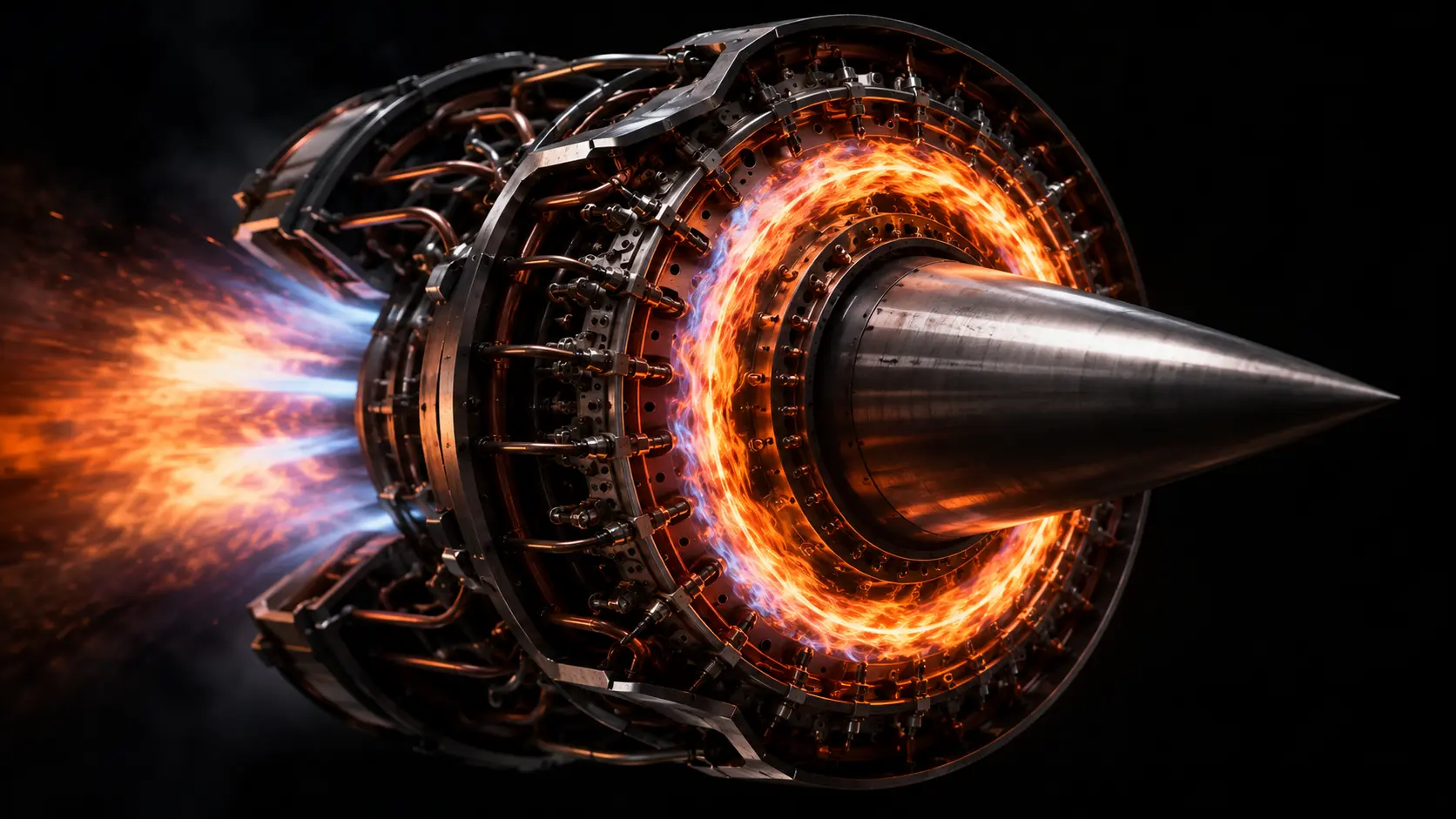

For seventy years, reaching space has relied on a severe thermodynamic compromise. In a conventional rocket engine, liquid fuel and oxygen are mixed and ignited in a continuous, smooth fire—a chemical process known as deflagration. While undeniably powerful, this type of constant-pressure combustion is incredibly inefficient. It forces modern orbital rockets to be composed of roughly 90% fuel by mass just to escape Earth’s gravity, leaving a microscopic 4% to 5% margin for the actual payload. To fundamentally alter the economics of spaceflight, aerospace engineers realized they had to stop burning fuel and figure out how to detonate it.
Instead of a standard fire, advanced propulsion labs have engineered a way to harness a supersonic shockwave that endlessly chases its own tail inside a circular chamber. Why should you care right now? Because in 2026, joint initiatives by DARPA and NASA successfully transitioned this concept from a theoretical physics experiment into a scalable, 3D-printed engine architecture. By extracting significantly more thrust from the exact same amount of fuel, this shift to pressure-gain combustion is poised to slash the mass of deep-space vehicles, permanently changing the payload economics of interplanetary logistics, commercial satellite deployment, and orbital defense.
What are Rotating Detonation Rocket Engines (RDRE)?
Rotating Detonation Rocket Engines (RDRE) are advanced propulsion systems that generate thrust using continuous, supersonic explosions. Instead of burning fuel at a constant pressure, an RDRE injects propellant into a circular channel where a detonation wave travels continuously around the ring, creating highly efficient, pressure-gain combustion.
At a Glance
- Concept: Discarding the traditional bell-shaped combustion chamber in favor of a ring. Fuel explodes in a continuous, rotating shockwave, compressing the fuel ahead of it and blasting exhaust out the back.
- Why it matters: Standard rockets have hit a technological ceiling. RDREs deliver up to a 25% increase in fuel efficiency, meaning a spacecraft requires drastically less fuel to reach Mars, allowing it to carry significantly more cargo.
- Who uses it: NASA (for future lunar and Martian landers), DARPA (for high-speed hypersonic interceptors), and advanced aerospace startups seeking an edge in the commercial launch market.
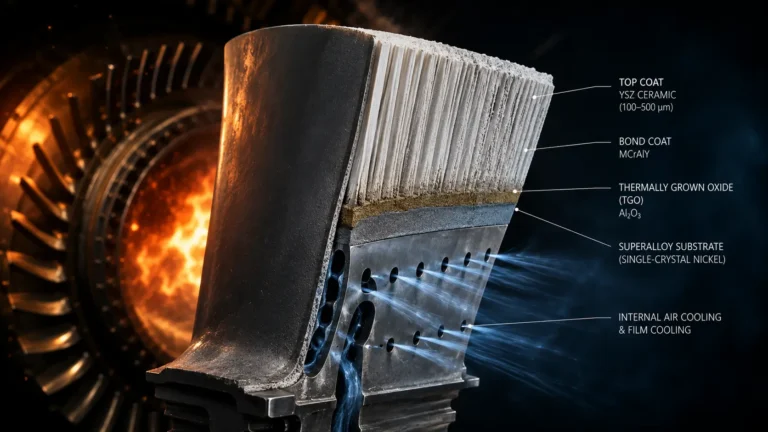
- Biggest takeaway: Detonation generates extreme heat and violent vibrations that would shatter a normal engine. The recent breakthrough in RDREs is entirely due to additive manufacturing (3D printing), which allows engineers to print microscopic, complex cooling channels directly into the engine’s metal walls to keep it from melting.
In Simple Words
If you throw a match onto a pile of dry wood, the wood burns. The fire spreads relatively slowly, and the heat expands outward. This is called deflagration. Every rocket currently flying into space—from the Saturn V to the Falcon 9—works by deflagration. It is essentially a very fast, controlled campfire inside a metal bell.
If you hit a stick of dynamite with a blasting cap, it doesn’t burn; it explodes. The reaction moves faster than the speed of sound, creating a violent, high-pressure shockwave. This is called detonation.
A Rotating Detonation Rocket Engine uses dynamite-style physics.
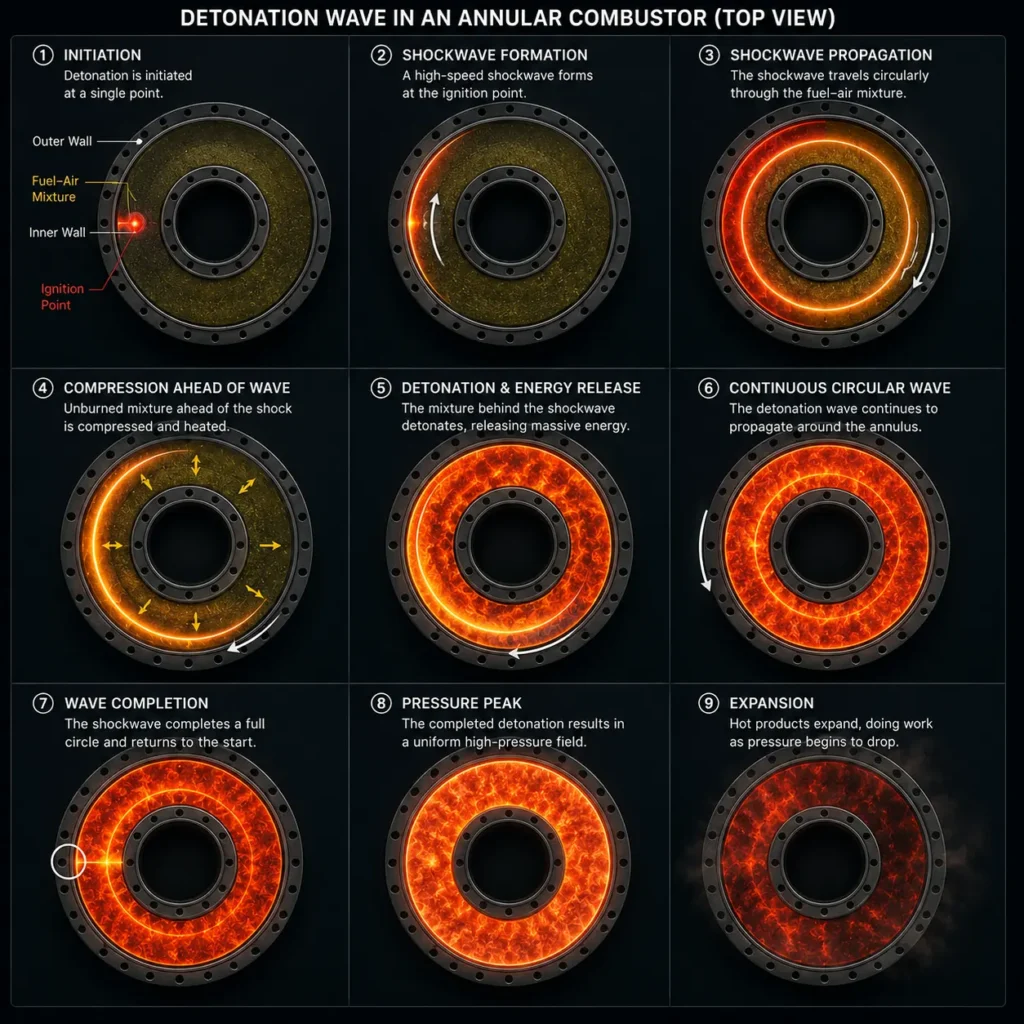
Inside the engine is a hollow metal ring. Fuel and oxygen are pumped into this ring continuously. A detonator triggers a single explosion. That explosion creates a shockwave that races around the circular ring at thousands of miles per hour. As the shockwave spins, it acts like a violent snowplow, violently compressing the fresh fuel sitting in front of it and detonating it instantly. This creates a permanent, spinning ring of explosions. Because the fuel is compressed by a shockwave right before it detonates, the engine generates significantly more pressure and thrust from the exact same drop of fuel.
Why This Matters
In orbital mechanics, the “Tyranny of the Rocket Equation” dictates that to carry more fuel, you need a bigger rocket, which requires even more fuel to lift the heavier rocket.
For Space Investors and Defense Analysts, the RDRE is the key to breaking this mathematical cycle. If an engine is 15% more efficient, a deep-space vehicle bound for the Moon requires 15% less propellant. That mass savings translates directly into heavier rovers, more scientific equipment, or larger satellite buses. In the commercial launch market, where payload to Low Earth Orbit (LEO) is priced by the kilogram, transitioning to pressure-gain combustion is a multi-billion-dollar economic arbitrage.
The Role of 3D Printing in RDRE Technology
The physics of detonation have been understood since the 1950s, but building a machine capable of surviving continuous detonations was impossible until the 2020s.
The breakthrough is entirely rooted in materials science and additive manufacturing. Specifically, NASA’s development of GRCop-42, a specialized copper-chromium-niobium alloy. Because copper conducts heat exceptionally well, engineers use 3D printing to create an RDRE engine out of GRCop-42, printing hundreds of microscopic, intricate cooling channels directly into the walls of the combustion chamber. By pumping freezing liquid rocket fuel through these walls before it enters the engine, the copper avoids melting despite being subjected to gigawatt-level heat spikes thousands of times a second.
How Rotating Detonation Rocket Engines Work
Extracting more kinetic energy from a chemical reaction requires shifting the thermodynamic cycle. Here is the first-principles breakdown of the architecture.
1. The Fundamental Problem: The Brayton Cycle
Standard rocket engines operate on a thermodynamic model called the Brayton cycle (constant-pressure combustion). Fuel and oxidizer are pumped into a chamber and burned. Because the gas is expanding as it burns, the pressure inside the chamber actually drops slightly from the injector face to the exhaust nozzle. To get high pressure, you need massive, heavy, power-hungry turbopumps to force the fuel in.
2. The Insufficiency of Traditional Deflagration
Deflagration is a subsonic reaction; the flame front propagates via thermal conduction. Aerospace engineers have pushed this process to its absolute physical limits over 70 years (e.g., the Space Shuttle’s RS-25 or the Raptor engine). Squeezing another 1% of efficiency out of the Brayton cycle requires exponentially higher chamber pressures and increasingly fragile metallurgy.
3. The Core Mechanism: The Annular Detonation Wave
An RDRE abandons the Brayton cycle. It consists of two concentric cylinders forming an annular (ring-shaped) gap. Propellant is injected continuously through thousands of microscopic holes at the top of the ring. A localized ignition source initiates a detonation wave.
4. Technical Depth: The Humphrey Cycle and Pressure-Gain
Detonation is a supersonic reaction where the combustion is driven by a shockwave. This aligns with the Humphrey cycle (constant-volume combustion).
When the supersonic shockwave sweeps through the fresh propellant in the annular ring, it compresses the gas instantly, raising its pressure and temperature simultaneously before the gas has time to expand.
Because the combustion increases the pressure of the gas after it has left the injectors, it is classified as Pressure-Gain Combustion (PGC). This inherently increases the thermodynamic efficiency of the engine, dramatically raising the specific impulse Isp , defined as:
Isp = F / (ṁ * g0)
(Where F is thrust, ṁ is the mass flow rate of the propellant, and g0 is standard gravity). By extracting more thrust without increasing the mass flow rate, the Isp skyrockets.
5. Real-World Consequences: Exhaust Dynamics
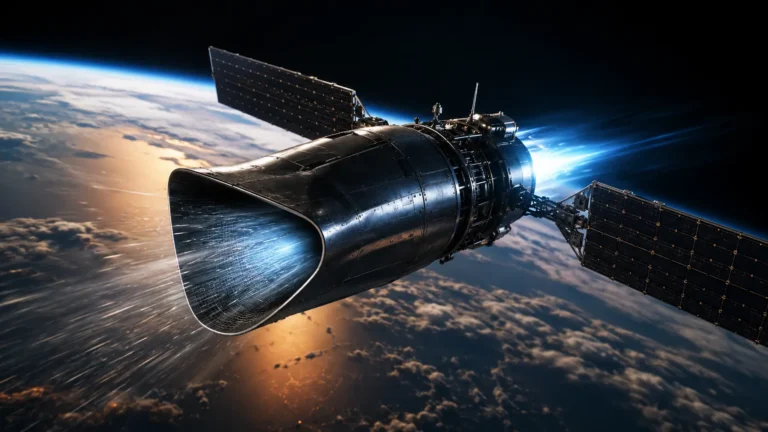
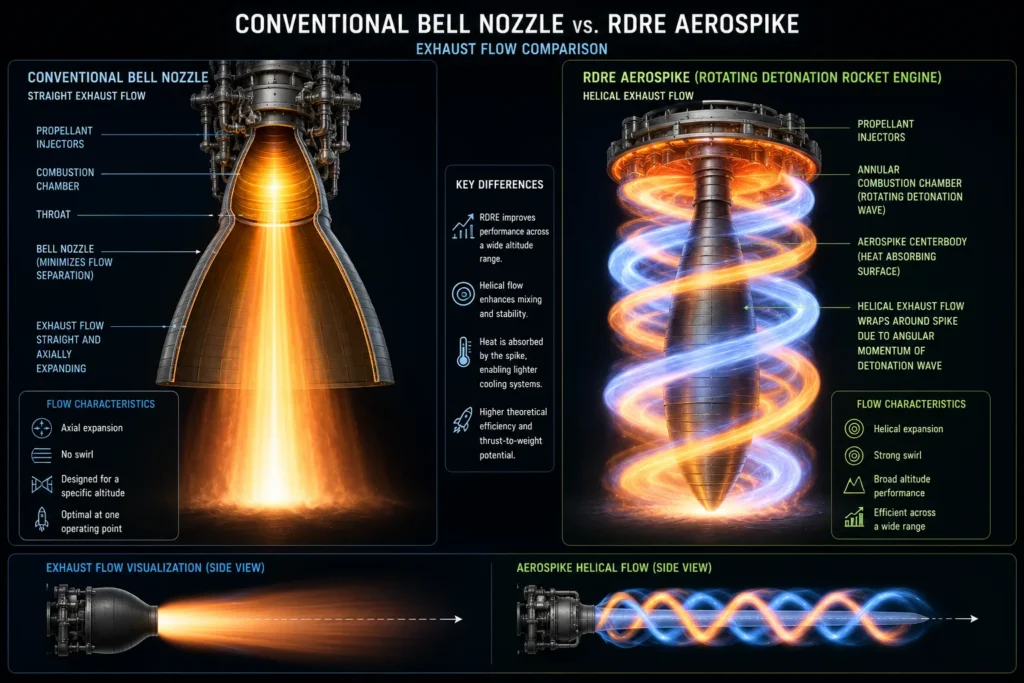
In a traditional rocket, exhaust shoots straight down out of a bell nozzle. In an RDRE, the detonation wave is spinning circularly, meaning the exhaust gases exit the bottom of the ring in a spiraling, helical vortex. To straighten this vortex into usable forward thrust, RDREs are frequently paired with an aerospike nozzle—a central cone that the exhaust expands against, using atmospheric pressure to keep the thrust column perfectly focused.
Commercial Applications of RDRE Propulsion
The extreme power density of RDREs makes them viable for both deep-space logistics and atmospheric defense.
In-Space Orbital Transfer Vehicles (OTVs): The primary commercial target for RDREs is the “space tug.” Once a heavy-lift rocket drops a payload into Low Earth Orbit (LEO), an OTV is required to move that satellite to Geostationary Orbit (GEO) or the Moon. Because OTVs operate entirely in the vacuum of space, mass efficiency is paramount. An RDRE-powered OTV requires vastly smaller fuel tanks, allowing it to move heavier satellites across different orbital regimes faster and cheaper than chemical or electric propulsion tugs.
Hypersonic Missile Defense: Defending against agile hypersonic glide vehicles requires interceptors that are lightweight but incredibly fast. Because RDREs produce pressure-gain combustion, they require significantly smaller, lighter turbopumps to feed the engine. This allows defense contractors to build smaller, highly maneuverable “kill vehicles” that can rapidly accelerate to hypersonic speeds to intercept incoming threats.
Planetary Landers: Landing on the Moon or Mars requires deep throttling (the ability to slowly dial down the engine’s thrust to hover before touching down). Because the RDRE relies on a continuous ring of explosions, operators can throttle the engine by simply slowing down the propellant injection rate and reducing the number of active detonation waves spinning around the ring, providing highly stable, precise thrust control without extinguishing the engine.
Economic & Strategic Impact
The implementation of RDREs heavily disrupts the Turbomachinery Supply Chain.
In a traditional rocket, the turbopump (the machine that forces fuel into the high-pressure combustion chamber) is often the most expensive, complex, and failure-prone component of the entire vehicle. Because traditional rockets lose pressure during combustion, the pump must do all the heavy lifting.
Because an RDRE generates its own pressure spikes during the detonation cycle, the engine can theoretically “self-aspirate” or operate using significantly lower-pressure feed systems. For aerospace startups, eliminating the need to design and manufacture multi-million-dollar, ultra-high-pressure turbopumps drastically lowers the barrier to entry. This simplification threatens the revenue models of legacy defense contractors who have historically monopolized the specialized turbomachinery market.
Advantages
- Higher Specific Impulse Isp: Approximates the Humphrey cycle, extracting up to 10% to 25% more usable energy from the exact same volume of propellant.
- Compact Form Factor: The annular ring design and reduced reliance on massive turbopumps allow the engine to be significantly shorter and lighter, freeing up physical volume for payload.
- Inherent Scalability: Unlike a bell nozzle which is difficult to scale, an RDRE can be scaled up simply by increasing the diameter of the combustion ring, maintaining the exact same detonation physics.
Limitations
- Extreme Acoustic and Vibrational Fatigue: A wave detonating at Mach 5 thousands of times a second creates catastrophic high-frequency acoustic vibrations. If not perfectly dampened, these vibrations will literally shake the surrounding rocket avionics and fuel lines to pieces.
- Thermal Management Crisis: The continuous shockwave creates transient heat fluxes that are orders of magnitude more severe than standard rockets. Without flawless, 3D-printed regenerative cooling channels, the engine walls will melt in seconds.
- Injector Backflow: Because the explosion creates a massive pressure spike, the blast wave naturally wants to travel backward up into the fuel injectors. Preventing this “backflow” without cutting off the continuous flow of fresh fuel is the most difficult fluid dynamics challenge in the design.
Common Misconceptions
Misconception: The engine has moving parts that spin.
Reality: The name “Rotating Detonation” is misleading. The engine itself is a solid, completely stationary piece of metal with zero moving parts. The only thing “rotating” is the invisible shockwave of combusting gas spinning inside the hollow chamber.
Misconception: RDREs are the same as Pulse Detonation Engines (PDEs).
Reality: A PDE uses a long tube, fills it with fuel, detonates it, blows the exhaust out, and then stops to refill the tube. It is a pulsing, stop-and-go engine (which creates massive, jerky thrust). An RDRE operates continuously; because the wave spins in a circle, the exhaust flows out in a constant, smooth stream.
Misconception: They can only use exotic, highly volatile fuels.
Reality: RDREs are highly fuel-agnostic. NASA has successfully tested them using standard Liquid Oxygen/Liquid Hydrogen (LOX/LH2) and Liquid Oxygen/Liquid Methane (LOX/LCH4)—the exact same standard propellants used by SpaceX and Blue Origin.
What Most People Miss
The strategic pairing of RDREs with Aerospike Nozzles.
Most renderings of rockets show a traditional, bell-shaped exhaust nozzle. Bell nozzles are only efficient at a specific atmospheric altitude; they lose efficiency as the rocket climbs into the vacuum of space.
What most observers miss is that the annular (ring-shaped) design of the RDRE naturally forms a hollow center. This hollow center perfectly accommodates an Aerospike—an inverted, cone-shaped nozzle. The spinning exhaust of the RDRE clings to the outer slope of the aerospike. This pairing creates a “Holy Grail” engine: it achieves the thermodynamic efficiency of detonation, combined with the aerodynamic efficiency of an aerospike that automatically adjusts to atmospheric pressure from sea level to the vacuum of space, yielding a true single-stage-to-orbit (SSTO) capability.
Comparison Table
| Feature | Conventional Rocket (Deflagration) | Pulse Detonation Engine (PDE) | Rotating Detonation Engine (RDRE) |
| Combustion Type | Constant Pressure (Brayton) | Constant Volume (Humphrey) | Constant Volume (Humphrey) |
| Reaction Speed | Subsonic (Burning) | Supersonic (Exploding) | Supersonic (Exploding) |
| Thrust Profile | Smooth, continuous | Jerky, pulsing | Smooth, continuous (spinning) |
| Complexity | High (Massive turbopumps) | High (Mechanical valves) | Moderate (No moving parts) |
| Thermodynamic Efficiency | Baseline limit | High | Highest (10-25% improvement) |
Case Study
Situation: For decades, deep space missions were mathematically constrained by payload fractions. NASA recognized that establishing a permanent human presence on the Moon (Artemis) and eventually Mars required landers capable of carrying heavy habitats and scientific equipment, but traditional chemical rockets required too much fuel mass to make these logistics economically viable.
Challenge: Transitioning the thermodynamically superior concept of Rotating Detonation from a brief, millisecond laboratory physics anomaly into a sustained, throttleable rocket engine capable of surviving the extreme thermal environment of a multi-minute orbital burn.
Solution (The NASA Marshall Hot-Fire Tests): In collaboration with DARPA and commercial partners like IN Space LLC, engineers at NASA’s Marshall Space Flight Center utilized advanced powder bed fusion 3D printing to manufacture a full-scale RDRE using the highly conductive GRCop-42 alloy.
Outcome: In late 2023 and continuing through subsequent test campaigns, NASA successfully hot-fired the 3D-printed RDRE for 251 seconds, generating over 5,800 pounds of continuous thrust. The engine survived extreme chamber pressures and heat fluxes, proving that the regenerative cooling channels could prevent the copper alloy from melting under sustained detonation conditions.
Lessons Learned: The milestone proved that the materials science bottleneck had been broken. It validated that additive manufacturing is the mandatory prerequisite for pressure-gain combustion. By successfully throttling the engine and maintaining a stable detonation wave for over four minutes, NASA proved that RDREs are a fully mature, scalable technology ready for integration into commercial orbital transfer vehicles and next-generation planetary landers.
Future Outlook
Next 12–24 Months
The era of Upper-Stage Flight Verification. Ground testing has proven the thermodynamic models. The next two years will witness the first actual deployments of RDREs into the vacuum of space. Commercial aerospace startups (like Venus Aerospace) and defense contractors will launch small-scale, RDRE-powered upper stages on commercial rideshare missions to validate the engine’s ignition reliability and sustained specific impulse (Isp) in a zero-gravity, zero-atmosphere environment.
Next 3–5 Years
The scaling of Heavy-Lift Aerospike Integration. By the late 2020s, the focus will shift from small orbital tugs to main propulsion systems. The industry will attempt to scale RDRE technology to generate 50,000 to 100,000 pounds of thrust. During this phase, the definitive architectural pairing of the RDRE ring with a central Aerospike nozzle will be aggressively pursued, aiming to create a highly efficient, single-stage engine that outperforms current closed-cycle engines (like the Raptor) without the need for complex, heavy pre-burners.
Next 10 Years
The Commercial Deep Space Standard. By the mid-2030s, the economic arbitrage of pressure-gain combustion will render traditional deflagration engines obsolete for long-duration spaceflight. RDREs will become the standard propulsion architecture for lunar logistics ferries, asteroid mining prospectors, and rapid-response military satellites. The 25% mass savings in propellant will be reallocated entirely to commercial payload, triggering a massive drop in the cost-per-kilogram for deep space operations.
Most Likely Scenario
Rotating Detonation Rocket Engines are the most significant advancement in chemical propulsion since the invention of the staged combustion cycle. While extreme acoustic vibrations pose an ongoing avionics integration challenge, the undeniable mathematical advantage of the Humphrey cycle guarantees that RDREs will dominate the future of high-efficiency orbital maneuvering and hypersonic atmospheric defense.
Key Takeaways
- Rotating Detonation Rocket Engines (RDRE) generate thrust using a continuous, supersonic ring of explosions, rather than the slow, continuous burning of traditional rockets.
- By detonating the fuel, the engine operates on “pressure-gain combustion,” significantly increasing the thermodynamic efficiency and generating up to 25% more specific impulse Isp.
- The engine is an empty, hollow ring with zero moving parts. The “rotation” refers to the invisible shockwave racing circularly around the chamber at Mach 5.
- The extreme heat and violent pressure spikes would destroy normal metals; RDREs are only possible today because of 3D-printed copper alloys (GRCop-42) that contain microscopic cooling channels.
- NASA and DARPA have successfully hot-fired full-scale RDREs for over four minutes, proving the technology is mature enough to survive the durations required for deep space missions.
- Because the engine forms a natural ring, it pairs perfectly with an “Aerospike” nozzle, creating a highly efficient hybrid engine that self-adjusts to atmospheric pressure.
Glossary
Additive Manufacturing: Advanced 3D printing of metals. It is the only manufacturing method capable of creating the complex internal cooling channels required to keep an RDRE from melting.
Aerospike Nozzle: An inverted, cone-shaped rocket nozzle. Instead of firing exhaust through a bell, the exhaust fires along the outside of the spike, using atmospheric pressure to maintain efficiency at any altitude.
Brayton Cycle: A thermodynamic cycle representing constant-pressure combustion (deflagration). It is the inefficient baseline model that all traditional modern rockets use.
Deflagration: A subsonic combustion process (burning) where the flame front travels via heat transfer. It is smooth and continuous but relatively inefficient.
Humphrey Cycle: A thermodynamic cycle representing constant-volume combustion (detonation). It is highly efficient because it raises the pressure and temperature of the gas simultaneously.
Pressure-Gain Combustion (PGC): A combustion process where the pressure of the exhaust gas is actually higher than the pressure of the fuel when it was injected, resulting in vastly more thrust per unit of fuel.
Specific Impulse Isp: The ultimate metric of a rocket engine’s fuel efficiency. It measures how much thrust is generated per unit of propellant consumed per second.
Frequently Asked Questions
Does the engine spin like a jet turbine?
No. The entire metal engine is completely stationary and bolted to the rocket. The only thing that “spins” is the supersonic explosion (the detonation wave) racing around the hollow ring inside the engine.
Will the vibrations tear the rocket apart?
It is a major engineering hurdle. A detonation wave spinning thousands of times a second creates high-frequency acoustic vibrations that can damage sensitive computers (avionics) on the rocket. Engineers must heavily dampen the engine mounts to isolate the spacecraft from the violence of the combustion chamber.
Can an RDRE be used on airplanes?
Yes, but in a modified form. Rotating Detonation Engines (RDEs) can be designed to breathe atmospheric air (using oxygen from the sky instead of carrying liquid oxygen tanks). These air-breathing RDEs are actively being developed for hypersonic cruise missiles and high-speed drones.
Why did it take 70 years to build one?
Because until roughly five years ago, if you built an RDRE, it would melt into a puddle of slag within three seconds. We understood the physics, but we lacked the 3D-printing technology required to print specialized copper alloys with the microscopic cooling channels necessary to survive the heat.
Does it use special, dangerous fuel?
No. They run perfectly on the exact same propellants used by traditional space companies today, such as Liquid Methane and Liquid Oxygen, making them a seamless drop-in replacement for current supply chains.
Sources
[1] NASA Technical Reports Server: Hot-Fire Testing of a 3D-Printed Rotating Detonation Rocket Engine (2024/2026 Analysis)
[2] DARPA / Department of Defense: Operational Maturation of Pressure-Gain Combustion Systems
[3] American Institute of Aeronautics and Astronautics (AIAA): Thermodynamic Evaluation of the Humphrey Cycle in Annular Detonation Chambers
[4] IN Space LLC / Venus Aerospace: Commercializing Rotating Detonation Propulsion for Orbital Transfer Vehicles
[5] Journal of Propulsion and Power: Heat Flux and Thermal Management in GRCop-42 RDRE Architectures