Advertisement
)
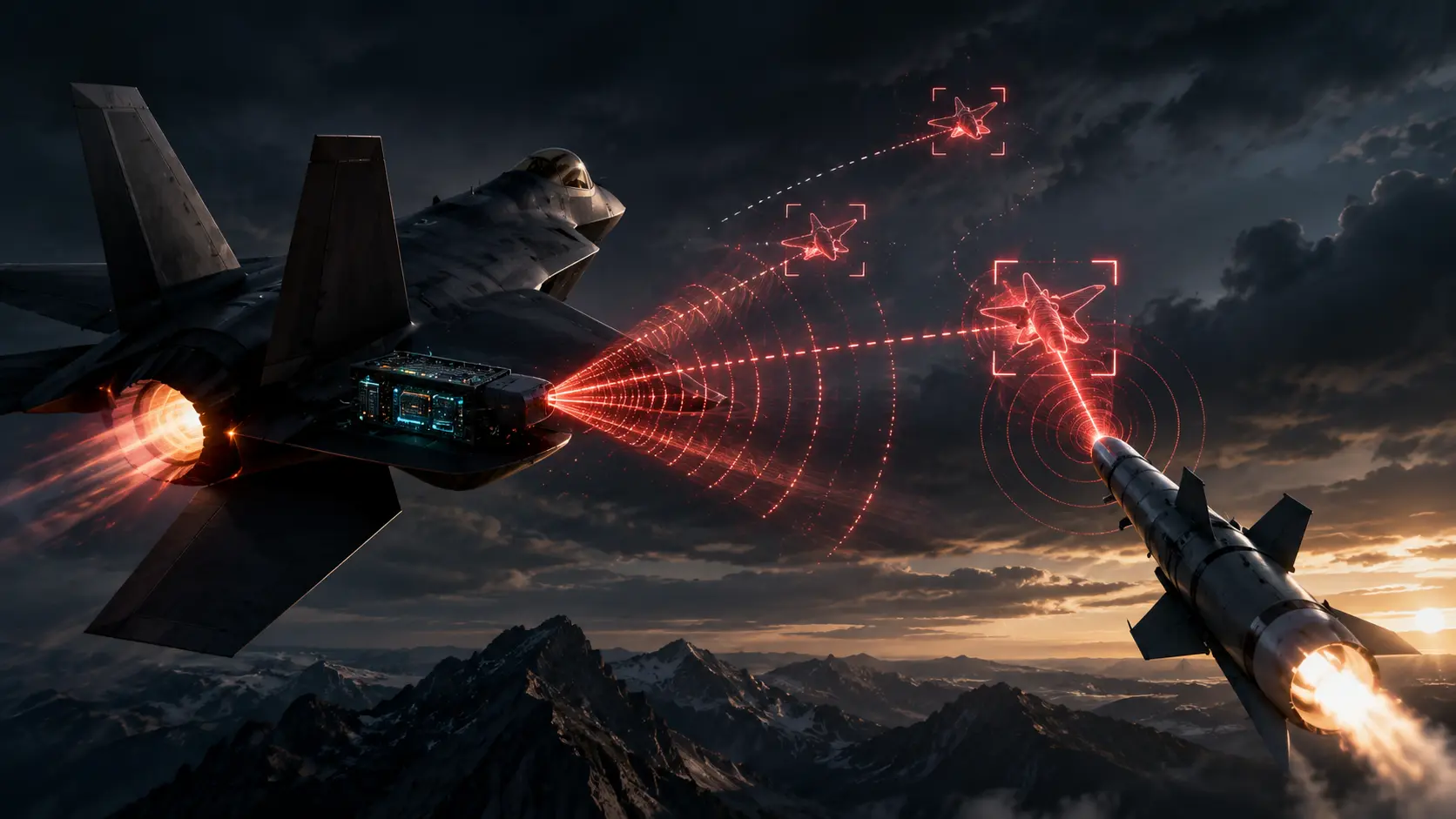

An advanced anti-aircraft missile streaks through the sky at Mach 3, its active radar seeker firmly locked onto a multi-million-dollar fighter jet. In the analog era of warfare, the pilot’s only option was to execute violent physical maneuvers and drop strips of aluminum chaff, hoping to blindly break the missile’s line of sight. Today, the physical jet does not try to outrun the missile; the jet’s computer simply outsmarts it.
Milliseconds before impact, the fighter jet intercepts the missile’s radar ping. In a fraction of a nanosecond, an onboard computer swallows the radar wave, perfectly mimics its unique digital signature, mathematically alters its physics, and beams an identical “ghost” signal back at the missile. The missile’s brain is tricked into believing the jet has suddenly moved 500 meters to the left. The missile adjusts its fins, chases the ghost, and detonates harmlessly in empty air. Why should you care right now? Because the era of physical dogfighting is over. Modern aerial survival relies entirely on the invisible, algorithmic physics of Digital Radio Frequency Memory (DRFM). In the high-stakes chess match of global geopolitics, the nation that can manipulate the electromagnetic spectrum fastest dictates the survival of its fleet.
What is Digital Radio Frequency Memory (DRFM)?
Digital Radio Frequency Memory (DRFM) is an electronic warfare technology that digitally captures, stores, and modifies incoming radar signals before retransmitting them. By sending back a perfectly timed, coherent replica of the original signal with altered frequency or delay, DRFM deceives enemy radar systems by generating highly realistic false targets.
At a Glance
- Concept: A highly advanced digital tape recorder for radio waves. It catches an enemy’s radar ping, alters its metadata (like speed and distance), and plays it back to confuse them.
- Why it matters: Older jammers just yelled “noise” to blind radars. Modern radars ignore noise. DRFM speaks the radar’s exact language, convincing the radar that a fake ghost target is real.
- Who uses it: Defense contractors (BAE Systems, Raytheon, L3Harris), Air Force electronic warfare officers, and naval surface combatants countering anti-ship missiles.
- Biggest takeaway: DRFM works because it is “coherent.” The fake radar return perfectly matches the unique phase and frequency of the enemy’s original pulse, ensuring the enemy’s computer accepts it as absolute truth.
In Simple Words
Imagine you are standing in a dark canyon, shouting “HELLO!” to hear your echo and figure out how far away the canyon wall is.
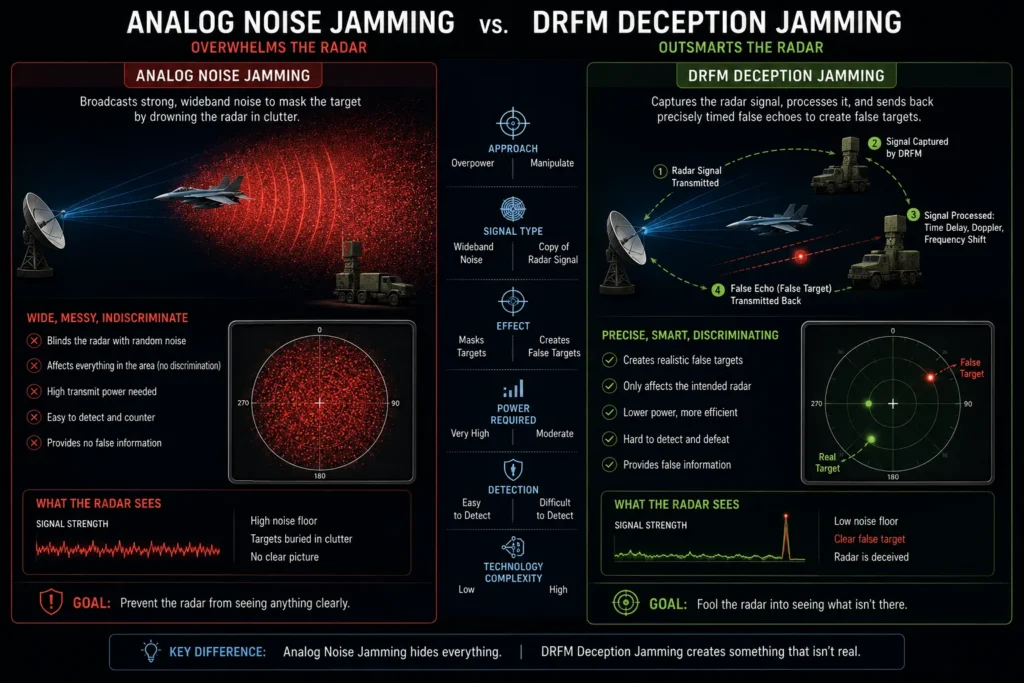
If your enemy wants to hide the wall using an Analog Noise Jammer, they simply set up a massive speaker that blares loud, continuous static. You can’t hear your echo over the static, so you are temporarily blinded. But if you have a smart modern computer, you can easily filter out the static, listen closely for your own voice, and find the wall anyway.
A DRFM Jammer does something terrifying. When you shout “HELLO!”, the DRFM system records your exact voice digitally. It waits a tiny fraction of a second, and then shouts your exact “HELLO!” back at you.
When you hear it, your brain recognizes your own voice perfectly. Because the timing of the echo was slightly delayed by the computer, you do the math and falsely conclude the canyon wall is a mile further away than it actually is. The DRFM system used your own voice to lie to you, making it physically impossible for your radar to tell the difference between reality and the algorithmic ghost.
Why This Matters
For Defense Strategists and Cyber Warfare Analysts, the electromagnetic spectrum is the most critical domain of the 21st-century battlefield.
Modern air defense systems—like the Russian S-400 or the Patriot missile—utilize Active Electronically Scanned Array (AESA) radars. These systems are incredibly lethal and highly resistant to traditional brute-force jamming. DRFM is the only mathematically proven mechanism to defeat coherent AESA processing. By mastering the ability to synthesize fake Doppler shifts and manipulate sub-microsecond pulse delays, DRFM systems allow strike packages to penetrate heavily defended, anti-access/area denial (A2/AD) zones. Without this algorithmic shielding, stealth alone is insufficient to guarantee the survival of modern combat aircraft.
The Evolution of DRFM Radar Jamming
Electronic warfare is an endless loop of Countermeasures (ECM) and Electronic Counter-Countermeasures (ECCM).
When DRFM was first introduced, it decimated early radar trackers. To fight back, radar engineers introduced pulse compression and waveform agility—rapidly changing the “grammar” of the radar pulse a thousand times a second so the jammer couldn’t record and play it back fast enough. In response, DRFM evolved from simple repeaters into high-speed, parallel digital logic systems (utilizing FPGAs) capable of receiving, slicing, modifying, and transmitting complex signals in mere nanoseconds. Today, this architectural chess match dictates billions of dollars in defense procurement.
How Digital Radio Frequency Memory (DRFM) Works
Convincing a supercomputer that a ghost is real requires manipulating the fundamental physics of electromagnetic radiation. Here is the first-principles breakdown of the DRFM architecture.
1. The Fundamental Problem: Coherent Processing
Modern radars do not just listen for a loud radio wave returning to them; they analyze the phase and frequency of the returning wave using matched filters. If a traditional jammer broadcasts a random, high-power noise signal, the radar’s processing gain rejects it as non-coherent background noise, isolating the true target echo.
2. The Core Mechanism: Digitization
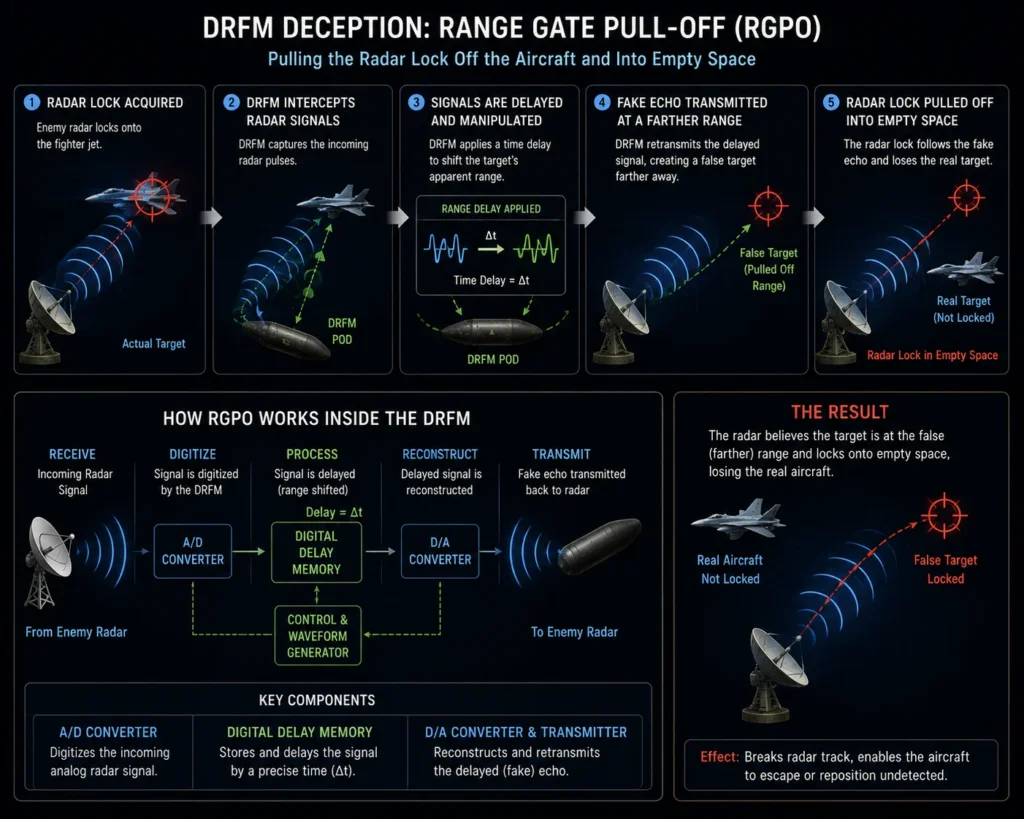
To deceive the radar, the jammer must exploit the radar’s coherence. The DRFM system intercepts the incoming radio frequency (RF) pulse, mixes it down to a lower baseband frequency, and uses a high-speed Analog-to-Digital Converter (ADC) to translate the wave into binary code, storing it in digital RAM.
3. Technical Depth: RGPO and VGPO Manipulation
Once the pulse is stored digitally, the system’s Digital Signal Processor (DSP) executes deceptive algorithms before converting it back to analog:
- Range Gate Pull-Off (RGPO): Radar measures distance by timing how long a pulse takes to return. The DRFM takes the stored pulse, matches it perfectly to the real echo, and then slowly introduces synthetic time delays (Δt) into the retransmission. The radar’s tracking gate locks onto the stronger DRFM pulse and is smoothly “pulled” away from the true target distance.
- Velocity Gate Pull-Off (VGPO): Radar measures target speed by analyzing the Doppler frequency shift of the returning wave. The DRFM applies a mathematical phase ramp to the stored digital signal, slowly altering its frequency. The enemy missile’s velocity tracker locks onto this false frequency and calculates a completely fabricated target speed.
4. Real-World Consequences: Cross-Eye Jamming
Range and velocity deception spoof the missile’s timing, but what about its physical steering? Modern monopulse seekers use multiple antennas to calculate the physical angle of a target. Advanced DRFM employs Cross-Eye Jamming, utilizing two separated antennas on the defending aircraft’s wingtips. The DRFM meticulously controls the phase and amplitude of the replicas fired from each wingtip, mathematically destroying the missile’s angular calculation and forcing the missile to steer violently off-boresight.
Military Applications of Electronic Countermeasures (ECM)
DRFM architectures are universally deployed across multiple domains to execute complex electronic attacks.
Airborne Self-Protection Pods: Fighter aircraft (like the F/A-18 Growler or F-35) rely heavily on internal or pod-mounted DRFM modules. When a pilot receives a radar-lock warning, the DRFM automatically initiates an RGPO/VGPO sequence, silently pulling the enemy’s targeting crosshairs off the physical jet without the enemy radar operator ever receiving a warning that their system has been compromised.
Naval Electronic Decoys: When a massive warship detects an incoming sea-skimming anti-ship cruise missile, the ship’s DRFM system can execute “Multiple False Targets” (MFT) routines. The system broadcasts dozens of distinct, coherent radar replicas. To the incoming missile’s radar, the single warship suddenly splits into a fleet of 50 different ships, instantly overwhelming the missile’s processing capabilities and forcing it to fly harmlessly into the ocean.
Offensive Electronic Attack (EA): In strike missions, specialized electronic warfare planes fly ahead of the bombers. They use DRFM to record the ambient radar sweeps of the enemy nation and inject coordinated false targets into the network. By making the enemy believe a massive bomber fleet is approaching from the North, the EA planes create a “free” electromagnetic corridor for the real strike package sneaking in from the South.
Economic & Strategic Impact
The evolution of DRFM relies heavily on a massive bottleneck in the semiconductor supply chain: Gallium Nitride (GaN) Amplifiers.
In the past, generating enough power to blast the coherent fake signal back at the enemy required massive, heavy, and fragile Traveling-Wave Tubes (TWTs). Today, the defense industry has transitioned to solid-state amplifiers built with Gallium Nitride (GaN).
GaN allows microchips to handle incredibly high voltages and extreme heat, drastically shrinking the size of the DRFM jammer while exponentially increasing its broadcasting power. The defense contractors who secure reliable, domestic supply chains for high-purity GaN wafers effectively control the lethality and range of a nation’s entire electronic warfare portfolio.
Advantages
- Perfect Signal Replication: Because DRFM uses the enemy’s exact signal as the “seed,” the jamming wave inherently mimics the exact pulse compression and coding of the victim radar, making it virtually undetectable as a fake.
- Infinite Mathematical Flexibility: Once the signal is digitized in RAM, software algorithms can synthesize any combination of distance, speed, and size modifications before retransmission.
- Multi-Threat Engagement: Modern digital processing allows a single DRFM module to capture, modify, and retransmit tailored false echoes to multiple different enemy radars simultaneously.
Limitations
- Processing Latency: The system must intercept the wave, convert it to digital, apply complex math, convert it back to analog, and broadcast it. If this “sample-decide-replay” loop is too slow, the fake signal arrives too late, and the enemy radar rejects it.
- Vulnerability to Waveform Agility: If an enemy AESA radar changes its frequency or pulse shape randomly a thousand times a second, the DRFM might record “Pulse A” and play back a modified “Pulse A”, but the enemy radar is already listening exclusively for “Pulse B”.
- Intense Compute Heat: Digitizing massive swaths of the RF spectrum in real-time requires immense FPGA processing power, generating severe thermal loads that are difficult to cool inside the cramped nosecone of a fighter jet.
Common Misconceptions
Misconception: Jamming just breaks the enemy’s radar screen.
Reality: While brute-force noise jamming turns a radar screen white with static, DRFM “deception jamming” is invisible to the human eye. The enemy radar screen looks perfectly normal, but the dots on the screen representing planes are algorithmic lies generated by the DRFM.
Misconception: A stealth plane doesn’t need a jammer.
Reality: Stealth (low observability) merely reduces the distance at which an aircraft can be detected. DRFM works in tandem with stealth. If a stealth jet is finally detected at close range, the DRFM engages to break the missile lock, serving as the ultimate active defense shield.
Misconception: The jammer just creates a new radio wave.
Reality: DRFM is distinct because it does not create a new wave from scratch (which would be non-coherent and easily filtered out). It acts as a digital mirror, physically capturing the enemy’s exact wave and twisting its reflection.
What Most People Miss
The lethal vulnerability of Micro-Doppler Signatures.
Early DRFM systems were excellent at faking the speed and distance of an entire airplane. What most engineers missed is that modern radars are sensitive enough to see the microscopic vibrations of the aircraft.
When a real plane flies, the spinning blades of its jet engine and the subtle vibrations of its wings create tiny, unique frequency ripples called “micro-Doppler” textures. If a DRFM system just plays back a perfectly clean, smooth ghost signal, a modern AI-driven radar will instantly recognize it as a fake because it lacks the messy, vibrating signature of a physical jet engine. The current bleeding edge of DRFM development is writing algorithms that intentionally add fake, highly realistic engine vibrations into the synthetic radar echo to fool the world’s most advanced seekers.
Comparison Table
| Feature | Analog Noise Jamming | DRFM Deception Jamming |
| Primary Mechanism | High-power static broadcasting | Digital capture and coherent modification |
| Radar Screen Effect | Blinds the screen (Whiteout) | Generates clean, realistic false targets |
| Coherence | Non-Coherent | Perfectly Coherent (Matches radar) |
| J/S Ratio Efficiency | Poor (Wastes energy across bands) | Extreme (Energy concentrated at receiver) |
| Defeats AESA Radars? | No | Yes (via RGPO, VGPO, Cross-Eye) |
Case Study
Situation: In the modern combat training environments of the 2020s, air forces required realistic simulations to teach pilots how to recognize and defeat advanced electronic deception.
Challenge: Replicating the exact signature of top-tier adversarial DRFM systems (like those used in peer-nation air defense networks) without exposing actual, highly classified military jammer architectures to open-air interception.
Solution (The EKKO II Architecture): Researchers developed advanced experimental testbeds, such as the EKKO II system built with multiple Field Programmable Gate Arrays (FPGAs). Rather than operating purely in the time domain, the system utilized digital signal processing in the frequency domain to generate false targets.
Outcome: The EKKO II DRFM modulator successfully produced complex radar scenes populated by multiple false targets, each constructed from individual reflectors with highly credible background noise. By executing these algorithms, training units could simulate advanced RGPO and VGPO dynamics perfectly.
Lessons Learned: The deployment proved that “training beats slogans”. Pilots and radar operators who observed the actual screen drift caused by RGPO/VGPO during these simulations were vastly harder to fool in live engagements. It validated that frequency-domain DRFM processing allows a jammer’s complexity to remain constant even when synthesizing massive, multi-target deceptive scenes.
Future Outlook
Next 12–24 Months
The era of Ultra-Wideband Digitization. Current DRFM systems are often restricted by the bandwidth of their Analog-to-Digital Converters (ADCs). They can only monitor a specific “slice” of the electromagnetic spectrum at a time. Over the next two years, the integration of ultra-high-speed commercial ADCs will allow DRFMs to digitize massive, multi-gigahertz swaths of the spectrum simultaneously, ensuring they never miss a frequency-hopping radar pulse.
Next 3–5 Years
The scaling of Cognitive Electronic Warfare (CEW). The human programmer is being removed from the loop. By 2030, DRFM systems will be fully integrated with onboard reinforcement learning AI. When a completely novel, unknown enemy radar waveform hits the aircraft, the Cognitive DRFM will analyze the waveform, rapidly simulate thousands of different RGPO/VGPO jamming algorithms internally, select the optimal deception strategy, and deploy it in milliseconds—adapting to new threats on the fly without requiring a ground-based software update.
Next 10 Years
The Distributed DRFM Swarm. By the mid-2030s, the concept of a single, massive jammer pod on a fighter jet will evolve into distributed architectures. Swarms of disposable, low-cost drones flying ahead of the main fleet will all carry miniaturized DRFM nodes. These nodes will network together via optical lasers, acting as a massive, synchronized phased array in the sky. They will capture enemy radar across hundreds of miles and collaboratively generate city-sized phantom fleets, entirely blinding the adversary’s situational awareness.
Most Likely Scenario
As the processing power of radar systems and jammers scales symmetrically, the physical survival of an aircraft will be dictated entirely by the latency of its DRFM logic gates. The continuous cycle of measure and countermeasure will persist, shifting warfare from the realm of aerodynamics into a pure, invisible clash of applied mathematics and radio frequency physics.
Key Takeaways
- Digital Radio Frequency Memory (DRFM) records enemy radar pulses digitally, manipulates them, and beams them back to create highly believable ghost targets.
- Because DRFM uses the enemy’s own signal as a template, the jammer is perfectly “coherent” with the victim radar, bypassing modern noise filters.
- Range Gate Pull-Off (RGPO) uses micro-time delays to trick the radar into thinking a target is moving further away.
- Velocity Gate Pull-Off (VGPO) alters the Doppler frequency of the radar return, tricking the enemy into tracking a fabricated flight speed.
- Cross-Eye jamming uses two separated antennas to broadcast precise phase shifts, destroying a missile’s angular targeting logic and forcing it to fly off-course.
- To fool advanced AI radars, cutting-edge DRFM algorithms must simulate “micro-Doppler” textures, faking the physical vibrations of jet engines and propellers.
Glossary
Active Electronically Scanned Array (AESA): A highly advanced radar technology that steers radio waves digitally using thousands of tiny transmit/receive modules, allowing it to hop frequencies and evade basic jammers.
Coherence: The property of a signal where its phase and frequency are perfectly maintained. A DRFM jammer must be coherent with the victim radar to ensure the fake signal is accepted as real.
Digital Signal Processor (DSP): The mathematical “brain” inside the DRFM that calculates the exact time delays, phase shifts, and frequency ramps needed to spoof the enemy radar.
Electronic Countermeasures (ECM): The broad military term for actions taken to prevent or reduce an enemy’s effective use of the electromagnetic spectrum, including jamming and deception.
Range Gate Pull-Off (RGPO): A deception technique where the jammer captures the radar’s tracking gate and slowly adds time delays, physically walking the targeting crosshairs off the real aircraft.
Velocity Gate Pull-Off (VGPO): A deception technique that targets a radar’s Doppler velocity trackers by smoothly shifting the frequency of the returning signal.
Frequently Asked Questions
Why can’t the missile just look for the jammer’s radio waves?
Missiles do have a mode called “Home-on-Jam” (HOJ), where they stop tracking the radar bounce and just fly straight toward the source of the loud jamming noise. This is why DRFM is so critical; instead of being a loud, obvious noise source, DRFM quietly sends back a perfectly sized, coherent echo that tricks the radar into believing normal physics are occurring.
Does DRFM work against stealth aircraft?
DRFM is used by the stealth aircraft to defend itself, not to detect other stealth aircraft. If an enemy radar manages to get a weak track on a stealth jet, the jet’s DRFM system will engage to break that track.
Can DRFM intercept encrypted communications?
While DRFM technology is highly capable of digitizing the RF spectrum, its primary operational goal is manipulating radar pulses for deception (ECM), not decrypting complex communications (which falls under Signals Intelligence or SIGINT).
How much power does a DRFM system need?
The digital processing requires highly specialized, heat-intensive computing (FPGAs). The physical transmission requires substantial wattage, increasingly managed by highly efficient Gallium Nitride (GaN) solid-state amplifiers that provide massive power in compact, airborne pods.
Can radar operators tell they are being jammed by DRFM?
It is incredibly difficult. Unlike noise jamming, which looks like a massive storm of static on the screen, DRFM spoofing creates clean, sharp dots that look exactly like real airplanes. The only way an operator can tell is if the “airplane” behaves in a way that violates physics, or if they have advanced training to spot the specific drift signatures of RGPO.