Advertisement
)

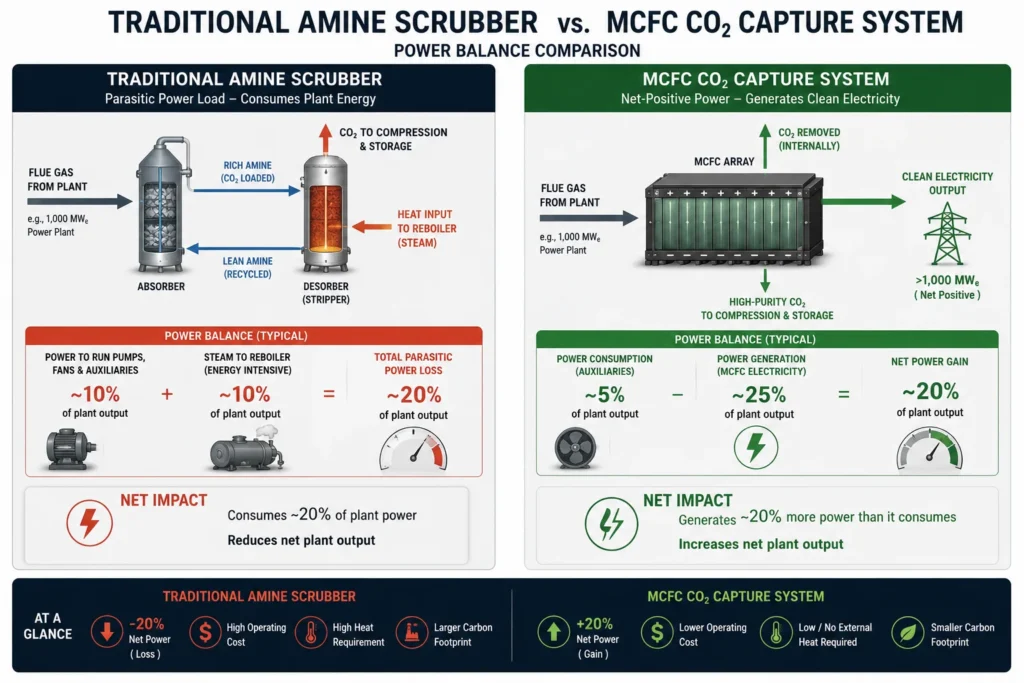
The push to decarbonize heavy industry is colliding with a brutal thermodynamic reality: capturing carbon requires massive amounts of energy. Today, if a steel mill or natural gas plant installs a traditional carbon capture system (like an amine scrubber), that system consumes roughly 20% of the plant’s total electrical output. To clean the air, the factory has to burn more fuel to power the cleaning machine, creating a vicious cycle of parasitic energy loss that obliterates profit margins. Solving the climate crisis requires an entirely new approach to industrial chemistry—one that does not penalize businesses for capturing their own pollution.
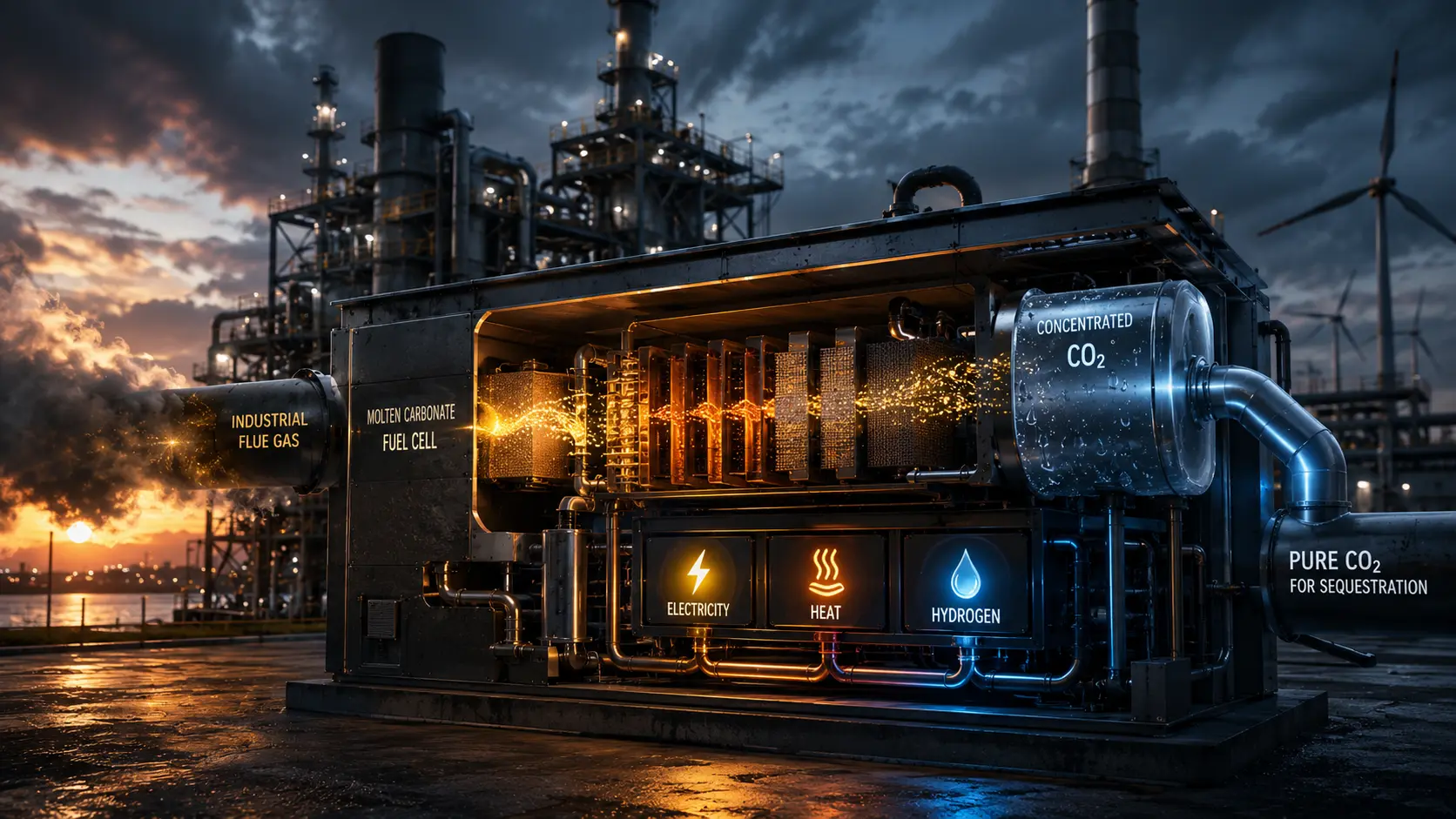
Why should you care right now? Because energy engineers have successfully weaponized the fuel cell to reverse this paradigm. By routing dirty factory exhaust through a matrix of 650°C liquid salt, Molten Carbonate Fuel Cells (MCFCs) selectively pump carbon out of the smoke and concentrate it for deep underground storage. But unlike legacy scrubbers, this electrochemical reaction actually generates massive amounts of extra electricity, heat, and hydrogen. It transforms carbon capture from a multi-million-dollar energy drain into an active, revenue-generating power plant, rewriting the economics of global industrial decarbonization.
What is Molten Carbonate Fuel Cells (MCFC)?
Molten Carbonate Fuel Cells (MCFC) are high-temperature electrochemical power generation devices that utilize a liquid carbonate salt electrolyte. They generate electricity by oxidizing a fuel source, while simultaneously acting as a highly efficient carbon capture membrane by pulling carbon dioxide from industrial flue gas and concentrating it for permanent sequestration.
At a Glance
- Concept: A power generator that acts as an active carbon filter. It eats dirty industrial exhaust and natural gas, and spits out clean power, usable heat, hydrogen, and a pure stream of liquid CO2.
- Why it matters: It completely eliminates the “parasitic load” of carbon capture. Instead of costing a factory 20% of its electricity to capture carbon, the factory gains extra megawatts of power to use or sell to the grid.
- Who uses it:Mega-tier industrial facilities, natural gas power plants, and petrochemical giants like ExxonMobil.
- Biggest takeaway:Because MCFCs operate at a blistering 650°C, they don’t need expensive platinum catalysts or external chemical reformers. The extreme heat allows them to break down fuels internally, drastically lowering their long-term material costs.
In Simple Words
Imagine buying a heavy-duty air purifier for your house. Normally, you plug it into the wall, it cleans your air, and your electricity bill goes up at the end of the month because the machine consumes power.
A Molten Carbonate Fuel Cell (MCFC) is an air purifier that breaks the laws of traditional appliances.
Instead of plugging it into the wall, you feed it natural gas or biogas. You attach its intake pipe directly to the dirty exhaust chimney of a factory. Inside the machine is a scorching-hot layer of liquid salt. This salt acts like a magnetic sponge that only absorbs carbon dioxide. As the dirty smoke passes through, the salt pulls the carbon out and concentrates it into a pure liquid that can be safely buried underground.
Because this separation is achieved through a chemical reaction rather than just physical filtering, the process creates an electrical charge. The “air purifier” ends up generating enough electricity to power itself, plus enough leftover electricity to help run the factory.
Why This Matters
For Energy Planners, ESG Funds, and Industrial Engineers, the commercial deployment of MCFCs solves the ultimate impasse of the energy transition: the economic penalty of compliance.
Heavy industries (cement, steel, chemicals) operate on razor-thin margins. Mandating carbon capture via traditional absorption systems destroys those margins by inflating operating expenditures (OpEx). By deploying MCFCs, industrial operators transform a compliance cost into a co-generation asset. The fuel cell produces baseload electricity that can be sold back to the grid, generates high-quality waste heat suitable for industrial drying or steam turbines, and produces surplus hydrogen that can be monetized in the emerging clean-fuels market. It is the only known platform that makes carbon capture mathematically profitable prior to the application of government tax credits.
The Evolution of MCFC Carbon Capture
Fuel cells are not new, but their application has historically been limited to small-scale, clean power generation. The pivot to using them explicitly as large-scale carbon capture membranes is a recent evolution in industrial strategy.
The chemistry of the MCFC makes it uniquely suited for this task. While other fuel cells (like Solid Oxide or Proton Exchange Membrane fuel cells) are poisoned by carbon dioxide or carbon monoxide, MCFCs actively require CO2 to function. This inherent chemical appetite turns industrial flue gas—the primary driver of global warming—into a necessary operational feedstock, permanently linking the future of fossil-fueled power plants to the deployment of advanced electrochemistry.
How Molten Carbonate Fuel Cells Work
Capturing CO2 while simultaneously generating power requires orchestrating a complex, high-temperature ion exchange. Here is the first-principles breakdown of the MCFC architecture.
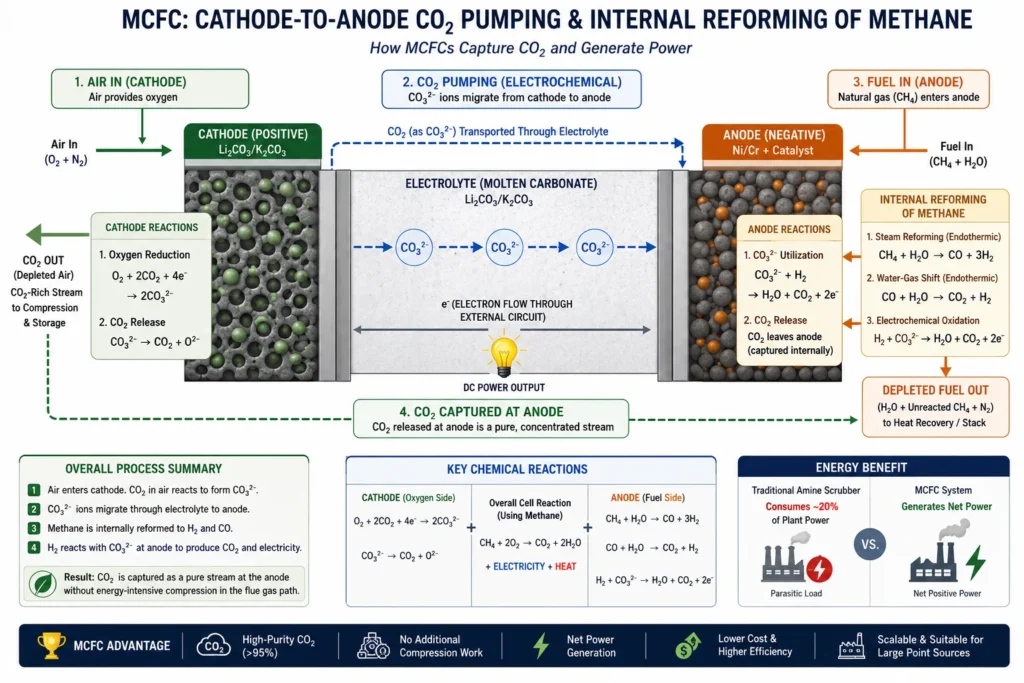
1. The Fundamental Problem: Dilute Exhaust
The exhaust (flue gas) coming out of a natural gas or coal power plant is highly dilute, typically containing only 6% to 16% CO2 mixed with massive amounts of nitrogen and oxygen. Capturing CO2 from this fast-moving, low-concentration stream using chemical solvents requires boiling massive vats of liquid, creating a massive energy penalty.
2. The Core Mechanism: The Molten Salt Electrolyte
An MCFC uses an electrolyte composed of a molten carbonate salt mixture (usually lithium and potassium carbonates) suspended in a porous ceramic matrix. At 650°C, this salt melts into a highly conductive liquid that only allows carbonate ions(CO3 2-) to pass through it.
3. Technical Depth: Cathode-to-Anode CO2 Pumping
The industrial flue gas is fed into the fuel cell’s Cathode. Here, the oxygen and the dilute CO2 react with incoming electrons to form carbonate ions:
1/2 O2 + CO2 + 2e- -> CO3 2-
These carbonate ions physically carry the CO2 through the molten salt electrolyte over to the Anode.
4. Technical Depth: Internal Reforming and Oxidation
Simultaneously, fuel (like natural gas or biogas) is fed into the Anode. Because the cell is running at 650°C, the fuel cell can perform Internal Reforming—converting the methane directly into hydrogen gas inside the cell without needing a separate, expensive external reforming machine.
At the Anode, the hydrogen reacts with the arriving carbonate ions:
H2 + CO3 2- -> H2O + CO2 + 2e-
This reaction releases the electrons (creating the electric current) and releases the CO2 and water vapor.
5. Real-World Consequences: Concentration and Co-Generation
Look closely at the chemistry: CO2 is pulled from the dilute exhaust at the Cathode, and pushed out at the Anode. The MCFC acts as an electrochemical pump. The gas exiting the Anode is a highly concentrated, pure mixture of CO2 and water. Once the water is condensed and removed, you are left with an ultra-pure stream of CO2 ready to be piped underground for permanent storage, all while generating continuous baseload electricity.
Industrial Applications for MCFC Technology
The modularity of fuel cells allows them to scale from localized microgrids to massive heavy-industry installations.
Decarbonizing Natural Gas Power Plants: As the grid relies on natural gas to firm up intermittent solar and wind, those gas plants must be decarbonized. Installing an array of MCFC modules at the exhaust stack of a natural gas plant extends the life of the fossil-fuel asset. The MCFC captures the plant’s emissions, generates supplemental power, and effectively creates a firm, zero-carbon baseload power node that regulators will not force into early retirement.
Hydrogen Co-Production (Tri-Generation): Depending on how the cell is operated, the internal reforming process can be tuned to run in excess. This means the MCFC generates more hydrogen than it actually consumes to produce electricity. The excess hydrogen can be extracted and sold to nearby industrial facilities or used to power heavy-duty fuel cell trucking fleets, creating a “tri-generation” system (Power, Heat, and Hydrogen).
Bioenergy with Carbon Capture and Storage (BECCS): MCFCs are highly resilient to impurities, allowing them to run on raw biogas produced by agricultural waste or wastewater treatment plants. When an MCFC captures the CO2 emitted from burning biomass, the entire facility achieves negative emissions—physically removing legacy carbon from the biosphere while generating renewable power.
Economic & Strategic Impact
The ultimate viability of the MCFC market rests on the successful execution of Mega-Scale Strategic Pilots.
For decades, fuel cell companies have struggled with profitability, surviving largely on small, bespoke combined heat and power (CHP) deployments. The technology was scientifically sound, but the market doubted its ability to scale to the massive volumes required by global energy conglomerates.
This dynamic shifted fundamentally with the intervention of ExxonMobil. By partnering with FuelCell Energy to deploy a pilot project at their massive manufacturing site in Rotterdam (groundbreaking late 2024, operational 2026), the industry is attempting to validate the technology’s economics on a global stage. If the Rotterdam pilot proves that MCFCs can capture 90%+ of industrial CO2 while delivering a positive return on investment, it will unlock a multi-billion-dollar backlog of data center and industrial decarbonization projects, transitioning MCFCs from niche science experiments into mandatory infrastructure.
Advantages
- Negative Parasitic Load:Generates additional power rather than consuming 20% of a plant’s output like conventional thermal-based CO2 capture systems.
- No Precious Metals Required: Because they operate at 650°C, the chemical reactions happen easily. This eliminates the need for astronomically expensive platinum catalysts, relying instead on cheap nickel-based alloys.
- Internal Reforming:The high operating temperature allows the cell to directly convert natural gas into hydrogen internally, completely removing the need for a massive, separate steam-methane reforming facility.
- NOx Destruction:If there are nitrogen oxides (NOx) in the industrial flue gas, the MCFC destroys approximately 70% of them as the stream passes through the cathode, acting as a secondary air scrubber.
Limitations
- Severe Material Corrosion: Molten carbonate salt is incredibly aggressive. At 650°C, the electrolyte accelerates the corrosion and breakdown of the cell’s internal components, drastically limiting the operational lifespan of the fuel cell stack (typically requiring major overhauls every 5 to 7 years).
- Cathode Dissolution: The primary technical failure point is the nickel oxide (NiO) cathode. It reacts with the CO2 and slowly dissolves into the molten electrolyte. This dissolved metal precipitates and can eventually cause a short circuit, destroying the cell.
- Financial Fragility of Suppliers:The companies building these systems (like FuelCell Energy) have historically struggled to achieve consistent profitability. Deploying a 20-year infrastructure asset requires total confidence that the manufacturer will exist long enough to service it.
Common Misconceptions
Misconception: Fuel cells only run on pure hydrogen.
Reality: While PEM (Proton Exchange Membrane) fuel cells in cars require ultra-pure hydrogen, MCFCs are “fuel flexible.” They can run directly on natural gas, biogas, or even synthetic gases made from coal, because their extreme heat allows them to break down complex hydrocarbons internally.
Misconception: The fuel cell burns the natural gas.
Reality: There is zero combustion. The fuel cell oxidizes the fuel electrochemically. Because nothing is physically set on fire, the process produces virtually no smog-forming particulates or air pollution compared to traditional combustion engines.
Misconception: Carbon capture with MCFCs is a theoretical concept.
Reality: The physics have been proven in operational prototypes and small-scale rigs (up to ~30kW capabilities treating real flue gas) for years. The current challenge is simply scaling the physical architecture up to process the millions of tons of gas required by a full-size petrochemical refinery.
What Most People Miss
The highly lucrative market of CO2 Utilization (CCU).
Most discussions around carbon capture assume the CO2 is simply treated as garbage and pumped thousands of feet underground (Sequestration).
What most analysts miss is that the CO2 output from an MCFC is highly concentrated and pure. Instead of burying it, industrial plants can capture this CO2 and recycle it directly on-site to create valuable end-products. The captured CO2 can be combined with excess hydrogen to produce synthetic sustainable aviation fuels via Fischer-Tropsch reactors, used to cure low-carbon cement, or utilized in industrial water treatment and dry ice production. This turns the chemical exhaust of the MCFC into a direct, monetizable commodity stream.
Comparison Table
| Feature | Amine Scrubbing (Conventional CCS) | Solid Oxide Fuel Cells (SOFC) | Molten Carbonate Fuel Cells (MCFC) |
| Operating Temperature | Low (~40°C – 120°C) | Very High (~800°C – 1000°C) | High (~600°C – 700°C) |
| Energy Impact | High Parasitic Load (-20% Power) | Generates Power | Generates Power (Co-Generation) |
| Carbon Capture Mechanism | Thermal/Chemical absorption | Pre-combustion separation | Electrochemical Cathode-to-Anode Pumping |
| Tolerance to CO2 in Air | Target molecule | Poor (Causes degradation) | Excellent (Required for operation) |
| Internal Reforming? | N/A | Yes | Yes |
Case Study
Situation: ExxonMobil recognized that achieving net-zero emissions across its massive global refining and chemical footprint required carbon capture and storage (CCS). However, retrofitting legacy facilities with traditional thermal-based CCS technology would consume vast amounts of electricity, driving up operational costs and straining local power grids.
Challenge: Develop and deploy a carbon capture technology that could efficiently pull CO2 out of high-volume industrial exhaust streams without incurring a devastating parasitic energy penalty.
Solution (The Rotterdam Pilot): ExxonMobil partnered with FuelCell Energy to expand the application of MCFCs from small-scale power generation to large-scale carbon capture. They initiated a pilot project at ExxonMobil’s manufacturing site in Rotterdam. The project routes the plant’s industrial exhaust directly into modular carbonate fuel cell units.
Outcome: Groundbreaking occurred in October 2024, with operations scheduled for 2026. The pilot is designed to capture more than 90% of the targeted CO2 emissions while simultaneously co-generating low-carbon power, heat, and hydrogen.The captured CO2 will be compressed and transported for permanent storage under the North Sea via the Porthos project.
Lessons Learned: The Rotterdam deployment represents a critical inflection point. It demonstrates that heavy industry is willing to abandon legacy thermal scrubbing in favor of advanced electrochemistry. If successful, it proves that MCFCs can transition from a niche power generator into a mandatory, highly profitable “technology toolkit” component for global industrial decarbonization.
Future Outlook
Next 12–24 Months
The era of Strategic Validation and Data Center Pivots. Through 2026 and 2027, the industry’s fate rests on the operational data streaming from mega-pilots like Rotterdam. Simultaneously, fuel cell manufacturers will aggressively pivot their marketing toward the exploding AI data center market. Because data centers require massive, uninterrupted, low-carbon baseload power, 12.5 MW standardized MCFC power blocks will be pitched as the ultimate off-grid solution, allowing tech giants to bypass grid interconnection queues while generating their own firm, clean electricity.
Next 3–5 Years
The scaling of Cathode Material Breakthroughs. To achieve true economic dominance, the industry must solve the degradation of the fuel cell over time. By the late 2020s, materials scientists will commercialize advanced cathode replacements. Current research into adding Magnesium Oxide (MgO) to the nickel cathode, or transitioning entirely to advanced LiFeO2-LiCoO2-NiO alloys, shows massive promise in halting the dissolution of the cathode into the liquid salt. Extending the stack life from 5 years to 10+ years will drastically reduce OpEx and make the Levelized Cost of Energy (LCOE) of MCFCs vastly more attractive.
Next 10 Years
The Ubiquitous Tri-Generation Hub. By the mid-2030s, MCFCs will no longer be viewed purely as carbon capture devices; they will be the localized chemical hearts of industrial parks. A single massive MCFC array attached to a steel mill will capture the mill’s carbon, provide all the electricity required to run the mill, pipe its 600°C waste heat into the mill’s furnaces, and export a continuous stream of pure hydrogen to a neighboring chemical refinery. Electrochemistry will fully integrate into the physical layout of global manufacturing.
Most Likely Scenario
Molten Carbonate Fuel Cells represent the most elegant physical solution to the carbon capture paradox. While they face immense engineering challenges regarding high-temperature corrosion and the financial stability of their manufacturers, the thermodynamic superiority of generating power while filtering carbon is undeniable. As international carbon taxes penalize emissions and reward clean power generation, the dual-revenue stream of the MCFC ensures its place as a cornerstone technology of the mid-21st century industrial transition.
Key Takeaways
- Molten Carbonate Fuel Cells (MCFCs) capture carbon dioxide from dirty industrial exhaust while simultaneously generating electricity, heat, and hydrogen.
- Unlike traditional carbon capture systems that consume 20% of a factory’s electricity, MCFCs produce a net-positive power output, drastically improving the economics of decarbonization.
- They operate at extreme temperatures (650°C), which allows them to internally reform natural gas into hydrogen without needing expensive external chemical processors.
- The system acts as an electrochemical pump: it pulls dilute CO2 into the cathode, mixes it with the molten salt, and pushes a highly concentrated, easily capturable CO2 stream out of the anode.
- Major players like ExxonMobil and FuelCell Energy are currently proving the technology at a massive industrial scale at a pilot plant in Rotterdam.
- The main limitation of the technology is durability; the hot, corrosive liquid salt slowly breaks down the internal metal components, requiring expensive replacements every 5 to 7 years.
Glossary
Amine Scrubbing: The traditional, legacy method of carbon capture that uses liquid chemical solvents to absorb CO2. It is highly energy-intensive and creates a massive parasitic load on power plants.
Anode: The negative electrode in a fuel cell where the fuel (like hydrogen) is oxidized, releasing electrons to create an electrical current.
Cathode: The positive electrode in a fuel cell. In an MCFC, this is where the dirty industrial exhaust (flue gas) enters and the CO2 is pulled into the molten salt.
Internal Reforming: The ability of a high-temperature fuel cell to convert hydrocarbon fuels (like natural gas or methane) directly into hydrogen gas inside the cell, bypassing the need for separate, expensive chemical equipment.
Molten Carbonate Salt: A mixture of alkali carbonates (like lithium and potassium) that melts into a liquid at 600°C and serves as the highly conductive electrolyte in an MCFC.
Parasitic Load: The amount of electricity a power plant or factory must consume to run its own internal equipment (like a carbon capture machine), which reduces the amount of electricity it can actually sell.
Sources
- FuelCell Energy – ExxonMobil: Carbon Capture and Storage Infographic
- ExxonMobil: Breakthrough carbon capture technology ready for field testing (May 2024)
- FuelCell Energy: The Basics of FuelCell Energy’s Carbon Capture Platform (September 2022)
- Enki AI: Fuel Cell Energy 2026, $1.17B Backlog
- ExxonMobil Europe: Rotterdam Carbon Capture Pilot Project Updates (May 2024)
- Wikipedia: Molten carbonate fuel cell
- ECCSEL: Molten Carbonate Fuel Cell (MCFC) Pilot Plant Factsheet (June 2023)
- Wikipedia: Molten carbonate fuel cell – Operating Principles
- ECS Meeting Abstracts: Carbonate Fuel Cell Anode: A Review (May 2014)