Advertisement
)
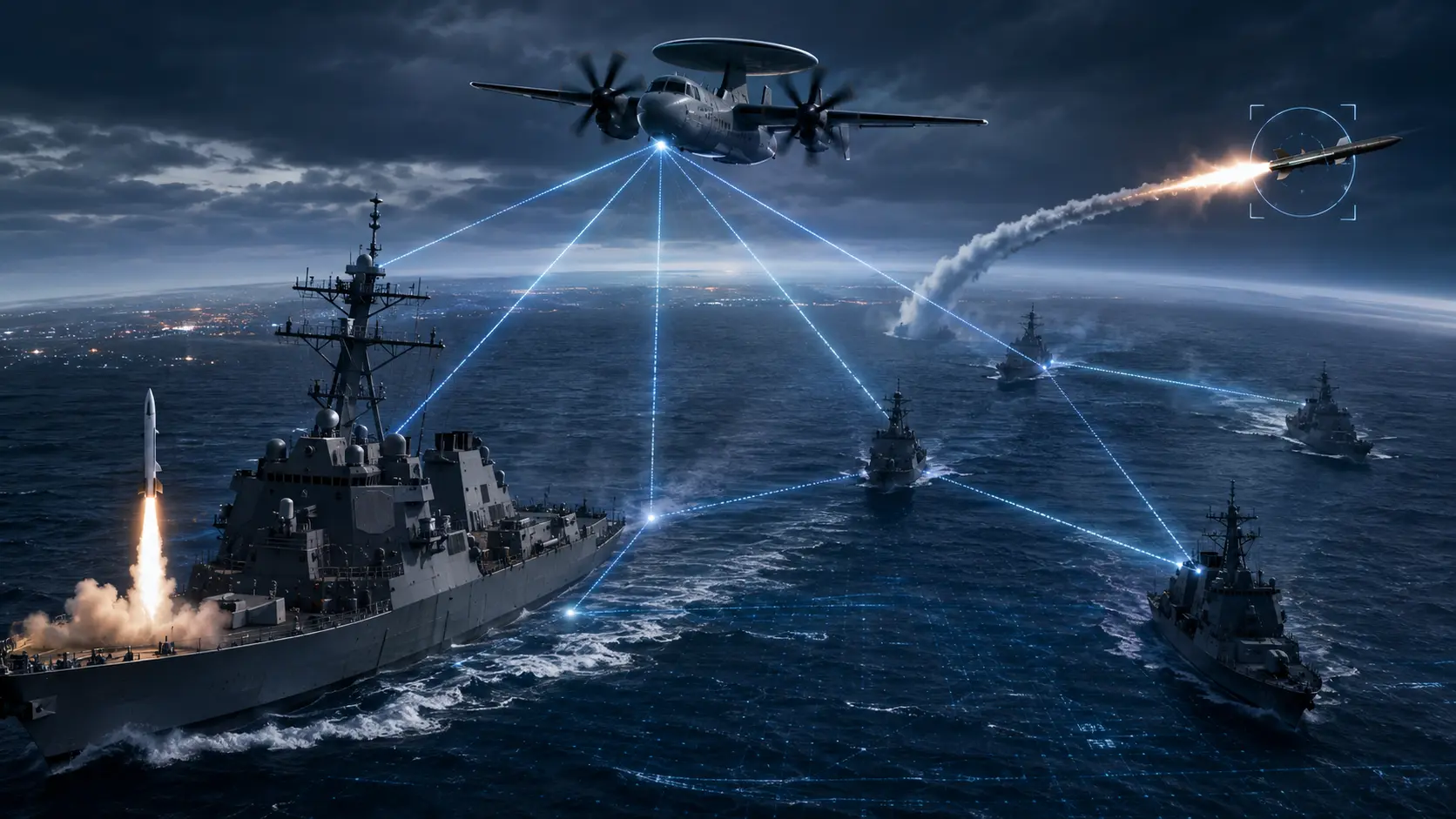

Imagine a U.S. Navy destroyer sailing in the Pacific. Suddenly, it launches a multi-million-dollar interceptor missile into the sky. The ship’s radar is completely blank; it has detected zero threats. The missile arcs over the curvature of the Earth and flawlessly destroys a supersonic anti-ship cruise missile flying a hundred miles away—a target the ship never actually saw. For decades, naval warfare was governed by an absolute law of physics: you cannot shoot what your radar cannot see. Because the Earth is round, the ocean horizon forms an impenetrable wall, giving ships only seconds to react to incoming threats that fly low to the water. Today, that physical barrier has been eradicated.
Why should you care right now? Because modern warfare is no longer about which ship has the biggest gun; it is about which fleet has the fastest, most resilient internet connection. Through a highly classified, ultra-fast network known as Cooperative Engagement Capability (CEC), the military has linked every ship, fighter jet, and radar plane into a single, synchronized neural network. If a stealth fighter spots a target, every ship in the fleet instantly “sees” it with mathematical precision. By completely detaching the radar sensor from the missile shooter, the Navy has rewritten the geometry of combat, turning isolated warships into an inescapable, interconnected web of destruction.
What is Cooperative Engagement Capability (CEC)?
Cooperative Engagement Capability (CEC) is a real-time sensor network that links multiple naval ships and aircraft into a single, integrated air defense system. It mathematically fuses raw radar data from distinct platforms into a unified, composite tracking picture, allowing a ship to fire a missile at a target detected entirely by another vehicle’s sensors.
At a Glance
- Concept: Combining the radar eyes of every plane and ship in the fleet so they all share the exact same brain. If one unit sees a threat, they all see it instantly.
- Why it matters: Enemies try to overwhelm ships by firing low-flying missiles that hide under the radar horizon until the last second. CEC puts a radar plane high in the sky to see over the horizon and remotely commands the ships to fire early.
- Who uses it: The United States Navy, the Marine Corps, and allied nations (like Australia and Japan) integrating Aegis Combat Systems and E-2D Advanced Hawkeye aircraft.
- Biggest takeaway: Older military networks shared “summaries” of what a radar saw, which was too slow and inaccurate to guide a weapon. CEC shares the raw, unfiltered radar math in real-time, creating a target lock so perfect a ship can blindly fire a missile at it.
In Simple Words
Imagine you are playing a team video game where you have a sniper rifle, but you are standing behind a tall brick wall and cannot see the enemy.
In a Traditional Military Network, your teammate stands on top of the wall and shouts, “There is an enemy roughly 50 feet away, running left!” This information is helpful for your awareness, but it is not accurate enough for you to actually pull the trigger through the wall. You would probably miss.
In a Cooperative Engagement Capability (CEC) Network, your teammate on the wall wires their own eyeballs directly into your brain. When they look at the enemy, you instantly see the exact crosshairs projected perfectly into your own vision, down to the millimeter. You can pull the sniper rifle trigger and shoot through the wall with absolute certainty, hitting the target perfectly, even though your physical eyes are staring at a brick wall.
Why This Matters
For Defense Strategists, Military Contractors, and Geopolitical Analysts, CEC represents the definitive counter to Anti-Access/Area Denial (A2/AD) Bubbles.
Adversaries like China and Russia have developed massive networks of long-range “carrier-killer” missiles designed to keep the U.S. Navy thousands of miles away from their shores. Defeating this A2/AD bubble requires intercepting these threats at maximum possible range. If a cruiser has to wait until an incoming missile clears the radar horizon, it is too late. CEC extends the defensive umbrella of a carrier strike group by hundreds of miles. It physically decouples the sensor from the shooter, meaning a cheap, expendable drone can fly deep into enemy territory to act as a spotter, while the expensive cruiser remains safely out of range, firing its magazines empty from a position of absolute safety.
The Evolution of Naval Datalinks: Beyond Link 16
Military forces have used tactical datalinks (like the ubiquitous Link 16) since the Cold War. Link 16 is excellent at answering the question: “Where is everyone?”
However, Link 16 is fundamentally a situational awareness tool. Because it operates on a relatively narrow bandwidth, a ship processes its own radar data, decides it sees a target, and then transmits a small, compressed digital “track” to the rest of the fleet. Because every ship calculates this slightly differently, multiple ships might report the same target in slightly different locations. CEC abandons this paradigm. It does not share compressed tracks; it shares the massive, heavy, raw radar measurements themselves, establishing an entirely new standard for network-centric warfare.
How Cooperative Engagement Capability (CEC) Fuses Radar Data
Creating a synchronized, distributed fire-control network across vehicles moving at supersonic speeds requires flawless data fusion. Here is the first-principles breakdown of the architecture.
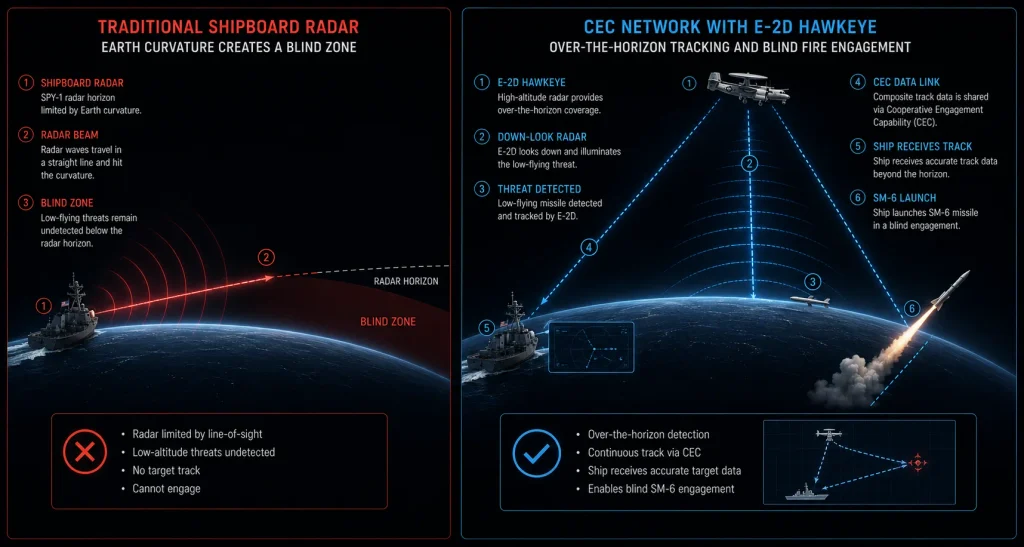
1. The Fundamental Problem: The Radar Horizon
Because the Earth is a sphere, radar waves (which travel in straight lines) eventually shoot straight out into space, leaving a blind spot close to the surface. A ship’s radar simply cannot see a sea-skimming missile until it is less than 30 miles away. By the time the ship detects a Mach 3 missile, it has only seconds to calculate a firing solution and launch an interceptor.
2. The Insufficiency of Traditional Datalinks
If an airplane flying high above the ship sees the missile 100 miles away, it can use Link 16 to tell the ship. However, Link 16 introduces latency, and the aircraft’s GPS coordinates might be off by a few meters. If a ship fires an interceptor missile based on a Link 16 coordinate, the interceptor will arrive at the destination and grab empty air. Link 16 provides “Track Quality,” not “Fire Control Quality.”
3. The Core Mechanism: Raw Measurement Fusion
CEC bypasses the ship’s local processing. It extracts the raw radar measurements (range, bearing, Doppler velocity) directly from the radar antenna. It blasts this massive stream of raw data to every other ship using the Data Distribution System (DDS)—a highly classified, directional C-band phased-array antenna that actively fights through enemy jamming.
4. Technical Depth: Composite Track Correlation
Every ship in the fleet is equipped with a Cooperative Engagement Processor (CEP). The CEP takes the raw radar data from its own ship, plus the raw data beamed over from the airplane, and mathematically aligns them to the microsecond. The CEP merges these multiple viewpoints into a single, flawlessly accurate “Composite Track.” Because every ship is running the exact same CEP algorithm on the exact same raw data, every ship sees the exact same target in the exact same millimeter of space.
5. Real-World Consequences: NIFC-CA and Engage-on-Remote
Because the Composite Track is mathematically perfect, the ship’s Aegis Combat System trusts it completely. This enables Naval Integrated Fire Control-Counter Air (NIFC-CA). The ship can now execute an “Engage-on-Remote.” The ship locks its SM-6 interceptor missile onto the airplane’s composite track and fires. The ship’s radar remains totally blind, acting purely as an invisible magazine, while the distant aircraft guides the missile to the kill.
NIFC-CA Deployments: E-2D Hawkeyes and F-35 Integration
CEC is not a future concept; it is the foundational architecture of the modern U.S. Carrier Strike Group.
The E-2D Advanced Hawkeye: The E-2D is a twin-engine turboprop plane with a massive radar dome on its roof, operating as the undisputed quarterback of the fleet. Because it flies at 30,000 feet, its radar horizon extends for hundreds of miles. The E-2D is natively equipped with CEC. It can detect a swarm of incoming anti-ship missiles long before they threaten the fleet, and instantly feed that fire-control data directly into the vertical launch tubes of every Aegis cruiser in the ocean below.
The F-35 Lightning II Integration: The F-35 is a flying supercomputer. With its advanced stealth, it can penetrate deep into contested airspace without being shot down. Its AN/APG-81 radar and electro-optical targeting systems map the entire battlefield. By integrating F-35 telemetry into the NIFC-CA network, a single stealth fighter can act as an invisible forward observer, silently painting targets for destroyers sitting safely hundreds of miles out at sea.
Army and Marine Corps Interoperability: CEC is breaking the boundary between the Navy and land forces. The U.S. Marine Corps relies on ground-based air defense systems, while the Army utilizes the Patriot missile system. By installing CEC nodes onto ground vehicles, a Marine Corps launcher sitting on a beach can fire a missile at an incoming enemy aircraft that was detected by a Navy destroyer sailing 50 miles offshore, creating a seamless, joint-domain defensive shield.
Economic & Strategic Impact
The core strategic value of CEC is the Optimization of Interceptor Inventory.
Warships have a finite number of Vertical Launch System (VLS) tubes. A destroyer might carry 90 missiles. If those missiles run out, the ship is defenseless and must return to port.
In a traditional scenario, if three ships detect the same incoming target independently, they might all panic and fire two interceptor missiles at it to be safe, wasting six multi-million-dollar missiles on a single threat.
Because CEC forces all three ships to share the exact same brain, the fleet recognizes it is looking at a single target. The battle commander can instruct Ship A to fire exactly one missile, while Ship B and Ship C hold their fire. This algorithmic optimization preserves the fleet’s magazine depth, ensuring the strike group does not run out of ammunition during a sustained, multi-day engagement against a near-peer adversary.
Advantages
- Radar Horizon Evasion: Completely bypasses the physical limits of the Earth’s curvature by utilizing elevated airborne sensor nodes.
- Jamming Resilience: If an enemy tries to jam a ship’s radar, that ship instantly switches to using the radar data from another ship 20 miles away. The enemy would have to successfully jam every single radar in the fleet simultaneously to blind the group.
- Decoupled Risk: Allows the highly visible, vulnerable asset (the radar emitting the signal) to be separated from the valuable, heavy asset (the ship carrying the missiles).
- Track Continuity: If an enemy aircraft flies behind a mountain, Ship A loses the track. But Ship B, looking from a different angle, maintains the track. The composite CEC track never drops, providing seamless, unbroken targeting.
Limitations
- Bandwidth Exhaustion: Sharing raw radar returns requires a massive, incredibly fast data pipe. While the directional C-band antennas are powerful, passing gigabytes of raw telemetry between dozens of moving ships is a heavy burden on the electromagnetic spectrum.
- Emission Signatures: To share data, the CEC antennas must transmit powerful radio signals. Advanced enemies possess Signals Intelligence (SIGINT) satellites that can detect these transmissions, potentially revealing the fleet’s location.
- The Cost of Entry: Equipping a ship with the specific hardware, phased-array antennas, and Cooperative Engagement Processors is incredibly expensive. Upgrading legacy platforms to handle the intense computing requirements of NIFC-CA limits full adoption to only the most advanced tier-one allied navies.
Common Misconceptions
Misconception: CEC controls the missile directly.
Reality: The CEC network connects the ships and planes, not the missile. The network gives the ship the target coordinates. The ship then uses its own separate targeting illuminators to talk to the missile after it launches.
Misconception: Any data link can do “Engage on Remote.”
Reality: Standard data links (like Link 16) are for situational awareness. They show a pilot a dot on a map. Only the raw, unfiltered, microsecond-aligned data of CEC provides the mathematical precision required to actually guide a weapon to a kill.
Misconception: It only works for shooting down airplanes.
Reality: The sensor-to-shooter mesh is multi-domain. It is equally devastating against sea-skimming cruise missiles, ballistic missiles entering from space, and fast-attack swarm boats on the surface of the ocean.
What Most People Miss
The disruptive capability of the SM-6 Active Radar Homing Missile.
When analysts discuss CEC, they focus heavily on the network. What they miss is that the network would be useless without the Raytheon Standard Missile-6 (SM-6).
Older interceptor missiles were “semi-active.” They required the launching ship to continuously bounce a radar beam off the target for the missile to follow. If the ship couldn’t see the target, the missile was useless.
The SM-6 changed the game. It possesses its own internal, active radar seeker in its nosecone. Using CEC, the fleet gives the SM-6 the general GPS coordinates of the over-the-horizon target. The ship launches the SM-6 blindly. Once the SM-6 flies over the horizon, it turns on its own internal radar, hunts down the target autonomously, and destroys it. The marriage of the CEC network and the autonomous SM-6 is the true engine of modern naval supremacy.
Comparison Table
| Feature | Link 16 (Tactical Datalink) | Cooperative Engagement Capability (CEC) |
| Data Shared | Processed Tracks (Summaries) | Raw Sensor Measurements |
| Primary Use Case | Situational Awareness | Fire Control & Weapons Guidance |
| Track Accuracy | High (but with latency errors) | Perfect (Microsecond alignment) |
| Engage-on-Remote | Not Possible | Native Capability |
| Bandwidth Requirement | Moderate | Massive (High-speed directional arrays) |
Case Study
Situation: As adversary nations developed highly advanced, supersonic cruise missiles capable of flying just feet above the ocean surface, the U.S. Navy recognized a fatal vulnerability. A standard Aegis destroyer could only detect these sea-skimming threats at roughly 20 miles. At supersonic speeds, the ship would have less than 30 seconds to react, rendering traditional defense perimeters obsolete.
Challenge: Create a system capable of passing fire-control quality data from an elevated airborne radar directly into the weapons computer of a surface ship, allowing the ship to launch a defensive weapon before the threat ever crossed the radar horizon.
Solution (NIFC-CA Deployment): The Navy aggressively accelerated the Naval Integrated Fire Control-Counter Air (NIFC-CA) architecture, leveraging the CEC network. In a landmark live-fire test, the Navy utilized an E-2D Advanced Hawkeye flying far ahead of an Aegis cruiser. The E-2D detected an over-the-horizon target mimicking a cruise missile.
Outcome: The E-2D passed the raw radar telemetry through the CEC mesh to the cruiser. The cruiser’s combat system generated a firing solution without ever turning on its own primary radar. The cruiser successfully launched an SM-6 missile. The missile received mid-course updates from the network, dropped over the horizon, activated its internal seeker, and annihilated the target at record-breaking range.
Lessons Learned: The live-fire event validated that the future of naval defense is network-centric. It proved that a fleet is no longer defined by the limits of a single ship’s hull, but by the distributed, aggregate sensor power of every asset in the battlespace.
Future Outlook
Next 12–24 Months
The era of Allied Integration and JADC2. The immediate horizon will see the aggressive expansion of CEC into the fleets of highly trusted allies, specifically Japan and Australia. Because both nations operate Aegis-equipped destroyers, integrating them into the CEC mesh essentially turns the entire Pacific allied fleet into a single, unified sensor grid. This naval integration is the foundational stepping stone for the Pentagon’s ultimate goal: Joint All-Domain Command and Control (JADC2), which aims to link every sensor and shooter across all branches of the U.S. military.
Next 3–5 Years
The scaling of Unmanned Aerial Sensor Nodes. Currently, the E-2D Hawkeye is the primary airborne node for CEC, putting human pilots in danger to extend the radar horizon. In the near future, the Navy will deploy high-altitude, long-endurance stealth drones (like the MQ-4C Triton or future unmanned carrier-launched variants) packed with CEC data distribution arrays. These expendable drones will push the sensor boundary thousands of miles deep into hostile A2/AD territory, quietly painting targets for destroyers sitting safely out of range.
Next 10 Years
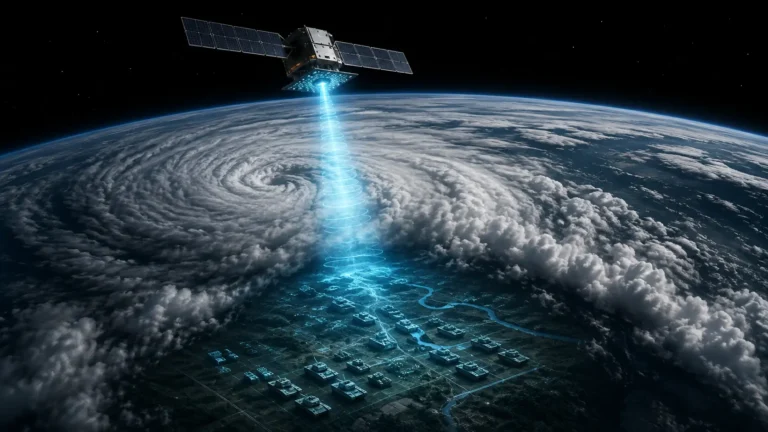
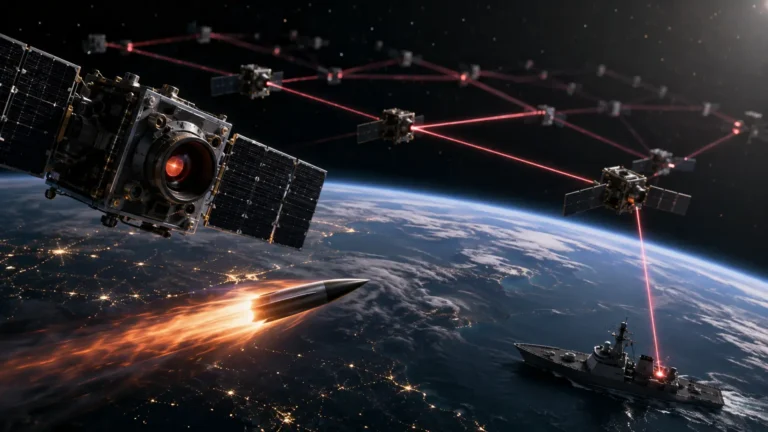
The Low-Earth Orbit (LEO) Telemetry Integration. By the mid-2030s, the CEC network will sever its reliance on aircraft entirely. The Space Development Agency is building a proliferated constellation of hundreds of LEO tracking satellites. These satellites will peer down from space, tracking hypersonic and cruise missiles instantly upon launch. Using ultra-secure optical laser communication links, the satellite constellation will beam fire-control quality composite tracks directly into the vertical launch tubes of warships in milliseconds, establishing an invincible, global, orbital sensor-to-shooter mesh.
Most Likely Scenario
Cooperative Engagement Capability is the most critical software and networking advantage currently held by Western navies. While hypersonic missiles and railguns capture the public imagination, the true lethality of a military is determined by its ability to close the “Kill Chain” faster than the enemy. By perfectly decentralizing the eyes and the fists of the fleet, CEC guarantees that if a single unit sees a threat, the entire armada can instantly pull the trigger.
Key Takeaways
- Because the Earth is round, ship radars cannot see low-flying missiles until they are roughly 20 miles away, giving the crew seconds to react.
- Cooperative Engagement Capability (CEC) solves this by sharing the raw radar data from every ship and plane in the fleet in real-time, creating a single, perfect “hive mind.”
- This allows a high-flying radar plane (like the E-2D Hawkeye) to see a target hundreds of miles away and beam the exact coordinates down to a ship.
- The ship can execute an “Engage on Remote”—firing a missile at the target without its own radar ever seeing the enemy.
- Older networks like Link 16 only share compressed summaries of data, which is too inaccurate to guide a weapon. CEC shares raw math, making it the only network accurate enough for fire control.
- This technology completely neutralizes enemy strategies that rely on hiding below the radar horizon, allowing the Navy to shoot down threats from positions of absolute safety.
Glossary
Aegis Combat System: The highly advanced, centralized computer brain and radar system used on U.S. Navy cruisers and destroyers to track and destroy incoming missiles.
Anti-Access/Area Denial (A2/AD): A military strategy that uses long-range missiles and radars to create a massive “bubble” that prevents enemy ships and aircraft from entering a specific geographic region.
Composite Track: A single, mathematically flawless digital representation of a target created by fusing the raw radar measurements from multiple different ships and planes simultaneously.
Engage on Remote (EoR): A combat tactic where a ship fires a weapon at a target using entirely off-board targeting data provided by another vehicle on the network.
Naval Integrated Fire Control-Counter Air (NIFC-CA): The overarching U.S. Navy strategy and architecture that utilizes the CEC network and the SM-6 missile to shoot down targets beyond the radar horizon.
Radar Horizon: The physical limit of a radar’s vision caused by the curvature of the Earth, creating a dangerous blind spot close to the ocean surface.
Sources
U.S. Naval Institute (USNI): The Cooperative Engagement Capability
Raytheon Missiles & Defense: Cooperative Engagement Capability (CEC) Network
Johns Hopkins APL Technical Digest: The Cooperative Engagement Capability Systems Architecture
Defense Technical Information Center (DTIC): Naval Integrated Fire Control – Counter Air (NIFC-CA)
Congressional Research Service (CRS): Navy Aegis Ballistic Missile Defense (BMD) Program