Advertisement
)
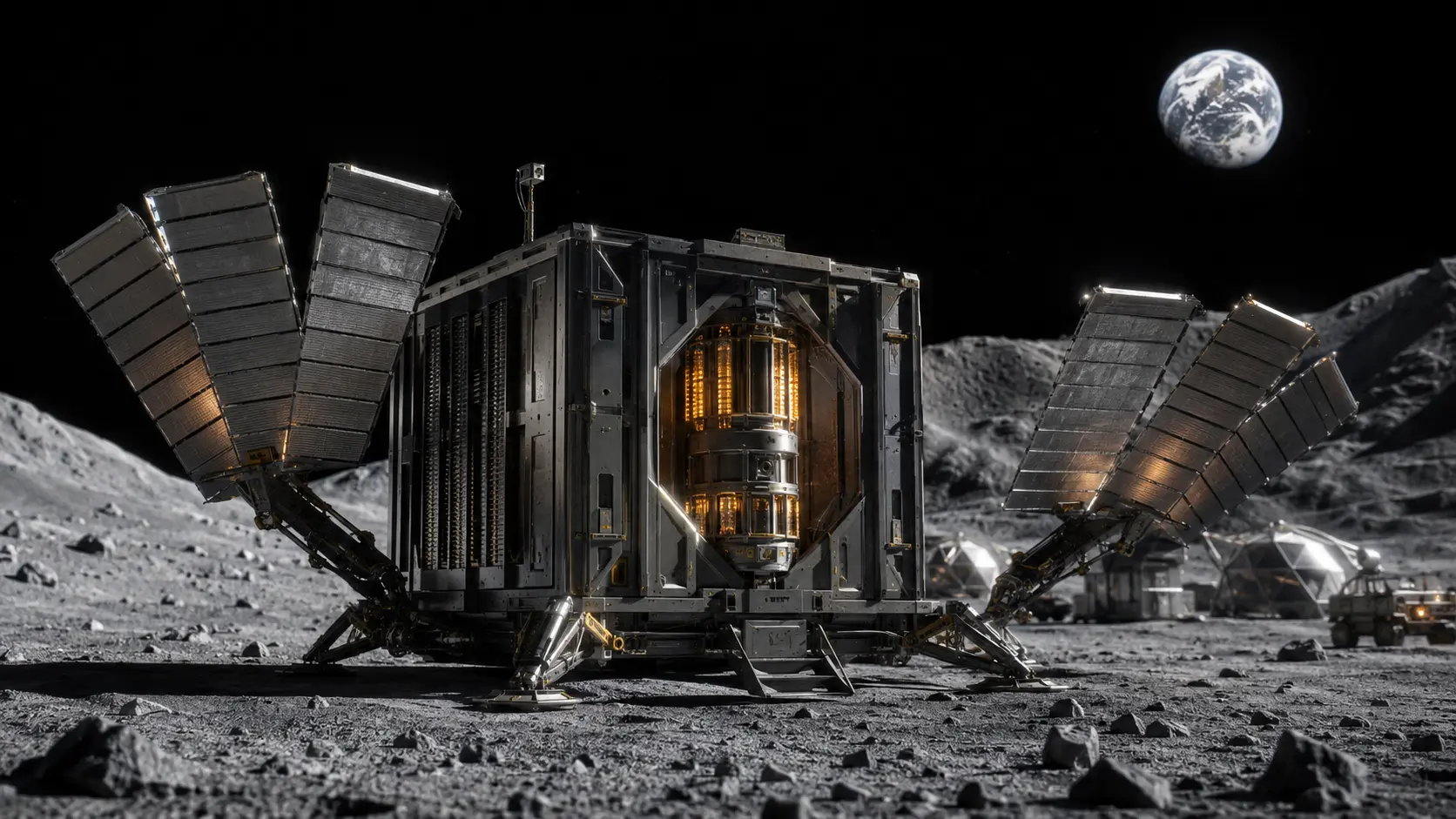

If you want to build a permanent human colony on the Moon, you have to survive the night. Unlike Earth, the Moon rotates agonizingly slowly. When the sun sets on a lunar base, darkness lasts for 14 straight Earth days. The temperature plunges to -130°C, freezing lubricants, shattering electronics, and killing astronauts. Furthermore, the most valuable real estate on the Moon—the craters at the South Pole that hold millions of tons of water ice—are “Permanently Shadowed Regions” (PSRs) that have not seen sunlight in billions of years. To survive this, space agencies cannot use solar panels. Trying to store enough solar energy in lithium-ion batteries to power a habitat for 14 days in the freezing dark would require batteries so heavy they would bankrupt any space agency attempting to launch them off Earth.
Why should you care right now? Because NASA is officially abandoning solar reliance for deep space outposts. To keep the lights on and the life-support systems running, engineers have designed “Fission Surface Power” (FSP) units. These are fully autonomous, miniaturized nuclear reactors packaged into the size of a standard shipping container. Once dropped onto the lunar surface, they turn on and generate 40 kilowatts of continuous, weather-proof electricity for an entire decade. By mastering liquid metal heat pipes and Stirling engine thermodynamics in a vacuum, the aerospace industry is building the ultimate cosmic extension cord, making the permanent colonization of the Moon and Mars physically possible.
What is Space Fission Surface Power (FSP)?
Space Fission Surface Power (FSP) is a highly compact, 40-kilowatt nuclear reactor designed for extraterrestrial deployment. Using a low-enriched uranium core, liquid metal heat pipes, and Stirling engine power conversion, the system provides continuous, sun-independent baseload electricity to sustain lunar and Martian habitats over a 10-year operational lifespan.
At a Glance
- Concept: A mini nuclear power plant that fits on a single rocket. It powers itself, requires no human maintenance, and produces enough electricity to run a small lunar town.
- Why it matters: The Moon is dark for 14 days at a time. Batteries are too heavy to launch from Earth. Nuclear fission is the only technology with enough energy density to keep astronauts alive in the dark.
- Who uses it: NASA (Artemis Program), the Department of Energy (DOE), and defense contractors like Lockheed Martin and Westinghouse.
- Biggest takeaway: Earth reactors use water to move heat and spin turbines. You can’t do that in space. These reactors use liquid metal inside pipes to move the heat, and pistons driven by expanding helium gas to generate the electricity.
In Simple Words
Imagine you are going camping in the Arctic for two weeks in the dead of winter, where there is absolutely no sunlight.
If you bring Solar Panels and Batteries, you will freeze. You can’t charge the panels in the dark, and carrying enough batteries to run a heater for two weeks would make your backpack weigh 10,000 pounds. You would never make it up the mountain.
If you bring a Fission Surface Power (FSP) unit, it is like bringing a magical, indestructible, glowing hot rock in a lead box. You set the box in the snow. The rock creates intense heat just by sitting there. The box uses a clever engine to turn that heat into electricity to run your heater, your lights, and your radio. It weighs almost nothing compared to the batteries, it doesn’t care if the sun is shining, and it won’t run out of fuel for ten years.
Why This Matters
For Aerospace Engineers, Space Tech Investors, and Mission Planners, FSP solves the Payload Mass Penalty of deep space exploration.
In the aerospace industry, mass is money. Launching one kilogram to the lunar surface costs tens of thousands of dollars. To power a commercial lunar ice-mining facility using solar panels, a company would need to launch a field of panels, plus thousands of kilograms of chemical batteries to survive the lunar night.
A 40 kWe FSP unit is engineered to weigh less than 6,000 kilograms total. It fits seamlessly inside the payload fairing of a commercial heavy-lift rocket (like SpaceX’s Starship or Blue Origin’s New Glenn). By packing a decade of multi-megawatt total energy yield into a 6-ton box, FSP radically alters the economic viability of off-world manufacturing and resource extraction.
The Evolution of Space Power: RTGs to Lunar Fission
The United States has only flown one nuclear reactor in space: the SNAP-10A in 1965. Since then, deep space probes (like the Voyager and Curiosity rovers) have used RTGs (Radioisotope Thermoelectric Generators). RTGs are essentially warm lumps of Plutonium-238 that produce a tiny trickle of electricity (about 100 watts).
RTGs are great for a small robot, but they cannot power a human habitat. A lunar base requires 40,000 watts (40 kWe). To cross that massive power chasm, the industry had to abandon the passive decay of Plutonium and return to active, controlled nuclear fission—splitting atoms to generate profound industrial heat. FSP is the graduation of space power from the robotic era to the human colonization era.
How Space Fission Surface Power (FSP) Works
Building a nuclear reactor that operates safely in a vacuum without water, air, or human maintenance requires abandoning almost all Earth-based nuclear engineering principles. Here is the first-principles breakdown of the architecture.
1. The Fundamental Problem: Boiling Water in a Vacuum
On Earth, nuclear reactors are giant kettles. The uranium heats water, the water turns to high-pressure steam, and the steam spins a massive turbine.
In space, using water is catastrophic. Water freezes in the shadows and boils in the sun. Furthermore, there is no gravity to naturally circulate convection currents, and no atmosphere to cool the steam back into water.
2. The Core Mechanism: The Solid LEU Core
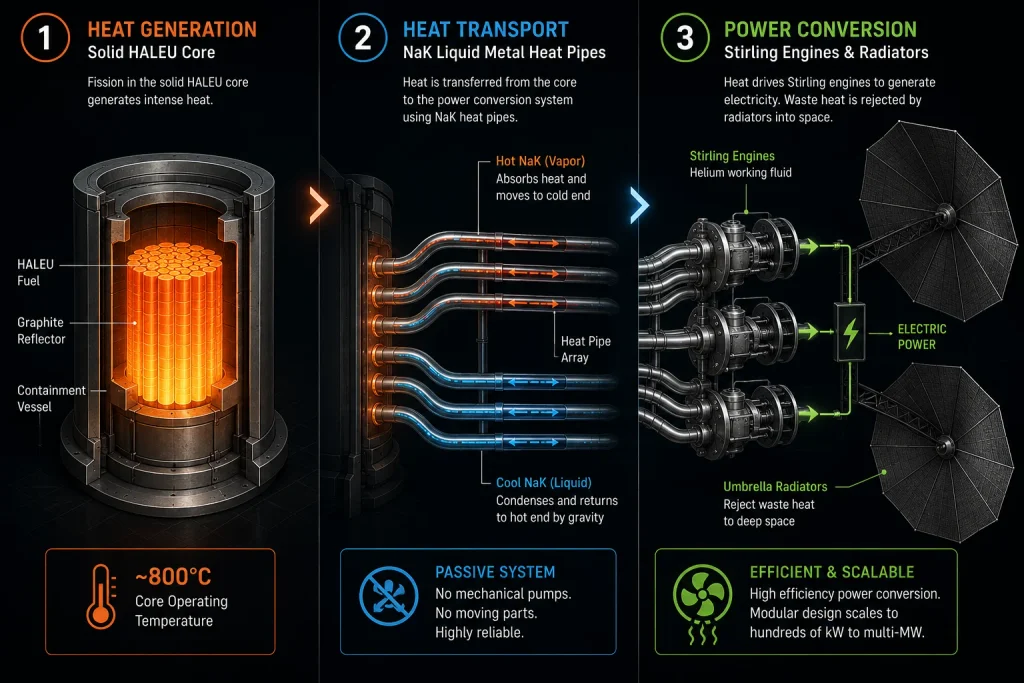
The FSP uses a solid core of High-Assay Low-Enriched Uranium (HALEU). Unlike Earth reactors filled with thousands of fuel rods suspended in a swimming pool of water, the FSP core is essentially a solid metal cylinder of uranium-molybdenum alloy. It uses a single, simple rod of boron carbide that slides in and out of the center to control the nuclear reaction. If anything goes wrong, the rod drops in, and the reactor safely shuts down.
3. Technical Depth: Sodium-Potassium (NaK) Heat Pipes
To get the heat out of the solid core without using water, engineers use Heat Pipes.
These are sealed titanium tubes filled with a liquid metal alloy of Sodium and Potassium (NaK). The heat from the uranium boils the liquid metal into a vapor at one end of the tube. The vapor shoots down the tube at the speed of sound, carrying massive heat. At the other end, it cools, turns back into liquid, and a microscopic metal sponge (a “wick”) sucks the liquid back to the reactor core using capillary action. No mechanical pumps are required. It operates entirely on physics and has zero moving parts to break.
4. Bypassing the Turbine: Stirling Engines
The heat pipe brings the 800°C heat to a Stirling Engine.
A Stirling engine is a closed cylinder filled with helium gas. When the heat from the pipe hits the bottom of the cylinder, the helium gas rapidly expands, pushing a piston upward. The top of the cylinder is connected to a cold radiator, which cools the gas, making it contract and pulling the piston back down. This rapid expansion and contraction drives a linear alternator, converting the heat directly into electricity with high efficiency (over 25%), entirely bypassing the need for steam turbines.
5. Real-World Consequences: Vacuum Heat Rejection
The engine only works if there is a massive temperature difference between the hot side and the cold side. The biggest challenge in space is getting rid of waste heat, because there is no air to blow over a radiator. The FSP must deploy massive, umbrella-like radiator panels. These panels glow with waste heat, slowly bleeding the thermal energy away via infrared radiation into the dark vacuum of space.
FSP Use Cases: Lunar Ice Mining and Mars Propulsion
The design and validation of compact fission systems dictate the timeline for the Artemis human landing missions and subsequent Mars architectures.
The KRUSTY Prototype (The Predecessor): In 2018, NASA and the DOE completed the Kilopower Reactor Using Stirling Technology (KRUSTY) experiment in the Nevada desert. They built a fully functional 1-kilowatt space reactor. During testing, engineers intentionally shut off the cooling systems, removed the control rods, and attempted to push the reactor to catastrophic failure. The reactor perfectly self-regulated; as it got too hot, the physics of the uranium core naturally slowed the reaction down. KRUSTY proved that solid-core, heat-pipe, Stirling-engine reactors are intrinsically safe, providing the exact mechanical blueprint for the larger 40 kWe FSP currently in development.
Lunar Water-Ice Mining (ISRU): The primary goal of the Artemis program is In-Situ Resource Utilization (ISRU)—mining the Moon for resources instead of bringing them from Earth. The water ice trapped in the dark craters of the lunar South Pole can be melted and split into liquid hydrogen and liquid oxygen (rocket fuel). However, running heavy excavators, thermal drills, and chemical electrolysis plants in the freezing darkness requires massive amounts of power. A single 40 kWe FSP unit landed on the rim of the Shackleton crater provides the uninterrupted thermal and electrical power required to operate an off-world propellant factory.
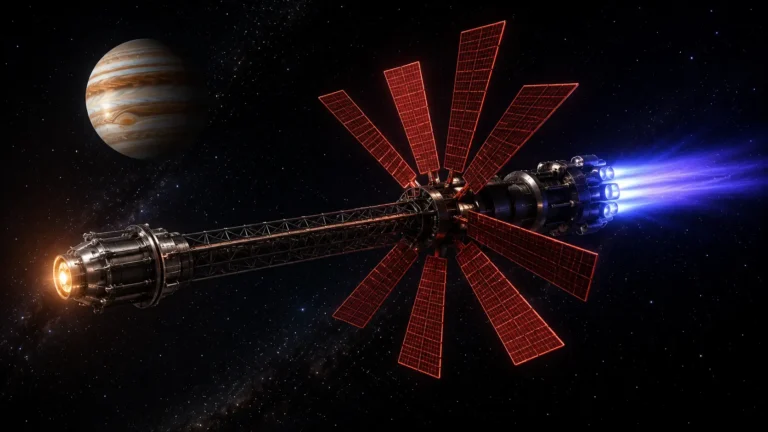
Nuclear Electric Propulsion (NEP) for Mars: The FSP technology does not stay on the surface. If you take the exact same 40 kWe reactor and bolt it to the back of a spaceship, you can use the electricity to power an ion thruster (firing xenon or argon gas at high speeds). This Nuclear Electric Propulsion (NEP) allows spacecraft to constantly accelerate for months at a time. NEP drastically cuts the travel time between Earth and Mars, reducing astronauts’ exposure to deep-space cosmic radiation and zero-gravity muscle atrophy.
Economic & Strategic Impact
The core strategic value of FSP is the Standardization of the Extraterrestrial Plug.
In the current space economy, every satellite and rover is a bespoke, self-contained unit. If a rover’s solar panel breaks, the million-dollar rover dies.
FSP changes the paradigm from “self-contained power” to “utility grid power.” Once NASA lands an FSP reactor on the Moon, it acts as a centralized municipal power plant. Commercial companies (like Intuitive Machines or Astrobotic) can land their own rovers, habitats, and mining equipment near the reactor and literally “plug in.” By providing a standardized, heavily subsidized power grid on the Moon, the U.S. government drastically lowers the capital expenditure required for private corporations to operate in space, accelerating the commercialization of the cislunar economy.
Advantages
- Sun-Independent Operations: Provides continuous, 24/7 power regardless of the 14-day lunar night, dust storms (on Mars), or orbital shadows, allowing habitats to survive in the most hostile environments.
- Extreme Mass Efficiency: A 6,000-kilogram FSP replaces tens of thousands of kilograms of heavy lithium-ion batteries and fragile solar arrays, freeing up rocket payload capacity for scientific instruments and human life support.
- Intrinsic Safety: The reactor is launched “cold” (turned off and non-radioactive). It is only turned on once it safely reaches the Moon. If the system overheats or a heat pipe breaks, the physics of the core naturally expand and shut the nuclear reaction down without human intervention.
- Scalability: If a lunar base grows, engineers do not redesign the reactor. They simply launch a second identical 40 kWe container and plug it into the local microgrid.
Limitations
- Radiation Shielding Weight: A working reactor emits deadly neutron and gamma radiation. To protect astronauts, the FSP must have a “Shadow Shield” (a thick layer of lithium hydride and depleted uranium) placed between the core and the habitat. This shield alone often accounts for up to 30% of the reactor’s total weight, heavily penalizing the launch mass.
- Regolith Scattering: On Earth, radiation shoots into the air. On the Moon, radiation hits the ground (regolith) and scatters outward like a shotgun blast. Astronauts cannot just stand behind the Shadow Shield; they must be positioned miles away, or the reactor must be physically buried in a crater or surrounded by sandbags of lunar dirt to absorb the scattered neutrons.
- Radiator Vulnerability: The massive, umbrella-like radiator panels required to dump waste heat into the vacuum of space are fragile. A strike from a micrometeoroid could puncture the coolant lines, crippling the reactor’s ability to shed heat and forcing an automatic shutdown.
Common Misconceptions
Misconception: If the rocket blows up on the launch pad, it will cause a nuclear explosion.
Reality: The reactor is launched “cold.” The uranium inside has barely any radioactivity before it is turned on. If the rocket explodes, the reactor core is designed to survive the blast and crash into the ocean intact, presenting less environmental risk than the rocket fuel itself.
Misconception: The reactor needs a crew of nuclear engineers to run it.
Reality: The FSP is entirely autonomous. Because it uses passive heat pipes and self-regulating physics, it requires zero human maintenance, no refueling, and no on-site operators for its entire 10-year lifespan.
Misconception: 40 kilowatts is a massive amount of power.
Reality: 40 kWe is enough to power about 30 standard American homes. It is a massive amount of power for space, but it is tiny compared to an Earth-based nuclear plant (which generates 1,000,000 kilowatts).
What Most People Miss
The disruptive intelligence value of High-Assay Low-Enriched Uranium (HALEU).
Historically, naval submarines and space reactors used Highly Enriched Uranium (HEU—weapons-grade, >90% enriched). HEU makes reactors incredibly small and light, but it creates a massive geopolitical proliferation risk. If an HEU reactor crashes or is stolen, it can be used to build a nuclear bomb.
To avoid these security nightmares, NASA mandated that the FSP must use HALEU (enriched between 5% and 20%). HALEU is utterly useless for building a weapon, completely de-risking the launch and deployment process. However, HALEU is less energy-dense, forcing engineers to use beryllium-oxide neutron reflectors and advanced Stirling engines to squeeze every drop of efficiency out of the heavier, lower-grade fuel, driving a renaissance in civilian micro-reactor metallurgy.
Comparison Table
| Feature | Solar Panels + Batteries | Radioisotope Generators (RTG) | Fission Surface Power (FSP) |
| Power Output | High (Day) / Zero (Night) | Tiny (~100 Watts) | High (40,000 Watts) |
| Duration capability | Days (Limited by battery mass) | Decades | 10+ Years |
| Mass Efficiency | Very Poor for lunar night | Excellent (for small robots) | Excellent (for habitats) |
| Sunlight Dependency | 100% Dependent | Independent | Independent |
| Moving Parts | Solar tracking hinges | Zero | Stirling Engine Pistons |
Case Study
Situation: As NASA transitioned from the Apollo era (short flags-and-footprints missions) to the Artemis era (permanent, sustainable lunar presence), mission planners faced a fatal bottleneck. Establishing a habitat at the Lunar South Pole required continuous power to run life support, heat the habitat during the -250°C night, and power oxygen-extraction drills.
Challenge: Solar and battery architectures broke the mass limits of the Space Launch System (SLS) rocket. Planners needed a 40 kWe power source that was light enough to launch, small enough to fit on a commercial lunar lander, and robust enough to operate autonomously in a vacuum for a decade.
Solution (The FSP Industry Solicitations): In 2022, NASA and the DOE abandoned in-house siloed development and issued commercial contracts. They awarded $5 million each to three joint ventures: Lockheed Martin, Westinghouse, and IX (Intuitive Machines and X-Energy). The mandate was to deliver a preliminary design for a 40 kWe reactor utilizing a HALEU core, fitting within a 12-meter by 4-meter cylinder, and weighing under 6,000 kilograms.
Outcome: The Phase 1 designs universally gravitated toward the legacy of the KRUSTY experiment—utilizing solid cores, alkali-metal heat pipes, and highly efficient Stirling converters to hit the strict mass and power targets. The commercial engagement proved that the aerospace supply chain was mature enough to manufacture extraterrestrial nuclear hardware.
Lessons Learned: The FSP initiative validated that deep space colonization cannot rely on incremental improvements to solar technology. To conquer the outer solar system, humanity must transition to advanced nuclear infrastructure. By leveraging private defense and energy contractors, NASA successfully accelerated the deployment timeline, establishing fission as the non-negotiable backbone of the cislunar economy.
Future Outlook
Next 12–24 Months
The era of Phase 2 Down-Selection and Flight Hardware. NASA and the DOE will soon transition the FSP program from paper designs to physical metal. They will down-select from the three competing commercial teams (Lockheed, Westinghouse, IX) to a single primary contractor to build the flight-ready unit. The immediate engineering focus will shift to rigorous vacuum-chamber testing of the massive thermal radiators and proving the long-term reliability of the Stirling engine alternators under simulated launch vibration profiles.
Next 3–5 Years
The scaling of In-Situ Shielding Robotics. Launching heavy lead and uranium radiation shields from Earth is wildly inefficient. Over the next five years, the focus will shift to autonomous construction rovers. Startups will design robotic bulldozers capable of operating in the lunar dust. Before the FSP reactor is turned on, these rovers will either dig a deep hole to bury the reactor or build a thick wall of lunar dirt (regolith) around it. This “In-Situ” shielding approach absorbs the lethal neutron scattering using local materials, allowing astronauts to safely live much closer to the power plant.
Next 10 Years
The Martian Microgrid Deployment. By the late 2030s, the 40 kWe lunar FSP design will be mass-produced and adapted for the Martian atmosphere. Because Mars has an atmosphere (albeit thin) and massive dust storms that block out the sun for months, solar power is famously unreliable (having killed several NASA rovers). The first human missions to Mars will send three to four FSP units ahead of the crew. These reactors will automatically deploy, network together into a 160 kWe microgrid, and spend two years pulling CO₂ out of the Martian air to manufacture liquid rocket fuel, ensuring the astronauts have a fully fueled return vehicle waiting for them before they even leave Earth.
Most Likely Scenario
Space Fission Surface Power represents the crossing of the Rubicon for human spaceflight. We are transitioning from explorers carrying batteries in their backpacks to settlers plugging into a nuclear grid. As the geopolitical race to secure the water-ice reserves of the Lunar South Pole accelerates, the nation that successfully deploys the first FSP reactor will dictate the physical location and operational tempo of the first permanent off-world city.
Key Takeaways
- The Moon experiences 14 days of total darkness followed by 14 days of sunlight. Solar panels and heavy batteries are mathematically incapable of keeping a large human base alive through the freezing night.
- NASA is building Fission Surface Power (FSP) units—small, 40-kilowatt nuclear reactors that fit inside a rocket and provide uninterrupted electricity for 10 years without refueling.
- Because there is no water in space to make steam, these reactors use “heat pipes” filled with liquid metal to safely pull heat out of the uranium core without using any mechanical pumps.
- The heat drives a “Stirling Engine,” which uses the rapid expansion and contraction of helium gas to push a piston and generate electricity.
- The biggest danger is radiation hitting the lunar dirt and scattering toward the astronauts. To fix this, future missions will use robots to bury the reactor in a crater or build a wall of moon dirt around it.
- The reactor is launched turned off (cold) and uses Low-Enriched Uranium, meaning if the rocket explodes on the launch pad, it cannot cause a nuclear explosion or a major radiation leak.
Glossary
High-Assay Low-Enriched Uranium (HALEU): Uranium enriched between 5% and 20%. It provides enough energy density to run a small reactor but is impossible to use for a nuclear weapon, making it politically safe to launch.
In-Situ Resource Utilization (ISRU): The practice of using local materials found in space (like melting lunar ice for water or using moon dirt for radiation shielding) instead of paying millions of dollars to launch them from Earth.
Permanently Shadowed Regions (PSRs): Deep craters at the poles of the Moon that have not seen sunlight in billions of years. They contain massive reserves of frozen water but are impossible to explore using solar panels.
Radiator Panels: Massive, umbrella-like metal fins attached to a spaceship or reactor that dump excess, waste heat out into the vacuum of space using infrared radiation.
Sodium-Potassium (NaK): A liquid metal alloy used inside sealed heat pipes to transfer extreme heat away from the nuclear core faster than water, without boiling or creating dangerous pressure.
Stirling Engine: A closed-cycle engine that generates electricity not by burning fuel, but by repeatedly heating and cooling a trapped gas (like helium) to drive a piston up and down.
Sources
NASA: Fission Surface Power Project Overview
Department of Energy (DOE): Kilopower Project and Space Nuclear Power
Los Alamos National Laboratory: KRUSTY: Kilopower Reactor Using Stirling Technology
Lockheed Martin Space: Space Nuclear Power and Fission Surface Systems
Aerospace Corporation: Powering the Artemis Program: The Role of Nuclear Fission