Advertisement
)
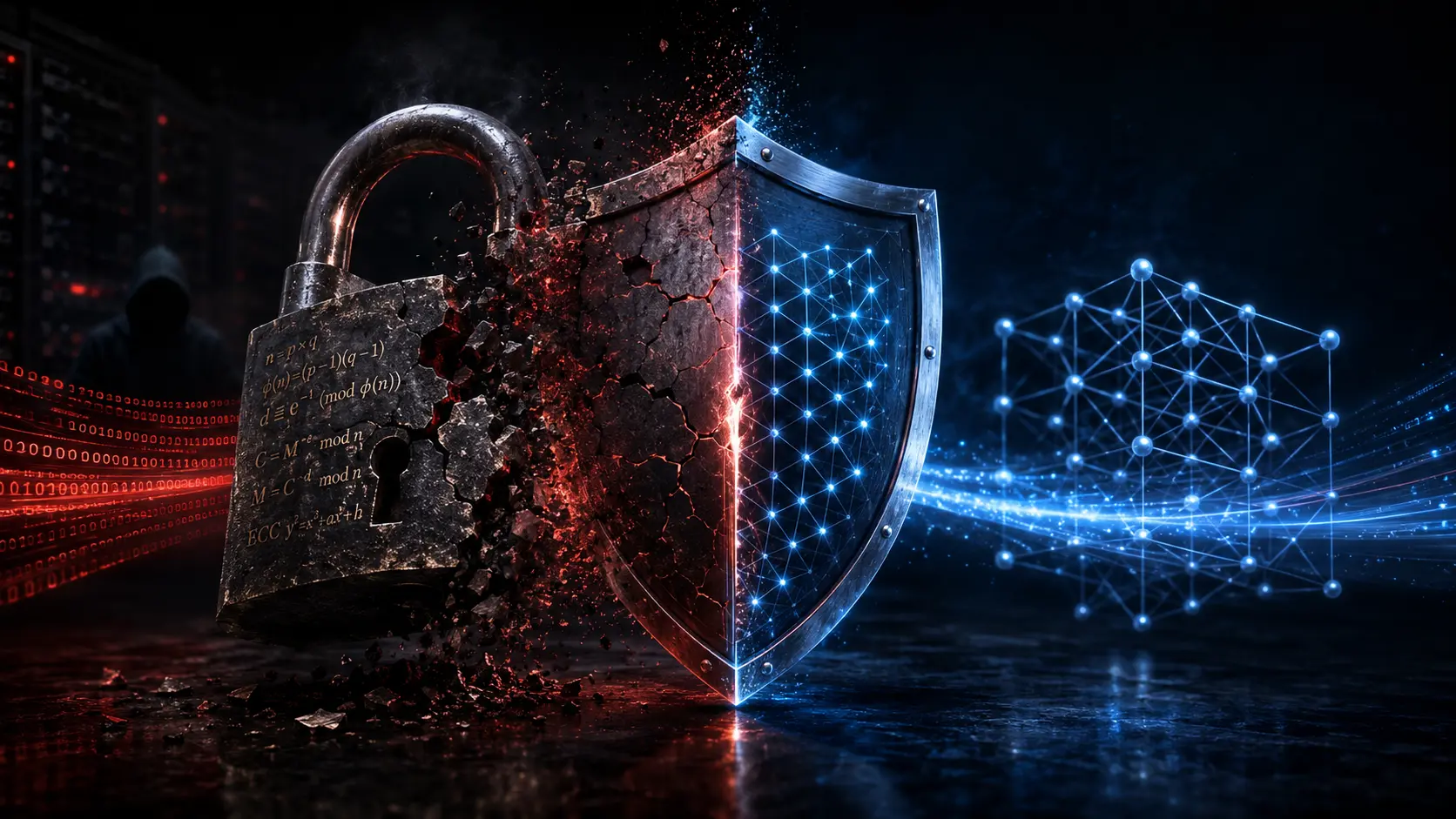

Every secure digital transaction on Earth—from a $50 billion interbank wire transfer to your encrypted medical records—relies on a mathematical illusion. For forty years, the internet has been secured by algorithms like RSA, which assume that multiplying two massive prime numbers is easy, but factoring them back apart is impossibly slow for a standard computer. This illusion is about to be shattered. Quantum computers do not calculate linearly; they operate in multidimensional states. Using Shor’s algorithm, a sufficiently powerful quantum computer will tear through RSA and Elliptic Curve Cryptography in hours, rendering the entire global cryptographic infrastructure utterly defenseless.
Why should you care right now? Because adversaries are actively executing “Harvest Now, Decrypt Later” (HNDL) attacks. State-sponsored hacking groups are vacuuming up oceans of encrypted corporate data today, storing it on massive server farms, and waiting for the day they possess the quantum hardware to unlock it. If your enterprise data has a shelf-life longer than five years, it is already compromised. In response, the National Institute of Standards and Technology (NIST) finalized the new Post-Quantum Cryptography (PQC) algorithms. Transitioning your entire enterprise IT stack to these new, quantum-resistant lattice algorithms is no longer a future-proofing exercise; it is an immediate, existential compliance mandate.
What is Post-Quantum Cryptography (PQC) Migration?
Post-Quantum Cryptography (PQC) Migration is the enterprise-wide transition from vulnerable legacy encryption algorithms, like RSA and ECC, to quantum-resistant mathematical structures, primarily lattice-based cryptography. This mandatory IT overhaul replaces susceptible public-key infrastructures with algorithms proven to withstand decryption attempts by cryptographically relevant quantum computers.
At a Glance
- Concept: Ripping out the math that protects the internet today and replacing it with harder, multi-dimensional math that even a quantum computer cannot solve.
- Why it matters: Hackers are stealing your encrypted data right now. They can’t read it yet, but they are saving it in data centers until quantum computers are built.
- Who uses it: Fortune 500 CISOs, federal agencies (under national security mandates), and cloud infrastructure providers executing massive cryptographic infrastructure upgrades.
- Biggest takeaway: The new PQC keys are physically larger and heavier than old encryption keys. Shoving these massive new keys through legacy network pipelines will slow down internet traffic and break older hardware.
In Simple Words
Imagine your company’s data is locked inside a vault secured by a massive combination lock (RSA encryption). Today, guessing the combination would take a thief a billion years of spinning the dial. You feel completely safe.
However, a new type of thief is being born (the Quantum Computer). This thief doesn’t spin the dial one number at a time. This thief has a magical tool that allows them to test every single combination on the dial simultaneously, opening the vault in five minutes.
PQC Migration is the process of ripping that combination lock off your vault before the new thief arrives. Instead of a combination, you install a lock made of a chaotic, 500-dimensional maze (Lattice-based cryptography). Even with their magical simultaneous-guessing tool, the thief gets hopelessly lost in the maze. The vault remains secure.
Why This Matters
For IT Directors, CISOs, and Network Architects, PQC migration exposes the terrifying reality of Cryptographic Sprawl.
Most enterprises have absolutely no idea where their encryption actually lives. Over decades, developers have hard-coded RSA and ECC algorithms directly into application source code, embedded them in proprietary hardware security modules (HSMs), and buried them deep inside legacy VPN configurations.
Migrating to PQC isn’t as simple as downloading a software patch. It requires a forensic audit of the entire enterprise software supply chain. If an IT director misses a single legacy microservice communicating via an old TLS 1.2 handshake using RSA-2048, that single endpoint becomes the fatal breach point for a quantum adversary. The compliance mandates of 2026 force enterprises to establish “Cryptographic Agility”—the architectural ability to swap out encryption algorithms across the entire network dynamically without breaking the business.
Micro-Insight: Encryption is the structural rebar of your software. You are being asked to swap out the rebar while the skyscraper is fully occupied and functioning.
The NIST PQC Regulatory Timeline
The global migration to PQC was officially triggered by the United States government.
With the publication of the finalized Federal Information Processing Standards (FIPS 203, 204, and 205), the National Institute of Standards and Technology (NIST) established the mathematical baseline. Simultaneously, mandates like the National Security Memorandum 10 (NSM-10) legally bound federal agencies to prepare for the PQC transition.
This is not isolated to governments. Because heavily regulated industries (banking, healthcare, critical infrastructure) rely on federal compliance frameworks as their baseline, the NIST standards immediately cascaded into the private sector. By 2026, failing to initiate a PQC migration plan is actively classified as gross negligence during cybersecurity compliance audits.
HNDL Quantum Threat Simulator
“Harvest Now, Decrypt Later” PQC Migration Timeline
2026
2024
2035
2032
2028
2040
10 Years
1 Yr
25 Yrs
Compromised Data Window
2022 – 2026 (4 Years)
THREAT STATUS
SEVERE RETROACTIVE EXPOSURE
Cryptographic Principle: Data is vulnerable to Harvest Now, Decrypt Later (HNDL) if the time until Q-Day is shorter than the data’s required shelf-life. Any classical encryption (RSA/ECC) used before the PQC Migration Start will be intercepted and stored by adversaries. If that stored data remains sensitive when Q-Day arrives, it represents a catastrophic, retroactive enterprise breach. Shifting the PQC Migration earlier is the only mathematical defense.
How Post-Quantum Cryptography (PQC) Works
Replacing integer factorization with geometry requires a fundamental shift in how computers process public keys. Here is the first-principles breakdown of the architecture.
1. The Fundamental Problem: Shor’s Algorithm
Classical encryption (RSA/ECC) relies on mathematical trapdoors—problems that are easy to do in one direction but hard in reverse. Multiplying two prime numbers is easy; factoring the product is impossibly hard. However, in 1994, Peter Shor proved that a quantum computer could exploit quantum superposition and entanglement to find the prime factors exponentially faster, completely neutralizing the trapdoor.
2. The Core Mechanism: Lattices
To defeat Shor's algorithm, mathematicians turned to Lattice-based Cryptography. Imagine a grid of dots extending infinitely in hundreds of dimensions. The "trapdoor" in a lattice relies on the Shortest Vector Problem (SVP). If you are dropped into a random, chaotic coordinate within a 500-dimensional grid, finding the closest actual grid point (the shortest vector) is mathematically impossible, even for a quantum computer.
3. Technical Depth: ML-KEM (Kyber)
The primary standard for key establishment is Module-Lattice-Based Key-Encapsulation Mechanism (ML-KEM), formerly known as Kyber.
When two computers want to talk, they can't just send the secret password over the internet. Instead, Computer A creates a highly complex, multidimensional lattice puzzle. It hides the secret key inside the puzzle and sends the puzzle over the network. Computer B holds the specific mathematical matrix (the private key) required to untangle the dimensions and extract the secret key instantly.
Takeaway: We stopped hiding secrets behind big numbers. We are now hiding secrets inside hyper-complex, multi-dimensional geometric shapes.
4. Technical Depth: Key Size Bloat
Lattice puzzles require a lot of data to describe. An ECC public key might be a sleek 32 bytes. An ML-KEM public key is roughly 800 to 1,100 bytes—an increase of nearly 3,000%.
This "Key Bloat" is the primary engineering headache. When millions of devices try to execute TLS handshakes simultaneously using massive keys, the network experiences severe packet fragmentation and latency.
5. Real-World Consequences: Hybrid Cryptography
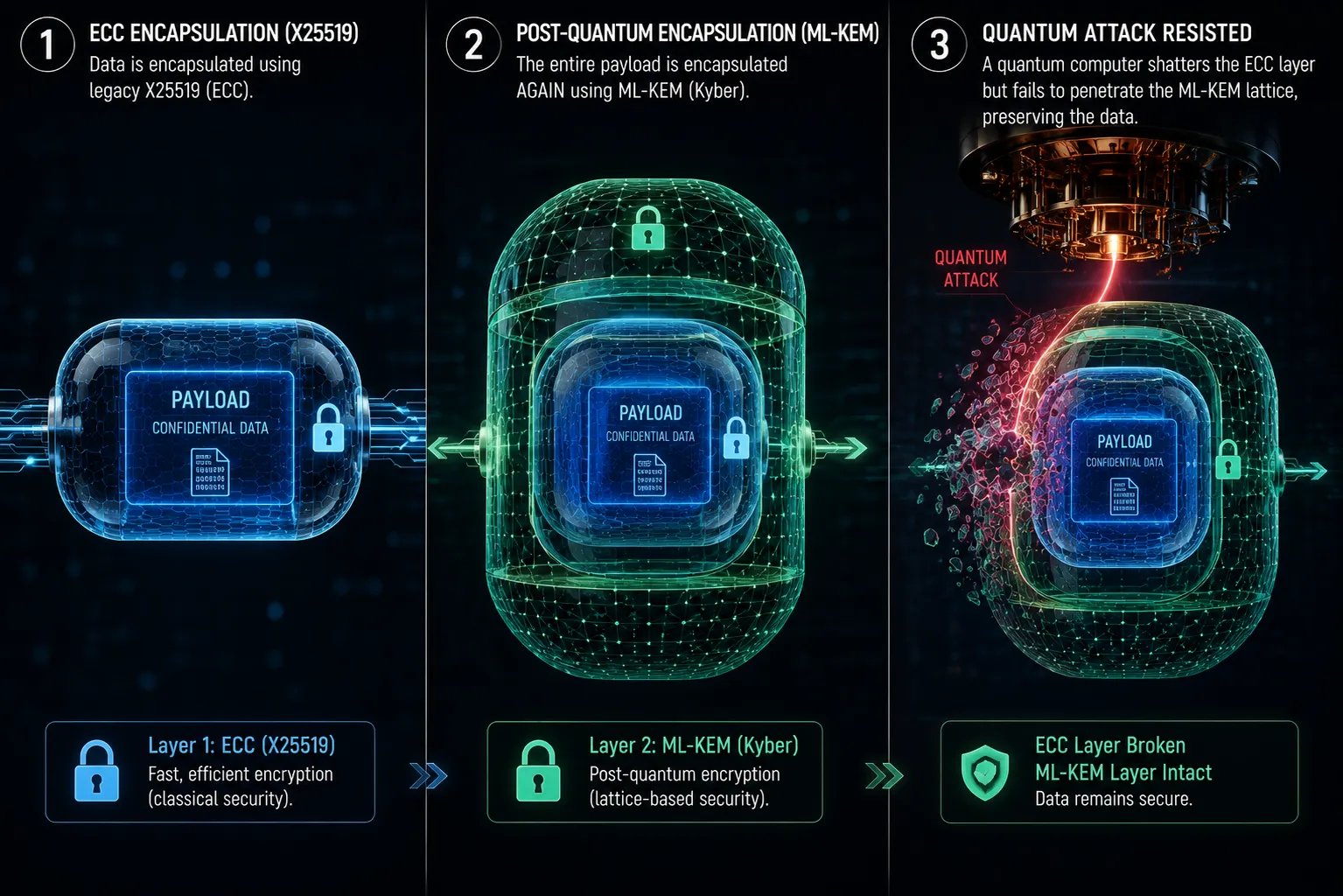
Because lattice algorithms are mathematically new, CISOs are terrified that a brilliant mathematician might discover a classical loophole that breaks them tomorrow. To hedge this risk, enterprises are deploying Hybrid Cryptography. They wrap the data in both the old algorithm (ECC) and the new algorithm (ML-KEM). An attacker must break both to steal the data. If the quantum math fails, the classical math holds. If the classical math is broken by a quantum computer, the quantum math holds.
Enterprise Use Cases for PQC Migration
PQC migration is tearing through the foundational infrastructure of the global digital economy.
Financial Services and SWIFT: The global banking network relies on encrypted ledgers to settle trillions of dollars in daily transactions. Banks are heavily targeted by HNDL attacks. Major financial institutions are aggressively upgrading their internal Hardware Security Modules (HSMs) to support ML-DSA (Dilithium) for digital signatures. This ensures that a quantum attacker in 2030 cannot retroactively forge a digital signature and authorize a fraudulent, multi-billion-dollar wire transfer.
IoT and Edge Computing: A smart meter or a pacemaker installed in 2026 will likely still be operating in 2036—well past Q-Day. These IoT devices have microscopic processors and run on tiny batteries. Forcing a low-power edge device to process a massive, 1,000-byte ML-KEM lattice key without draining its battery or crashing its memory buffer is driving a massive wave of hardware-accelerated PQC silicon design in the semiconductor industry.
Secure Web Browsing (TLS 1.3): The padlocks in your web browser are already migrating. Cloudflare, Google Chrome, and major content delivery networks (CDNs) have implemented hybrid key exchanges (combining X25519 with ML-KEM) for standard web traffic. If you visit a modern secure website, there is a high probability your connection is already shielded by post-quantum geometry.
Economic & Strategic Impact
The core strategic consequence of PQC is the Cybersecurity Capital Expenditure (CapEx) Shock.
Enterprises grossly underestimated the cost of replacing their cryptographic foundations. PQC migration is not a software subscription; it is a brutal, manual infrastructure overhaul. It requires purchasing new, quantum-capable HSM hardware, refactoring millions of lines of proprietary application code to support larger key payloads, and upgrading network load balancers to handle the increased bandwidth of hybrid TLS handshakes.
This creates a massive budgetary vacuum. Throughout 2026 and 2027, IT departments will be forced to cannibalize funding from other innovation initiatives (like AI integration or cloud expansion) simply to pay the immense compliance toll required to swap out their cryptographic rebar. Cybersecurity SaaS firms that offer automated "Cryptographic Discovery and Orchestration" tools are capturing staggering valuations by promising to reduce this manual labor.
Advantages
- Quantum Immunity: Mathematically verified to withstand decryption attempts by Shor’s algorithm running on cryptographically relevant quantum computers.
- Protection Against Retroactive Decryption: Halts the "Harvest Now, Decrypt Later" threat by securing current network traffic before the adversary's hardware matures.
- Forces Cryptographic Agility: The pain of the PQC migration is forcing enterprises to build flexible architectures, ensuring that the next time an algorithm breaks, replacing it will take days instead of years.
Limitations
- Performance Latency and Key Bloat: Lattice-based public keys and digital signatures are significantly larger than legacy ECC keys, causing slower connection times, network congestion, and packet fragmentation on legacy hardware.
- Implementation Vulnerabilities: The math is secure, but the code written by human developers is often flawed. PQC algorithms are highly complex and prone to "side-channel attacks," where hackers monitor the electricity or heat radiating off a microchip to steal the lattice key while the computer is processing it.
- Hardware Incompatibility: Millions of legacy IoT devices, industrial control systems (ICS), and older routers physically do not possess the memory buffers required to store and process a massive ML-KEM key. They will simply break and must be physically thrown away.
Takeaway: PQC solves a math problem but creates an engineering problem. You are replacing a sleek, highly optimized lock with a massive, heavy, clunky lock that doesn't fit on older doors.
Common Misconceptions
Misconception: We don't need PQC until Quantum Computers are built.
Reality: Due to "Harvest Now, Decrypt Later," the attack is happening today. If your data must remain secret for 10 years, and a quantum computer is built 7 years from now, your data is already compromised. You are out of time.
Misconception: Quantum computers will break AES-256 (Symmetric Encryption).
Reality: Quantum computers easily break Public-Key (Asymmetric) cryptography (RSA/ECC) using Shor's algorithm. They do not easily break Symmetric cryptography (AES-256). A quantum computer using Grover's algorithm will weaken AES-256, but simply doubling the key size maintains its security. AES-256 is already considered quantum-resistant.
Misconception: PQC algorithms require a quantum computer to run.
Reality: Post-Quantum Cryptography runs on standard, classical computers (your current laptop or server). It is classical math designed to be resistant to quantum attacks.
What Most People Miss
The disruptive capability of Digital Certificate Revocation Chaos.
When analysts discuss PQC, they focus on key encapsulation (keeping secrets safe). What they miss is the catastrophic threat to Digital Signatures (proving who you are).
Every piece of software on your computer, every website you visit, and every secure document you sign is validated by a digital certificate using legacy algorithms (like ECDSA). To migrate to PQC (ML-DSA), the entire global Public Key Infrastructure (PKI) ecosystem must revoke and reissue billions of digital certificates. If an enterprise fails to update its root certificates, all of its internal software will suddenly look like malware to its own servers, triggering a self-inflicted, enterprise-wide network blackout.
Comparison Table
| Cryptographic Standard | Primary Use Case | Key Size (Public) | Vulnerability to Quantum (Shor's Algorithm) | Enterprise Action Required |
| RSA-2048 | Key Exchange / Signatures | 256 bytes | Critically Vulnerable (Instant Break) | Deprecate and Replace |
| ECC (X25519) | Key Exchange | 32 bytes | Critically Vulnerable (Instant Break) | Deprecate and Replace |
| AES-256 | Bulk Data Encryption | 32 bytes | Resistant (Requires Grover's Mitigation) | Safe (Maintain 256-bit keys) |
| ML-KEM (Kyber) | Key Encapsulation (PQC) | 800 - 1568 bytes | Immune (Lattice-Based) | Deploy via Hybrid TLS |
| ML-DSA (Dilithium) | Digital Signatures (PQC) | 1312 - 2592 bytes | Immune (Lattice-Based) | Upgrade PKI/Certificates |
Case Study
Situation: A major global telecommunications provider was preparing its core 5G network backbone to support defense and intelligence contractors. During a 2025 compliance audit, the DoD notified the telecom that its network management traffic was shielded entirely by legacy elliptic curve (ECDHE) key exchanges. The intelligence community flagged this as an unacceptable HNDL risk, threatening to pull billions in federal contracts if a post-quantum architecture was not implemented within 18 months.
Challenge: Migrate the 5G core's transport layer security (TLS) to quantum-resistant standards without causing unacceptable latency spikes in voice/data routing, and without knowing the exact locations of all legacy hard-coded cryptographic calls across thousands of legacy servers.
Solution (The Cryptographic Agility Overlay): The telecom halted manual patching. Instead, they deployed a specialized Cryptographic Discovery and Orchestration SaaS platform. The software autonomously scanned the network, identifying every isolated instance of legacy ECC and RSA usage. The telecom then implemented a network-wide mandate for Hybrid Key Exchange. They wrapped their TLS 1.3 handshakes in both classical X25519 and the new NIST ML-KEM algorithm.
Outcome: The hybrid implementation successfully blocked the HNDL threat by introducing the lattice mathematical defense. The orchestration software detected that several older, edge-routing firewalls dropped the massive ML-KEM packets due to fragmentation errors. Because the telecom had established cryptographic agility, the software dynamically negotiated smaller, classical keys for those specific legacy devices while flagging them for immediate hardware replacement. The telecom secured their DoD compliance certification ahead of the 2026 deadline, transforming a rigid network into a cryptographically fluid architecture.
Lessons Learned: The migration validated that PQC cannot be treated as a brute-force software update. It requires extreme visibility into the network. By enforcing hybrid cryptography, the enterprise mathematically insulated itself against both the imminent quantum threat and the terrifying possibility that the new PQC math might harbor undiscovered classical flaws.
Future Outlook
Next 12–24 Months
The era of Discovery and Hybrid Implementation. Through 2026 and 2027, the primary enterprise focus will be the "Discovery Phase." CIOs will spend millions on automated tools just to figure out where their vulnerable encryption lives. Once mapped, the entire internet will transition heavily into Hybrid Mode. Web browsers, cloud providers, and VPNs will execute handshakes using both classical and PQC algorithms simultaneously, accepting the temporary bandwidth bloat as the necessary cost of hedging mathematical risk.
Next 3–5 Years
The scaling of Hardware Lifecycle Attrition. The software can be patched, but the hardware must die. Over the next five years, companies will hit a wall with legacy IoT devices, older HSMs, and industrial SCADA systems that simply lack the processing power to run ML-KEM or ML-DSA. We will see a massive, forced hardware replacement cycle. Semiconductor fabs will churn out specialized cryptographic co-processors optimized specifically for lattice matrix multiplication, permanently retiring the silicon that powered the RSA era.
Next 10 Years
The Post-Quantum Zero-Trust Baseline. By the mid-2030s, the concept of "PQC" will disappear from the lexicon; it will simply be "cryptography." Classical algorithms will be stripped from all major protocols and completely deprecated. The global digital economy will operate on a natively agile, lattice-based foundation. Any device attempting to connect to an enterprise network using an RSA key will be treated immediately as a hostile anomaly and quarantined by the Zero Trust architecture.
Most Likely Scenario
The migration to Post-Quantum Cryptography is the most profound and expensive plumbing project in the history of the internet. We are racing against an invisible clock to replace the foundation of digital trust before a quantum computer can break it. While the mathematical transition will be fraught with network latency, broken legacy hardware, and massive CapEx bloat, it is fundamentally unavoidable. PQC compliance is the ultimate, non-negotiable filter for the next era of enterprise survival.
Key Takeaways
- Quantum computers will easily break the mathematical locks (RSA and ECC) that currently protect all global banking, internet traffic, and classified data.
- Hackers are already executing "Harvest Now, Decrypt Later" attacks—stealing unreadable data today to unlock it as soon as quantum computers are built.
- The government finalized new Post-Quantum Cryptography (PQC) standards in 2026. These use multi-dimensional "lattice" puzzles that even quantum computers cannot solve.
- Migrating to PQC is incredibly difficult because the new keys are physically massive. They take up more bandwidth and cause older hardware and routers to crash.
- Companies are currently using "Hybrid Cryptography"—locking data with both the old math and the new math simultaneously—to ensure total protection during the transition.
Glossary
Cryptographically Relevant Quantum Computer (CRQC): A theoretical quantum computer powerful enough and stable enough to run Shor's algorithm and break modern encryption.
Cryptographic Agility: The architectural ability of an enterprise to quickly swap out one encryption algorithm for another across its entire network without breaking the system.
Harvest Now, Decrypt Later (HNDL): A cyberattack where adversaries steal encrypted data they cannot currently read, storing it in data centers until quantum hardware matures to decrypt it retroactively.
Lattice-based Cryptography: The new mathematical foundation for PQC. It relies on the extreme difficulty of finding the shortest vector in a chaotic, multi-dimensional grid.
ML-KEM (Kyber): The finalized NIST standard for Key Encapsulation. It allows two computers to securely share a secret password over the internet using lattice math.
ML-DSA (Dilithium): The finalized NIST standard for Digital Signatures. It proves identity and ensures a file or message has not been tampered with.
Shor's Algorithm: The specific quantum algorithm that allows quantum computers to instantly find the prime factors of massive numbers, completely neutralizing RSA encryption.
Sources
National Institute of Standards and Technology (NIST): FIPS 203, 204, and 205 Post-Quantum Cryptography Standards
Cybersecurity and Infrastructure Security Agency (CISA): Preparing for Post-Quantum Cryptography
World Economic Forum: The Quantum Economy and 'Harvest Now, Decrypt Later' Threat
SANS Institute: Navigating the Cryptographic Discovery Phase for PQC
Cloudflare: Defending against the quantum threat: Post-Quantum TLS