Advertisement
)
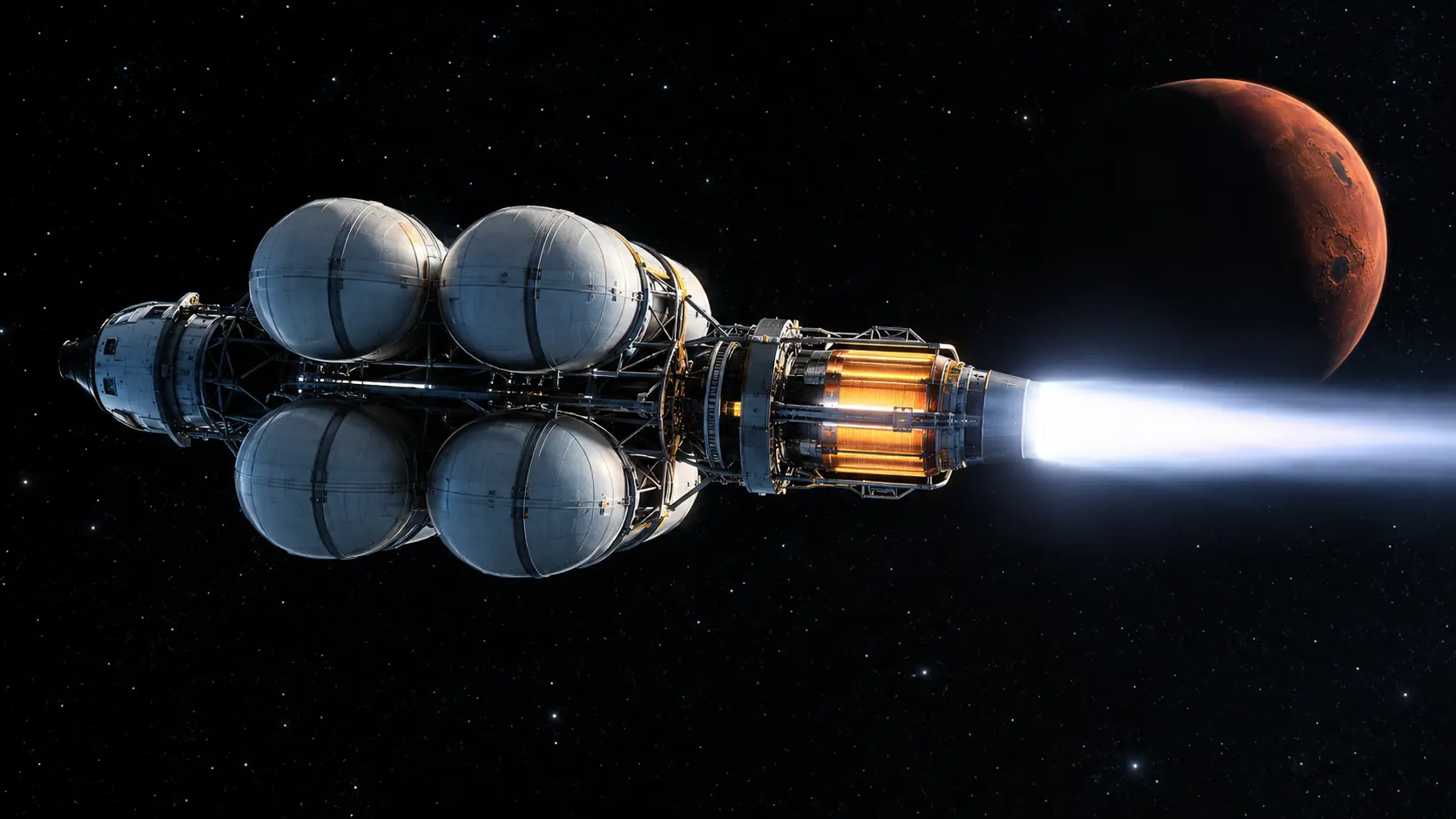

If humanity attempts to send astronauts to Mars using current chemical rockets, the journey will take up to nine months. That is nine months trapped inside a microscopic tin can, enduring relentless microgravity muscle atrophy and absorbing severe doses of cosmic radiation. We cannot simply pack more fuel to go faster; the rocket equation is merciless. Every pound of fuel you add requires even more fuel to lift it, creating an inescapable mathematical trap. The chemical bonds of rocket fuel have reached their absolute physical limit.
Why should you care right now? Because the aerospace industry has stopped trying to optimize fire and has moved entirely to splitting the atom. Enter Nuclear Thermal Propulsion (NTP). By placing a miniature nuclear reactor inside a rocket engine, spacecraft no longer need to carry heavy liquid oxygen to burn their fuel. They simply use nuclear fission to flash-heat liquid hydrogen to 2,700°C. This breakthrough is not science fiction—NASA and DARPA are actively building the DRACO orbital test vehicle right now. NTP is the exact technology that will transform deep space travel from a slow, dangerous drift into a rapid, point-and-shoot logistics network.
What is Nuclear Thermal Propulsion (NTP)?
Nuclear Thermal Propulsion (NTP) is an advanced aerospace technology that replaces chemical combustion with a nuclear fission reactor. It works by pumping liquid hydrogen through a superheated reactor core, rapidly expanding the gas out of a nozzle to generate high-thrust propulsion with double the efficiency of traditional chemical rockets.
At a Glance
- Concept: Putting a nuclear power plant inside a rocket to heat up gas, rather than setting the gas on fire.
- Why it matters: It doubles the fuel efficiency (Specific Impulse) of the rocket. This allows spacecraft to carry heavier payloads and travel twice as fast, reducing radiation exposure for human crews.
- Who uses it: NASA, DARPA, Lockheed Martin, and BWX Technologies via the DRACO program.
- Biggest takeaway: A traditional rocket carries heavy liquid oxygen to ignite its fuel. An NTP rocket drops the oxygen entirely, shedding massive amounts of weight and forcing a pure, lightweight hydrogen exhaust that moves incredibly fast.
In Simple Words
A rocket moves forward by throwing mass backward as fast as possible.
In a standard Chemical Rocket, you mix two liquids (like hydrogen and oxygen) and set them on fire. The explosion creates hot gas that shoots out the back. But the resulting gas (water vapor) is relatively heavy. Heavy things cannot be thrown backward very fast, which limits your top speed.
In a Nuclear Thermal Rocket, there is no fire. Instead, you have a nuclear reactor that acts like an incredibly hot, glowing brick. You spray pure, freezing-cold liquid hydrogen directly onto this brick. The hydrogen instantly boils into a violently expanding gas and shoots out the back. Because hydrogen is the lightest element in the universe, it shoots out twice as fast as the heavy exhaust from a chemical fire.
You throw lighter material backward at double the speed, pushing the rocket forward with vastly more efficiency.
Why This Matters
For Aerospace Engineers, Mission Planners, and Space Investors, NTP solves the Specific Impulse (Isp) Ceiling.
In aerospace, fuel efficiency is measured by Specific Impulse (Isp), calculated in seconds. The highest-performing chemical rocket engines ever built (like the RS-25 on the Space Shuttle) top out around 450 seconds of Isp. To get a heavy payload to Mars at 450s, you must launch an absurd amount of fuel into Low Earth Orbit (LEO) first, requiring dozens of refueling launches before the Mars ship can even leave Earth.
NTP engines operate at roughly 900 seconds of Isp.
By doubling the efficiency, you instantly cut the required propellant mass in half. This reduces the number of heavy-lift launches needed to assemble a Mars vehicle by 50%, saving billions of dollars in Earth-to-orbit launch costs. Once in transit, that extra efficiency allows mission planners to keep the engine firing longer, accelerating the ship to vastly higher top speeds and cutting the Mars transit window from 9 months down to roughly 3 or 4 months.
Agile Cislunar Logistics via Nuclear Propulsion
We are witnessing the dawn of Agile Cislunar Logistics.
While Mars gets the headlines, the immediate geopolitical battleground is “cislunar space”—the vast orbital region between the Earth and the Moon.
If a military or commercial satellite needs to change its orbit today, it must use chemical thrusters and wait days for orbital mechanics to line up perfectly, saving as much fuel as possible. NTP provides both high efficiency and high thrust. An NTP-equipped spacecraft can execute aggressive, non-optimal orbital transfers. It can change planes, intercept other satellites, and traverse the Earth-Moon system at will, effectively turning cislunar space into a tactical, highly maneuverable logistics corridor.
How Nuclear Thermal Propulsion Works
Extracting propulsion from a splitting atom without melting the rocket requires extreme thermal management. Here is the first-principles breakdown of the architecture.
1. The Fundamental Problem: The Oxygen Penalty
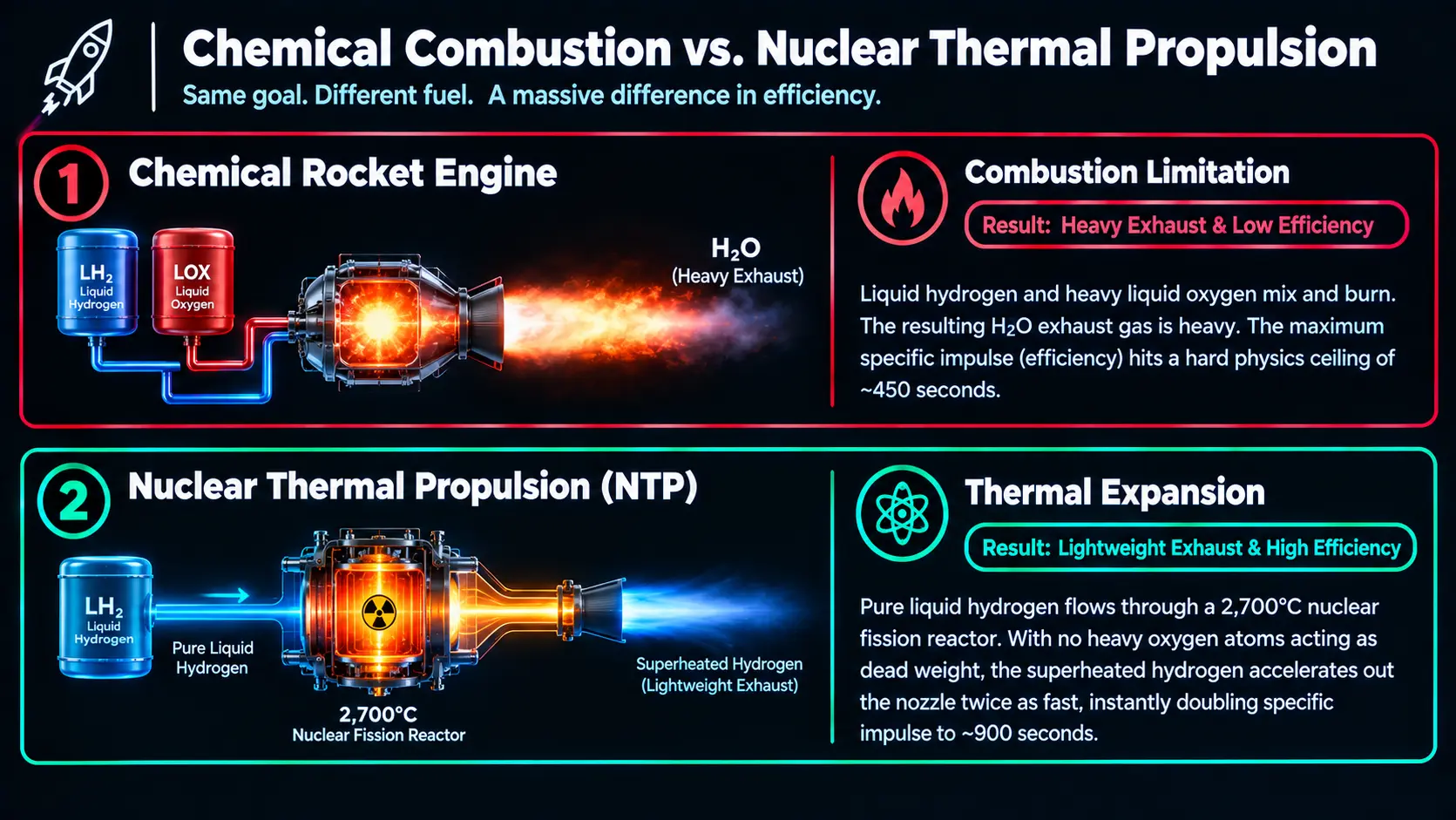
To burn fuel in space, you must bring your own oxygen. In a standard hydrogen-powered rocket, the liquid oxygen tank is vastly heavier and larger than the hydrogen tank. Oxygen is atomic dead weight; it exists only to create the chemical fire, severely lowering the top speed of the exhaust gas.
2. The Core Mechanism: The Fission Reactor Core
NTP removes the oxygen tank entirely. At the heart of the engine is a compact nuclear reactor, typically fueled by High-Assay Low-Enriched Uranium (HALEU). When the control drums rotate, the uranium begins to fission, generating intense, sustained heat—upwards of 2,700°C (4,900°F).
3. Technical Depth: Heat Transfer and Expansion
The spacecraft stores liquid hydrogen (LH2) at a cryogenic -253°C. High-pressure turbopumps force this freezing liquid directly into hundreds of microscopic cooling channels woven through the glowing-hot uranium core. The extreme temperature differential causes the hydrogen to violently flash-boil and expand.
Micro-Insight: The liquid hydrogen actually serves a dual purpose. Before it is ejected as thrust, it acts as the primary coolant that prevents the nuclear reactor from melting itself into radioactive slag.
4. Technical Depth: Exhaust Velocity Math
The velocity of exhaust gas is inversely proportional to the square root of its molecular mass. In a chemical rocket, hydrogen (mass 2) binds with oxygen (mass 16) to form water vapor (mass 18). An NTP rocket ejects pure hydrogen gas (mass 2). Because the exhaust is nine times lighter, it accelerates outward at vastly higher velocities, resulting in the magical 900s Isp.
Takeaway: By entirely removing heavy liquid oxygen from the rocket equation, NTP mathematically forces the exhaust to move faster.
5. Real-World Consequences: The DRACO Program
This isn’t just theory on a white-board. DARPA’s DRACO program is physically building an NTP engine, named X-NTR, alongside Lockheed Martin. It utilizes advanced ceramic-metallic (cermet) nuclear fuels that can withstand the intense thermal shock of cryogenic hydrogen slamming into a 2,700°C reactor. DRACO is scheduled to ignite in orbit by 2027, officially inaugurating the nuclear aerospace era.
Mars Propulsion Simulator
Specific Impulse (Isp) and Transit Time: Chemical vs. Nuclear Architectures
Mission Parameters
Payload Mass (Variable 1)
50 Tons
Propulsion Architecture (Variable 2)
Chemical (LOX/LH2)
Nuclear Thermal (NTP)
Nuclear Electric (NEP)
Specific Impulse (Isp)
450 s
Transit Time
0.0 Months
Propellant Remaining
100%
Interplanetary Trajectory: Earth to Mars
PRE-FLIGHT STANDBY
Propellant Mass Consumption vs. Mission Duration
Real-World Deployments of NTP Engines
Nuclear propulsion is transitioning from a 1960s Cold War dream (Project Rover/NERVA) into a heavily funded, modern defense and exploration mandate.
Manned Mars Architectures: NASA’s explicit architecture for human missions to Mars relies heavily on NTP. Chemical rockets would require astronauts to be subjected to immense solar radiation and bone density loss for over a year of round-trip transit. NTP shortens the transit to roughly 100 days each way. More importantly, the high efficiency leaves enough fuel in reserve to abort the mission and execute a rapid return to Earth if a critical failure occurs during transit.
The DRACO Orbital Demonstration: The DARPA DRACO vehicle will be the first modern test. It will launch on a standard chemical rocket (like a SpaceX Falcon 9 or Vulcan Centaur). The nuclear reactor will remain completely dormant, safe, and “cold” during the dangerous atmospheric ascent. Only when the vehicle is in a stable, high Earth orbit (above 700 miles) will the control drums rotate to activate the reactor, guaranteeing zero radioactive risk to Earth’s biosphere.
Deep Space Robotic Science: Satellites sent to Jupiter, Saturn, and beyond currently rely on gravitational slingshots around planets, taking up to 10 years to reach their destinations. An NTP-powered robotic probe could fly on a direct trajectory, cutting deep space transit times by years and allowing spacecraft to carry heavier scientific instruments rather than massive chemical fuel tanks.
Economic & Strategic Impact
The core strategic consequence of NTP is the Collapse of Orbital Assembly Costs.
To build a Mars-bound ship using chemical rockets, you cannot launch it fully fueled. You must launch the empty ship, and then launch roughly 10 to 15 massive “tanker” rockets to fill it with liquid oxygen and liquid hydrogen in Low Earth orbit. Each of those launches costs tens of millions of dollars.
Because NTP requires no oxygen and uses hydrogen twice as efficiently, the total fuel required drops massively. A mission that required 15 tanker launches might only require 4 tanker launches with an NTP architecture. By slashing the required mass-to-orbit, NTP makes interplanetary infrastructure financially viable for national space agencies and commercial players.
Advantages
- Double Fuel Efficiency: ~900s Isp allows for vastly heavier payloads or significantly faster transit times.
- High Thrust-to-Weight Ratio: Unlike Nuclear Electric Propulsion (NEP) which accelerates incredibly slowly, NTP provides the massive, immediate kick of thrust required to escape planetary gravity wells efficiently.
- Zero Ignition Risk: There is no explosive combustion in an NTP engine, meaning the engine can be shut down and restarted thousands of times in deep space without the risk of an ignition failure.
- Abort Capability: The surplus of fuel efficiency opens up wider launch windows and the physical capability to turn around mid-flight, a luxury chemical rockets simply do not have.
Limitations
- Liquid Hydrogen Storage: Liquid hydrogen boils at -253°C. Keeping it from boiling away into space during a multi-month mission requires heavy, complex active-cryocooler systems (Zero-Boil-Off technology), which are currently unproven at scale.
- Core Material Engineering: The reactor core must survive 2,700°C without melting, while being blasted by highly corrosive, freezing hydrogen. Finding ceramics and metallic alloys that survive this thermal shock without shedding radioactive particles is incredibly difficult.
- Radiation Shielding: While the reactor is heavily shielded, it still emits neutron radiation. Spacecraft must be designed with a long “spine,” placing the crew habitats as far away from the reactor as physically possible, complicating the vehicle’s structural integrity.
Takeaway: NTP solves the engine problem perfectly, but it creates a massive fuel storage problem. Keeping hydrogen liquid in deep space is currently the hardest engineering challenge in the solar system.
Common Misconceptions
Misconception: Nuclear rockets shoot a trail of radioactive fallout into space.
Reality: The exhaust is completely safe. The liquid hydrogen flows through sealed pipes inside the reactor. It absorbs the heat, but it never physically mixes with the radioactive uranium. The exhaust out the back is just highly energetic, non-radioactive hydrogen gas.
Misconception: If an NTP rocket explodes on the launchpad, it will cause a nuclear disaster.
Reality: The reactor is launched “cold.” During liftoff, the uranium is completely inert, with neutron-absorbing control rods locked in place. If the rocket explodes on the pad, it is simply a messy pile of heavy metal, not a nuclear meltdown. The reactor is only turned on once it reaches a safe, high orbit.
Misconception: Nuclear Thermal (NTP) and Nuclear Electric (NEP) are the same thing.
Reality: They are totally different. NTP uses a reactor to heat gas and blast it out a nozzle (High thrust, medium efficiency). NEP uses a reactor to generate electricity, which powers a small ion thruster (Low thrust, extreme efficiency).
What Most People Miss
The disruptive capability of Bimodal Nuclear Propulsion.
When analysts debate NTP vs. NEP, they treat them as separate technologies. What they miss is the architecture of the 2030s: the Bimodal engine.
A Bimodal reactor does both. When the spacecraft needs to escape Earth orbit quickly, the reactor acts as an NTP engine, dumping raw heat into hydrogen for massive thrust. Once the ship is cruising in deep space, the reactor shifts gears. It stops heating hydrogen and starts using its heat to generate electricity (like a traditional power plant). This electricity powers high-efficiency ion thrusters for the long cruise, while also providing massive electrical power to the crew habitat and scientific instruments.
Comparison Table
| Metric | Chemical (LH2/LOX) | Nuclear Thermal (NTP) | Nuclear Electric (NEP) |
| Energy Source | Chemical Combustion | Fission Reactor Heat | Fission Reactor Electricity |
| Propellant Used | Hydrogen + Heavy Oxygen | Pure Hydrogen | Xenon or Argon |
| Specific Impulse (Isp) | ~450 seconds | ~900 seconds | > 3,000 seconds |
| Thrust Generation | Extremely High | High | Extremely Low (Ion Beam) |
| Best Use Case | Launching from Earth | Fast Mars Transit / Agility | Deep Space / Cargo Hauling |
Future Outlook
Next 12–24 Months
The era of DRACO and Ground Testing. Through 2026, BWXT and Lockheed Martin will finalize the HALEU core assembly and conduct rigorous, non-nuclear thermal shock tests on the ground. The aerospace industry’s focus is intensely calibrated on the 2027 launch window, where the X-NTR engine will achieve the first controlled in-space fission propulsion event since the Cold War.
Next 3–5 Years
The scaling of Cryogenic Fluid Management (CFM). As the engine proves successful, the entire industry will pivot to the fuel tanks. Companies like SpaceX, Blue Origin, and ULA will launch massive, heavily insulated orbital fuel depots to test active cryocoolers. Proving that liquid hydrogen can be stored in space for 300+ days without boiling off is the mandatory precursor to utilizing an NTP engine for Mars.
Next 10 Years
The Manned Mars Assembly in LEO. By the mid-2030s, the first manned Mars transit vehicles will be assembled in Low Earth Orbit. Heavy-lift rockets (Starship or SLS) will launch the NTP core, the habitat module, and the hydrogen fuel tanks separately. They will dock autonomously. Once assembled, the crew will board, the control drums will rotate, and humanity will break the chemical barrier, reaching the Red Planet in roughly 100 days.
Most Likely Scenario
Nuclear Thermal Propulsion is the mandatory key to the inner solar system. The absolute physical limits of chemical combustion guarantee that human exploration cannot progress beyond the Moon without splitting the atom. As the DRACO program validates the safety and performance of HALEU reactors in orbit, the regulatory and political hesitations surrounding nuclear aerospace will evaporate, positioning NTP as the undeniable backbone of the 21st-century interplanetary logistics network.
Key Takeaways
- Standard chemical rockets carry heavy liquid oxygen just to burn their fuel, severely limiting how fast the exhaust gas can leave the nozzle.
- Nuclear Thermal Propulsion (NTP) removes the oxygen and uses a nuclear fission reactor to flash-heat pure liquid hydrogen, instantly doubling fuel efficiency.
- Because NTP is twice as efficient, ships can carry significantly more payload or burn their engines longer, cutting the travel time to Mars from 9 months to less than 4 months.
- The reactor is perfectly safe during launch. It remains completely turned off and “cold” until the spacecraft reaches a safe orbit high above the Earth.
- The DARPA/NASA DRACO program is currently building a functional NTP engine, actively targeting a landmark in-space demonstration in 2027.
Glossary
Bimodal Reactor: An advanced nuclear engine that can switch between heating gas for rapid thrust (NTP) and generating electricity for slow, efficient ion cruising (NEP).
DRACO: Demonstration Rocket for Agile Cislunar Operations. The joint DARPA/NASA program tasked with launching a functional nuclear thermal rocket by 2027.
HALEU (High-Assay Low-Enriched Uranium): Uranium enriched between 5% and 20%. It is highly efficient for compact space reactors but falls below the threshold of weapons-grade material, reducing security risks.
Liquid Hydrogen (LH2): The lightest element in the universe, chilled to -253°C to become a liquid. It is the perfect propellant for NTP because its low mass allows it to accelerate to massive velocities when heated.
Specific Impulse (Isp): The ultimate measure of a rocket engine’s fuel efficiency, measured in seconds. Chemical engines max out at ~450s; NTP hits ~900s.
Zero-Boil-Off (ZBO): The advanced thermal engineering required to keep liquid hydrogen from turning into a gas and leaking into space over a multi-year deep space mission.
Sources
NASA: Nuclear Thermal Propulsion and the Space Technology Mission Directorate
Defense Advanced Research Projects Agency (DARPA): DRACO Program Architecture and Objectives
American Institute of Aeronautics and Astronautics (AIAA): Specific Impulse Advantages of HALEU NTP Systems
BWX Technologies: Advanced Nuclear Fuels and Cermet Core Manufacturing
Lockheed Martin Space: Agile Cislunar Operations and In-Space Transportation