Advertisement
)

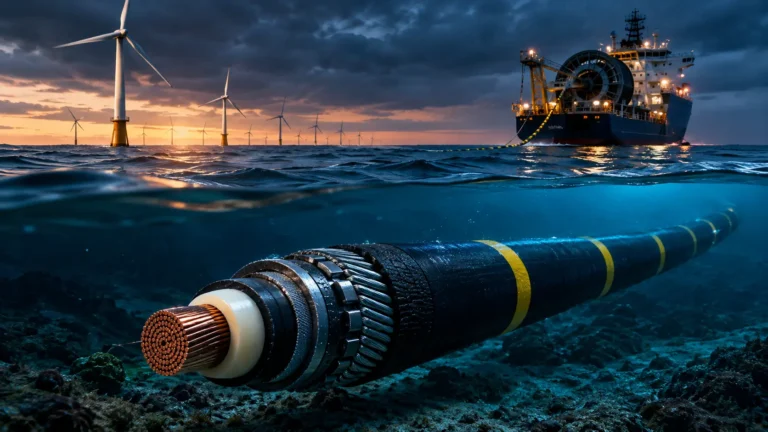
A massive offshore wind farm suddenly connects its peak generation to an aging coastal city grid. Moments later, a catastrophic inverter failure sends a massive electrical surge racing down the transmission lines straight toward a $10 million substation transformer. The grid relies on state-of-the-art mechanical circuit breakers to stop the surge. But the breaker is a physical machine; it takes roughly 50 milliseconds for its heavy metal contacts to unlatch and pull apart. In the world of high-voltage electricity, 50 milliseconds is an eternity. Before the breaker even begins to move, the first massive wave of the surge smashes into the transformer, instantly melting its internal copper coils. The city goes dark.
Why should you care right now? Because grid engineers have realized that mechanical physics is simply too slow to manage the volatile, bidirectional surges of modern renewable energy. To save the grid, they are turning to quantum physics. Enter Superconducting Fault Current Limiters (SFCLs). By utilizing exotic materials submerged in liquid nitrogen, SFCLs offer zero electrical resistance during normal operations, but instantly turn into an impenetrable wall of resistance the exact millisecond a surge hits. They are the ultimate, invisible shield—protecting the trillions of dollars of infrastructure required to achieve a decarbonized global economy.
What are Superconducting Fault Current Limiters (SFCLs)?
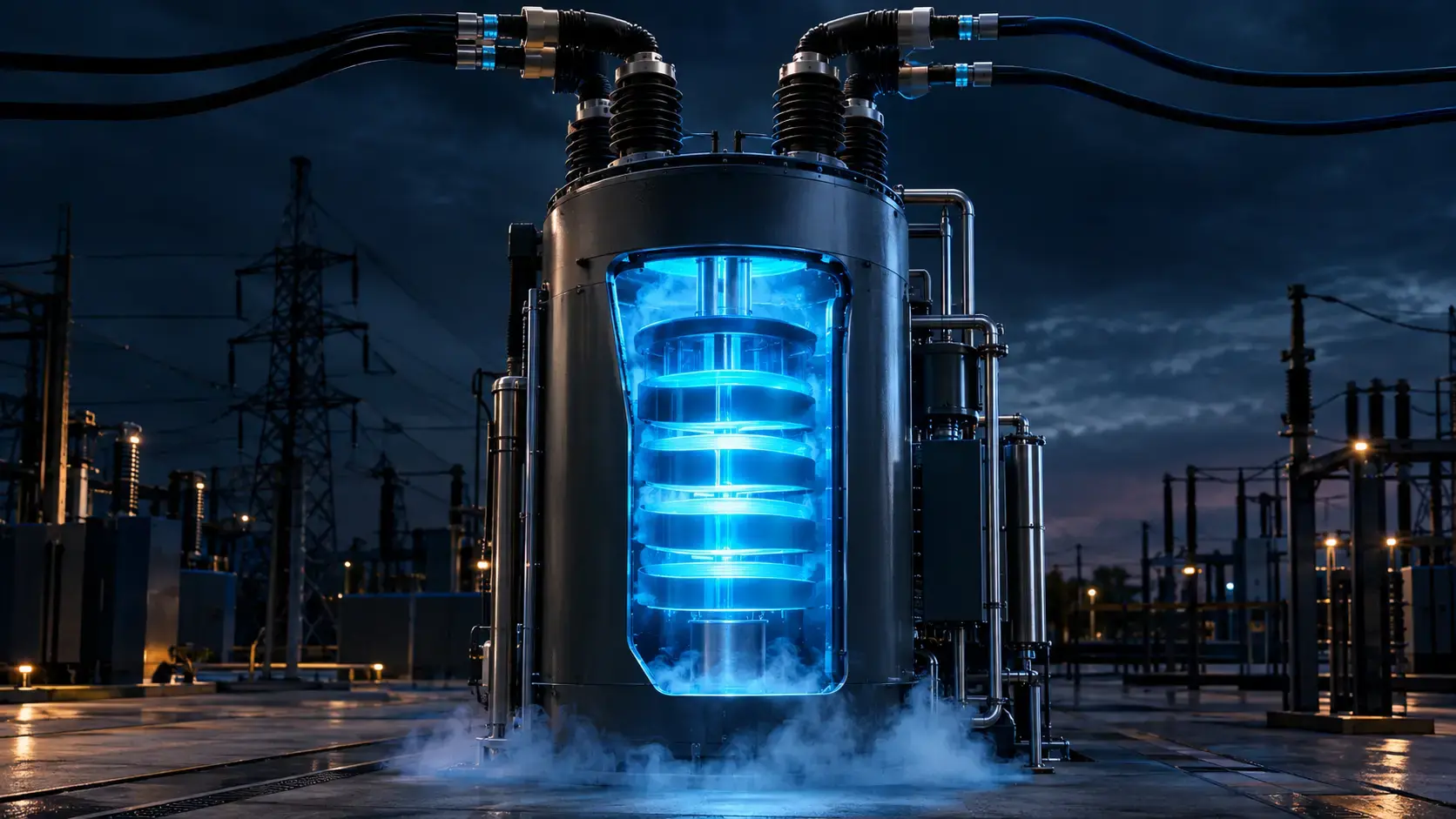
Superconducting Fault Current Limiters (SFCLs) are advanced grid protection devices that use cryogenic superconductor materials to restrict dangerous electrical surges. During normal operation, they offer zero electrical resistance. When a massive fault current occurs, the superconductor instantly loses its zero-resistance state (a “quench”), immediately choking the surge before mechanical breakers are forced to act.
At a Glance
- Concept: A “smart wire” kept at ultra-cold temperatures that lets normal electricity flow perfectly, but physically transforms into a massive resistor to choke a power surge.
- Why it matters: Traditional mechanical circuit breakers are too slow to stop modern, massive renewable energy surges from blowing up expensive grid transformers.
- Who uses it: Tier-1 utility operators (e.g., Con Edison, National Grid) and major industrial microgrids.
- Biggest takeaway: An SFCL is not a circuit breaker. It does not turn the power off. It acts like a speed bump, instantly slowing the massive surge down to a manageable level so the standard mechanical breaker has time to safely trip.
In Simple Words
Imagine a massive, wide-open highway where cars (electricity) travel at 100 miles per hour. Ordinarily, the highway is perfectly smooth. But suddenly, a massive, out-of-control convoy of thousands of trucks (a power surge) barrels down the road, threatening to smash into the city at the end of the highway.
The city has a heavy steel gate (a mechanical circuit breaker) to protect itself, but the gate takes 3 seconds to close. The trucks will smash into the city before the gate can shut.
A Superconducting Fault Current Limiter (SFCL) is like a stretch of magical asphalt placed just before the gate. When normal cars drive over it, it is perfectly smooth. But the moment the heavy convoy hits it, the physical weight of the trucks causes the asphalt to instantly turn into deep, thick mud. The trucks are instantly bogged down and slowed to a crawl. Because the trucks are now moving slowly, the heavy steel gate has plenty of time to close and safely lock them out.
Why This Matters
For Utility Planners, Energy Investors, and Grid Engineers, SFCLs solve the CapEx Deferral Crisis.
As nations connect gigawatts of decentralized solar, wind, and battery storage to the grid, the overall “fault current capacity” of the network skyrockets. If a short circuit happens today, the resulting surge is exponentially more violent than it was ten years ago.
This creates a terrifying mathematical reality for utility companies: the existing transformers and circuit breakers throughout their entire city are no longer rated to survive these new, massive surges. The standard engineering solution is to rip out and replace every single transformer and breaker in the city with larger, heavier models—a multi-trillion-dollar Capital Expenditure (CapEx) nightmare that would bankrupt most utility providers.
SFCLs offer an economic escape hatch. By installing a single SFCL upstream of an aging substation, the utility instantly caps the maximum possible surge that can ever reach the equipment. The utility doesn’t have to replace a single transformer. SFCLs are not just safety devices; they are high-leverage financial tools that defer billions of dollars in mandatory infrastructure upgrades.
Micro-Insight: You do not install an SFCL to upgrade the grid; you install an SFCL so that you don’t have to upgrade the rest of the grid.
The Quantum Hardening of Grid Infrastructure
We are witnessing the Quantum Hardening of Macro-Infrastructure.
For a century, power grids were governed entirely by classical electromagnetism and mechanical inertia. If you wanted to stop a bigger surge, you built a heavier, clunkier copper switch.
SFCLs represent the moment quantum mechanics scales up to industrial infrastructure. Superconductivity relies on the delicate quantum pairing of electrons. By utilizing the instantaneous breakdown of these quantum pairs to choke high-voltage power grids, we are replacing mechanical reaction times with atomic reaction times.
How Superconducting Fault Current Limiters (SFCL) Quench Surges
Turning a quantum phase transition into a ruggedized, high-voltage industrial appliance requires absolute mastery of thermodynamics and materials science. Here is the first-principles breakdown of the architecture.
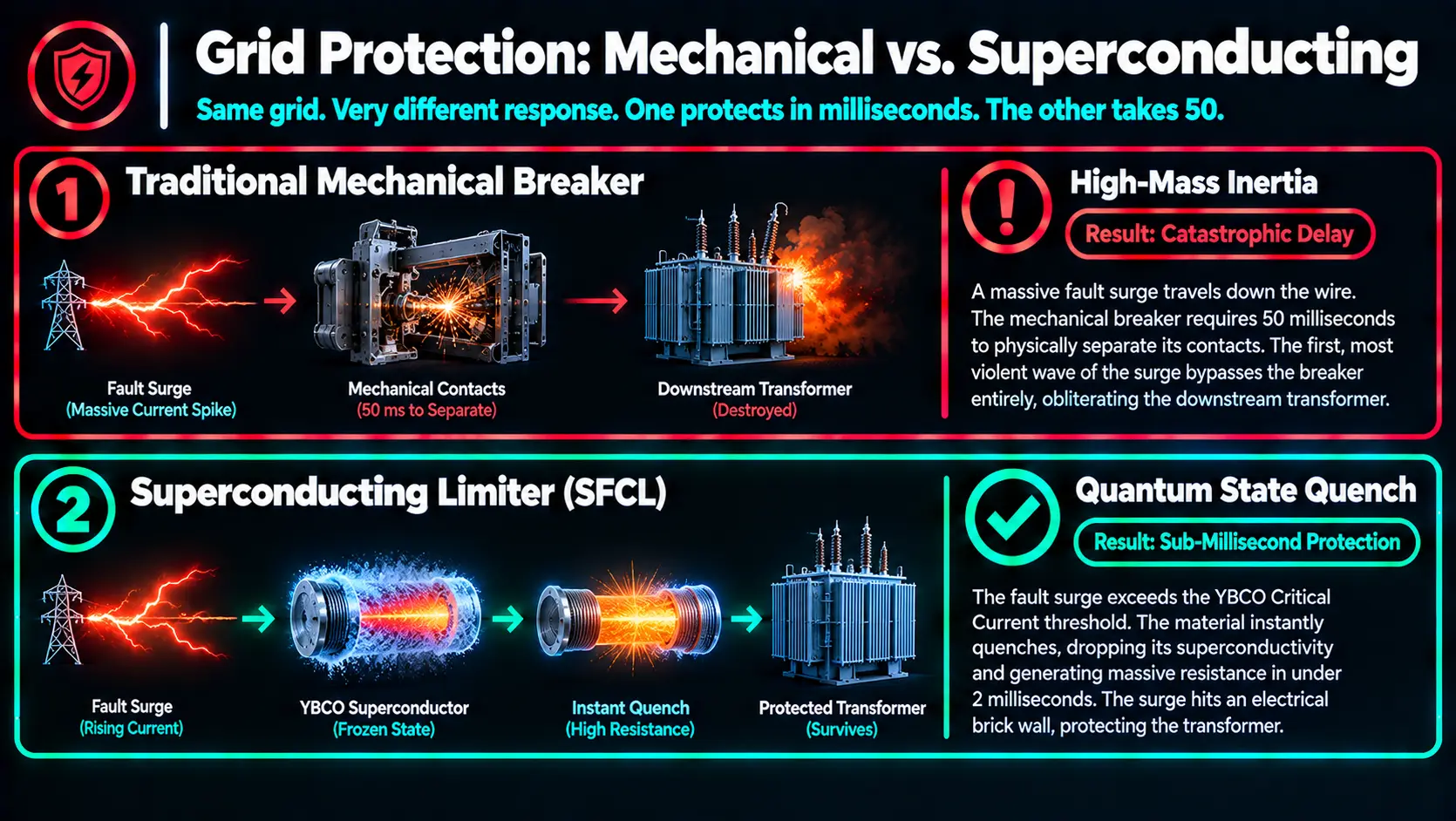
1. The Fundamental Problem: Mechanical Inertia
A standard circuit breaker uses a physical spring or compressed gas to pull two metal contacts apart. When the contacts separate, the 100,000-volt electricity tries to jump the gap, creating a massive, white-hot arc of plasma. The breaker must stretch and extinguish this plasma arc to stop the current. The physical mass of the metal components means this process fundamentally cannot happen faster than a few dozen milliseconds.
2. The Core Mechanism: YBCO Superconductors
To bypass mechanical movement, engineers use High-Temperature Superconductors (HTS), typically a ceramic material called YBCO (Yttrium Barium Copper Oxide). Inside the SFCL, long ribbons of YBCO are submerged in a tank of liquid nitrogen, cooling them to 77 Kelvin (-196°C). At this extreme temperature, the YBCO material enters a superconducting state. Its electrical resistance drops to absolute zero.
3. Technical Depth: Cooper Pairs and the Critical Current
In this frozen state, electrons bind together into “Cooper pairs,” gliding through the YBCO crystal lattice with zero friction. The grid’s normal electricity flows through the SFCL completely unimpeded. There is zero voltage drop and zero energy lost as heat.
However, superconductivity is fragile. It can only survive if the electrical current stays below a specific threshold, known as the Critical Current (Ic.
4. Technical Depth: The Quench
When a lightning strike or grid failure causes a massive power surge, the current instantly spikes past the Ic threshold. The moment this happens, the quantum Cooper pairs are violently ripped apart. In less than 2 milliseconds, the YBCO material “quenches”—it transitions from having zero resistance to having incredibly high resistance.
Because the material is suddenly resisting the massive surge, it chokes the current, dropping the surge down to a safe, manageable level before it can reach the downstream transformer.
Plain-English Takeaway: An SFCL is a wire that only tolerates normal behavior. The exact microsecond the electricity tries to turn into a violent surge, the wire instantly changes its physical properties to become a high-friction barrier, absorbing the impact without moving a single inch.
5. Real-World Consequences: Autonomous Recovery
The brilliance of the SFCL is its recovery. When it quenches and absorbs the surge, the YBCO material heats up. Once the downstream mechanical breaker finally trips and clears the fault, the current stops. The surrounding liquid nitrogen rapidly cools the YBCO back down to 77 Kelvin. Within a few seconds, the material regains its superconductivity, completely resetting itself for the next surge without a human engineer ever having to flip a switch or replace a fuse.
SFCL vs. Mechanical Breaker Simulation
Zero-Impedance Cryogenic Quench vs. 50ms Mechanical Inertia Delay
Prospective Fault Current
50 kA Peak
Protection Architecture
Mechanical Breaker
Superconducting SFCL
Peak Let-Through Current
2.0 kA
Suppression Latency
0.0 ms
Transformer Thermal Stress
0.0%
Substation Grid Hardware & Phase Dynamics
NORMAL OPERATION (STEADY STATE)
Oscilloscope Transient Current i(t) (0 – 100 ms)
Utility Deployments of SFCL Technology
SFCLs are moving rapidly from pilot programs into massive, multi-billion-dollar commercial deployment across critical infrastructure.
Urban Substation Upgrades (Project RESILIENCE): In highly dense urban environments like New York City or London, electrical substations are often buried underground or located inside skyscrapers. If an aging transformer needs to be replaced because fault currents have risen, the physical logistics of extracting a 100-ton piece of metal from a basement are financially ruinous. Utilities are installing compact SFCLs in the feeder lines above these transformers, instantly future-proofing the urban grid without executing massive heavy-civil construction projects.
Offshore Wind High-Voltage Direct Current (HVDC) Ties: Massive offshore wind farms are connected to the mainland via HVDC cables. A short circuit on a direct current (DC) line is exponentially harder to interrupt than on an alternating current (AC) line, because DC current does not naturally drop to zero 60 times a second. Mechanical DC breakers are massive and unreliable. SFCLs are being deployed on offshore platforms to instantly choke DC surges, allowing smaller, cheaper mechanical breakers to safely cut the connection.
Naval and Military Microgrids: Modern military vessels (like the US Navy's Gerald R. Ford-class aircraft carriers) operate entirely on electric propulsion and feature massive electromagnetic launch systems (EMALS). The localized power surges on these ships are incredibly violent. SFCLs are integrated into naval microgrids to isolate battle damage. If a section of the ship is struck, the SFCL instantly quenches, preventing the short circuit from cascading and shutting down the entire vessel's power plant.
Economic & Strategic Impact
The core strategic consequence of SFCL deployment is the Enabling of Dense Grid Meshing.
Historically, grid operators keep different sections of a city's power grid isolated from one another. They do not tie them together because if a fault occurs in one section, the surge would travel across the tie and take down the neighboring section as well.
However, renewable energy requires a tightly tied, "meshed" grid so that excess solar power in one neighborhood can seamlessly flow to another.
SFCLs serve as the perfect "bus-tie." They allow two grid sectors to be connected, sharing normal, zero-resistance power back and forth effortlessly. But the exact moment a catastrophic fault occurs in Sector A, the SFCL instantly turns into a brick wall, blocking the surge from entering Sector B. This allows cloud architects and utility planners to build dense, highly interconnected, resilient renewable grids without the risk of cascading, city-wide blackouts.
Advantages
- Zero Steady-State Energy Loss: Because they operate in a superconducting state during normal conditions, they have exactly zero electrical resistance. They waste absolutely zero power, unlike standard inductors or reactors which constantly bleed energy as heat.
- Sub-Millisecond Reaction Time: The quantum quench from zero to high resistance happens in 1 to 2 milliseconds, vastly outpacing any physical, moving mechanical part.
- Fail-Safe Physics: The device does not rely on external software, sensors, or computers to detect the fault. The high current itself physically causes the material to quench. It cannot be hacked by cyberattacks and cannot fail to trigger.
- Automatic Reset: Once the fault is cleared by the downstream breaker, the liquid nitrogen cools the YBCO back into a superconducting state, automatically resetting the protection shield without requiring a technician to replace parts.
Limitations
- Cryogenic OPEX: Maintaining liquid nitrogen at 77 Kelvin (-196°C) requires continuous operation of advanced cryocoolers. This introduces a permanent operational expenditure (OPEX) in terms of electricity to run the coolers and maintenance for the cryogenic compressors.
- Recovery Time Delay: After a quench, the YBCO material heats up. It can take anywhere from a few seconds to several minutes for the cryocoolers to freeze the material back down to its superconducting state. During this "recovery time," that specific power line must remain offline.
- High Initial CapEx: Specialized high-temperature superconductor tape is incredibly expensive to manufacture. A utility-scale SFCL can cost millions of dollars upfront, requiring utilities to carefully calculate the ROI against the cost of deferring a transformer replacement.
Takeaway: The physics of the SFCL are flawless; the liability is the refrigerator. The entire industry is currently focused on building ultra-reliable, zero-maintenance cryogenic cooling loops that can survive for 20 years in harsh, unmanned environments.
Common Misconceptions
Misconception: SFCLs replace circuit breakers.
Reality: They work together. An SFCL does not "break" the circuit; it merely limits the surge to a safe level. You still need a mechanical circuit breaker downstream to physically open the line and completely stop the flow of electricity.
Misconception: If the liquid nitrogen leaks, the grid explodes.
Reality: If the cooling system fails and the SFCL warms up, the YBCO material simply loses its superconductivity and gains normal resistance. The grid control system detects the rising resistance and safely routes power around the SFCL before any damage occurs.
Misconception: Superconductors need liquid helium.
Reality: Old Low-Temperature Superconductors (like those in MRI machines) require liquid helium (-269°C), which is incredibly expensive and rare. SFCLs use High-Temperature Superconductors (YBCO), which operate at liquid nitrogen temperatures (-196°C). Liquid nitrogen is cheap, abundant, and easily manufactured directly from the surrounding air.
What Most People Miss
The disruptive capability of Superconducting Fault Current Limiting Cables (SFCL-C).
When analysts look at SFCLs, they picture a large box sitting inside a substation. What they miss is the integration of this technology directly into the power lines themselves.
Engineers are now manufacturing Superconducting Cables that stretch for miles beneath cities. These cables carry massive amounts of power with zero loss. But brilliantly, the cable itself acts as the SFCL. If a fault occurs anywhere on the grid, the entire three-mile cable quenches simultaneously, absorbing the surge across its entire length. This completely eliminates the need to build a separate SFCL "box," fusing the transmission line and the ultimate protection device into a single, elegant infrastructure asset.
Comparison Table
| Feature | Standard Mechanical Circuit Breaker | Air-Core Current Limiting Reactor | Superconducting Fault Current Limiter (SFCL) |
| Response Time | Slow (30 - 50 ms) | Instantaneous | Near-Instantaneous (< 2 ms) |
| Normal Power Loss | Very Low | High (Constant energy bleed) | Absolutely Zero (Superconducting) |
| Action Mechanism | Physical separation of contacts | Continuous magnetic impedance | Quantum phase transition (Quench) |
| Impact on Grid Voltage | None until tripped | Causes constant voltage drops | Completely invisible until a fault occurs |
| Maintenance Burden | Moderate (Contact wear) | Very Low | High (Cryocooler maintenance) |
Future Outlook
Next 12–24 Months
The era of Strategic Urban Retrofits. Through 2027, the $5.4 billion SFCL market will be dominated by utility companies in mature, densely populated grid sectors (Europe, US Northeast). As massive offshore wind projects connect to these legacy grids, utilities will deploy resistive-type SFCLs at the exact interconnection points, ensuring the new, volatile green energy does not overwhelm the 1970s-era substations buried beneath the cities.
Next 3–5 Years
The scaling of Solid-State Cryogenics. By 2030, the primary limitation of SFCLs—the mechanical cryocooler compressors—will undergo a revolution. The industry will pivot toward advanced solid-state acoustic cooling and Stirling engines that possess zero moving parts. This will drop the maintenance requirements of the liquid nitrogen loops to near zero, clearing the path for mass deployment in remote, unmanned solar and wind farms in extreme desert and offshore environments.
Next 10 Years
The Standardized Superconducting Mesh. By the mid-2030s, the concept of a grid without superconducting protection will be considered an engineering liability. As global power grids transition to highly complex, bidirectional HVDC architectures to support ubiquitous AI data centers and global renewable sharing, SFCLs will become the mandatory, standardized "valves" of the network. They will allow power to flow freely across continents while ensuring that a catastrophic failure in one nation's grid cannot electronically cascade into another.
Most Likely Scenario
Superconducting Fault Current Limiters represent the necessary evolution of grid protection. The mechanical switches of the 20th century are fundamentally incapable of managing the speed and violence of 21st-century renewable energy surges. While the operational expenditure of maintaining ultra-cold liquid nitrogen presents a localized engineering challenge, the staggering macroeconomic value of preventing cascading blackouts and deferring multi-billion-dollar transformer replacements guarantees that quantum-state SFCLs will become the foundational armor of the decarbonized grid.
Key Takeaways
- The transition to renewable energy increases the violence of short-circuit surges, which can easily destroy multi-million-dollar transformers.
- Traditional mechanical circuit breakers are too slow; they take 50 milliseconds to react, allowing the most destructive part of the surge to pass through.
- SFCLs solve this using High-Temperature Superconductors (YBCO) submerged in liquid nitrogen. Normally, they have zero electrical resistance and waste no power.
- When a massive surge hits, the superconductor exceeds its "critical current" and instantly quenches, transitioning into a high-resistance wall in under 2 milliseconds.
- This instantly chokes the power surge, acting as a speed bump that saves the transformer and gives the mechanical breaker enough time to safely turn the power off.
Glossary
Cooper Pairs: A quantum mechanical phenomenon where electrons bind together at extremely low temperatures, allowing them to flow through a superconductor with absolutely zero friction (zero electrical resistance).
Critical Current (Ic): The exact threshold of electrical current above which a superconductor can no longer maintain its zero-resistance state. Exceeding this triggers a quench.
Cryocooler: A specialized industrial refrigerator used to continuously cool the liquid nitrogen bath surrounding the SFCL, keeping it at 77 Kelvin (-196°C).
Fault Current: A massive, unintended surge of electrical power (a short circuit) caused by events like lightning strikes, downed power lines, or equipment failure.
High-Temperature Superconductor (HTS): Advanced ceramic materials (like YBCO) that achieve superconductivity at "high" temperatures (liquid nitrogen, -196°C), as opposed to old materials requiring liquid helium (-269°C).
Quench: The sudden, violent phase transition where a superconductor instantly loses its superconductivity and reverts to being a normal, highly resistive material, effectively blocking power surges.
Sources
IEEE Transactions on Applied Superconductivity: Design and Deployment of Resistive Superconducting Fault Current Limiters
US Department of Energy (DOE): Grid Modernization Initiative: HTS and SFCL Integration
CIGRE (International Council on Large Electric Systems): Fault Current Management in Grids with High Penetration of Renewables
American Superconductor (AMSC): Resilient Electric Grid (REG) Systems and Urban Substation Deferral
European Network of Transmission System Operators for Electricity (ENTSO-E): HVDC Protection Strategies and Cryogenic Infrastructure